
Introduction
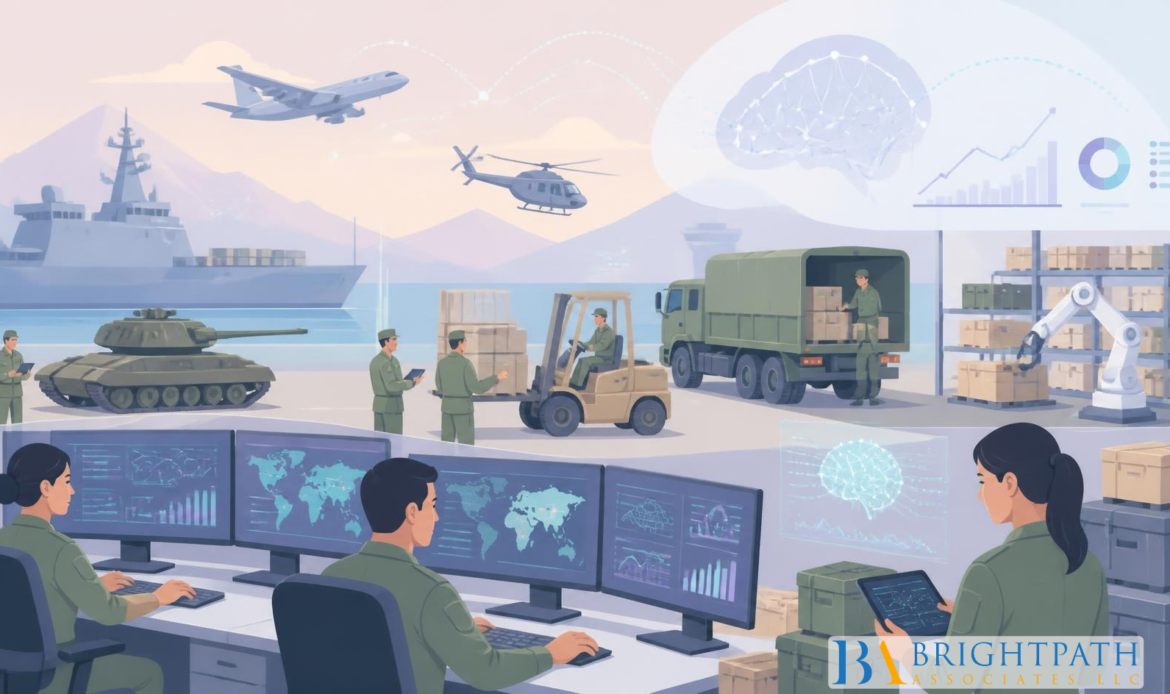
#DefenseLogistics is undergoing a significant technological transformation as military organizations and defense manufacturers seek greater efficiency, reliability, and visibility across increasingly complex supply chains. Legacy logistics systems were often designed around fixed schedules, manual reporting, historical demand patterns, and siloed databases. While these systems supported traditional operating environments, they can struggle to respond to modern requirements involving distributed operations, rapidly changing equipment configurations, global suppliers, and increasingly sophisticated technologies.
Predictive AI analytics offers an opportunity to modernize these legacy systems without necessarily replacing every existing platform. By combining historical logistics data with machine learning, sensor information, maintenance records, inventory data, and operational information, organizations can anticipate potential disruptions before they become costly problems.
The objective is not simply to automate logistics. It is to create a more intelligent and responsive defense supply chain capable of identifying risks, improving inventory planning, supporting maintenance decisions, and strengthening operational resilience.
Traditional defense logistics networks can contain decades of accumulated processes, databases, equipment records, procurement systems, and maintenance procedures. Many organizations continue to depend on a combination of modern applications and older infrastructure because replacing mission-critical systems entirely can be expensive and disruptive.
These environments frequently create fragmented data. Procurement information may exist separately from maintenance records, while inventory information may not be directly connected to transportation or operational planning systems. As a result, decision-makers may receive an incomplete picture of supply availability and equipment readiness.
Predictive AI analytics can provide a layer of intelligence across these disconnected systems. Rather than requiring immediate replacement of every legacy application, organizations can use analytics platforms to collect, normalize, and interpret information from multiple sources.
This approach allows modernization to occur progressively while preserving critical systems that remain operationally valuable.
Predictive AI and Defense Logistics
Predictive AI changes logistics from a primarily reactive process into a more forward-looking discipline. Traditional logistics often responds after an item becomes unavailable, equipment fails, or a shipment is delayed. Predictive systems attempt to identify the probability of these events before they occur.
For example, historical maintenance records can help identify patterns associated with component degradation. Inventory data can reveal recurring shortages. Supplier information can help identify potential procurement delays. Transportation data can contribute to more accurate delivery forecasting.
The value of predictive analytics comes from connecting these different signals. Instead of examining individual data points independently, AI models can identify relationships that may not be obvious through manual analysis.
For defense organizations, this can support planning for spare parts, maintenance requirements, inventory levels, transportation capacity, and equipment availability.
Modern defense logistics increasingly intersects with sophisticated aerospace and space capabilities. Defense Space Systems depend on highly specialized components, long procurement cycles, strict quality requirements, and complex maintenance and testing procedures.
Predictive analytics can support these environments by monitoring component histories, supplier performance, inventory positions, and maintenance requirements. Because specialized space hardware may have long replacement timelines, identifying potential supply problems early can be particularly valuable.
The growing importance of space-based capabilities also makes logistics planning more interconnected. Ground infrastructure, communication systems, sensors, electronics, software, and specialized components may all depend on overlapping supplier networks.
Integrating predictive analytics into these environments can help organizations understand dependencies and identify areas where supply-chain disruption could affect broader programs.
Supporting Defense Space Policy and Regulatory Requirements
Technology modernization must operate within established governance frameworks. #DefenseSpacePolicy increasingly intersects with questions involving procurement, technology development, international cooperation, cybersecurity, sustainability, and responsible use of space capabilities.
Predictive AI systems used in defense environments therefore require appropriate governance. Organizations need to establish clear rules for data access, model validation, system accountability, security controls, and human oversight.
The regulatory dimension is equally important. Space Regulatory requirements can affect satellite operations, communications, spectrum usage, export controls, procurement procedures, and commercial partnerships.
AI modernization programs should incorporate these requirements from the beginning rather than attempting to address compliance after deployment. A strong governance framework can help organizations determine which data can be shared, which systems require additional security controls, and where human authorization remains necessary.
Digital logistics networks create new opportunities but also introduce additional cybersecurity considerations. Space Cybersecurity is particularly important because space-related systems increasingly depend on interconnected ground infrastructure, communication networks, software platforms, and data systems.
Predictive analytics can contribute to cybersecurity by identifying unusual patterns in system activity, supply-chain data, or equipment behavior. Analytics can also help organizations identify vulnerabilities associated with outdated components, supplier dependencies, or unsupported technologies.
However, AI should not be considered a replacement for established cybersecurity controls. Authentication, access management, encryption, network segmentation, monitoring, software security, and incident-response procedures remain essential.
The AI system itself must also be protected. If attackers manipulate the data used by a predictive model, the resulting recommendations could become unreliable. Data integrity is therefore a central component of trustworthy defense analytics.
The Role of Space Robotics
The growth of Space Robotics introduces another layer of logistical complexity. Robotic platforms require specialized sensors, processors, actuators, power systems, software, and replacement components. Maintaining these systems can involve highly specialized supply chains.
Predictive analytics can help organizations monitor component histories and identify potential maintenance requirements. In long-duration missions or remote environments, advance knowledge of component performance can be particularly important because replacement opportunities may be limited.
The same principle can apply to terrestrial robotic systems used in manufacturing, inspection, warehousing, and maintenance. By collecting equipment data continuously, organizations can develop predictive maintenance models that identify patterns associated with degradation.
This can reduce dependence on fixed maintenance schedules and allow resources to be allocated according to actual equipment conditions.
Space Electronics represent another area where predictive logistics can provide significant value. Electronics used in aerospace and defense applications may require specialized manufacturing processes, stringent testing, and detailed traceability.
Supply shortages can become difficult to resolve when components have long lead times or limited qualified suppliers. Predictive analytics can examine historical purchasing patterns, supplier performance, inventory levels, and demand forecasts to identify potential vulnerabilities.
Organizations can then use these insights to improve procurement planning and develop appropriate inventory strategies.
This does not mean that AI can eliminate supply-chain uncertainty. Semiconductor availability, geopolitical developments, manufacturing capacity, and regulatory changes can still create unexpected disruptions. However, predictive systems can give decision-makers more information with which to prepare for those uncertainties.
Responding to Aerospace Industry Trends
Current #AerospaceIndustryTrends include greater digitalization, advanced manufacturing, commercial-space participation, autonomous systems, sophisticated electronics, and increasingly interconnected supply chains.
These developments are changing the logistics requirements of defense organizations. Production programs may involve larger numbers of suppliers and increasingly specialized components. At the same time, organizations must maintain visibility across traditional defense platforms and emerging technologies.
Predictive AI can create a common analytical layer across these environments. Instead of treating each platform or program as an isolated logistics problem, organizations can examine broader patterns in procurement, maintenance, inventory, and supplier performance.
This can be particularly useful for large organizations managing multiple generations of equipment simultaneously.
Defense Simulation has traditionally been used to model operational scenarios, equipment performance, training environments, and mission conditions. Predictive analytics can expand the value of simulation by connecting logistics variables with operational scenarios.
For example, simulations can incorporate assumptions about equipment usage, maintenance cycles, spare-parts consumption, transportation requirements, and inventory availability. This creates an opportunity to examine how logistical constraints could affect different operational scenarios.
The objective is not to predict every future event. Instead, simulation can help organizations explore different possibilities and identify logistical dependencies that require additional planning.
When combined with historical data, AI models can also improve the assumptions used in simulations. This creates a feedback loop between real-world logistics information and analytical planning tools.
Modernizing Defense Manufacturing
The logistics transformation cannot be separated from Defense manufacturing. Manufacturing facilities depend on reliable supplies of raw materials, components, tooling, specialized electronics, and production equipment.
Predictive analytics can support production planning by forecasting material requirements and identifying potential bottlenecks. Machine-learning models can also analyze equipment data to anticipate maintenance requirements and reduce unexpected production interruptions.
Quality data can provide another source of intelligence. When organizations connect manufacturing quality records with supplier and component information, they can identify recurring patterns that may require further investigation.
Modern manufacturing environments can therefore become important sources of logistics intelligence rather than simply destinations for supplied materials.
One of the biggest challenges in modernization is determining how new AI capabilities should interact with legacy infrastructure. A complete replacement of existing systems is not always practical.
A more gradual approach is to create an analytical layer that can connect existing databases and applications. Data integration tools can normalize information from different sources while maintaining appropriate controls around access and security.
This architecture allows organizations to introduce predictive capabilities without immediately disrupting established workflows.
Data quality remains essential. Inconsistent part numbers, incomplete maintenance records, outdated supplier information, and duplicate records can reduce model reliability. Before implementing advanced AI, organizations should therefore establish clear data standards and validation processes.
Human Oversight and AI Trust
Predictive analytics should support decision-makers rather than remove accountability from logistics operations. Employees need to understand why a system has identified a particular supply risk or maintenance requirement.
Explainable models can help provide this transparency by identifying the variables contributing to a prediction. Human experts can then review the recommendation and determine whether additional information is required.
This approach is particularly important in defense environments, where logistics decisions can have significant operational consequences. AI-generated recommendations should be subject to appropriate validation, oversight, and authorization procedures.
Building trust also requires acknowledging model limitations. Predictive systems are based on historical and current data, meaning unexpected events can produce outcomes outside the model’s previous experience.
Technology transformation requires leadership capable of connecting operational requirements with emerging technologies. #ExecutiveSearchRecruitment can help defense and aerospace organizations identify professionals with experience across logistics, AI, manufacturing, cybersecurity, supply-chain management, and digital transformation.
The most relevant leadership profiles may combine technical knowledge with experience managing large-scale organizational change. Leaders must understand not only how predictive analytics works but also how to introduce it into organizations with established procedures and highly specialized workforces.
Talent development is equally important. Existing employees can be trained in data interpretation, AI-assisted decision-making, digital maintenance systems, and analytical tools. Combining internal expertise with targeted recruitment can create a workforce capable of managing increasingly sophisticated logistics networks.
Building a Resilient Predictive Logistics Model
The future of defense logistics will likely depend on the ability to connect data, technology, infrastructure, and people. Predictive AI analytics provides an important foundation, but successful modernization requires a broader transformation strategy.
Organizations can begin by identifying high-value logistics problems where better forecasting could produce measurable improvements. Pilot programs can then test predictive models against real operational data. Once reliability has been established, successful applications can be expanded across additional systems and programs.
Cybersecurity, regulatory compliance, data governance, workforce training, and human oversight should remain part of every stage of the process.
Conclusion
Modernizing legacy defense logistics with predictive AI analytics is fundamentally about improving visibility and preparedness. Instead of relying exclusively on historical reports and reactive responses, organizations can use AI to identify emerging patterns across inventory, maintenance, procurement, manufacturing, and transportation data.
The expanding ecosystem of Defense Space Systems, #SpaceRobotics, Space Electronics, and advanced manufacturing is making logistics increasingly interconnected. At the same time, Defense Space Policy, Space Cybersecurity, and Space Regulatory considerations require organizations to approach modernization with strong governance and security practices.
Predictive AI cannot eliminate uncertainty, replace professional judgment, or guarantee uninterrupted supply chains. Its value lies in helping organizations identify patterns earlier, understand dependencies more clearly, and make better-informed operational decisions.
With a carefully designed data architecture, appropriate human oversight, strong cybersecurity, skilled leadership, and continuous workforce development, predictive analytics can become an important component of modern defense logistics. The result is not simply a more automated supply chain, but a more informed, adaptive, and resilient logistics ecosystem capable of supporting increasingly complex defense and aerospace operations.
Find your next leadership role in Defense and Space Industry today!
Stay informed with the latest insights on Defense and Space Industry!