
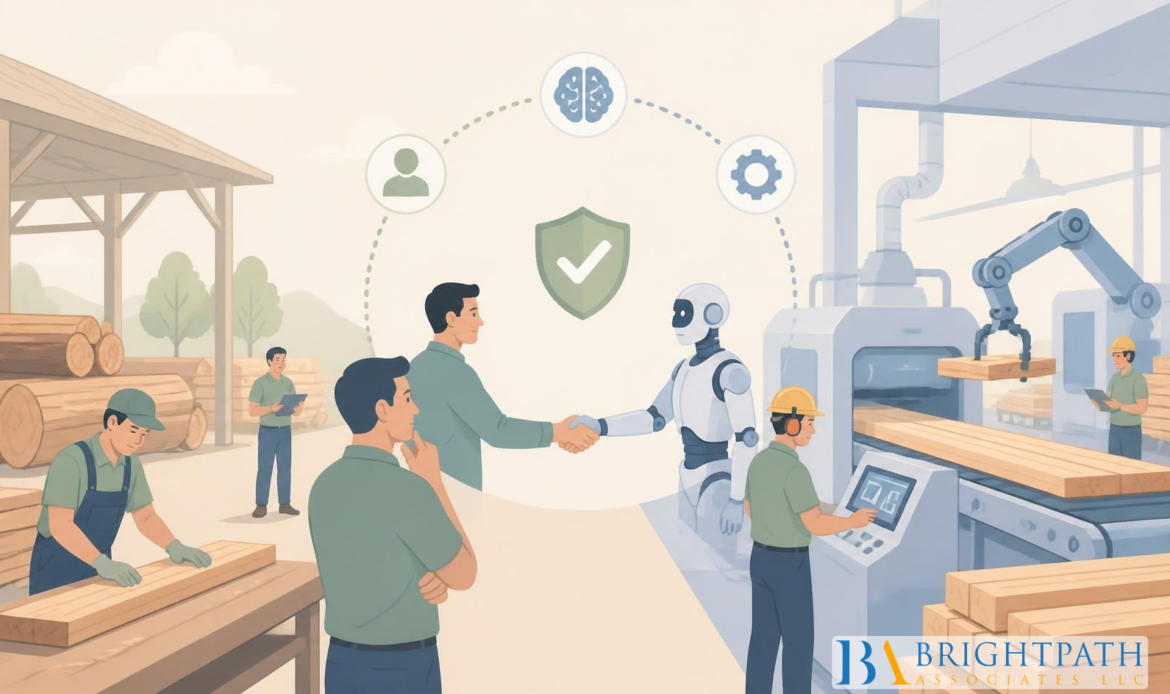
[Bethany, Connecticut – 30 September 2026] — BrightPath Associates has highlighted the growing need for greater trust in artificial intelligence among traditional wood-processing businesses, where established operating methods often coexist with rapidly developing digital technologies. Its latest industry analysis examines how C-Suite leaders can address the AI Trust Gap in Traditional Wood Processing by introducing AI gradually, improving workforce understanding, and connecting technology investments to measurable operational goals. The approach is increasingly relevant as companies respond to changing Lumber industry trends, evolving Forestry regulations, sustainability expectations, and competitive pressures.
Building Confidence in AI Adoption
AI can support many activities across wood processing, from equipment monitoring and quality control to production planning and demand forecasting. However, technology adoption is not determined only by technical capability. Employees and managers must also understand how AI-generated recommendations are produced, where human oversight remains necessary, and how new systems can improve rather than disrupt established workflows.
BrightPath Associates’ analysis explains that trust can be developed through practical implementation rather than broad technology promises. Starting with clearly defined operational challenges allows companies to demonstrate value while giving employees time to become familiar with AI-supported processes. This can be particularly important in Wood product manufacturing, where operational knowledge accumulated over years remains a valuable part of decision-making.
For executives, this means AI adoption should be treated as both a technology initiative and a workforce transformation effort. Training, transparent communication, and clearly defined responsibilities can help bridge the gap between experienced employees and emerging digital tools. Leadership teams can also use executive search recruitment to identify executives and specialists who understand both traditional manufacturing environments and modern digital transformation.
Connecting AI With Forest Product Innovation
The opportunity for AI extends across the broader forest-products value chain. In timber operations, data-driven systems can help improve planning, equipment utilization, inventory visibility, and resource management. When combined with responsible Timber harvesting practices and compliance processes, digital tools can contribute to more informed operational decisions while supporting environmental objectives.
AI can also contribute to Forest product innovation by helping manufacturers analyze production data and identify opportunities for improved material utilization. Better data can support the development of Sustainable materials, more efficient production processes, and improved resource planning. These capabilities can become increasingly important as customers and regulators demand greater transparency regarding sourcing, production, waste, and environmental performance.
The transition toward digital operations also intersects with Paper and pulp technology. Manufacturers can use automation and analytics to monitor production conditions, identify quality variations, and improve resource efficiency. Within the broader Automation in Paper industry, AI-supported systems can complement employee expertise by providing timely information for maintenance, production, and quality decisions rather than attempting to replace human judgment.
AI, Recycling, and Operational Efficiency
Another area where digital technology can support industry transformation is recycling. Improved data collection and process monitoring can help businesses understand material flows, identify inefficiencies, and improve sorting and processing decisions. As demand for circular production models grows, Paper recycling solutions can become an important component of broader sustainability strategies.
These developments are also connected to the changing economics of the sector. Paper industry economics are influenced by energy costs, raw-material availability, transportation expenses, consumer demand, regulatory requirements, and investment in new production technologies. AI can provide decision-makers with additional operational data, but its value depends on how effectively organizations integrate that information into everyday management processes.
The central issue is therefore not simply whether companies should adopt AI. It is how they can introduce technology in ways that employees understand and leadership teams can measure. Small-scale implementations, clear performance metrics, and human oversight can provide a structured pathway for organizations that are interested in modernization but remain cautious about technology risk.
Leadership and the Future of the Forest Products Sector
Addressing the AI Trust Gap can also strengthen the industry’s ability to respond to future changes. Organizations operating across forestry, timber, paper, pulp, and wood products must manage changing regulations, sustainability requirements, customer expectations, and international competition. Building digital confidence today can help companies prepare their workforce for these longer-term changes.
BrightPath Associates’ analysis, AI Trust Gap in Traditional Wood Processing, provides additional insight into how industry leaders can introduce AI while maintaining employee confidence and operational control. Executives seeking broader industry resources can also explore the company’s insights for the Paper & Forest Industry, including developments affecting technology, sustainability, talent, and manufacturing.
For C-Suite leaders, the message is increasingly relevant: successful digital transformation requires more than purchasing technology. It requires leadership, workforce engagement, appropriate skills, measurable objectives, and a culture that allows employees to understand how AI supports their work. By combining established industry knowledge with carefully implemented digital capabilities, companies can pursue modernization while preserving the operational expertise that has long supported the forest products sector.
About BrightPath Associates
BrightPath Associates is an executive recruitment and talent solutions firm that helps small and mid-sized organizations identify leadership and specialized professionals to support sustainable business growth. The company provides recruitment and talent solutions across multiple industries, with a focus on connecting organizations with qualified professionals and helping businesses address evolving workforce needs. BrightPath Associates’ mission is to support organizations with the people and expertise required to build stronger teams and achieve long-term growth.
Media Contact:
Name: Corporate Communications Team
Company: BrightPath Associates
Email: media@brightpathassociates.com
Website: https://brightpathassociates.com