
Introduction
The #WoodProcessingIndustry is entering a period of significant technological change. From timber harvesting and sawmilling to wood product manufacturing, companies are increasingly exploring artificial intelligence (AI), automation, computer vision, predictive analytics, and connected production systems to improve efficiency and sustainability. However, technological capability alone does not guarantee successful adoption. One of the biggest barriers facing traditional wood processors is the AI trust gap—the hesitation among employees, managers, and business leaders to rely on AI-driven systems for decisions that have historically depended on human experience.
This trust gap is particularly important in an industry where practical knowledge, material variability, craftsmanship, safety, and operational judgment play central roles. Wood is a naturally variable material, and every log can differ in species, moisture content, density, dimensions, defects, and structural characteristics. AI systems must therefore demonstrate that they can work reliably in complex production environments rather than simply perform well in controlled demonstrations.
Closing this gap requires more than purchasing advanced software or installing automated machinery. It requires a combination of transparent technology, employee involvement, reliable data, appropriate training, and a clear understanding of where AI can complement rather than replace human expertise.
Traditional wood processing businesses have developed their operating methods over decades. Experienced workers can identify changes in timber quality, recognize equipment abnormalities, adjust cutting approaches, and respond to unexpected production conditions. Much of this knowledge is difficult to document because it is based on practical observation and accumulated experience.
AI systems operate differently. They depend on data, algorithms, sensors, cameras, and predefined models to identify patterns and recommend actions. When an AI recommendation conflicts with an experienced operator’s judgment, employees may naturally question the technology.
This does not necessarily mean that workers are resistant to innovation. In many cases, the problem is a lack of transparency. Employees may not understand why an AI system has recommended a particular cutting pattern, classified a particular piece of timber as defective, or predicted that a machine requires maintenance.
Building trust therefore begins with making AI understandable. Operators need to know what information the system uses, what its limitations are, and when human intervention remains necessary.
AI and Forest Product Innovation
Forest product innovation is expanding beyond the development of new wood-based materials. It increasingly includes digital technologies that improve how forest resources are harvested, processed, monitored, and converted into finished products.
AI-powered imaging systems can identify knots, cracks, discoloration, warping, and other characteristics that influence timber value. In sawmills, these systems can help determine optimal cutting patterns and reduce unnecessary material loss. In manufacturing facilities, machine-learning models can analyze production data to identify inefficiencies and predict equipment problems.
However, successful forest product innovation depends on connecting technological innovation with operational knowledge. AI should not be introduced as an isolated digital project. Instead, companies should integrate it into existing workflows and demonstrate measurable improvements in yield, quality, safety, maintenance, or energy consumption.
When workers can see that an AI system helps them perform their jobs more effectively, trust tends to develop naturally.
Data quality is one of the most important foundations of AI adoption. Traditional wood processing facilities often operate with information distributed across machinery, spreadsheets, maintenance records, production systems, and manual logs. If these sources are inconsistent, an AI system can produce unreliable recommendations.
Companies should therefore establish clear data standards before implementing sophisticated AI applications. Sensors should be calibrated, production information should be recorded consistently, and historical records should be cleaned and organized.
The same principle applies to Paper and pulp technology. Facilities that use AI to optimize pulping, drying, energy consumption, or quality control need dependable operational data. Poor-quality inputs can reduce confidence in even technically advanced systems.
Data governance also helps employees understand that AI decisions are based on measurable information rather than unexplained assumptions. This transparency can significantly reduce skepticism.
Connecting AI With Timber Harvesting
AI adoption does not begin inside the sawmill. It can also influence timber harvesting and forest management. Advanced imaging, satellite data, geographic information systems, and predictive analytics can help companies understand forest conditions, estimate timber volumes, plan harvesting operations, and optimize transportation.
These technologies can improve resource utilization while supporting compliance with #ForestryRegulations. Accurate digital records can help organizations document harvesting activities, monitor protected areas, and demonstrate responsible sourcing.
Nevertheless, forestry professionals remain essential. Environmental conditions, local knowledge, terrain, weather, biodiversity considerations, and regulatory requirements can create circumstances that automated systems cannot fully understand. AI should therefore support field professionals rather than eliminate their decision-making responsibilities.
The relationship between AI and employment is one of the most sensitive aspects of technology adoption. Workers may fear that automation will eliminate their jobs or reduce the value of their experience. These concerns can become a major source of resistance if management does not address them openly.
Automation in Paper industry operations demonstrates how technology can change job responsibilities without necessarily removing human involvement. Automated inspection, process control, and predictive maintenance can reduce repetitive work while creating greater demand for employees who understand digital systems, equipment diagnostics, and data interpretation.
Wood processing companies can follow a similar approach. Instead of presenting AI as a replacement for workers, management can position it as a tool that removes repetitive tasks and allows employees to focus on quality control, maintenance, process improvement, and higher-value activities.
Reskilling should become part of the technology investment itself. Employees who understand how AI systems work are more likely to trust and effectively use them.
Improving Transparency in Wood Product Manufacturing
The need for transparency becomes particularly important in wood product manufacturing, where AI may influence product grading, cutting decisions, quality inspection, and production planning.
A useful approach is to implement explainable AI systems that provide understandable reasons for recommendations. For example, instead of simply classifying timber as unsuitable, an AI system could identify the visible characteristics that influenced its classification.
This creates a feedback loop between technology and human expertise. Operators can review the recommendation, confirm whether it is correct, and provide feedback when the system makes an error. Over time, this feedback can improve model performance while giving employees greater confidence in the technology.
Human oversight should remain particularly important in safety-critical and quality-sensitive applications. AI can provide recommendations, but companies should establish clear rules regarding when a trained employee must make the final decision.
The development of Paper recycling solutions provides another useful example of how AI can support resource efficiency. Recycling facilities increasingly need to sort complex material streams, identify contaminants, optimize processing conditions, and improve recovered fiber quality.
AI-powered vision systems can help classify materials more consistently, while predictive analytics can identify process inefficiencies. Similar principles can be applied to wood processing, particularly in facilities handling wood waste, residues, chips, and secondary materials.
Integrating waste streams into production planning can support the broader use of Sustainable materials. Sawdust, wood chips, bark, and other by-products can become valuable inputs for panels, pellets, bio-based products, or other applications rather than being treated simply as waste.
Responding to Lumber Industry Trends
Current #LumberIndustryTrends increasingly emphasize productivity, traceability, sustainability, labor efficiency, and digitalization. Customers and downstream manufacturers are demanding greater visibility into material origins and production practices, while companies face pressure to control costs and use resources more efficiently.
AI can contribute to these objectives by improving forecasting, optimizing production schedules, monitoring equipment, and supporting quality assurance.
However, businesses should avoid adopting AI simply because it is considered an industry trend. Every implementation should begin with a clearly defined operational problem. If a company cannot identify how an AI system will improve a specific process, the investment may create unnecessary complexity.
The strongest implementations usually begin with smaller applications where results can be measured clearly. Once employees see reliable outcomes, companies can gradually expand AI into other areas.
Sustainability is becoming increasingly important throughout the forest products value chain. Forestry regulations are also evolving as governments and markets place greater emphasis on responsible resource management, traceability, biodiversity, and environmental protection.
AI can support compliance by improving documentation and monitoring. Digital systems can help organizations maintain records, track material movement, and identify potential deviations from established procedures.
At the same time, technology should not be treated as a substitute for regulatory knowledge. Compliance teams, forestry specialists, and management remain responsible for interpreting applicable requirements and ensuring that automated systems are configured appropriately.
The objective should be to use technology to make responsible practices easier to monitor and verify.
Understanding Paper Industry Economics and Investment
The financial dimension of digital transformation cannot be ignored. #PaperIndustry economics and related forest-product markets are affected by energy costs, raw material prices, labor availability, transportation expenses, product demand, and capital investment requirements.
AI projects should therefore be evaluated according to measurable business outcomes. These may include higher recovery rates, reduced downtime, lower energy consumption, improved product quality, reduced waste, or greater production consistency.
A phased implementation can reduce financial risk. Companies can first test AI in one production line or one process, measure its performance, and then determine whether broader deployment is justified.
This approach also creates a controlled environment in which employees can become familiar with the technology before it becomes deeply integrated into operations.
Technology adoption ultimately depends on people. Companies need employees who understand both traditional wood processing and emerging digital technologies. This creates a growing demand for professionals who can bridge operational expertise with data science, automation, engineering, and sustainability.
This is where #ExecutiveSearchRecruitment can play an important role. Organizations implementing large-scale digital transformation may need leaders with experience in manufacturing technology, AI strategy, operational excellence, forestry, supply chain management, and sustainability.
Recruitment strategies should focus not only on technical qualifications but also on change-management capabilities. Leaders must be able to communicate technological objectives clearly, understand workforce concerns, and create a culture where experimentation and continuous improvement are encouraged.
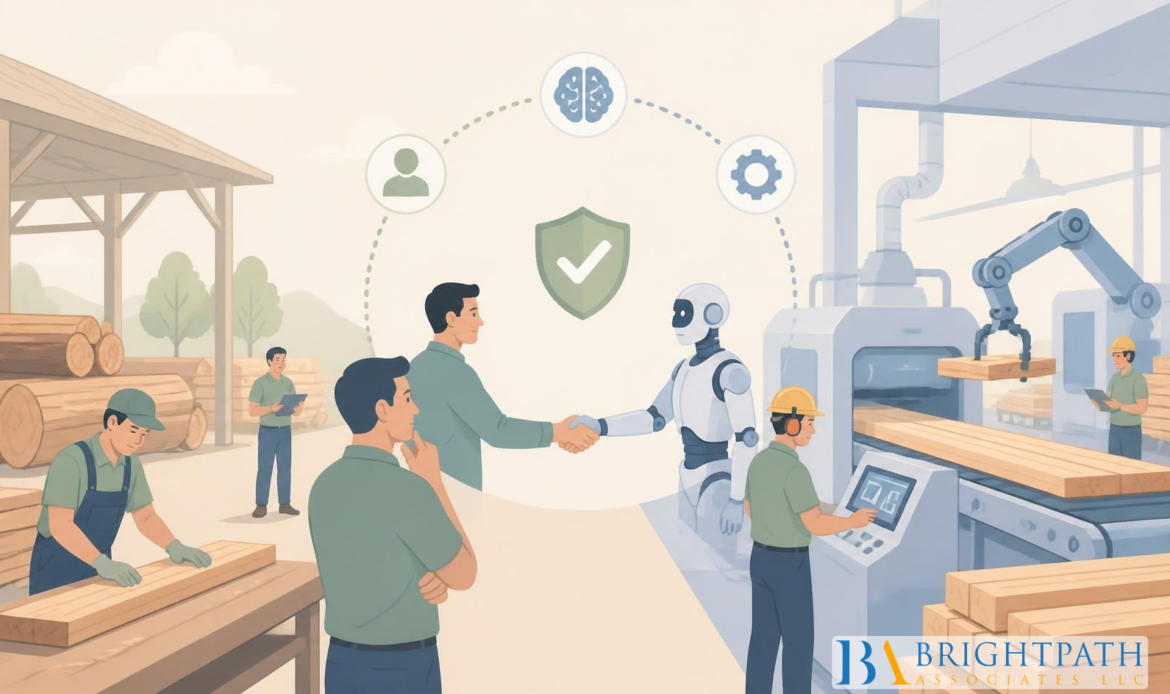
The long-term solution to the AI trust gap is not simply better technology. It is a workplace culture built around collaboration between humans and intelligent systems.
Management should involve operators early in technology projects, allowing them to participate in testing and provide feedback. Training should explain both the capabilities and limitations of AI. Performance measurements should evaluate whether technology is genuinely improving production rather than simply measuring the number of automated processes introduced.
Companies should also accept that AI systems will sometimes make mistakes. A trustworthy organization is not one that assumes technology is infallible. It is one that creates procedures for detecting, correcting, and learning from errors.
Conclusion
Overcoming the AI trust gap in traditional wood processing requires a balanced approach to technology and human expertise. AI can transform timber harvesting, wood product manufacturing, paper processing, recycling, maintenance, quality control, and resource management, but successful adoption depends on more than technological capability.
Forest product innovation will deliver lasting value when employees understand how new systems work and see clear benefits in their daily responsibilities. Reliable data, transparent AI models, workforce training, human oversight, and phased implementation can help companies move from uncertainty toward practical adoption.
As lumber markets, sustainability expectations, forestry regulations, and manufacturing technologies continue to evolve, companies that combine traditional operational knowledge with carefully implemented digital tools can strengthen their resilience. The future of wood processing is unlikely to be defined by humans versus AI. Instead, it will increasingly depend on how effectively people and intelligent technologies work together to improve productivity, sustainability, quality, and long-term competitiveness.
Find your next leadership role in Paper & Forest Industry today!
Stay informed with the latest insights on Paper & Forest Industry!