
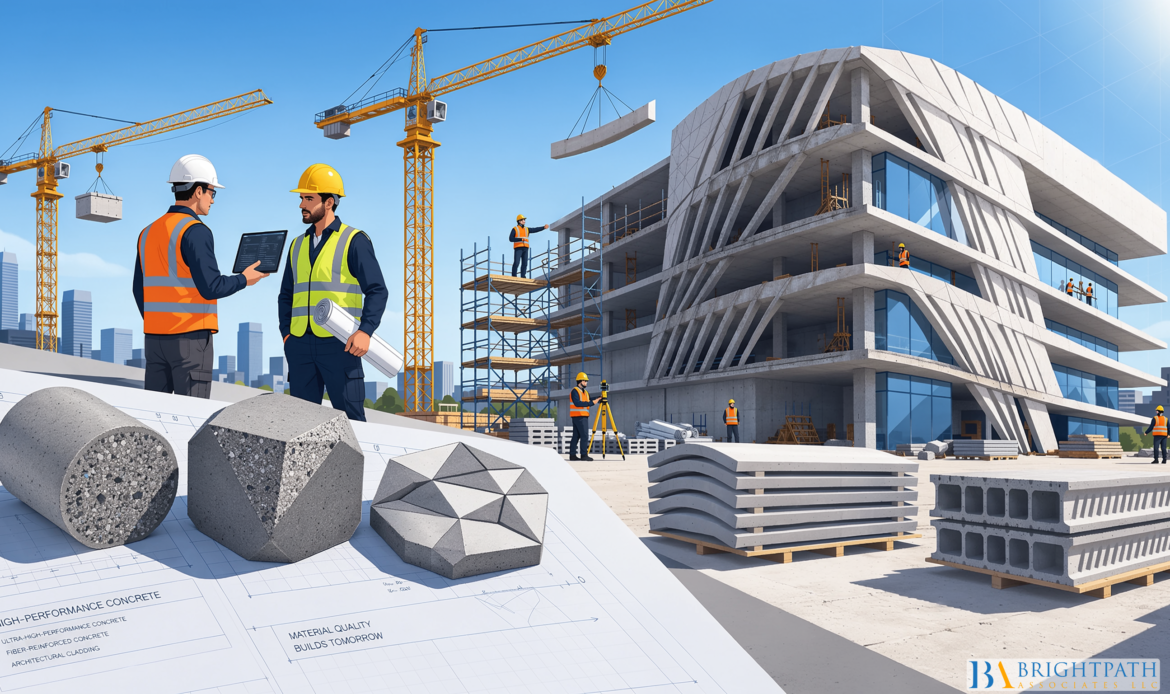
The #BuildingMaterialsIndustry sits at a critical junction where structural performance and visual design meet. High-performance concrete, particularly Ultra-High-Performance Concrete (UHPC), has transitioned from an infrastructure material into an architectural surface choice. Modern architects and developers increasingly demand thinner exterior panels, custom textures, intricate perforations, and precise surface finishes. These requirements place unprecedented technical demands on building material manufacturers. At BrightPath Associates, we observe that navigating this shift requires more than just advanced chemistry. It requires forward-thinking executive leadership, cross-functional engineering management, and strategic workforce planning across production lines.
Table of Contents
• Key Takeaways
• Understanding Architectural High-Performance Concrete
• Visual Design Trends and Surface Customization
• Engineering Constraints, Panel Fabrication, and Quality Control
• Executive Leadership Dynamics in the Building Material Industry
• Frequently Asked Questions
• Resources and Citations
Key Takeaways
• High-performance concrete enables thin architectural panels, complex shapes, and custom visual finishes without sacrificing strength.
• Surface aesthetics rely on mold precision, aggregate distribution, pigment selection, and factory curing controls.
• Color variation between production batches represents a primary quality risk that requires rigorous batch management.
• Perforated UHPC screens combine structural durability with functional solar shading and daylight filtering.
• Building material companies face critical executive talent shortages in R&D, advanced manufacturing, and technical sales leadership.
Understanding Architectural High-Performance Concrete
High-performance cementitious materials have fundamentally altered exterior building envelopes. Unlike standard structural concrete, architectural UHPC uses an optimized particle packing design, low water-to-cement ratios, and specialized fiber reinforcement. This combination yields high density, low permeability, and exceptional durability.
Material Properties and Mechanical Capabilities
The fundamental mechanical distinction of architectural UHPC lies in its compressive and flexural performance. Traditional precast concrete often exhibits compressive strengths between 30 and 50 MPa. In contrast, architectural high-performance formulations achieve significantly higher thresholds while maintaining tensile ductility.
According to an American Concrete Institute presentation on architectural UHPC, architectural #UHPCApplications in U.S. building façades are defined by high compressive strengths, frequently reaching a 56-day strength threshold of at least 120 MPa for mixtures with nonmetallic fibers or 150 MPa for mixtures with metallic fibers. These high thresholds allow engineering teams to design thin, lightweight cladding elements that reduce the dead load imposed on structural building frames.
Understanding how these material advances reshape product portfolios requires analyzing long-term market directions. Executives evaluating strategic product roadmaps can explore our analysis on the state of building materials vision and strategies for 2030 to align material R&D with future construction demand.
Architectural Cladding Material Comparison
To contextualize where high-performance concrete fits within the cladding ecosystem, consider the following technical comparison against conventional precast concrete and metallic façade systems:
| Performance Metric | Conventional Precast Concrete | Architectural UHPC Façade Panels | Metal & Glass Curtain Wall Systems |
|---|---|---|---|
| Typical Panel Thickness | 100 mm to 150 mm | 19 mm to 30 mm | 3 mm to 6 mm (Sheet Metal) |
| Compressive Strength | 30 MPa to 50 MPa | 120 MPa to 150+ MPa | N/A (Metallic Tensile Focus) |
| Surface Texture Fidelity | Moderate detail reproduction | High fidelity mold replication | Smooth, stamped, or rolled finishes |
| Weight & Structural Load | High dead load | Low to moderate dead load | Low dead load |
| Design Flexibility | Limited perforation capability | High perforation and lattice options | Panelized or screen systems |
| Service Life Expectancy | 50+ years | 75+ to 100+ years | 30 to 50 years |
Visual Design Trends and Surface Customization
Visual trends in commercial and institutional architecture increasingly favor monolithic stone appearances, organic geometric relief, and expressive open-work screens. High-performance concrete gives fabricators the ability to capture delicate surface detailing while guaranteeing long-term resistance to environmental exposure.
Mold Fidelity, Textures, and Surface Finishing
Because architectural high-performance concrete contains fine particle suspensions without coarse gravel, it acts as a fluid medium that captures mold surfaces with extraordinary detail. Fabricators use elastomeric formliners, CNC-milled timber, and smooth polyurethane molds to impart varied textures ranging from ribbed geometric patterns to fine wood-grain surfaces.
As detailed in TAKTL architectural finish guidance, mold texture, mediablasting, exposed aggregate, and factory-applied finishing materially affect the appearance and color consistency of architectural UHPC. Factory treatments allow manufacturers to control light reflectivity, depth of tone, and tactile feel across large panel runs.
Common surface finishes used in high-performance architectural applications include:
• Smooth Form Finishes: Silky, low-sheen surfaces cast directly against polished mold surfaces.
• Mediablasted Finishes: Lightly abraded surfaces that remove surface cement film to expose embedded mineral aggregates.
• Exposed Aggregate Finishes: Deeper etching or chemical retarders that uncover colorful natural quartz, granite, or basalt aggregates.
• Linear and Micro-Ribbed Textures: Fluted or corrugated casting profiles that create dynamic shadow patterns across the building face.
• Polished Finishes: Ground and honed surfaces that resemble polished natural limestone or terrazzo.
Color Consistency and Pigment Integration
Achieving color consistency across hundreds of individual façade panels represents a primary challenge for concrete producers. Unlike post-applied paints or organic coatings, architectural concrete relies primarily on integral pigmentation. Synthetic iron oxides, titanium dioxide, and chromium oxides are blended directly into the cementitious matrix alongside white Portland cement.
However, color perception depends on more than pigment dosing. Slight shifts in moisture content, aggregate sourcing, water-cement ratios, and ambient curing temperatures can introduce visible tonal variations between casting days. Fabricators often apply factory sealers or tinted inorganic mineral stains to achieve tighter visual uniformity while maintaining a natural material appearance.
Perforations, Screens, and Environmental Performance
#ArchitecturalScreens and sunshades represent one of the fastest-growing design applications for high-performance concrete. Due to high tensile and flexural strength, slender UHPC components can span open areas without conventional rebar reinforcement.
The National Precast Concrete Association guide to architectural precast elements notes that UHPC can form thin, perforated, and complex architectural façade elements with daylight and privacy functions. By adjusting perforation density and angle, architectural teams can optimize interior daylighting while reducing solar heat gain.
Furthermore, integrated wall assemblies allow thin panels to work alongside standard curtain-wall systems. A Construction Canada report on building façade upgrades highlights a curtain-wall project that used approximately 30-mm exterior and 19-mm interior UHPC panels selected partly for their visual finish. These dimensions demonstrate how high-performance concrete competes directly with lighter sheet materials while retaining stone-like mass and longevity.
Engineering Constraints, Panel Fabrication, and Quality Control
Translating visual design ideas into reliable building cladding requires strict quality control processes. Fabricators must balance complex visual requirements with real-world handling, attachment mechanics, and weather performance.
Thickness, Weight, and Attachment Mechanics
While high-performance concrete allows thin cross-sections, thinness changes structural behavior during lifting, transit, and thermal expansion. Panel edges must withstand localized stresses around anchor inserts, pins, and support brackets.
Engineers must carefully evaluate several attachment principles:
- Gravity Anchors: Supporting the primary dead load of the thin panel while accommodating differential building movement.
- Tieback Connection Systems: Resisting positive and negative wind pressures without introducing bending stresses into thin panels.
- Cast-in Embeds vs. Drilled Anchors: Selecting hardware that fits within thin panel profiles without compromising concrete cover or causing stress concentration cracks.
- Handling Stresses: Designing temporary lifting points to prevent flexural cracking during mold stripping, plant storage, and jobsite erection.
Managing Color Variation and Curing Controls
Color variation in exposed concrete is often called efflorescence or tonal drift. To minimize visual defects across an installed façade, manufacturing plants enforce rigorous production standards:
• Aggregate Selection: Sourcing mineral aggregates from unified quarry seams to ensure uniform background color.
• Moisture Metering: Utilizing real-time microwave moisture sensors in aggregates to maintain precise water-to-cement ratios.
• Temperature-Controlled Curing: Enclosing cast elements in climate-controlled curing chambers with managed humidity to standardize hydration speeds.
• Sequential Panel Casting: Casting adjacent elevation panels in continuous sequential runs using raw material batches from identical #SupplyShipments.
Weathering, Efflorescence, and Long-Term Maintenance
Visual durability over a multi-decade building lifespan depends on surface water absorption. Standard concrete absorbs water readily, making it susceptible to freeze-thaw damage, atmospheric staining, and calcium carbonate efflorescence. High-performance concrete features low capillary porosity, which inhibits water penetration.
However, surface protection remains essential. Non-film-forming silane or siloxane sealers penetrate the outer matrix to create a hydrophobic barrier. This treatment prevents water stains, protects integral pigments from dirt pickup, and allows natural rain to clean the building skin.
Executive Leadership Dynamics in the Building Material Industry
As high-performance concrete shifts from niche specification to mainstream adoption, building material manufacturers face strategic operational challenges. Companies must bridge technical research, manufacturing capabilities, and architectural sales strategy. At BrightPath Associates, we work closely with building material leaders to address the talent shortages that emerge when companies introduce advanced material technologies.
Aligning R&D, Operations, and Sales Leadership
Successfully bringing high-performance architectural materials to market requires harmony across three key operational areas:
- Research & Development: Formulating mixes that achieve compressive strength targets while maintaining fluidity, air void consistency, and color stability.
- Plant Operations: Upgrading batching facilities, training precast technicians on high-shear mixing, and controlling mold maintenance processes.
- Commercial Technical Sales: Educating architects, structural engineers, and general contractors on technical specifications, lead times, and panel detailing.
Executives seeking to capitalize on shifting market demands can read our insights on construction market trends and opportunities for growth to guide operational expansion.
Managing Executive Talent Shortages in Advanced Building Materials
As building material companies expand into specialized UHPC production, executive leadership requirements evolve rapidly. Traditional concrete manufacturing experience alone is often insufficient. Organizations require leaders who understand complex material chemistry, automated precast production, building code compliance, and direct-to-architect marketing strategies.
Key executive vacancies that create operational risk for material manufacturers include:
• VP of Product Innovation: Leaders capable of managing materials science teams and accelerating commercialization schedules.
• Director of Plant Operations: Managers skilled in high-precision precast production, quality assurance frameworks, and scrap reduction.
• Head of Architectural Sales: Commercial executives who possess technical credibility with architectural specifiers and façade consultants.
• Director of Technical Services: Engineering leaders who manage mock-up approvals, structural testing, and jobsite installation support.
When these roles remain vacant, product launches slow, quality defects increase, and companies lose project bids to competitors. Professional executive search partnerships help building material companies identify, attract, and secure #SpecializedLeadership talent capable of navigating these technical market shifts.
Frequently Asked Questions
What makes UHPC different from conventional architectural precast concrete?
Architectural UHPC relies on an optimized particle composition without coarse aggregate, very low water-cement ratios, and fiber reinforcement. This yields compressive strengths above 120 MPa and high flexural ductility. Conventional precast typically achieves 30 to 50 MPa. As a result, UHPC panels can be cast significantly thinner and lighter while replicating fine mold textures with higher fidelity.
How thin can architectural UHPC panels be manufactured for building envelopes?
Architectural UHPC façade panels are routinely cast between 19 mm and 30 mm thick. Standard architectural precast concrete panels usually require structural thicknesses of 100 mm to 150 mm to protect internal steel reinforcement.
How do manufacturers control color variation between different UHPC casting batches?
#FabricatorsControl color consistency by sourcing aggregates from unified quarry seams, using automated moisture sensors in raw mixes, maintaining strict curing chamber temperatures, and employing factory-applied sealers or mineral stains to harmonize subtle natural variations.
Can perforated UHPC panels improve building energy performance?
Yes. Perforated UHPC panels can be engineered as exterior sunscreens or rainscreens. They block direct solar radiation, lower cooling loads, mitigate glare, and admit natural daylight, thereby supporting overall building energy efficiency.
What finishes are available for architectural UHPC façades?
Fabricators offer smooth form finishes, light to deep mediablasted surfaces, exposed aggregate treatments, polished hone surfaces, and custom 3D-milled linear textures.
What executive roles are most critical for building material companies adopting UHPC technologies?
Key roles include VP of Product Innovation, Director of Plant Operations, Head of Architectural Sales, and Director of Technical Services. These leaders bridge technical formulation, factory quality control, and commercial specification workflows.
How do project teams approve custom architectural UHPC finishes before full fabrication?
Project teams use a multi-step approval workflow that starts with small lab-cast control samples, progresses to full-scale visual mock-ups showing jointing and hardware, and culminates in pre-production visual range samples establishing acceptable upper and lower color variations.
Resources and Citations
• National Precast Concrete Association — Ultra High Performance Concrete (UHPC): Guide to Manufacturing Architectural Precast UHPC Elements
• American Concrete Institute — Applications of Architectural UHPC in USA Building Facades
• Construction Canada — An Ultra-High-Performance Upgrade
• TAKTL Architectural UHPC — Finish and Sealer Guidance
• BrightPath Associates Building Materials Leadership Insights: state of building materials vision and strategies for 2030
Find your next leadership role in Building Material Industry today!
Stay informed with the latest insights on Building Material Industry!