
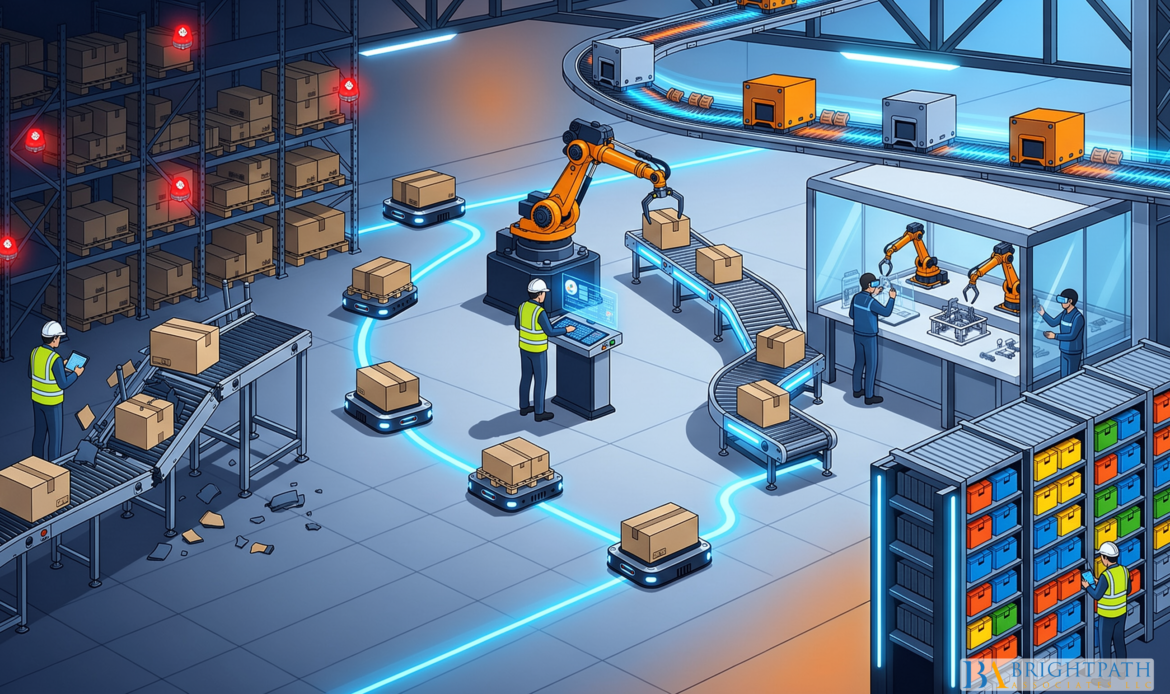
The concept of a static, predictable global manufacturing pipeline is over. We are witnessing the Death of Standard Supply Chain: Building for Constant Volatility for Industrial Automation Industry as a permanent structural shift rather than a temporary disruption. For executive leaders, plant managers, and engineering heads across the United States, traditional forecast-driven purchasing model no longer works. Long lead times for programmable logic controllers (PLCs), sudden shifts in #SemiconductorAllocations, energy price spikes, and hardware obsolescence have turned operational planning into a continuous balancing act. Industrial leaders cannot rely on linear supply chains anymore; they must build systems, component engineering protocols, and executive leadership structures designed specifically for persistent disruption.
Table of Contents
• Key Takeaways
• The Death of Standard Supply Chain: Building for Constant Volatility for Industrial Automation Industry
• Component Criticality and Engineering Interchangeability in Modern Automation
• Operational Technology Cybersecurity as a Core Supply Chain Vector
• Financial Scenarios and Volatility-Triggered Operating Rules
• Executive Leadership Strategies for Constant Volatility
• Frequently Asked Questions
• Resources and Citations
Key Takeaways
• Traditional linear forecasting is obsolete; industrial automation companies must adopt dynamic, trigger-based procurement and volatile-operating rules.
• Resilience depends on engineering interchangeability—designing printed circuit boards and control software to accept substitute components without requiring full system redesigns.
• Operational technology (OT) cybersecurity incidents directly cause physical supply chain failures, requiring integrated recovery and continuity planning.
• Semiconductor availability for industrial equipment relies heavily on mature-node manufacturing capacity, which experiences distinct demand cycles compared to consumer electronics.
• Executive leadership hiring must prioritize leaders who can bridge procurement, control system engineering, and cybersecurity risk management.
The Death of Standard Supply Chain: Building for Constant Volatility for Industrial Automation Industry
Why Traditional Linear Supply Chain Models Fail Industrial Automation
For decades, #ManufacturingAutomation relied on just-in-time delivery and predictable lead times. Executives calculated order points using historical lead-time averages and steady supplier pricing. In today’s market, those static assumptions fail continuously. Component lead times can jump from 8 weeks to 52 weeks in a single quarter due to upstream material shortages or logistics bottlenecks.
When a key industrial control system component becomes unavailable, an entire manufacturing facility can stall. A missing $50 fieldbus interface chip can halt the delivery of a $500,000 robotic assembly cell. Standard linear models treat components as static line items on a bill of materials. Modern volatile environments demand dynamic bills of materials that dynamically point to alternative parts, alternative suppliers, and alternate software configurations. Organizations that fail to adjust remain stuck in cycles of emergency expedite fees, unfulfilled customer orders, and idle assembly lines.
Semiconductor Bottlenecks and Mature-Node Constraints
Industrial automation components—including PLCs, variable frequency drives, human-machine interfaces (HMIs), and machine vision systems—depend heavily on legacy microcontrollers and power management integrated circuits. According to the Semiconductor Industry Association resilience report, semiconductor resilience must address cyclicality, changing industrial-automation demand, mature-node capacity, and the cost of excessive self-sufficiency. While media attention often focuses on sub-3-nanometer chips for artificial intelligence, industrial equipment relies on mature nodes (such as 28nm, 45nm, and older trailing-edge processes).
+————————————————————————-+
| SEMICONDUCTOR SUPPLY CHAIN SPLIT |
+————————————————————————-+
| ADVANCED NODES (< 7nm) | MATURE NODES (28nm – 180nm) |
| • Consumer Smartphones | • Industrial PLCs & I/O Modules |
| • Cloud Data Centers | • Motor Drives & Inverters |
| • High-Performance AI Chips | • Automotive & Robotics Sensors |
| • High Capital Investment Focus | • Tight Capacity & Supply Swings |
+————————————————————————-+
When semiconductor foundries reallocate mature-node capacity during demand spikes, automation equipment manufacturers face extended component shortfalls. Furthermore, a report from the SEMI and DHL semiconductor supply chain study notes that semiconductor supply-chain resilience is being pursued through capacity investment, digitalization, stronger partnerships, and resilient inventory strategies. Organizations must look deep into their multi-tier supply network to understand where their raw microcontrollers are fabricated, rather than relying solely on high-level distributor promises.
The Executive Talent Shift: Sourcing Leaders Who Manage Volatility
Navigating these structural challenges requires a fundamental shift in leadership talent. At BrightPath Associates, we regularly observe small and mid-sized automation firms struggle when relying on traditional procurement executives. Yesterday’s purchasing director focused primarily on unit cost negotiation and contract consolidation. Today’s supply chain leader must understand hardware engineering trade-offs, global trade compliance, and operational risk.
Finding leadership talent capable of bridging hardware design and strategic sourcing is difficult. Companies need operational leaders who can build resilient distribution network strategies for volatile markets while maintaining gross margins. When executive vacancies linger in critical supply chain or operations functions, organizations experience prolonged project delays, increased component costs, and customer churn. Executive hiring must evaluate candidates on their ability to design flexible operational systems rather than their familiarity with steady-state environments.
Component Criticality and Engineering Interchangeability in Modern Automation
Building an Industrial Automation Criticality Matrix
Not all automation components carry equal operational risk. A missing terminal block can be substituted easily, but a proprietary safety PLC or custom vision controller can shut down production indefinitely. To manage constant volatility, engineering and procurement teams must collaborate to categorize all bill of materials (BOM) items using a formal criticality matrix.
| Component Class | Operational Impact | Redesign Complexity | Primary Vulnerability | Resilience Strategy |
|---|---|---|---|---|
| Safety PLCs & Controllers | Catastrophic (Line Stop) | High (Requires Safety Re-certification) | Single-source silicon, proprietary firmware | Strategic buffer stock & direct factory allocation |
| Variable Frequency Drives (VFDs) | Severe (Machine Downtime) | Medium (Pinout & Parameter Matching) | Power electronics, IGBT chip shortages | Dual-sourcing with pre-validated mounting brackets |
| Machine Vision & Smart Sensors | Moderate (Quality Delays) | Medium (Software API Re-integration) | Image processor availability | Modular software abstraction layers |
| Industrial PCs & HMIs | Moderate (Operator Disruption) | Low (Standardized Operating Systems) | Touchscreen panels, OS compatibility | Off-the-shelf panel standardization |
| Fieldbus & I/O Modules | High (Network Communication Break) | High (Protocol Dependencies) | Transceiver chips, connector hardware | Protocol-agnostic hardware architectures |
By categorizing components across these metrics, organizations can allocate capital effectively. High-impact, high-complexity parts require dedicated strategic buffers or direct engineering redesigns, while low-complexity components rely on automated multi-supplier reorder rules.
Hardware and Firmware Redesign as Sourcing Capabilities
One of the most effective responses to component volatility is treating engineering interchangeability as an active sourcing strategy. When a primary microcontroller lead time explodes to 48 weeks, sitting idle is not a viable option. Forward-thinking automation companies design printed circuit boards (PCBs) with dual-footprint layouts that accept two different chip packages.
#SoftwareAbstraction plays a critical role here. By decoupling low-level hardware drivers from upper-level PLC programming and SCADA interfaces, control engineers can swap underlying processing hardware without rewriting application code. This level of technical agility requires close coordination between hardware designers, firmware developers, and purchasing agents. Understanding these broader industrial automation trends and smart manufacturing challenges allows technical teams to build adaptable products from the start.
Resolving Technical Trade-Offs: Inventory Carrying vs. Redesign Speed
Every resilience choice carries financial trade-offs. Holding 12 months of safety stock for every component burns cash and increases inventory obsolescence risk. Conversely, relying entirely on rapid engineering redesigns strains research and development teams and risks project delivery delays.
+————————————————————————-+
| RESILIENCE TRADE-OFF BALANCE MODEL |
+————————————————————————-+
| STRATEGY A: EXCESS INVENTORY | STRATEGY B: RAPID REDESIGN |
| • High Capital Requirement | • High R&D Engineering Load |
| • Risk of Component Obsolescence | • Regulatory/Safety Re-testing |
| • Instant Material Availability | • Lower Long-Term Inventory Cost |
| |
| BALANCED APPROACH: Dynamic buffer stock on non-substitutable parts |
| combined with pre-qualified alternate layouts for core assemblies. |
+————————————————————————-+
Executive teams must evaluate these trade-offs by comparing carrying costs against potential redesign costs and lost production revenue. If a component requires 6 months of safety compliance testing after a redesign, holding buffer stock is the rational financial choice. If a component can be swapped with minimal testing, engineering flexibility provides a better long-term return on investment.
Operational Technology Cybersecurity as a Core Supply Chain Vector
Connecting Physical Shortages to Operational Technology Security
#SupplyChain volatility is not caused solely by physical transportation delays or component shortages. Operational technology (OT) cybersecurity breaches act as severe supply chain disruptions. According to the NIST SP 1800-41 guidelines on cyber incident recovery, ICS cyber incidents can affect manufacturing safety, production, supply chains, and economic performance. A ransomware attack on an industrial control system supplier or a tier-one systems integrator halts physical shipments just as effectively as a port shutdown or silicon shortage.
+————————————————————————-+
| OT CYBERATTACK TO SUPPLY CHAIN IMPACT |
+————————————————————————-+
| Cyber Incident on ICS/SCADA Network |
| └── Operational Disruption & System Lockout |
| └── Production Line Shutdown |
| └── Shipment Delays to Downstream Customers |
| └── Physical Supply Chain Stagnation |
+————————————————————————-+
Furthermore, modern automation equipment relies on continuous firmware updates, cloud-based analytics, and remote maintenance access. If a vendor’s software updates are compromised, malformed code can disable automated production lines across thousands of customer plants. OT security is no longer just an internal IT concern; it is a critical component of physical supply chain risk management.
Defense in Depth and Industrial Control Systems Restoration
To protect operations against vendor-borne cyber incidents, industrial leaders must implement robust defense-in-depth security architectures. Guidelines established in the NIST Cybersecurity Framework Manufacturing Profile establish that manufacturing security controls should address supply-chain risks in manufacturing systems. Securing automation environments requires network segmentation, strict access controls, and verified system restore capabilities.
+————————————————————————-+
| DEFENSE-IN-DEPTH OT SECURITY LAYERS |
+————————————————————————-+
| LAYER 1: Network Segmentation (DMZ between IT & OT Networks) |
| LAYER 2: Identity & Access Management (Multi-Factor Authentication) |
| LAYER 3: Industrial Protocol Defense (Enforce Encrypted/Signed Data) |
| LAYER 4: Air-Gapped Off-site Backups & System Image Integrity |
+————————————————————————-+
Additionally, the NIST SP 800-82 industrial control systems security standard emphasizes that ICS security must account for #IndustrialProtocols, authentication, and operational resilience. Industrial facilities must maintain isolated, tested backups of all PLC programs, SCADA configurations, and robot control scripts. If a cyber event compromises control hardware, operators must be able to re-flash devices from trusted offline repositories rather than waiting weeks for replacement controllers from vendors.
Talent Imperatives: Bridging Procurement, Engineering, and Cyber Leadership
Managing these combined physical and digital risks requires cross-functional leadership teams. Historically, procurement teams bought hardware, automation engineers programmed control loops, and IT departments secured office computers. In a constant volatility environment, these silos create severe operational vulnerabilities.
Organizations need engineering leaders who understand cybersecurity frameworks, as well as procurement managers who understand component firmware dependencies. Executive search strategies must target multidisciplinary leaders who can build cohesive operating policies across departments. Failing to secure qualified technical leadership leaves businesses exposed to unmitigated supply chain and security vulnerabilities.
Financial Scenarios and Volatility-Triggered Operating Rules
Moving from Fixed Reorder Points to Dynamic Volatility Triggers
Traditional #InventoryManagement uses fixed reorder points based on static lead-time calculations. When market conditions shift rapidly, static reorder formulas break down. Modern industrial automation managers must replace static parameters with dynamic, volatility-triggered operating rules.
A volatility-triggered operating rule changes procurement behavior based on real-time market signals rather than calendar schedules. For example, if an industrial microcontroller’s lead time increases past 24 weeks, the operating rule automatically authorizes dual-sourcing protocols or triggers safety-stock allocation adjustments. These automated rules eliminate decision delays, ensuring procurement teams take proactive measures before component shortages impact production lines.
Scenario-Based Economics for Regional Sourcing and Localization
Evaluating nearshoring or regional manufacturing requires dynamic financial modeling. While overseas suppliers may offer lower unit costs under normal operating conditions, shipping bottlenecks, tariffs, and geopolitical instability can quickly eliminate those cost advantages. Analyzing supply chain resilience for changing trade landscapes helps executive teams understand the total landed cost of global sourcing models.
Scenario-based financial models test production costs across multiple operational disruption scenarios:
- Base Case: Standard logistics schedules, baseline freight fees, zero tariff adjustments.
- Logistics Disruption Case: Extended ocean shipping delays, elevated air freight expedite costs, 15% safety stock holding increase.
- Geopolitical Shock Case: Component tariff escalations, mandatory regional component substitution, local assembly ramp-up expenses.
Through scenario modeling, nearshoring critical sub-assemblies often proves more cost-effective over a three-year window, even if direct labor costs are higher locally.
Measuring Supply Chain Health Beyond Alternate Supplier Counts
Having multiple approved vendors on paper does not guarantee operational resilience. If three secondary suppliers source their raw silicon from the same semiconductor foundry, a single facility disruption breaks all three supply options simultaneously. True resilience must be evaluated using functional operational metrics:
• Mean Time to Alternate Qualification (MTAQ): The exact number of days required for engineering to validate and approve a substitute component.
• BOM Redundancy Coverage: The percentage of active bill-of-materials line items that have at least one drop-in alternative component pre-validated by engineering.
• Recovery Time Objective (RTO): The maximum acceptable time required to restore full production following a physical material shortage or cyber disruption.
• Upstream Silicon Concentration: The geographic and foundry mapping of primary microcontrollers across all tier-one suppliers.
Tracking these operational metrics gives executive leadership a clear, realistic view of supply chain readiness.
Executive Leadership Strategies for Constant Volatility
Aligning Engineering, Procurement, and Operations Teams
Building a resilient organization requires breaking down internal silos. #ExecutiveLeadership must align goals across engineering, purchasing, and factory operations teams. When procurement is evaluated solely on purchase price variance (PPV), buyers are incentivized to select single-source, low-cost suppliers—increasing overall operational risk.
Instead, performance targets should incentivize component standardization, rapid qualification of alternatives, and cross-functional risk management. Establishing shared key performance indicators (KPIs) ensures engineering designs components with procurement flexibility in mind, while purchasing teams select suppliers based on long-term reliability rather than unit price alone.
Mitigating Vacancy Risks in Critical Automation Roles
Operational volatility places intense pressure on technical staff. Vacancies in key positions—such as senior control systems engineers, supply chain managers, or automation software architects—can stall critical resilience initiatives. When key engineering positions sit vacant, component redesigns slow down, supplier qualifications stall, and production line vulnerabilities remain unaddressed.
To mitigate vacancy risk, middle-market automation firms must adopt proactive talent acquisition strategies. Relying on passive job postings often fails to attract specialized technical talent. Partnering with executive search consultants who specialize in industrial technology enables firms to maintain active pipelines of qualified candidates. Swiftly filling critical leadership roles ensures strategic resilience initiatives remain on schedule.
Developing Agile Leadership Frameworks for Smart Manufacturing
Building resilient industrial operations is an ongoing leadership requirement, not a one-time project. As smart factories become more interconnected, technical complexity will continue to rise. Executive leaders must cultivate adaptive organizational cultures that embrace change, test contingency plans regularly, and respond quickly to market disruptions.
+————————————————————————-+
| AGILE LEADERSHIP EXECUTION FRAMEWORK |
+————————————————————————-+
| 1. Continuous Threat Assessment (Monitor Geopolitical & Supply Risks) |
| 2. Cross-Functional Governance (Align Engineering, Sales, & Sourcing) |
| 3. Rapid Decision-Making Triggers (Automated Procurement Actions) |
| 4. Proactive Executive Talent Pipeline (Eliminate Critical Vacancies) |
+————————————————————————-+
By prioritizing component interchangeability, integrated cybersecurity defense, dynamic financial modeling, and specialized leadership talent, industrial automation manufacturers can navigate market volatility effectively and maintain a competitive advantage.
Frequently Asked Questions
What does the death of the standard supply chain mean for industrial automation?
It marks the end of relying on linear, predictable supply chains and fixed reorder points. Industrial automation manufacturers must build operational models designed for persistent disruption, utilizing flexible component engineering, multi-region sourcing, and integrated OT risk management.
Why are traditional demand forecasts failing automation manufacturers?
Traditional forecasts rely on historical lead times and stable supplier pricing. Sudden shifts in semiconductor availability, shipping disruptions, and geopolitical events make historical data unreliable, leading to component shortages and inventory imbalances.
Which industrial automation components are most vulnerable to supply disruptions?
#ProgrammableLogicControllers (PLCs), variable frequency drives (VFDs), safety relays, and industrial network interface cards are highly vulnerable. They depend heavily on mature-node semiconductors and proprietary firmware, making fast component substitution difficult.
How can engineering teams support supply chain resilience?
Engineering teams can design printed circuit boards with multi-chip footprint layouts and implement software abstraction layers. Decoupling application software from low-level hardware drivers allows companies to switch microcontrollers without rewriting entire program codes.
How do operational technology cyber attacks affect physical supply chains?
Cyber incidents on industrial control systems or software vendors can lock access to SCADA networks, corrupt controller firmware, or shut down assembly lines. These operational shutdowns delay physical product deliveries just like traditional logistics bottlenecks.
What metrics best measure supply chain resilience?
Resilience should be measured using functional metrics such as Mean Time to Alternate Qualification (MTAQ), percentage of pre-validated alternative components on bills of materials, Recovery Time Objective (RTO), and upstream semiconductor foundry concentration.
Why is executive hiring critical to managing supply chain volatility?
Managing volatility requires cross-functional executives who understand control system engineering, strategic sourcing, and OT cyber risk. Prolonged vacancies in supply chain or engineering leadership leave companies unable to qualify alternative components or adjust to market shifts.
Resources and Citations
• NIST + NCCoE, Responding to and Recovering from a Cyber Attack: Cybersecurity for the Manufacturing Sector, https://csrc.nist.gov/pubs/sp/1800/41/ipd
• NIST, Cybersecurity Framework 2.0 Manufacturing Profile, https://nvlpubs.nist.gov/nistpubs/ir/2025/NIST.IR.8183r2.ipd.pdf
• NIST, Guide to Industrial Control Systems Security, https://nvlpubs.nist.gov/nistpubs/specialpublications/nist.sp.800-82.pdf
• SEMI and DHL, Resilience of the Semiconductor Supply Chain, https://www.semi.org/sites/semi.org/files/2022-12/glo-csi-dhl-resilience-of-the-semiconductor-supply-chain.pdf
• Semiconductor Industry Association, Emerging Resilience in the Semiconductor Supply Chain, https://www.semiconductors.org/wp-content/uploads/2024/05/Report_Emerging-Resilience-in-the-Semiconductor-Supply-Chain.pdf
• BrightPath Associates Insights, Industrial Automation Industry Expertise, https://brightpathassociates.com/industrial-automation-trends-challenges-and-the-future-of-smart-manufacturing/
Find your next leadership role in Industrial Automation Industry today!
Stay informed with the latest insights on Industrial Automation Industry!