
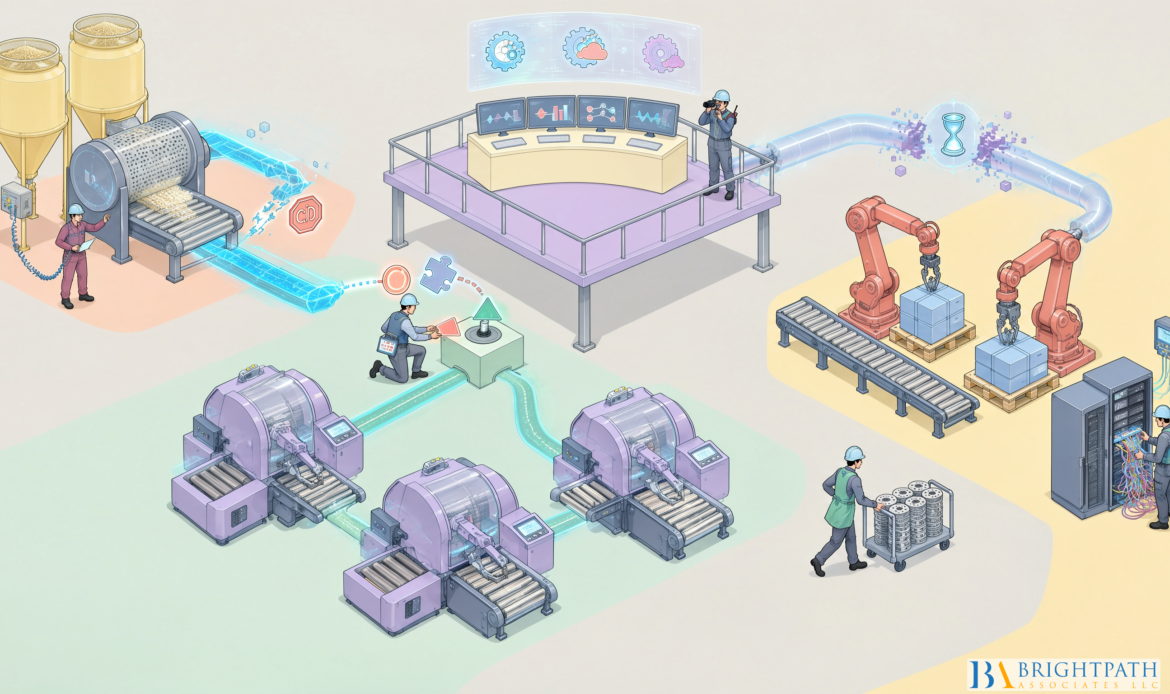
Data Interoperability: The Hidden Barrier to Mill Automation for Paper and Forest Industry is not primarily a software problem. It is a business design problem. A mill may have connected equipment, modern sensors, a historian, cloud analytics, and automation in #PaperIndustry initiatives underway, yet still lack the usable data needed to improve decisions across production, maintenance, quality, energy, and fiber supply.
The contradiction is simple: equipment can be connected without its data being understandable, trusted, or available in the right context. For paper, pulp, lumber, and forest-products leaders, that gap can delay automation programs and complicate the search for executives who can lead both operating performance and digital change.
Table Of Contents
- Key Takeaways
- Why Interoperability Is The Automation Barrier
- Building A Mill Data Foundation That Works
- Leadership And Hiring Implications For Forest Products
- Frequently Asked Questions
- Resources And Citations
Key Takeaways
• Protocol connectivity is not enough. A system may exchange data through OPC UA or an API while still failing to explain what a tag, unit, asset, grade, timestamp, or quality status means.
• Semantic normalization is the harder work. Common names, metadata, asset hierarchies, units, and production context make data usable across DCS, PLC, QCS, MES, historians, maintenance platforms, ERP, and cloud applications.
• Legacy systems require deliberate integration choices. Replacing every older controller is not always necessary, but leaders need an architecture that can collect, buffer, contextualize, and govern legacy data safely.
• Automation programs need cross-functional ownership. Operations, engineering, maintenance, quality, IT, OT cybersecurity, finance, and HR all influence whether data interoperability becomes an operating capability rather than an #IsolatedTechnologyProject.
• Executive requirements are broadening. The most relevant leaders may need process knowledge, commercial judgment, digital literacy, change-management discipline, and the ability to create clarity across technical teams.
Why Interoperability Is The Automation Barrier
Define The Problem Before Buying Another Platform
Data interoperability is the ability of different systems to exchange data and interpret it consistently enough to support a business or operational decision. In a paper mill, that means a quality result can be connected to the relevant machine conditions, grade, reel, shift, fiber furnish, maintenance state, and production order. In forest operations, it can mean linking timber harvesting information, fiber characteristics, yard inventory, transportation status, and mill intake data.
This is more demanding than moving numbers from one database to another. A moisture reading without a unit, calibration status, machine location, timestamp quality, or product context may be technically available but operationally weak.
ABB notes that mill data can be retrieved from fragmented control systems, harmonized through naming conventions and metadata, and exchanged through interfaces including OPC UA, OPC DA, REST, OData, ODBC, and software development kits in its process data management guidance for pulp and paper mills. The important executive implication is that access is only the first layer of the work.
Where Mill Data Loses Its Meaning
The paper and forest industry often operates with systems installed at different times, by different vendors, for different purposes. A DCS may hold continuous process measurements. PLCs may run discrete equipment. A QCS may track basis weight, moisture, caliper, and other #PaperProperties. Maintenance systems hold work orders and asset histories. ERP systems manage orders, inventory, purchasing, and financial information.
Each system can be useful on its own. The issue appears when a leader asks a cross-system question: Why did a quality deviation occur, what equipment condition preceded it, what grade was running, and was a maintenance event involved?
| System | Primary Role | Common Interoperability Risk |
|---|---|---|
| DCS | Process control and continuous measurements | Tags lack clear business context outside control engineering |
| PLC | Equipment and machine control | Older interfaces and inconsistent naming structures |
| QCS | Product quality measurement and control | Quality records are not aligned with production states or grades |
| Historian | Time-series storage | Old tags, missing metadata, and time alignment problems |
| MES | Manufacturing execution and production context | Incomplete integration with plant-floor or enterprise systems |
| ERP | Planning, inventory, financial, and order data | Delays or mismatched master data between business and operations |
| CMMS or EAM | Maintenance planning and work history | Asset hierarchies differ from control-system equipment names |
#PaperRecyclingSolutions, sustainable materials programs, and wood product manufacturing initiatives can all depend on this context. For example, a recycled-fiber quality shift may be visible in lab or QCS data, but it is harder to manage if furnish data, supplier information, process conditions, and finished-product results cannot be related reliably.
Connectivity And Meaning Are Different Tests
OPC UA is valuable because it can support structured industrial data exchange. But OPC UA alone does not decide whether PMP2_STEAM_07 means a steam valve position, a pressure value, a calculated target, or an obsolete tag left over after an engineering change.
We recommend treating interoperability as four connected tests:
- Connection: Can systems exchange data securely?
- Context: Are units, timestamps, quality flags, asset relationships, and production states retained?
- Consistency: Do the receiving system and the originating system interpret the data the same way?
- Control: Are access rights, change management, and data-flow rules defined across OT, IT, and cloud environments?
A project can pass the first test and fail the other three. That is why a proof of connection should not be mistaken for proof of automation readiness.
Building A Mill Data Foundation That Works
Start With A Decision, Not A Data Lake
The practical first project is usually not an enterprise-wide data lake. It is a defined operating decision with a measurable data requirement. Examples might include improving machine-condition visibility, connecting quality deviations to process conditions, reducing manual production reconciliation, or improving energy analysis for a specific line.
A useful question is: What decision would improve if the organization had timely, trusted, contextual data? The answer determines what must be connected, how quickly it must arrive, and who must own it.
ABB states that pulp-and-paper architecture must account for legacy systems, reliable sensors, open interfaces, APIs, real-time streaming, and data organization across control-system, site, and enterprise levels in its data management best-practices overview. That is a useful reminder: no analytics platform can correct a poor field measurement or recreate metadata that was never captured.
Use A Semantic Model And Data Contracts
A semantic model defines how the business represents assets, measurements, grades, units, events, and relationships. A data contract establishes what a source system must provide and what a receiving system may assume.
For a paper machine, a data contract may specify:
• The approved asset identifier and location in the mill hierarchy
• The tag’s engineering unit, valid operating range, timestamp source, and quality status
• Whether the value is raw, calculated, manual, or laboratory-derived
• The grade, reel, order, shift, and machine state required to interpret the value
• The responsible owner when the tag, calculation, or metadata changes
This is not administrative overhead. It is how an organization avoids building machine learning models on mismatched units, stale tags, or production records that cannot be reconciled.
ABB’s discussion of data management for pulp-and-paper analytics supports the need for governance and common data structures extending from enterprise systems through manufacturing operations and automation layers. In practice, governance should include a clear escalation path when a data owner changes a tag, a grade definition, or an #AssetHierarchy.
Treat Historian Contextualization As Its Own Workstream
Decades of historian data can be valuable, but it is rarely ready for analytics simply because it exists. Equipment names change. Sensors are recalibrated or replaced. Units may vary. Calculations may be revised without adequate documentation. A tag that once represented one machine condition may later represent another.
Consider a predictive-maintenance model trained on five years of vibration readings. If the asset was renamed after a rebuild, the sensor moved, and maintenance events were recorded under a different equipment hierarchy, the model may learn patterns that do not describe the current operating condition. The correct response is not automatically to discard the data. It is to classify, map, document, and validate it before relying on it.
A disciplined approach includes:
- Inventory high-value historian tags and their current owners.
- Identify duplicate, retired, stale, and undocumented tags.
- Map historical tags to current asset and process hierarchies.
- Preserve lineage so analysts can distinguish original values from transformed data.
- Validate a sample against engineering records, operator knowledge, and known production events.
This groundwork supports more credible digital-twin efforts. For a related perspective on where simulation depends on reliable operational inputs, see Harnessing Digital Twins for Mill Performance.
Test Vendor Claims With Representative Mill Data
Before committing to a platform, leaders should require an interoperability acceptance test using representative, not idealized, mill conditions. This is especially important where a proposed solution promises to connect legacy automation with new cloud or machine-learning tools.
| Acceptance-Test Area | What To Verify | Warning Sign |
|---|---|---|
| Data access | Streaming and pull-based access from required source systems | Only a demonstration with simulated data |
| Semantic consistency | Units, tags, asset IDs, grades, and quality flags remain intact | Data is visible but cannot be reconciled |
| Historian backfill | Older records can be mapped with documented lineage | Historical data is imported without validation |
| Resilience | Edge buffering and recovery after network interruption | Lost data or duplicate records after reconnection |
| Security | Controlled, role-based movement across OT, IT, and cloud layers | Broad bidirectional access without defined boundaries |
| Change control | Metadata changes are logged and governed | Tag edits silently break downstream reports |
The right architecture varies. An MES may be appropriate when production execution and operational context are fragmented. An edge platform may be preferable where local collection, buffering, or latency control is essential. A cloud environment may be suitable for cross-site analytics after the mill has defined controlled data flows. None is a substitute for #DataOwnership.
Leadership And Hiring Implications For Forest Products
Automation Changes The Executive Brief
The leadership challenge is not simply finding a chief information officer, mill manager, or operations executive with the word “digital” on a résumé. The relevant role depends on the transformation objective and the existing organization.
A mill modernization leader may need deep process knowledge and credibility with operations. An enterprise transformation executive may need stronger skills in governance, capital prioritization, cybersecurity, and cross-site change. A forest products company expanding sustainable materials or pursuing forest product innovation may need a leader who can connect fiber strategy, paper industry economics, automation, and customer requirements.
These requirements can make executive searches narrower. Candidates who understand paper and pulp technology may not have led enterprise data governance. Candidates with strong manufacturing systems experience may not understand quality control or timber harvesting economics. The most effective search process tests the actual operating decisions a candidate must improve rather than relying on broad technology labels.
Define The Mandate Before Recruiting
A prolonged executive vacancy can create uncertainty around who owns data standards, capital priorities, cybersecurity decisions, and operational adoption. But hiring quickly into an unclear mandate can create a different risk: a capable leader is placed in a role with conflicting authority and undefined success measures.
Before beginning a specialized leadership search, we suggest that boards and senior teams clarify the following:
• Which business outcomes matter most: quality, uptime, energy, fiber yield, safety, margin, inventory, or customer responsiveness?
• Which systems and sites are in scope during the first phase?
• Who owns data governance across operations, engineering, IT, maintenance, and finance?
• What authority will the executive have over standards, budgets, vendors, and organizational change?
• Which experience is essential, and which skills can be supported by a strong technical team?
This matters because a search for a “digital transformation leader” can attract a broad candidate pool while producing little clarity about fit. A search for a leader who must establish common mill data standards, prioritize interoperability investments, and build accountable operating routines is more specific and easier to evaluate.
For broader context on change priorities in the sector, Driving Innovation in the Pulp and Paper Sector examines the connection between #IndustryInnovation and organizational capability.
Build A Leadership Team, Not A Technology Hero
No executive can personally normalize thousands of tags, secure every data path, or resolve every process-control issue. Successful automation governance usually needs a leadership system with defined responsibilities.
| Leadership Area | Core Accountability | Search Or Development Question |
|---|---|---|
| Operations | Adoption, operating discipline, and business priorities | Can this leader translate data into frontline decisions? |
| Engineering and OT | Controls, reliability, process integrity, and technical standards | Can this leader work safely with legacy environments? |
| IT and cybersecurity | Identity, architecture, cloud controls, and enterprise integration | Can this leader protect data flow without blocking operations? |
| Quality and process technology | Product context, specifications, and process interpretation | Can this leader define what “good data” means for the product? |
| HR and executive leadership | Role clarity, talent planning, and change capability | Are incentives aligned with the operating model? |
Executive search can add value when the mandate is specialized, the candidate market is narrow, or confidentiality matters. It is not a remedy for an unresolved strategy. The stronger sequence is to define the mandate, assess internal leadership capacity, specify nonnegotiable capabilities, and then determine whether an external search is warranted.
Paper Manufacturing Innovation and Circular Economy offers additional context on how manufacturing innovation and circular-economy priorities can influence leadership requirements.
Frequently Asked Questions
What Does Data Interoperability Mean In A Paper Or Pulp Mill?
It means #MillSystems can exchange data and preserve its operational meaning. A quality measurement, for example, should remain connected to its unit, time, machine, grade, process state, and relevant asset information as it moves between systems.
Why Can A Mill Have Connected Equipment But Still Lack Usable Data?
Connections move data; they do not guarantee consistent interpretation. Incomplete metadata, inconsistent tags, mismatched asset names, unreliable sensors, and missing production context can make connected data unsuitable for automation or analytics.
Is OPC UA Enough To Solve Mill Interoperability?
No. OPC UA can help systems exchange structured industrial data, but it does not create common naming rules, asset hierarchies, governance, or reliable field data. It is part of the architecture, not the full operating model.
When Should A Mill Use MES, A Historian, An Edge Platform, Or A Data Lake?
Use an MES when production execution and operational context need coordination. Use a historian for time-series process data. Use edge platforms where local collection, buffering, or near-equipment processing is needed. Use a data lake or cloud environment when governed cross-site analysis requires scalable storage. Many mills need more than one layer.
How Should Legacy Automation Be Connected Without Replacing Everything?
First identify the data needed for a specific decision. Then assess available interfaces, data quality, cybersecurity boundaries, and supportability. A gateway or edge layer may extend access to older systems, but leaders should test reliability and recovery before depending on it for critical operations.
What Is The Most Practical First Interoperability Project?
Choose a bounded use case with a real operating owner, such as connecting a recurring quality issue to process conditions and maintenance history. Avoid starting with a broad platform deployment that has no defined #BusinessDecision or accountable sponsor.
Resources And Citations
• ABB — Process data management for pulp & paper mills: https://new.abb.com/pulp-paper/abb-in-pulp-and-paper/systems/abb-ability-manufacturing-execution-system-mes-for-pulp-and-paper/process-data-management
• ABB — Data management best practices in pulp & paper: https://new.abb.com/pulp-paper/abb-in-pulp-and-paper/articles/data-management-best-practices-in-pulp-paper
• ABB — Data management: the formula for pulp & paper analytics success: https://new.abb.com/pulp-paper/abb-in-pulp-and-paper/articles/data-management-the-formula-for-pulp-and-paper-analytics-success
• ABB — Manufacturing Execution System critical step in digital transformation: https://new.abb.com/pulp-paper/abb-in-pulp-and-paper/articles/why-mes-is-a-critical-stepping-stone-in-your-digital-transformation-journey
• ABB — Remote collaboration in pulp and paper industry: https://new.abb.com/pulp-paper/abb-in-pulp-and-paper/articles/the-pulp-and-paper-industry-welcomes-new-ways-to-collaborate-remotely
• BrightPath Associates — Paper Manufacturing Innovation and Circular Economy: https://brightpathassociates.com/paper-manufacturing-innovation-supports-circular-economy/
Find your next leadership role in Paper & Forest Industry today!
Stay informed with the latest insights on Paper & Forest Industry!