
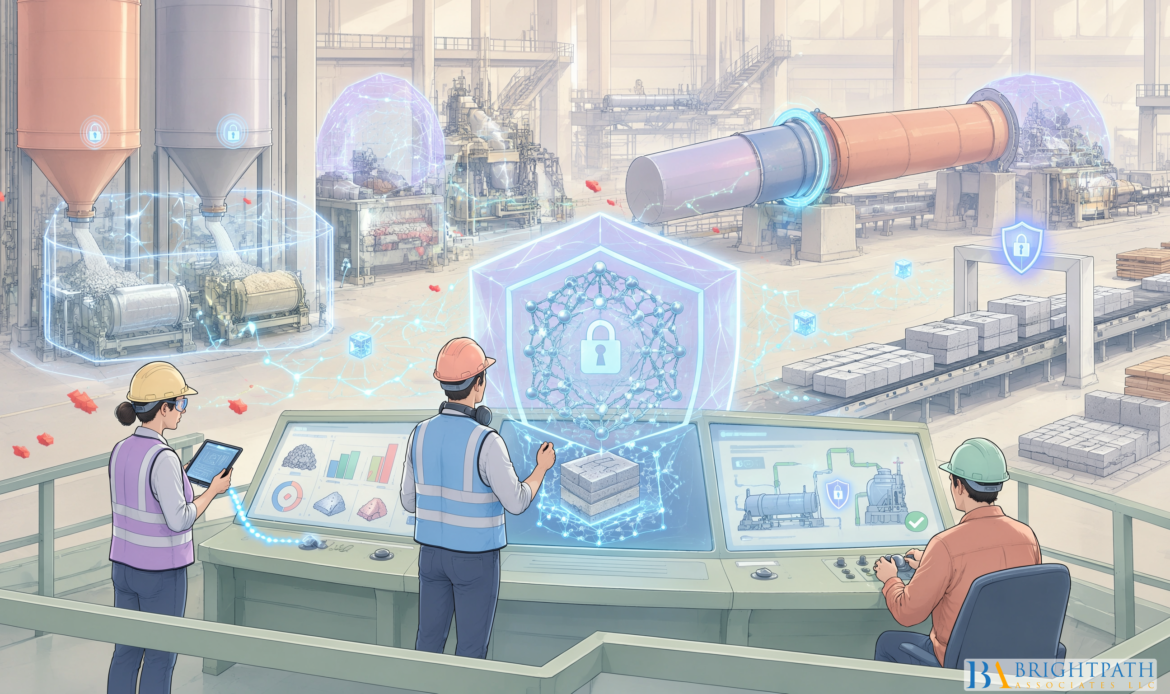
Cybersecurity for Construction Materials: Protecting Proprietary Production Data for Building Materials Industry is not only an IT concern. A #BuildingMaterials producer may hold mix designs, kiln settings, batch formulas, quality results, quarry data, maintenance records, customer specifications, and shipment data that directly affect product quality, margins, and customer trust.
For cement, concrete, asphalt, aggregates, steel, glass, insulation, lumber, and recycled-material businesses, the central question is practical: Can the organization protect sensitive production knowledge while keeping plants safe and operating? A data breach can expose proprietary information. A disruption to operational technology can halt batching, change process settings, delay dispatch, or complicate product traceability.
Table Of Contents
• Key Takeaways
• Classify The Data Before Selecting Controls
• Build Security Around Plant Operations
• Make Recovery And Leadership Accountability Operational
• Frequently Asked Questions
• Resources And Citations
Key Takeaways
• Proprietary production data is broader than a formula. It includes process settings, calibration records, lab results, supplier specifications, maintenance history, and customer project requirements.
• Plant cybersecurity must protect confidentiality, integrity, availability, and safety. These goals overlap, but they are not interchangeable.
• The most useful starting point is a combined asset and data-flow map showing how information moves among PLCs, HMIs, SCADA, historians, MES platforms, laboratories, ERP systems, logistics tools, cloud services, and vendors.
• Remote vendor access should be treated as a governed production-data privilege, not simply a VPN connection.
• Recovery is incomplete until the plant can validate recipes, calibration, batch records, quality evidence, and release decisions.
• Cybersecurity leadership requires cross-functional accountability. Plant leaders, OT engineers, IT, quality, procurement, legal, and HR each own part of the risk.
Classify The Data Before Selecting Controls
Treat Production Data As A Business Asset
A useful #SecurityProgram begins by answering a basic question: Which information would create operational, commercial, or legal harm if it were stolen, altered, unavailable, or unreliable?
Many companies start with a technical inventory of servers and endpoints. That is necessary, but it is incomplete. A materials producer should also classify the information those systems create and exchange.
| Production Data Category | Examples | Primary Business Risk | Practical Control Priority |
|---|---|---|---|
| Formulas And Recipes | Concrete mix designs, kiln recipes, asphalt blends, coatings, additives | Intellectual property loss or unauthorized replication | Restricted access, encryption, export controls, audit logs |
| Process Parameters | Temperatures, feed rates, curing cycles, mill settings, weighing tolerances | Quality failures, waste, safety concerns, process disruption | Integrity controls, change approval, historian protection |
| Quality And Traceability Records | Lab results, certificates, batch tickets, calibration records | Inability to prove compliance or release product confidently | Immutable backups, role-based access, retention rules |
| Commercial And Supplier Data | Customer specifications, pricing, supplier product data, quarry plans | Competitive harm, contract exposure, supply-chain disruption | Segmented access, data-loss controls, vendor governance |
| Maintenance And Engineering Files | PLC logic, HMI configurations, electrical drawings, equipment manuals | Longer outages and unauthorized equipment changes | Offline backups, least privilege, controlled repositories |
This classification changes decision-making. A proprietary concrete mix design needs strong access restrictions and controlled exports. A kiln control parameter needs a different emphasis: preventing unauthorized changes, confirming that commands are valid, and maintaining safe operation if systems become unavailable.
That distinction matters because a plant can survive a delayed report more easily than an altered batching sequence. It may also recover from a stolen document more easily than from a compromised HMI that changes an #OperatingSetpoint.
Map Data Flows, Not Just Devices
A PLC inventory does not show how a formula travels from a laboratory or ERP system into production. Executives need a data-flow map that identifies both the origin of important information and every system that receives it.
For example, a mix design may begin in a product-development database, move into an MES platform, reach a batching system, generate production records in a historian, then feed shipping documents and customer certificates. Each transfer creates a decision point: who can view it, modify it, export it, or approve it?
The map should cover at least these routes:
- Engineering workstation to PLC, HMI, SCADA, or distributed control system.
- Plant historian or MES platform to enterprise analytics, ERP, and cloud reporting tools.
- Laboratory information to quality release, certificates, and customer portals.
- Weighbridge, dispatch, fleet, and logistics data to billing and customer systems.
- Vendor remote-access connections to automation equipment and maintenance tools.
This exercise often exposes hidden dependencies. A dashboard may be consuming historian data through an unreviewed connection. A service account may allow a vendor tool to extract configuration files. A shared engineering drive may contain years of PLC backups without access review.
The business case is not abstract. Digital Transformation Drives Industrial Automation Growth helps frame why connected industrial systems require governance that keeps pace with operational connectivity.
Set Protection Tiers That Reflect Consequences
A four-tier model can help smaller and mid-sized producers avoid overengineering every record.
| Tier | Example | Access Standard | Recovery Expectation |
|---|---|---|---|
| Critical | Active PLC logic, batch recipes, safety-related configurations | Named users only, strong authentication, change approval | Restore quickly and validate before restart |
| Restricted | Proprietary formulas, quality data, engineering files | Role-based access and monitored export activity | Restore from tested backups |
| Internal | Production schedules, routine maintenance records | Business need access with periodic review | Restore through standard continuity procedures |
| General | Public product data and approved marketing materials | Normal business controls | Standard backup and retention practices |
The point is not to create paperwork. It is to ensure protection follows consequence. A plant should avoid giving broad file-share access to critical recipe libraries simply because the files are operationally convenient.
Build Security Around Plant Operations
Segment IT And OT With Purpose
#OperationalTechnology, or OT, includes the systems that monitor or control physical processes. In a materials plant, that can include PLCs, HMIs, SCADA platforms, batching controls, kiln controls, weigh systems, historians, and industrial networking equipment.
CISA advises organizations to segment IT and OT networks and use a demilitarized zone to reduce the effect of cyber incidents on essential OT operations. CISA’s OT segmentation guidance is particularly relevant where enterprise systems need plant data but should not have direct trust relationships with plant controls.
An industrial DMZ is not merely a firewall placed between two networks. It is a controlled exchange point. Instead of allowing an enterprise analytics tool to query a historian directly, the organization can use a brokered process that sends only approved data outward. That reduces the paths an attacker could use to move from an office environment into a production cell.
A sensible segmentation design generally separates:
• Corporate IT systems, including email, finance, HR, and standard user devices.
• Industrial DMZ services, such as approved data brokers, jump hosts, update repositories, and controlled remote-access tools.
• Plant supervisory systems, including SCADA, historians, engineering workstations, and MES components.
• Production cells, including PLCs, HMIs, weighing systems, and equipment controllers.
Segmentation should be adapted to actual production flows. A batch plant, for example, may need narrow and documented connections between mix management, batching, quality, and dispatch. A continuous-flow cement operation may require carefully engineered access to process historians and control networks without introducing delays or unstable communications.
Govern Vendor And Contractor Access
Equipment vendors and contractors can be essential to uptime. They may also need access to sensitive data, configurations, and production systems. The question is not whether to allow remote access. It is whether access is controlled tightly enough to support the work without creating an open-ended route into the plant.
A strong model uses time-bound access. The vendor requests access for a defined purpose, a plant owner approves it, access is granted only for the maintenance window, and the session is logged or recorded where feasible. Privileges should match the task. An OEM technician diagnosing a drive fault may not need the ability to export historian data or modify unrelated PLC logic.
This is also a procurement issue. Automation-system contracts should address account ownership, service-account use, notification of security vulnerabilities, support for multifactor authentication, data ownership, logging, incident notification, software lifecycle commitments, and access removal when the service relationship ends.
Where possible, require a software bill of materials for new production software and connected services. An SBOM does not make a system secure. It does help the organization identify components when a vulnerability affects a library, operating system, or application dependency.
Fair warning: vendor access controls can fail if they are so cumbersome that plant teams bypass them during an urgent outage. The answer is not weaker security. It is a fast, documented emergency approval process with named decision-makers.
Make Patching A Safety Decision, Not A Calendar Event
#LegacyPLCs, HMIs, and control applications often cannot be patched like office software. A patch may require shutdown time, validation, compatibility testing, or vendor support. Applying it without testing can create the very outage the organization is trying to prevent.
NIST’s manufacturing-sector material addresses the protection of information and system integrity in industrial control-system environments. NIST operational technology security publications provide a useful reference point for treating system integrity as an operational requirement rather than a routine desktop-maintenance task.
A practical patching decision should evaluate:
- Exploitability: Is the asset reachable from a less trusted network or exposed through remote access?
- Operational impact: Would failure affect a safety function, continuous process, batching line, dispatch system, or quality record?
- Compensating controls: Can segmentation, application allowlisting, restricted access, or monitoring reduce risk until a maintenance window?
- Testability: Is there a representative environment, vendor validation path, or rollback plan?
- Lifecycle status: Is the product supported, and if not, what replacement or isolation plan exists?
An unsupported HMI with direct remote access deserves immediate attention even if patching must wait. In contrast, a deeply isolated controller with no practical exposure may be managed first through compensating controls and a planned modernization budget. Neither choice should be made by IT or operations alone.
Protect Engineering And Quality Records From Quiet Loss
Many cyber events do not begin with a dramatic plant shutdown. They begin with an unauthorized export, a compromised email account, or a vendor credential that remains active after a project ends.
For proprietary data, use role-based access, separate administrator accounts, controlled file repositories, and logs that show downloads, configuration changes, and failed access attempts. Encrypt production databases and backups when technically appropriate, but do not assume encryption alone protects integrity. A trusted but compromised account can still change a recipe or delete a record.
This is where leadership roles become more demanding. Plant and #OperationsLeaders need enough cyber literacy to recognize risky workarounds. IT and security leaders need enough production context to understand why a five-minute interruption may carry material consequences. Recruitment for automation, OT security, quality, and manufacturing technology positions should test for this translation ability, not only product certifications.
Understanding the Current Landscape of Defense Cybersecurity offers a related perspective on protecting sensitive systems where continuity, access control, and proprietary information intersect.
Make Recovery And Leadership Accountability Operational
Recover Production And Traceability Together
A ransomware response that restores servers but cannot validate batch data is not a complete recovery. Before releasing product or restarting normal shipments, the business may need confidence in recipe versions, calibration status, laboratory results, weighbridge records, customer specifications, and product-release decisions.
A recovery sequence should be documented before an incident:
- Isolate affected systems while preserving evidence and protecting safety functions.
- Shift to approved manual or reduced-capability operation only when safe procedures permit it.
- Restore critical configurations from known-good backups, starting with the systems required for safe control.
- Validate PLC logic, HMI displays, recipe versions, calibration records, and communication paths.
- Reconcile production, laboratory, inventory, and dispatch records before product release.
- Review vendor accounts, service credentials, and temporary access before reconnecting systems.
Manual operation deserves practical testing. CISA recommends maintaining manual-operation capability and routinely testing continuity, recovery, fail-safe, and standby mechanisms. For a batch operation, that could involve a controlled exercise for manual batching, weighing, ticketing, and quality verification. For a continuous process, it may involve confirming safe fallback steps, communication protocols, and decision authority without attempting unsafe process changes.
The right test is not a theatrical drill. It should answer: Can qualified people operate safely, document what occurred, and recover traceability afterward?
Measure What Executives Need To Know
Cybersecurity reporting often becomes too technical for senior leaders or too vague to guide investment. A concise dashboard should connect security conditions to production risk.
| Executive Metric | Why It Matters | Warning Sign |
|---|---|---|
| OT assets inventoried | Shows whether the organization knows what it must protect | Unknown devices or unmanaged remote connections |
| Critical systems with tested backups | Indicates recoverability of configurations and records | Backups exist but restoration has not been validated |
| Vendor access revoked on time | Measures third-party access discipline | Former vendors retain active accounts |
| Critical vulnerabilities with compensating controls | Shows whether legacy risk is actively managed | Unsupported systems remain broadly reachable |
| Tested recovery time | Connects planning to actual operational resilience | Recovery estimates have never been exercised |
| Production-data recovery validation | Protects quality and traceability after restoration | Systems return, but batch or quality records cannot be trusted |
These measures also clarify leadership needs. A company expanding automation, sustainable construction products, material recycling operations, or connected supply-chain systems may need leaders who can coordinate production, engineering, quality, data governance, and cybersecurity decisions.
That does not mean every #BuildingSupplies company needs a large internal cyber team. It does mean executive roles should have clear accountability. In some organizations, this belongs to a COO with strong plant governance. In others, it may require a manufacturing technology leader, an OT security manager, or a CIO who has authority to work across business and production functions.
Advanced Composite Materials for Stronger Efficient Construction illustrates why innovation in construction materials can increase the value of the underlying product and process knowledge that companies need to protect.
Build The Right Cross-Functional Response Team
A capable response structure should include people who can make decisions under production pressure.
• Operations leadership decides what can safely continue, slow, or stop.
• OT and engineering teams validate control systems, configurations, and process constraints.
• IT and cybersecurity teams contain the event, preserve evidence, and restore digital services.
• Quality leadership verifies product status, records, and release decisions.
• Procurement and vendor management coordinate OEM and contractor access.
• Legal, HR, and communications leaders manage reporting, workforce communication, and contractual obligations.
From an executive-search perspective, the hiring implication is straightforward: titles alone reveal little. A candidate may have deep enterprise security experience but limited ability to make safe decisions around control systems. Another may understand plant automation but lack the governance skills required to manage vendors, data rights, and enterprise risk. The search process should define the operating context before evaluating resumes.
Frequently Asked Questions
What Proprietary Production Data Should Building Materials Manufacturers Protect?
Protect formulas, mix designs, process parameters, quality-control data, calibration records, PLC and HMI configurations, engineering files, supplier specifications, quarry or geology data, maintenance history, production schedules, and customer project requirements. Prioritize information based on the harm caused by theft, alteration, or loss.
How Is Plant Cybersecurity Different From Ordinary Office IT Security?
Office IT security mainly protects business systems and information. Plant cybersecurity must also protect physical processes. A compromised office device may disrupt communication. A compromised control system may affect batching, weighing, kiln operations, quality, equipment availability, or worker safety.
Should Legacy PLCs And HMIs Be Patched Immediately?
Not automatically. Patching should follow a risk review that considers exposure, vendor support, safety impact, testing capability, and rollback options. If patching cannot occur safely, isolate the asset, reduce remote access, monitor it, and establish a replacement or #ModernizationPlan.
What Is The Safest Way To Give Equipment Vendors Remote Access?
Use approved, time-bound access through a controlled remote-access path. Require strong authentication, define the work scope, assign least privilege, log sessions where feasible, and remove access after the maintenance window. Avoid shared credentials and permanent accounts that remain active without review.
What Backups Are Needed To Restore A Materials Plant?
Back up more than servers. Include PLC logic, HMI and SCADA configurations, historian databases, MES data, recipe libraries, engineering workstations, calibration records, lab data, weighbridge records, and approved operating procedures. Test restoration and confirm the recovered records can support product traceability.
How Can A Plant Test Manual Operation Without Creating Quality Or Safety Risks?
Use controlled exercises designed by operations, engineering, safety, and quality leaders. Test only approved fallback procedures, establish stop conditions, document every manual action, and reconcile the resulting production and quality records. Do not improvise manual operation during a test.
Does A Building Materials Company Need An SBOM?
An SBOM can be valuable when buying or operating connected production software, cloud services, HMI applications, MES tools, or vendor maintenance platforms. It helps identify software components affected by known vulnerabilities. It is most useful when the company also has a process to review and act on the information.
Resources And Citations
• cisa.gov — https://www.cisa.gov/resources-tools/resources/primary-mitigations-reduce-cyber-threats-operational-technology
• csrc.nist.gov — https://csrc.nist.gov/Projects/operational-technology-security/publications
• BrightPath Associates industry resource: Digital Transformation Drives Industrial Automation Growth
Find your next leadership role in Building Material Industry today!
Stay informed with the latest insights on Building Material Industry!