
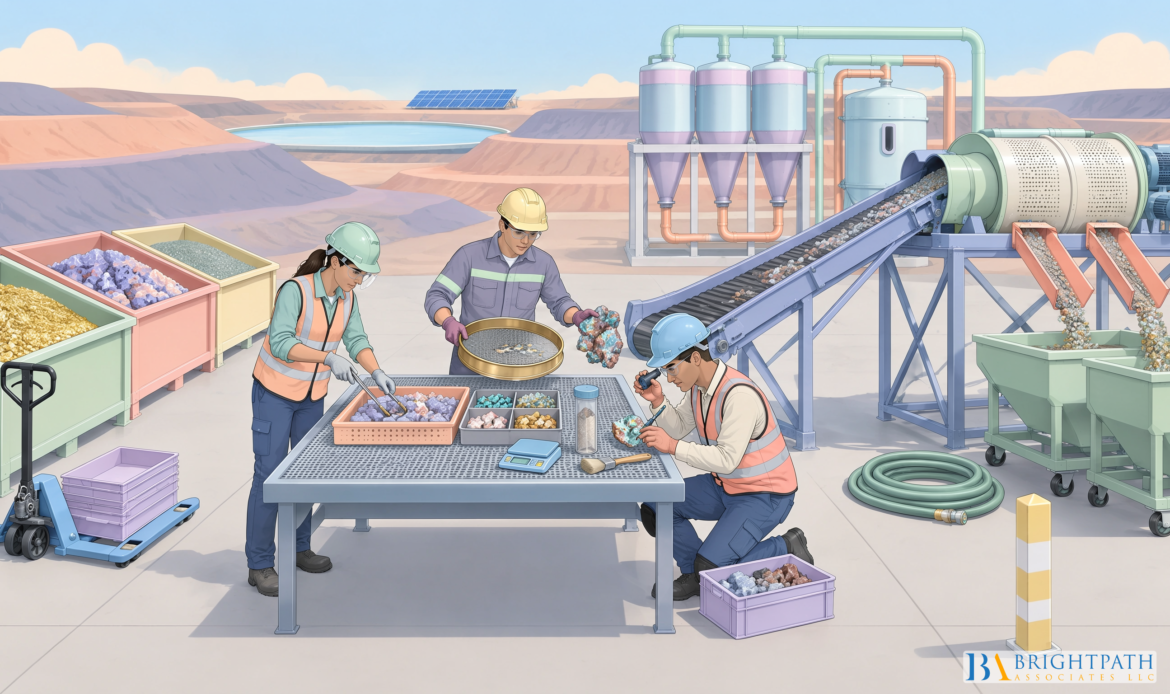
Secondary Sourcing: Unlocking Revenue in #MineTailingsReprocessing for metal and mining industry begins with a hard commercial truth: a tailings facility is not automatically an asset just because it contains metal. It may contain a recoverable resource, an expensive environmental liability, or both. The difference depends on representative sampling, mineralogy, recovery performance, product quality, water, permitting, and execution leadership.
For mining leaders, tailings reprocessing is no longer only a metallurgy question. It is a capital-allocation decision that connects sustainable mining, mineral extraction, project development, environmental management, and executive capability. A weak feasibility process can convert an apparent secondary source of metals into a costly processing experiment. A disciplined one can create a new revenue stream while improving closure outcomes.
Table Of Contents
• Key Takeaways
• Start With Revenue, Not Contained Metal
• Build Bankability Through Sampling, Testwork, And Market Qualification
• Treat Water, Residue, And Closure As Commercial Variables
• FAQ: Mine Tailings Reprocessing
• Resources And Citations
Key Takeaways
• Tailings are secondary raw materials, not guaranteed reserves. A resource estimate can establish potential inventory, but it does not prove recovery, saleable product quality, permits, or profitability.
• Revenue begins after recovery and commercial deductions. Contained metal must be adjusted for metallurgical recovery, concentrate quality, payability, treatment and refining charges, penalties, logistics, royalties, sustaining capital, closure, and tax.
• Sampling is often the first decisive risk. Historic tailings can vary by depth, location, particle size, deposition period, and process history. A limited sample can materially overstate value.
• Technology must follow mineralogy. Regrinding, flotation, gravity separation, leaching, hydrometallurgy, and bioleaching solve different problems. No flowsheet should be selected by metal name alone.
• Leadership matters as much as process design. A retreatment project needs integrated judgment across metallurgy, geotechnics, water, permitting, commercial strategy, capital delivery, and workforce planning.
Start With Revenue, Not Contained Metal
Secondary Sourcing Is A Commercial Question
#MineTailings are finely ground residues left after mineral processing. They can retain valuable minerals because historic processing lacked modern recovery methods, feed changed over time, liberation was incomplete, or the original operation optimized for a different commodity. Academic research recognizes that tailings can serve as secondary raw materials and alternative sources of critical metals, particularly where conventional supply routes are constrained.
That proposition deserves scrutiny. A copper, zinc, gold, lithium, or rare earth assay tells decision makers only what may be present. It does not show whether metal can be separated economically, delivered in a buyer acceptable form, or produced under permit conditions.
A practical screen starts with four questions:
- Is there enough tonnage at a representative grade to support a meaningful operating life?
- Is the valuable mineral liberated, or can it be liberated at reasonable energy and reagent cost?
- Can the process create a product that meets customer specifications?
- Does the resulting cash flow exceed capital, operating, closure, and risk costs?
The first question is geological. The second is metallurgical. The third is commercial. The fourth is an investment decision. Projects fail when these questions are handled in separate workstreams and only reconciled after plant design is underway.
The Revenue Waterfall That Executives Should Demand
Contained metal is the top of the waterfall, not the bottom. Consider a simplified gold or base metal retreatment calculation:
| Revenue Stage | What It Measures | Common Source Of Error |
|---|---|---|
| Contained metal | Tonnes multiplied by grade | Treating an average assay as representative of all tailings |
| Recovered metal | Contained metal multiplied by plant recovery | Using a single laboratory result as a life of mine recovery assumption |
| Saleable product | Recovered metal converted into doré, concentrate, or intermediate product | Ignoring moisture, handling losses, and product specifications |
| Payable metal | Buyer recognized metal after contract terms | Assuming 100% payability for concentrate |
| Net revenue | Payable metal less charges, penalties, and transport | Excluding treatment charges, refining charges, impurity penalties, and logistics |
| Cash flow | Net revenue less operating, capital, closure, royalty, and tax costs | Double counting avoided closure costs as revenue |
The logic is simple but often neglected. If a deposit contains 100 units of metal, a project may recover only a portion. Of that recovered portion, a buyer may pay for less than 100% after contractual deductions. Processing, power, water, transport, and sustaining capital then determine whether any margin remains.
A practitioner discussion of tailings economics makes the same caution in plain terms: grade multiplied by tonnage and price gives only a theoretical maximum before recovery, milling, shipping, and other costs. That is not a bankable valuation method, but it is a useful warning against inflated early estimates.
Aurelia Metals provides a concrete example of how recovery changes value. Its New Occidental tailings project reported 2.6 million tonnes grading 0.65 grams per tonne gold. Testwork recommended 63.3% recovery, while the financial model used 60%. That difference may look modest, yet across a multi year operation it changes saleable ounces and cash flow materially. The same project modeled approximately 32,000 saleable ounces over 10 years, rather than assuming all contained gold would be recovered.
Existing Infrastructure Is Valuable, But Not Free
Existing roads, power, water systems, laboratories, maintenance facilities, concentrators, and permits can improve a project’s capital profile. Sedgman notes that tailings retreatment viability remains highly dependent on mineralogy, logistics, water balance, market conditions, available infrastructure, and environmental liabilities. Its assessment of site specific tailings rescue economics and rehabilitation potential is a useful reminder that infrastructure only helps when it is technically suitable and available.
An idle concentrator may need major upgrades. A pipeline may be undersized. Existing power may not support regrinding. A water licence may not cover a new processing route. These constraints should be converted into schedule and capital assumptions, not described as general advantages.
For leaders evaluating industrial residues beyond tailings, the same discipline applies to industrial byproducts and growth opportunities: material value emerges only when processing, logistics, buyers, and #ComplianceAlign.
Build Bankability Through Sampling, Testwork, And Market Qualification
Representative Sampling Is The First Investment Decision
Tailings are rarely uniform. Changes in ore feed, plant recoveries, reagent regimes, cyclone performance, deposition methods, and weathering can produce wide variation across a facility. Fine particles may settle differently from coarse particles. Older beach zones may differ from central pond zones. Oxidized upper material may not behave like deeper sulfide material.
This is why a small group of high grade samples can mislead a board. The appropriate program usually requires spatial and vertical coverage, density measurement, moisture management, geological logging, assay quality control, and a clear model of historical deposition. Drilling alone is not enough if core handling or sample preparation loses fines, contaminates intervals, or fails to preserve material for metallurgical testwork.
A sensible sequence is:
- Reconstruct the tailings facility history, including ore sources, process changes, deposition periods, and known disturbances.
- Develop a sampling plan that represents lateral, vertical, particle size, and age related variability.
- Complete mineralogical and liberation analysis before committing to a recovery route.
- Test variability composites, not only a high grade master composite.
- Advance promising material through bench, pilot, and where justified, demonstration scale work.
- Update the resource model, flowsheet, water balance, and financial model together.
This work affects hiring as well. Mining executive search for retreatment projects should not focus only on executives with conventional open pit or underground production backgrounds. The leadership team needs people who can interpret uncertain data, challenge optimistic recovery assumptions, and coordinate specialists before capital is committed.
Metallurgy Must Follow The Material, Not The Commodity Label
“Copper tailings” is not a sufficient processing description. Sulfide copper minerals may respond to regrinding and flotation if valuable minerals remain locked in composite particles. Oxide copper material may require a leach based approach. Gold may respond to grinding followed by leaching, while refractory gold can require more complex pretreatment. Some critical metal opportunities may require hydrometallurgy or emerging microbial approaches rather than a conventional concentrator.
The correct route depends on mineral association, liberation size, oxidation, clays, sulfide content, deleterious elements, and water chemistry. Regrinding may increase recovery, but it also raises power demand, wear, and dewatering requirements. Leaching may improve extraction but create reagent, residue, and permitting complexity. Flotation can create a valuable concentrate, yet its economics may collapse if arsenic, mercury, fluorine, or other impurities cause penalties or buyer rejection.
Technology choices increasingly require data capability as well as metallurgical expertise. Process models, ore characterization databases, sensor data, and predictive maintenance can improve decisions when they are based on reliable inputs. Leaders considering AI implementation in mining should treat it as an operating tool, not a substitute for representative samples and pilot results.
Product Qualification Can Stop A Good Flowsheet
A concentrate is not automatically a marketable product. Buyers may impose minimum volume requirements, moisture limits, impurity thresholds, blending rules, payment terms, and treatment charges. A technically successful pilot may therefore have no acceptable commercial route.
#MarketQualification should begin before final plant design. Send representative product samples, obtain preliminary feedback from potential buyers, understand likely payable terms, and test whether product quality remains stable across tailings domains. If a concentrate is only saleable when blended with another product, that blending source must be reliable for the full operating life.
Future Element reported that one zinc tailings operation had reprocessed about 35 million tonnes and produced roughly 1.0 million tonnes of zinc concentrate by December 2023. The company also reported about US$830 million in concentrate revenue and approximately US$135 million in operational cash flow. Those figures, presented in Future Element’s circular metals industry presentation, demonstrate potential operating scale, but company reported results should not be used as a universal benchmark. Feed quality, product terms, metal pricing, infrastructure, and local costs differ sharply by site.
Treat Water, Residue, And Closure As Commercial Variables
Water Balance Sets Throughput And Cost
Water can determine whether a project processes 500,000 tonnes per year or stalls below plan. A thickened tailings stream needs water for hydraulic mining, slurry transport, grinding, flotation, leaching, and cleaning. Water then needs to be recovered, recycled, treated, stored, or discharged under permit conditions.
A water shortfall can reduce throughput. Excess water can require larger ponds, pumping, treatment, and dewatering capacity. High salinity or dissolved contaminants can increase reagent consumption or reduce flotation performance. These are revenue issues because they affect recoveries, plant availability, operating cost, and schedule.
The same principle applies to residue. Recovering metal from legacy tailings creates a new residue stream that must be placed, stabilized, monitored, and eventually closed. If the new residue has different geochemical behaviour or moisture characteristics, existing storage assumptions may no longer apply.
Reprocessing Versus Closure Requires A Counterfactual
Retreatment can reduce the volume or risk profile of stored material, support progressive rehabilitation, and defer or avoid some closure obligations. But avoided closure cost is not operating revenue. It is a potential economic benefit that must be compared against the closure plan that would apply if no processing occurred.
Executives should model at least three credible options:
| Option | When It May Fit | Principal Risk |
|---|---|---|
| Reprocess tailings | Recoverable metal, viable product route, manageable residue plan | Recovery or product value does not support capital and operating costs |
| Cap and close in place | Low recovery potential or high processing complexity | Long term monitoring and residual liability remain |
| Relocate or reengineer storage | Material is unstable or closure standards require major intervention | High earthworks, permitting, and community impact costs |
The decision is not simply “mine again” or “do nothing.” In some cases, capping and monitored closure may create a better risk adjusted outcome than building a retreatment plant. In others, revenue from metal recovery can fund rehabilitation that would otherwise compete with operating capital.
Leadership And Talent Risks Are Often Underestimated
#TailingsReprocessing changes what mining leadership teams must manage. The most capable project executive may need to integrate plant optimization, hydrogeology, geotechnical safety, environmental approvals, commercial offtake, community engagement, and capital discipline at once. That combination is scarce, especially for smaller operators that cannot carry large internal technical teams.
A prolonged vacancy in metallurgy, processing, project controls, environmental leadership, or operations can delay testwork decisions and increase the chance that assumptions go unchallenged. The business risk is not merely a slower hiring process. It is an investment model built on weak evidence.
For that reason, leadership assessment should test more than title history. It should examine whether candidates have handled variable feed, complex water circuits, concentrate marketing constraints, staged project development, and cross functional decision making. Technical depth matters, but so does the ability to stop a poor assumption before it becomes expensive. Companies using advanced drilling technology in mining face a related requirement: technical information only creates value when leaders can translate it into better resource, engineering, and capital decisions.
FAQ: Mine Tailings Reprocessing
What Is Secondary Sourcing From Mine Tailings?
Secondary sourcing means recovering metals from existing materials rather than extracting new ore. In this case, stored tailings become a potential feed source for mineral extraction. Their value depends on recoverable metal, not simply metal contained in assays.
Which Metals Are Most Commonly Recovered From Tailings?
Gold, copper, zinc, lead, silver, iron, and some critical metals may be recoverable, depending on the original ore and processing history. The metal name alone does not determine viability. Mineralogy and product marketability do.
How Do We Know Whether Tailings Are Economically Viable?
Start with representative sampling and a resource model. Then test metallurgy across major tailings domains, define a saleable product, estimate capital and operating costs, assess permits and water, and run sensitivities for recovery, price, throughput, and schedule delays.
Why Is A Tailings Resource Not The Same As A Reserve?
A resource estimates potentially material bearing tonnage. A reserve requires stronger evidence that material can be mined or processed economically under defined assumptions. For tailings, those assumptions include recovery, product quality, infrastructure, permitting, residue management, and market terms.
What Is The Biggest Sampling Risk In Historic Tailings?
The biggest risk is assuming a small sample represents the entire facility. Grade and mineral behaviour can change by depth, location, deposition period, and particle size. Variability testing is essential before using an average grade in a #FinancialModel.
Can An Existing Processing Plant Reduce Project Cost?
Yes, but only if the plant can handle the tailings’ mineralogy, moisture, throughput, water chemistry, and residue requirements. Existing infrastructure may reduce capital cost, but upgrades, downtime, power constraints, and permitting changes can offset that advantage.
Is Tailings Reprocessing Always More Sustainable Than New Mining?
No. It can reduce stored tailings and create value from existing material, but it may also require water, energy, reagents, new residue storage, and permits. The environmental case must be evaluated against the realistic closure alternative, not assumed.
Resources And Citations
• Springer linked academic chapter, Recovery of Critical Metals from Mine Tailings: https://ideas.repec.org/h/spr/prbchp/978-3-031-47925-0_24.html
• Sedgman, Circular Solutions for the Energy Transition: Tailings Rescue: https://www.sedgman.com/technical-publications/circular-solutions-for-the-energy-transition-tailings-rescue
• Future Element, Leading the transition to a circular metals industry: https://futureelement.com/content/uploads/2023/09/2023_09-Future-Element-External-Presentation.pdf
• BrightPath Associates, Industrial Byproducts Create New Growth Opportunities: https://brightpathassociates.com/industrial-byproducts-create-new-growth-opportunities/
https://www.ifri.org/sites/default/files/migrated_files/documents/atoms/files/ifri_deberdt_us_minerals_supplies_2024.pdf
Find your next leadership role in Mining & Metals Industry today!
Stay informed with the latest insights on Mining & Metals Industry!
Discover more about our staffing and recruitment solutions!