
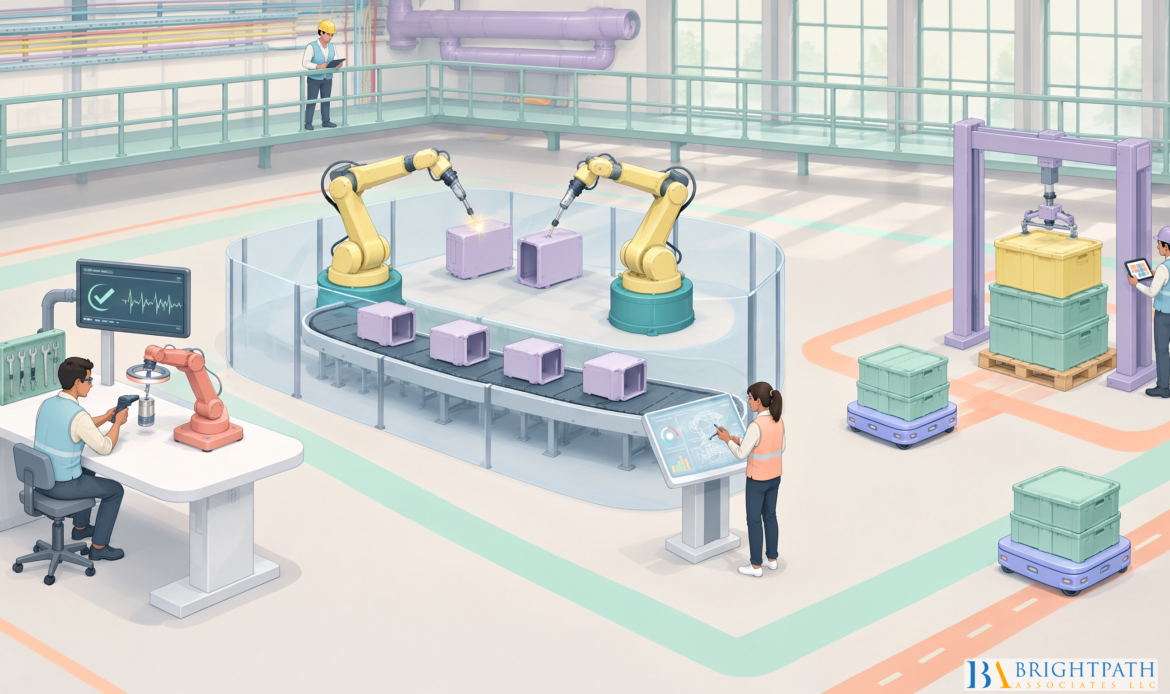
#AutomatingDirty, Dangerous, and Dull: A Strategic Workforce Roadmap for plastic industry is not mainly a robotics purchasing decision. It is a workforce, safety, quality, and operating-model decision. A robot may remove a repetitive task from an injection molding press, extrusion line, or packaging station. But the business value depends on what replaces that task, who owns recovery work, and whether the new cell performs reliably through real production variation.
For plastics manufacturers, the strongest starting point is often not “Where can we add a robot?” It is “Where are people absorbing preventable risk, inconsistency, and staffing pressure?” That question leads to better investment choices and a more credible transition plan for employees.
Table of Contents
- Prioritize The Work Before Selecting Technology
- Design The Cell Around Production Reality
- Build A Workforce Transition, Not A Headcount Plan
- Pilot, Validate, And Scale With Clear Gates
- Key Takeaways
- FAQ
- Resources And Citations
Prioritize The Work Before Selecting Technology
Dirty, dangerous, and dull work in plastics commonly includes hot-part handling, repetitive sprue removal, deep-bin picking, trimming, stacking, palletizing, machine tending, inspection, and packaging. The label is useful, but it is not a sufficient investment case. Not every unpleasant task is technically stable enough to automate, and not every technically feasible cell will produce meaningful business value.
Plastics manufacturers already use robotics for injection molding, part extraction, insert loading, and assembly when repeatability and exposure reduction matter, as outlined in NetSuite’s overview of robotics uses in plastics manufacturing. The executive question is which task should go first.
Use A Six Factor Prioritization Model
We recommend scoring candidate tasks against six factors before requesting automation proposals. The goal is not false precision. It is to expose tradeoffs early, before a plant commits to a system designed around the wrong problem.
| Decision Factor | What To Evaluate | Strong Automation Signal | Caution Signal |
|---|---|---|---|
| Exposure severity | Heat, sharp edges, lifting, repetitive motion, chemical contact | Frequent exposure with limited practical manual controls | Risk occurs rarely or can be removed through a simple process fix |
| Cycle repetition | Number of repeated movements and pace | Stable, high frequency cycle | Unpredictable or highly variable task sequence |
| Process variability | Part position, warpage, flash, resin changes, presentation | Consistent dimensions and orientation | Frequent variation from tooling, recycled feedstock, or handling |
| Quality impact | Defects, contamination, inconsistent placement | Manual variation affects yield or customer requirements | Quality issue originates upstream in molding or tooling |
| Staffing difficulty | Overtime, vacancy pressure, turnover, task avoidance | Work is difficult to cover consistently | Adequate staffing and low operational impact |
| Integration complexity | Machine interface, tooling, safety controls, floor space | Clear machine signals and accessible work envelope | Uncertain controls access or major facility modifications |
A task with high ergonomic exposure, a stable cycle, and repeated staffing gaps is usually a better pilot than a task chosen solely because it looks easy to automate. For example, removing hot molded parts may be attractive because it reduces exposure. Yet if the part routinely warps, sticks in the mold, or arrives in inconsistent orientations, the cell may require specialized end of arm tooling, sensors, machine vision, and recovery procedures. The real investment is the integrated production cell, not the arm alone.
Separate Ergonomic Success From Business Success
A cell can reduce lifting and repetition yet still miss its capacity, quality, or uptime target. These outcomes should be measured separately.
A peer reviewed review in Human Factors and Ergonomics in Manufacturing found that plastics related automation cases reported lower musculoskeletal risk factors and improved productivity in most reviewed cases. The evidence supports both goals, not the assumption that one automatically proves the other. See the full peer reviewed review of automation as a health and safety intervention and the study abstract and publication record.
That distinction changes executive reporting. A pilot dashboard should track ergonomic exposure, first pass quality, unplanned stops, cycle performance, changeover time, labor redeployment, and maintenance demand. A safety win matters. So does a cell that can run predictably through the #ProductionSchedule.
Design The Cell Around Production Reality
The most common planning error is choosing a robot type before defining the operating constraints. The choice between a cobot and a conventional industrial robot should follow the task, cycle, payload, reach, foreseeable human contact, and safeguarding requirements.
Choose Cobots And Industrial Robots For Different Conditions
| Cell Requirement | Collaborative Robot May Fit | Conventional Industrial Robot May Fit Better |
|---|---|---|
| Production volume | Lower volume, frequent redeployment, changing secondary work | Sustained production with stable demand |
| Speed requirement | Moderate pace with planned human interaction | High speed or tightly constrained cycle time |
| Workspace | Limited footprint and shared work area | Dedicated, guarded cell is available |
| Payload and reach | Lighter tooling and parts within rated limits | Heavy parts, large tools, long reach, or high inertia |
| Task complexity | Flexible packing, labeling, inspection, light tending | Fast extraction, palletizing, high output handling |
| Safety approach | Risk assessed shared space with defined operating conditions | Fixed safeguarding, interlocks, and restricted access |
A cobot is not automatically safe because it is collaborative. End of arm tooling, sharp sprues, hot parts, dropped parts, pinch points, conveyors, presses, and machine interfaces can create hazards that exceed what a shared workspace can reasonably manage. Application specific risk assessment must determine safeguarding, safety rated controls, access limits, emergency stops, safe speeds, and restart rules.
Automation solutions for plastics may cover injection molding, machining, machine tending, parts handling, and palletizing, as described by FANUC’s plastics automation application overview. That breadth is useful, but the same technology can behave very differently across plants because resin, mold condition, part geometry, and downstream handling vary.
Treat Variability As A Design Input
Plastics processing creates several forms of variability that executives should test before approving a cell:
• Part warpage that changes gripping surfaces or presentation
• Flash that affects cutting, inspection, or placement
• Resin and color changes that alter surface appearance or handling behavior
• Recycled feedstock variation that can affect process consistency
• Tool wear, mold release issues, or part ejection problems
• Mixed packaging, box, or pallet conditions downstream
#MachineVision may help when the robot must identify orientation, inspect features, verify inserts, or recognize a misplaced part. It is not a cure for an unstable upstream process. If a camera repeatedly finds warped parts or missing features, management should determine whether the underlying cause is molding, tooling, material control, or handling. Automating a bad process simply makes its failure faster and more visible.
For broader manufacturing context, Manufacturing Process Automation explains why process mapping should come before technology selection.
Count The Whole Cost Of Ownership
Robot purchase price is only one line in the business case. A credible total cost of ownership model includes integration engineering, end of arm tooling, guarding, controls, vision, electrical work, floor changes, programming, training, validation, spare parts, preventive maintenance, planned downtime, and expected changeover effort.
There is no universal payback period that can be responsibly applied across plastics plants. A high volume molding cell with stable parts and recurring overtime may produce a different result from a low volume operation with frequent molds and resin changes. Executives should model at least three cases: expected production conditions, lower utilization, and higher variability or downtime. If the project only works under ideal uptime and full labor elimination assumptions, it is not ready for approval.
Build A Workforce Transition, Not A Headcount Plan
Automation changes jobs most successfully when the workforce design is explicit. The objective is not simply to remove people from a station. It is to create clear roles that keep the cell safe, productive, and adaptable.
Define The New Work Before Go Live
When machine tending or packing is automated, employees may move into roles such as:
• Cell operator who verifies startup conditions, monitors output, and escalates abnormalities
• Setup technician who manages tooling, material changes, fixtures, and changeovers
• Quality technician who validates first articles, investigates defects, and manages inspection trends
• Maintenance technician who handles preventive maintenance, sensors, calibration, and controlled repairs
• Automation support specialist who documents recovery logic, updates programs through approved controls, and improves uptime
• Production lead who coordinates schedules, staffing, safety checks, and cross functional problem solving
The role design matters because fault recovery can recreate the risk that automation was intended to remove. A robot jam, dropped part, sensor fault, or lost calibration is not just a maintenance issue. It is a human factors issue. Operators need written boundaries for what they can clear, what requires lockout or other approved energy control, and when a trained technician must take over.
Build Skills In Levels
Training should follow job responsibilities rather than offering one generic robotics class. A practical pathway has three levels.
- Awareness and safe operation: Operators understand cell purpose, normal indicators, stop functions, escalation rules, and prohibited actions.
- Qualified recovery and changeover: Designated employees learn approved recovery steps, tooling checks, material change procedures, and restart verification.
- Technical maintenance and improvement: Maintenance and engineering personnel learn diagnostics, calibration, preventive maintenance, backup controls, and controlled program changes.
This approach protects production continuity. It also gives employees a visible path into more technical work rather than implying that automation is a one way reduction in opportunity.
A documented plastics case discussed by EU OSHA found that a cobot used for monotonous sample preparation reduced physical demand and contamination risk while allowing employees more time for challenging work. The practical lesson is not that every cobot will produce the same outcome. It is that quality and process integrity should sit beside labor and safety in the decision model.
#ExecutivesPlanning these changes may also find useful parallels in Smart Factory Implementation in the Chemical Industry, particularly around controls, safety discipline, and workforce readiness.
Pilot, Validate, And Scale With Clear Gates
A small pilot should prove a repeatable operating model, not merely demonstrate that a robot can move a part during a controlled demonstration. The pilot should include normal production variation, real operators, shift handoffs, planned changeovers, and realistic fault conditions.
Assign Safety And Operating Ownership
The employer retains responsibility for providing a safe workplace and for operating the cell safely. But successful deployment requires defined responsibilities across several parties.
| Party | Primary Responsibilities |
|---|---|
| Employer leadership | Investment approval, staffing plan, safety governance, performance review |
| EHS team | Risk assessment participation, safeguards review, training requirements, incident learning |
| Integrator | Cell design, controls integration, documentation, validation support, handoff materials |
| Machine builder or OEM | Machine interface information, operating limits, approved integration requirements |
| Maintenance team | Preventive maintenance, controlled repair, backups, spare parts readiness |
| Operators and production leads | Daily checks, safe operation, issue escalation, recovery within authorization limits |
No party should assume another party owns the entire risk. The machine, robot, gripper, sensors, guarding, conveyor, and operator interface work as one system. Commissioning should not close until the complete system has been assessed and employees can perform normal and abnormal tasks safely.
Use Four Gates Before Scaling
- Task confirmation: Verify the task’s exposure, staffing pressure, variability, and quality impact with direct production data.
- Design validation: Test gripping, cycle behavior, safety functions, part variation, and recovery procedures before production launch.
- Operational qualification: Confirm trained operators can run the cell, complete approved recovery steps, and escalate correctly across shifts.
- Scale decision: Expand only after the pilot meets defined safety, quality, uptime, and workforce #RedeploymentMeasures.
Fair warning: a pilot can be safe and still not be scalable. A cell that needs an integrator on site after every material change may be useful for one station but unsuitable for a multi cell rollout. Leaders should ask whether knowledge has transferred to the plant team and whether documentation is strong enough to support second and third shift operations.
Lessons from regulated manufacturing can also be relevant when quality verification is central. Automation Advancements in Medical Device Manufacturing offers a useful reference point for thinking about validation, consistency, and traceability.
Key Takeaways
• Prioritize tasks using exposure, repetition, variability, quality effect, staffing difficulty, and integration complexity.
• Select cobots or conventional industrial robots based on measurable operating constraints, not marketing labels.
• Evaluate safety, ergonomics, quality, capacity, and labor redeployment as separate outcomes.
• Build fault recovery, maintenance, and changeover responsibilities into the workforce plan before launch.
• Model total cost of ownership across integration, tooling, training, downtime, maintenance, and changeovers.
• Scale only after a pilot proves safe operation under normal production variability, not just during a demonstration.
FAQ
What Plastics Tasks Should Be Automated First?
Start with tasks that combine frequent ergonomic exposure, stable repetition, staffing difficulty, and a clear impact on quality or throughput. Hot part handling, repetitive packing, palletizing, predictable machine tending, and certain inspection tasks may qualify. Avoid starting with a process that has unresolved molding instability, frequent part variation, or unclear machine interfaces.
Are Cobots Or Industrial Robots Better For Injection Molding?
Neither is universally better. Cobots may suit flexible, lower volume, shared workspace applications when the risk assessment supports that design. Conventional industrial robots may be more suitable where cycle time, payload, reach, speed, or dedicated guarding are required. The gripper, press interface, and safety controls often matter as much as the robot category.
Can Robots Safely Handle Hot Parts And Sharp Sprues?
They can be designed for these tasks, but safe handling depends on the complete cell. Tooling must tolerate temperature and securely grip the part. Safeguards must account for sharp components, dropped parts, pinch points, and access during jams. A collaborative robot does not remove the need for a formal application specific risk assessment.
How Should A Plant Calculate Payback When Labor Is Redeployed?
Use labor redeployment as one benefit, not the only benefit. Include avoided overtime, reduced staffing disruption, improved output consistency, quality gains, lower ergonomic exposure, and possible capacity improvement. Then include all lifecycle costs. If employees move to setup, inspection, or other work that supports production, that value should be visible in the model rather than treated as a failed #LaborSaving.
What Training Do Operators Need After Automation Is Added?
Every affected employee needs safe operating awareness. Designated operators need training for authorized recovery and changeover steps. Maintenance and engineering staff need deeper capability in diagnostics, calibration, preventive maintenance, controlled programming, and backups. Training should be tied to demonstrated competence and documented responsibilities.
When Should Machine Vision Be Added To A Plastics Cell?
Add machine vision when the cell must verify orientation, detect missing inserts, locate variable parts, inspect defined features, or confirm placement. Do not add it simply because the upstream process is unstable. If warpage, flash, or ejection variation is frequent, investigate and control the source before expecting vision to compensate.
What Happens If A Robot Jams Or Drops A Part?
The cell should enter a defined safe state, and the response should follow approved recovery instructions. Operators should not reach into a cell or bypass safeguards to restore production. The recovery plan needs clear escalation points, energy control requirements, inspection steps before restart, and documentation of recurring faults.
How Can A Small Plastics Processor Pilot Automation Without Major Disruption?
Choose one stable, high burden task with a manageable interface. Run the pilot through actual shifts, product changes, operator handoffs, and fault scenarios before declaring success. A limited pilot can reduce risk, but only if its results are measured against clear safety, quality, uptime, and #WorkforceCriteria.
Resources And Citations
- netsuite.com: https://www.netsuite.com/portal/resource/articles/erp/robotics-in-manufacturing.shtml
- onlinelibrary.wiley.com: https://onlinelibrary.wiley.com/doi/full/10.1002/hfm.20971
- fanuc.eu: https://www.fanuc.eu/eu-en/industry/plastics
- onlinelibrary.wiley.com: https://onlinelibrary.wiley.com/doi/abs/10.1002/hfm.20971
- BrightPath Associates, Smart Factory Implementation in the Chemical Industry: https://brightpathassociates.com/smart-factory-implementation-transforming-chemical-industry/
- BrightPath Associates, Manufacturing Process Automation: https://brightpathassociates.com/manufacturing-process-automation-streamlining-operations-for-optimal-performance/
- BrightPath Associates, Automation Advancements in Medical Device Manufacturing: https://brightpathassociates.com/automation-advancements-transforming-medical-device-manufacturing/
Find your next leadership role in Plastics Industry today!
Stay informed with the latest insights on Plastics Industry!