
Introduction
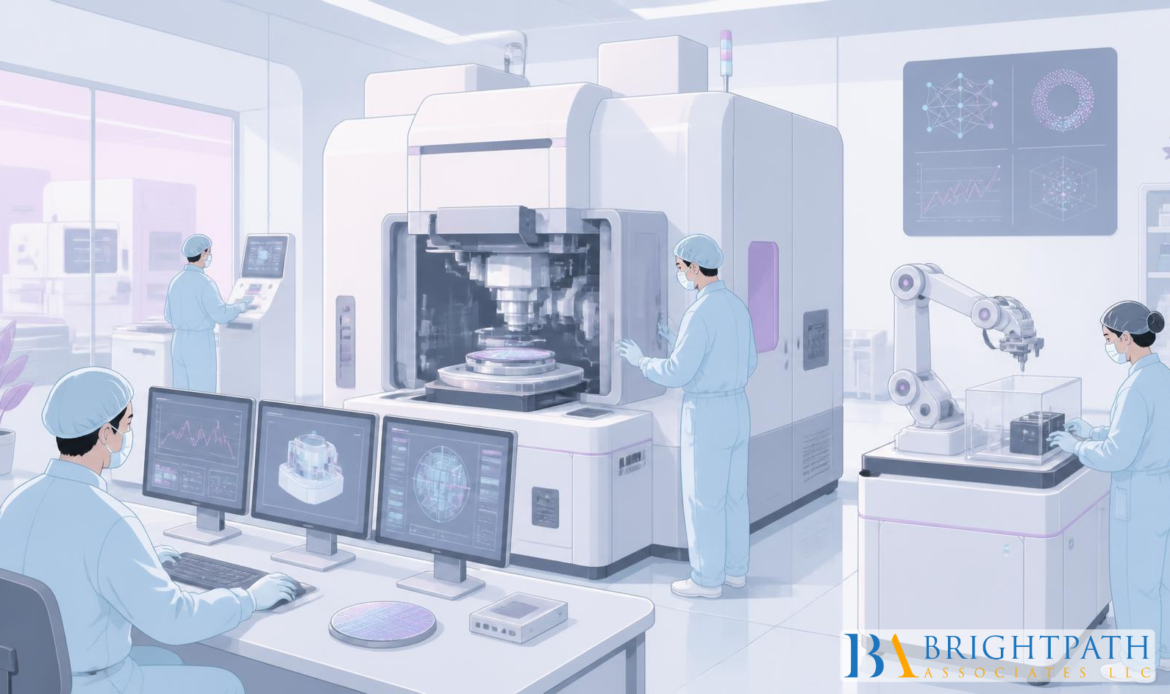
#NanotechnologyIndustry is transforming advanced manufacturing, semiconductor fabrication, medical diagnostics, biotechnology, materials science, and precision engineering. As organizations develop products at increasingly smaller scales, the reliability of high-precision equipment has become a critical factor in maintaining product quality, operational efficiency, and research accuracy. Instruments such as atomic force microscopes, electron microscopes, nanolithography systems, precision deposition equipment, and nanoscale metrology tools require exceptionally stable operating conditions. Even minor mechanical vibrations, temperature fluctuations, contamination, or component degradation can affect measurement accuracy and manufacturing outcomes.
Traditional maintenance strategies, which rely on fixed schedules or repairs after equipment failure, are becoming less effective for complex nanotechnology environments. Predictive maintenance offers a more intelligent alternative by using sensor data, historical performance records, statistical analysis, and machine learning to identify potential equipment problems before they cause operational disruptions.
As Nanotechnology Innovation accelerates across industrial and scientific applications, predictive maintenance is emerging as a strategic capability rather than simply a technical support function. It helps organizations protect expensive equipment, reduce unplanned downtime, improve process consistency, and extend asset lifecycles. Integrating predictive maintenance into nanotechnology operations requires a coordinated approach involving engineering, data science, equipment management, cybersecurity, and workforce development.
High-precision nanotechnology equipment operates under demanding conditions in which extremely small deviations can produce significant consequences. Semiconductor manufacturing systems, for example, depend on precise positioning, controlled environments, stable energy delivery, and accurate process parameters. Similarly, microscopy instruments require reliable motion systems, sensitive detectors, and effective vibration isolation to produce consistent results.
Equipment degradation does not always follow a predictable pattern. Bearings may gradually wear, vacuum pumps may lose efficiency, optical components may become contaminated, and temperature-control systems may develop performance inconsistencies. These changes can remain difficult to detect until they begin affecting product quality or instrument reliability.
Conventional maintenance programs often depend on manufacturer-recommended service intervals, operator observations, and periodic inspections. Although these practices remain important, they may not reflect the actual operating condition of individual machines. Servicing equipment too frequently can increase costs and interrupt productive work, while insufficient maintenance can expose organizations to unexpected failures.
Predictive maintenance addresses this limitation by evaluating equipment condition continuously or at appropriate intervals. By identifying subtle deviations from normal operating behavior, organizations can schedule interventions according to evidence rather than relying exclusively on fixed maintenance calendars.
The Role of Nanotechnology Data Analytics in Equipment Monitoring
Effective predictive maintenance begins with reliable data collection and interpretation. Modern nanotechnology equipment can generate information about temperature, vibration, electrical current, pressure, vacuum stability, actuator performance, calibration drift, and process consistency. When collected systematically, these measurements provide valuable insight into equipment health.
Nanotechnology Data Analytics transforms raw operational information into meaningful indicators that maintenance teams can use to identify emerging problems. Statistical methods can establish normal operating ranges, detect unusual patterns, and compare current performance against historical baselines.
For instance, a gradual increase in vibration within a precision positioning stage may indicate mechanical wear or a developing alignment issue. Changes in vacuum pump performance may reveal leakage, contamination, or declining component efficiency. In sensitive measurement systems, calibration drift can signal the need for inspection before inaccurate results affect research conclusions.
However, successful analytics depends on data quality, sensor reliability, and appropriate interpretation. Measurements collected under different environmental conditions may not be directly comparable, while incomplete maintenance records can weaken the accuracy of predictions.
Organizations should therefore establish standardized data collection practices, maintain accurate equipment histories, and integrate maintenance records with operational monitoring systems. These foundations enable more dependable analysis and improve the usefulness of predictive maintenance recommendations.
Machine learning can strengthen predictive maintenance by identifying complex relationships between equipment behavior and potential failure conditions. Unlike basic threshold-based monitoring, machine learning models can analyze multiple variables simultaneously and detect combinations of changes that may indicate developing faults.
Nanotechnology Machine Learning applications may include anomaly detection, equipment health classification, remaining useful life estimation, and failure probability forecasting. Models can learn from historical operating data, inspection reports, maintenance interventions, and known failure events to improve their ability to recognize warning signals.
For example, a model monitoring a nanolithography system might identify a combination of temperature variation, positioning error, and increased actuator current that precedes a performance problem. Maintenance teams could investigate the affected subsystem before the issue disrupts production.
Nevertheless, machine learning is not automatically reliable simply because it processes large amounts of data. Equipment failures may be relatively rare, historical datasets may contain few examples of critical faults, and operating conditions can change as machinery ages or production requirements evolve.
Organizations should validate models against independent data, monitor false alarms, and establish clear procedures for responding to predictions. Human engineering expertise remains essential for confirming likely causes, determining intervention priorities, and ensuring that maintenance decisions reflect actual equipment conditions.
Nanotechnology Simulation and Modeling for Maintenance Optimization
Simulation and digital modeling can help organizations understand equipment behavior before faults occur. Nanotechnology Simulation allows engineers to investigate mechanical stress, thermal variation, vibration transmission, fluid dynamics, and other factors that influence instrument performance.
These virtual experiments can reveal how environmental conditions or component changes may affect sensitive systems. For example, thermal simulations can help identify temperature gradients that contribute to positioning errors, while mechanical simulations can evaluate how structural vibration influences measurement stability.
#NanotechnologyModeling complements these approaches by creating mathematical representations of equipment behavior and degradation. Engineers can combine physical models with historical operating data to estimate how components respond to changing workloads, environmental conditions, and maintenance interventions.
When appropriate, digital twins can connect a virtual representation of equipment with current operational measurements. This approach allows engineers to compare expected performance with actual behavior and investigate deviations before they develop into significant failures.
However, simulations and models must reflect realistic physical conditions and validated engineering assumptions. Inaccurate representations can produce misleading predictions, particularly when equipment operates outside its original design parameters.
Integrating simulation, modeling, and sensor data creates a stronger foundation for maintenance planning by connecting observed changes with plausible physical causes.
Unplanned downtime can be particularly expensive in nanotechnology facilities because equipment may support multiple research projects, specialized production processes, or time-sensitive manufacturing schedules. A failure affecting a critical instrument can delay experiments, interrupt production batches, and require extensive recalibration before normal operations resume.
Predictive maintenance helps organizations schedule repairs during planned production breaks and arrange replacement components before they become urgently necessary. This improves maintenance coordination while reducing the risk of unexpected equipment unavailability.
The financial benefits extend beyond avoided repair costs. Reliable equipment can reduce material waste, prevent defective production batches, improve laboratory productivity, and minimize repeated testing caused by instrument instability.
Organizations operating several facilities can also use predictive insights to prioritize maintenance resources according to equipment criticality and business impact. A developing fault in a production-critical deposition system may require more immediate attention than a similar warning from a noncritical instrument with readily available alternatives.
Maintenance teams should measure performance through indicators such as unplanned downtime, mean time between failures, mean time to repair, maintenance expenditure, calibration stability, and equipment availability. These measures help demonstrate whether predictive maintenance is delivering measurable operational improvements.
Nanotechnology Risk Assessment and Reliability Management
Predictive maintenance must operate within a broader framework of equipment reliability and risk management. Not every potential failure carries the same consequences, and maintenance priorities should reflect the severity, likelihood, and detectability of each identified problem.
Nanotechnology Risk Assessment helps organizations determine which assets require continuous monitoring, additional inspections, or more conservative maintenance thresholds. Critical considerations include equipment replacement costs, personnel safety, product quality, environmental consequences, research integrity, and the possibility of cascading failures.
For example, a malfunction in a high-vacuum system could damage sensitive equipment or interrupt a production process. A calibration problem in a nanoscale measurement instrument could compromise experimental results without producing an obvious mechanical warning. Different failure modes therefore require different monitoring methods and response procedures.
Organizations should establish risk-based maintenance plans that combine predictive alerts with established inspection requirements and manufacturer recommendations. They should also define escalation procedures for high-risk warnings and maintain records of the decisions made in response to alerts.
Predictive maintenance should supplement, rather than automatically replace, legally required inspections, safety checks, and validated preventive maintenance activities. A balanced approach ensures that efficiency improvements do not introduce unacceptable operational risks.
As predictive maintenance systems become increasingly connected, protecting sensitive information becomes an important management priority. Operational datasets may reveal proprietary manufacturing parameters, equipment configurations, process performance, research methods, and production schedules.
Nanotechnology IP can represent substantial competitive value, particularly for organizations developing specialized materials, semiconductor processes, medical devices, and advanced manufacturing techniques. Unauthorized access to maintenance platforms could expose information that extends beyond equipment condition.
Organizations should establish access controls, secure communication channels, appropriate data retention policies, and clear rules governing third-party service providers. They should also assess the cybersecurity implications of connected sensors, remote maintenance platforms, and externally hosted analytics systems.
Data governance is equally important when maintenance information is shared between equipment manufacturers, research institutions, and production facilities. Contracts should clarify data ownership, permitted uses, confidentiality obligations, and access to analytical results.
A secure predictive maintenance architecture should allow authorized personnel to obtain useful operational insights without exposing unnecessary proprietary information. Integrating cybersecurity and intellectual property protection into system design reduces risks while supporting collaboration and innovation.
Advancing Nanotechnology Sustainability Through Predictive Maintenance
Sustainability is becoming increasingly important as nanotechnology operations face pressure to improve energy efficiency, minimize waste, and manage resource consumption. High-precision equipment can require substantial electricity, cooling, vacuum generation, environmental control, and specialized consumables.
Nanotechnology Sustainability initiatives can benefit from predictive maintenance because well-maintained equipment generally operates more consistently and can avoid certain forms of unnecessary energy consumption. Identifying deteriorating pumps, inefficient cooling systems, or malfunctioning control mechanisms may help facilities reduce avoidable resource use.
#ReliableEquipment also reduces the risk of rejected production batches and repeated experiments, which can consume expensive materials and energy. Extending component life through condition-based servicing may further reduce replacement requirements and maintenance waste.
However, sustainability gains should be measured rather than assumed. Additional sensors, computing infrastructure, and data processing can also consume resources. Organizations should compare the energy, material, and waste impacts of their maintenance programs against the operational improvements achieved.
By incorporating environmental performance into maintenance analytics, companies can evaluate equipment reliability and resource efficiency together. This integrated perspective supports responsible industrial growth without compromising precision or product quality.
Healthcare is an important application area for nanotechnology, particularly in diagnostic systems, biosensors, drug delivery research, medical materials, and specialized laboratory instruments. In these environments, equipment reliability can influence measurement accuracy, research reproducibility, and the consistency of development processes.
Predictive maintenance can help laboratories identify emerging equipment problems before they compromise sensitive experiments or interrupt essential workflows. For example, monitoring temperature stability, calibration performance, and component health may help maintain the reliability of instruments used in nanoscale biological analysis.
However, maintenance requirements in healthcare-related applications must account for the consequences of equipment failure and the relevant quality and regulatory obligations. Instruments supporting regulated manufacturing or diagnostic activities may require documented calibration, validated maintenance procedures, and formal change controls.
Predictive alerts should therefore be integrated into established quality management systems. Maintenance teams must document interventions, verify equipment performance after servicing, and ensure that any affected results or production activities are appropriately assessed.
By combining predictive insights with rigorous quality assurance, organizations can improve equipment availability while preserving the reliability expected in healthcare-related nanotechnology applications.
Executive Search Recruitment and the Future of Nanotechnology Maintenance
The success of predictive maintenance depends on access to professionals who understand both advanced equipment and data-driven decision-making. Nanotechnology facilities need engineers, instrumentation specialists, reliability professionals, data scientists, cybersecurity experts, and technical managers who can work effectively across disciplines.
#ExecutiveSearchRecruitment can help organizations identify experienced leaders capable of integrating maintenance strategy with research priorities, manufacturing objectives, and technology investment. Relevant leadership roles may include engineering directors, reliability managers, heads of advanced manufacturing, digital transformation leaders, and research operations executives.
Effective leaders must understand the limitations of predictive models, the importance of equipment validation, and the commercial consequences of unplanned downtime. They must also build collaboration between maintenance personnel, equipment manufacturers, data specialists, and operational teams.
Organizations should complement external recruitment with internal training, knowledge transfer, and succession planning. As experienced technicians retire or move into new roles, structured documentation and mentoring can preserve the specialized knowledge needed to maintain complex instruments.
Investing in workforce capabilities ensures that predictive maintenance systems become part of everyday operational practice rather than isolated technology projects. Strong leadership also helps organizations establish realistic performance targets and maintain accountability for long-term improvements.
Conclusion
Predictive maintenance is becoming an essential capability for organizations that depend on high-precision nanotechnology equipment. By combining sensor monitoring, Nanotechnology Data Analytics, machine learning, simulation, and modeling, businesses can identify developing equipment problems earlier and make more informed maintenance decisions.
Its value extends beyond reducing downtime. A well-designed program can improve product quality, strengthen operational resilience, support Nanotechnology Sustainability, protect Nanotechnology IP, and enhance the reliability of equipment used in healthcare and advanced manufacturing.
Successful implementation requires dependable data, validated analytical models, risk-based maintenance procedures, secure digital infrastructure, and skilled professionals. Organizations must also evaluate performance continuously to ensure that predictive insights translate into measurable operational benefits.
As the Nanotechnology market expands, companies that integrate maintenance intelligence with engineering expertise and strategic leadership will be better positioned to protect valuable assets and support innovation. The future of high-precision equipment management will depend not simply on predicting when a machine might fail, but on using reliable evidence to make safer, more efficient, and more sustainable decisions throughout its lifecycle.
Find your next leadership role in Nanotechnology Industry today!
Stay informed with the latest insights on Nanotechnology Industry!