
Introduction
The #AerospaceIndustry is entering a transformative phase as electric vertical takeoff and landing (eVTOL) aircraft move closer to practical deployment across urban transportation, regional mobility, emergency response, and specialized logistics. Designed to combine vertical takeoff capabilities with electric propulsion and advanced flight-control systems, eVTOL aircraft offer new possibilities for reducing travel times and expanding access to congested or geographically challenging locations. However, successful commercialization requires more than aircraft innovation. It demands coordinated airspace management, reliable infrastructure, robust cybersecurity, clear regulatory frameworks, and a highly skilled aerospace workforce.
In 2026, the development of advanced air mobility is increasingly focused on connecting aircraft certification with operational readiness. Manufacturers, aviation authorities, infrastructure developers, technology providers, and investors must work together to establish systems that support safe, scalable, and economically viable operations. Airspace coordination is particularly important because eVTOL aircraft will need to operate alongside conventional aviation, helicopters, unmanned aircraft, and other emerging aerial platforms.
A comprehensive deployment blueprint must therefore integrate digital traffic management, infrastructure planning, safety assurance, and industrial capability. Lessons from aerospace engineering, Defense Space Systems, and other complex technology sectors can contribute valuable insights into secure communications, resilient navigation, simulation, and mission-critical systems. By aligning these capabilities with aviation requirements, the industry can establish a practical foundation for the next generation of air transportation.
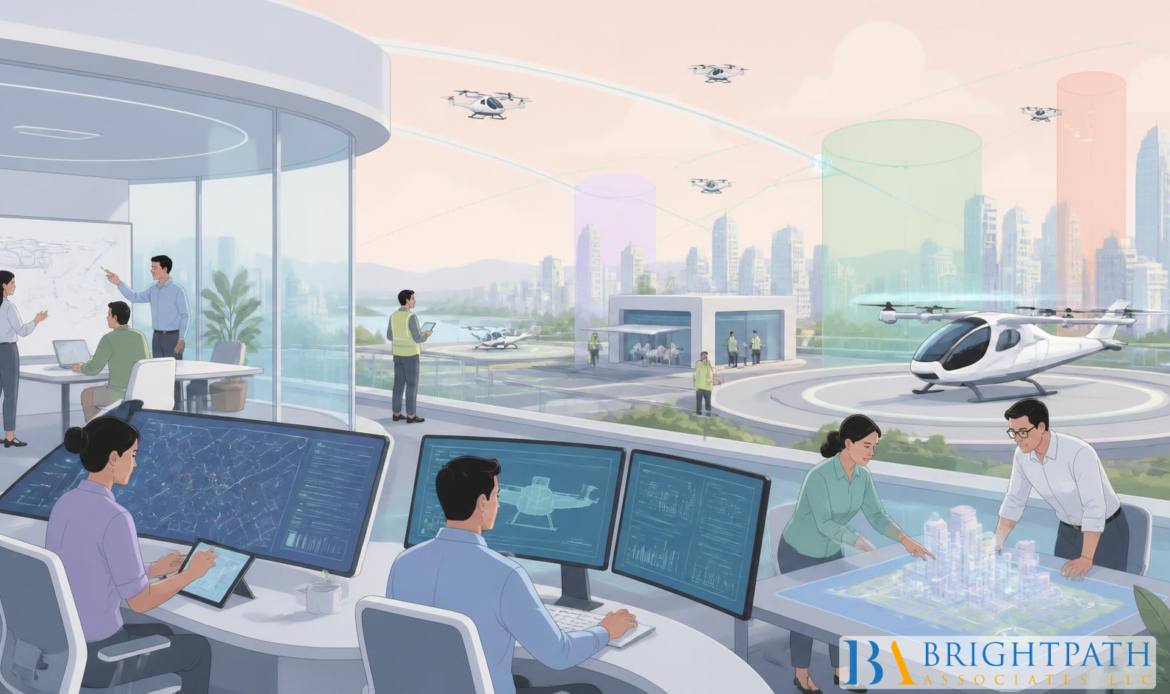
The introduction of eVTOL aircraft will create new demands on airspace management, particularly in densely populated metropolitan areas where flight routes, landing facilities, and conventional aviation activities must coexist. Unlike traditional aircraft operations that primarily depend on established airports and flight corridors, advanced air mobility may involve frequent short-distance flights between vertiports located near business districts, transportation hubs, hospitals, and regional centers.
Managing these operations requires reliable communication between aircraft operators, air navigation service providers, vertiport managers, and relevant aviation authorities. Flight planning systems must account for weather conditions, airspace restrictions, aircraft performance, traffic density, emergency diversions, and landing-site availability.
Digital traffic management systems can support this coordination by sharing operational information and helping authorized stakeholders maintain a consistent understanding of airspace conditions. However, automated coordination must operate within approved aviation procedures and clearly defined responsibilities. Technology alone cannot replace the regulatory oversight and safety assurance required for commercial flight operations.
The 2026 blueprint should prioritize interoperability, predictable operating procedures, and the ability to expand services without compromising safety. Establishing these foundations early can reduce deployment delays and support more consistent integration across different regions.
Building a Digital Architecture for Advanced Air Mobility
A scalable eVTOL ecosystem requires a digital architecture capable of connecting aircraft, ground infrastructure, air traffic services, and operational control centers. This architecture should support secure information exchange, accurate flight tracking, weather updates, route coordination, and real-time operational monitoring.
Aircraft systems must communicate reliably with ground-based services while maintaining appropriate safeguards against communication failures and inaccurate information. Redundant communication pathways, dependable navigation capabilities, and clearly defined contingency procedures can improve operational resilience.
The architecture should also support interoperability between different manufacturers and service providers. Without common technical standards, operators could face fragmented systems that increase operating costs and complicate coordination across jurisdictions.
Artificial intelligence and predictive analytics may improve traffic forecasting, route planning, and fleet utilization. Nevertheless, safety-critical decisions must remain subject to appropriate validation, human oversight, and applicable aviation requirements. Systems should be evaluated for reliability under degraded communication, unusual weather, and unexpected traffic conditions.
The objective is to develop an integrated operational environment in which digital tools improve efficiency while preserving the safety principles that underpin civil aviation.
Regulatory readiness is one of the most important determinants of eVTOL deployment. Aircraft certification, pilot qualification, maintenance standards, operational approvals, infrastructure requirements, and airspace access must be addressed before commercial services can scale.
The broader concept of Space Regulatory governance offers useful comparisons in managing emerging technologies that cross traditional operational boundaries. However, eVTOL aircraft operate primarily within civil aviation frameworks, so space-sector rules cannot substitute for aviation certification or air traffic requirements.
In the United States, the Federal Aviation Administration has developed an approach for powered-lift aircraft that addresses pilot qualifications, operational considerations, and integration into the national airspace system. Other jurisdictions are developing their own frameworks according to local aviation laws, infrastructure, and safety requirements.
For operators planning international deployment, regulatory differences can influence aircraft design, training programs, route authorization, and maintenance procedures. Manufacturers should therefore incorporate certification considerations into early engineering decisions rather than treating compliance as a final-stage activity.
Regulators and industry participants also need structured processes for sharing safety data, evaluating new operating concepts, and updating standards as technical evidence develops. A predictable regulatory environment can encourage investment while ensuring that commercial expansion remains grounded in demonstrated safety.
Applying Aerospace Industry Trends to eVTOL Deployment
Several Aerospace industry trends are shaping the transition from prototype development to operational deployment. These include electrification, advanced composite materials, autonomous assistance, digital engineering, predictive maintenance, and increasingly sophisticated flight-control systems.
#ElectricPropulsion can reduce local operational emissions when compared with conventional fuel-powered alternatives, although the overall environmental impact depends on electricity generation, battery production, aircraft utilization, and lifecycle considerations. Battery energy density, thermal management, charging infrastructure, and degradation remain important engineering challenges.
Manufacturers must also consider how aircraft designs affect maintenance requirements and turnaround times. Modular components, standardized inspection procedures, and condition-monitoring systems may improve fleet availability when supported by reliable engineering data and approved maintenance practices.
Another important trend is the integration of software throughout the aircraft lifecycle. Digital engineering models can help teams assess aerodynamic performance, electrical architecture, thermal behavior, and system interactions before physical testing. These methods can reduce development inefficiencies while identifying design weaknesses earlier.
For deployment planners, the key challenge is translating promising technologies into reliable services. Aircraft performance, infrastructure capacity, operating costs, and passenger demand must be evaluated together. Commercial success will depend on a coordinated ecosystem rather than isolated advances in propulsion or flight-control technology.
As eVTOL operations become more digitally connected, cybersecurity will become increasingly important to aviation safety and service continuity. Flight planning platforms, maintenance databases, communication networks, charging systems, and vertiport management software may all become potential targets for cyberattacks or unauthorized access.
Space Cybersecurity provides relevant lessons in protecting distributed, mission-critical systems that depend on communications, navigation, and interconnected digital infrastructure. Although aviation and space systems have different operational requirements, both demonstrate the importance of secure architecture, resilient communications, and disciplined access management.
An effective cybersecurity strategy should include secure software development, strong authentication, encryption where appropriate, vulnerability management, network segmentation, and continuous monitoring. Organizations should also establish procedures for identifying suspicious activity, isolating affected systems, and maintaining essential operations during an incident.
Supply-chain security deserves particular attention because aircraft and infrastructure systems may depend on components, software libraries, communication equipment, and third-party service providers. Manufacturers should evaluate supplier security practices and maintain visibility into critical software and hardware dependencies.
Cybersecurity must also be integrated into operational safety assessments. A compromised scheduling system, inaccurate navigation information, or disrupted communication service could have consequences beyond conventional data loss. Regular exercises involving operators, infrastructure providers, and emergency services can help verify that contingency procedures work under realistic conditions.
Integrating Space Electronics and Space Robotics Expertise
The development of eVTOL aircraft creates opportunities to apply knowledge from advanced electronics and robotics. Space Electronics, for example, emphasizes reliability, environmental tolerance, fault detection, and performance under demanding operating conditions. Similar engineering principles can inform the development of aviation sensors, power electronics, flight-control hardware, and communication components.
However, components designed for space applications cannot automatically be considered suitable for aircraft. Aviation equipment must meet the applicable environmental, electromagnetic compatibility, reliability, and certification requirements for its intended use.
Space Robotics also offers relevant insights into autonomy, remote monitoring, precision control, and operations in environments where direct human intervention is limited. These principles may support automated inspection of vertiport equipment, robotic battery-handling systems, and predictive maintenance workflows.
Robotic technologies could help reduce repetitive inspection tasks and improve consistency in selected maintenance processes. Their implementation must nevertheless include appropriate safeguards, qualified supervision, and compliance with approved maintenance procedures.
Combining aerospace electronics expertise with robotics and software engineering can strengthen the technological foundation of advanced air mobility. The priority should remain practical integration, with every new capability evaluated against measurable requirements for safety, reliability, maintainability, and operational value.
Simulation is essential for evaluating complex systems before they enter real-world service. In eVTOL development, simulation can support aerodynamic analysis, battery performance testing, flight-control verification, emergency procedure development, and assessment of traffic-management concepts.
Defense Simulation offers useful methodological lessons in scenario generation, systems integration, digital environments, and testing under challenging conditions. These methods can help engineering teams examine rare or high-consequence events that may be difficult, expensive, or unsafe to reproduce through physical testing alone.
For example, simulation can evaluate how an eVTOL fleet might respond to sudden weather deterioration, temporary communication loss, vertiport congestion, or the closure of a planned landing site. Researchers can also assess the interaction between multiple aircraft and identify conditions that could create operational bottlenecks.
Simulation must be supported by validated models and evidence from laboratory testing, ground trials, and flight testing. A digital model that does not accurately represent real-world aircraft behavior cannot provide sufficient assurance for safety-critical decisions.
Organizations should therefore establish traceable verification processes that connect design assumptions, simulated results, test evidence, and operational procedures. This approach improves confidence in system performance while helping regulators and operators understand the limits of the technology.
Defense Space Policy and Cross-Sector Technology Collaboration
#DefenseSpacePolicy highlights the strategic importance of resilient infrastructure, secure communications, technological independence, and coordinated investment in advanced systems. These priorities can inform selected aspects of civil eVTOL development, particularly where aviation services depend on satellite navigation, timing, communications, or other shared infrastructure.
Nevertheless, civil advanced air mobility and defense aerospace operations have distinct missions, legal obligations, and security requirements. Commercial eVTOL deployment should be governed by applicable civil aviation rules, with defense-related capabilities incorporated only where relevant and authorized.
Cross-sector collaboration may be especially valuable in research, component development, cybersecurity, simulation, and systems engineering. Partnerships between universities, aerospace manufacturers, technology companies, and public institutions can accelerate the development of reliable solutions while improving access to specialized expertise.
Organizations should establish clear boundaries for intellectual property, sensitive technical information, procurement requirements, and data sharing. These arrangements can encourage innovation without introducing unnecessary security risks or regulatory uncertainty.
A disciplined approach to collaboration allows the industry to benefit from established aerospace capabilities while maintaining the independence and transparency required for commercial aviation.
Capital investment will play a significant role in determining how quickly eVTOL services can become commercially viable. Aircraft development, certification, manufacturing facilities, battery systems, charging infrastructure, vertiports, software platforms, and operational support all require substantial investment.
Space Venture Capital provides a useful comparison because investors in both sectors often finance capital-intensive technologies with long development cycles, complex certification requirements, and uncertain commercial timelines. However, investment models must reflect the specific economics and regulatory environment of aviation.
Investors should evaluate more than aircraft performance or prototype demonstrations. Important considerations include certification progress, manufacturing readiness, battery durability, infrastructure costs, expected utilization, maintenance requirements, insurance, and evidence of customer demand.
Operators also need realistic assumptions about revenue per flight, fleet availability, passenger occupancy, charging time, and route economics. High passenger fares may initially limit demand, while insufficient utilization can undermine profitability even when aircraft performance meets technical expectations.
A phased deployment strategy can reduce financial exposure by introducing services on routes with suitable infrastructure, manageable operating conditions, and clear customer needs. Demonstrated operational performance can then support expansion into more complex markets.
The strongest investment opportunities will emerge where technical maturity, regulatory readiness, infrastructure planning, and a credible business model develop together.
Defense Manufacturing and Scalable Aerospace Production
The transition from prototype aircraft to commercial fleets requires manufacturing processes that deliver consistent quality, traceability, and dependable supply. Defense manufacturing offers relevant lessons in configuration management, quality assurance, supplier qualification, and production discipline.
These practices can inform eVTOL manufacturing, but civil aircraft production must satisfy its own certification and quality requirements. Manufacturers must demonstrate that production processes consistently deliver aircraft that conform to approved designs.
Scaling production requires careful coordination between battery suppliers, electric motor manufacturers, avionics providers, structural component producers, and final assembly facilities. Shortages or quality issues affecting a single critical component can disrupt delivery schedules and increase costs.
Digital manufacturing systems can improve traceability, identify production bottlenecks, and connect engineering changes with manufacturing documentation. Standardized inspection procedures and robust supplier oversight can further reduce variability.
Manufacturers should also plan for the full aircraft lifecycle, including spare parts, repair capabilities, software updates, battery replacement, and end-of-life recycling. Production capacity alone does not guarantee commercial readiness; sustainable operations require an equally dependable maintenance and support network.
Successful eVTOL deployment depends on multidisciplinary teams capable of managing aviation safety, electric propulsion, software development, cybersecurity, infrastructure, and commercial operations. Competition for experienced professionals in these fields makes workforce planning a strategic priority.
#ExecutiveSearchRecruitment can help organizations identify leaders with the experience needed to coordinate complex development programs and guide companies through certification, manufacturing expansion, and market entry.
Critical leadership capabilities include systems engineering, regulatory affairs, flight operations, battery technology, cybersecurity, supply chain management, and commercial strategy. Organizations also need leaders who can connect technical specialists with financial decision-makers and translate complex engineering requirements into measurable business objectives.
Recruitment strategies should assess candidates on demonstrated expertise, cross-functional collaboration, risk management, and experience leading regulated industrial operations. Companies should also develop internal talent through mentoring, technical training, and structured leadership succession.
A strong workforce strategy ensures that innovation does not outpace an organization’s ability to manage risk, maintain quality, and support customers. As the sector matures, the availability of experienced leaders and specialized technicians will become an important factor in determining which companies can scale reliably.
Conclusion
The deployment of eVTOL aircraft requires a coordinated approach that connects aircraft certification, digital airspace management, infrastructure development, cybersecurity, manufacturing readiness, and workforce capability. In 2026, the most important priority is turning technological progress into safe, repeatable, and economically sustainable operations.
Insights from Defense Space Systems, Space Cybersecurity, Space Robotics, Defense Simulation, and Defense manufacturing can contribute valuable methods for building resilient systems, validating performance, and managing complex supply chains. At the same time, civil aviation requirements must remain the foundation for aircraft certification and operational approval.
Long-term success will depend on cooperation among regulators, manufacturers, technology providers, infrastructure developers, investors, and aviation professionals. Clear standards, secure digital platforms, realistic business models, and strategic Executive Search Recruitment will help organizations manage the transition from development to commercial deployment.
Ultimately, advanced air mobility will scale when safety, reliability, and operational value advance together. Companies that invest in coordinated airspace systems, robust engineering, and capable leadership will be better positioned to establish dependable eVTOL services and contribute to the future of the aerospace industry.
Find your next leadership role in Defense and Space Industry today!
Stay informed with the latest insights on Defense and Space Industry!