
Introduction
The logistics and #TransportationIndustry is undergoing a significant transformation as businesses reconsider traditional distribution models built around large regional warehouses and centralized fulfillment centers. For decades, regional hubs have served as the backbone of supply chains, consolidating inventory, managing transportation flows, and distributing products across extensive geographic areas. However, rising customer expectations, increasing e-commerce volumes, urban congestion, and growing pressure to reduce delivery times are encouraging companies to explore decentralized distribution strategies.
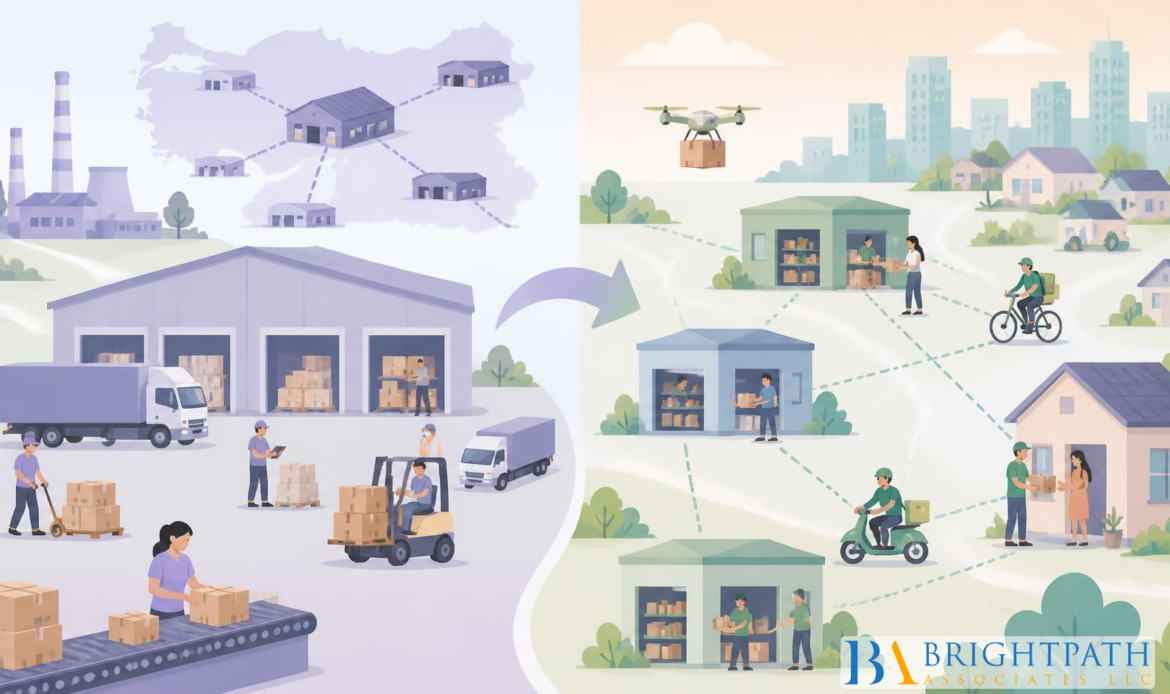
Edge delivery represents a shift toward placing inventory, fulfillment capabilities, and delivery resources closer to end customers. Instead of relying exclusively on a limited number of large facilities, businesses can use smaller urban warehouses, micro-fulfillment centers, local distribution points, and strategically positioned inventory to improve responsiveness. This approach can support faster deliveries, reduce certain transportation costs, and improve flexibility when demand changes unexpectedly.
However, decentralization is not simply a matter of opening more warehouses. It requires sophisticated inventory planning, coordinated transportation networks, accurate demand forecasting, and effective technology integration. Companies must also balance speed against operating expenses, facility availability, labor requirements, and environmental considerations.
As businesses evaluate new operating models, logistics consulting services, shipping optimization strategies, and advanced delivery technology are becoming increasingly important. Organizations that successfully integrate decentralized distribution into their supply chains can improve service quality while building more resilient and adaptable logistics networks.
Traditional distribution networks generally depend on centralized facilities that receive products from manufacturers, store inventory, and fulfill orders across large service territories. These hubs benefit from economies of scale because they consolidate storage, labor, handling, and transportation activities within a smaller number of locations.
Nevertheless, centralized networks can struggle when customers expect same-day or next-day delivery across geographically dispersed markets. Long distances between distribution facilities and final destinations can increase delivery times, fuel consumption, and exposure to traffic disruptions.
Edge delivery addresses these challenges by positioning inventory closer to areas of concentrated demand. A retailer might maintain its main inventory at a regional warehouse while placing frequently purchased products in smaller fulfillment facilities near major urban neighborhoods. Orders can then be dispatched from the closest suitable location rather than traveling through a centralized network for every transaction.
This model can improve responsiveness, particularly for high-demand products and time-sensitive shipments. However, decentralization also introduces additional facility expenses, inventory duplication, and more complicated replenishment requirements.
The most effective strategy is therefore not necessarily to eliminate regional hubs. Instead, businesses should determine which activities benefit from centralized scale and which require local proximity. A hybrid network can combine the efficiency of regional distribution with the speed and flexibility of edge delivery.
The Role of Logistics Consulting Services in Network Transformation
Transitioning to decentralized distribution requires careful evaluation of existing supply chain structures, customer demand, transportation capacity, and facility economics. Logistics consulting services can help businesses identify opportunities to redesign their networks without creating unnecessary complexity.
The process begins with an assessment of current distribution performance. Companies must understand where orders originate, how inventory moves through the network, which destinations experience recurring delays, and how transportation costs vary by shipment type. These insights provide a foundation for identifying potential locations for micro-fulfillment centers, local depots, and alternative delivery points.
Consultants can also evaluate the trade-offs between facility investment and transportation savings. A new urban warehouse may reduce delivery distances but introduce higher rental costs, additional staffing requirements, and greater inventory management complexity. Network modeling helps determine whether the expected service improvements justify these expenses.
Scenario planning is particularly valuable when demand fluctuates seasonally or when companies enter new geographic markets. Businesses can assess alternative facility locations, delivery coverage areas, and inventory allocation strategies before committing significant capital.
By aligning network design with measurable business objectives, logistics consulting services can help organizations develop a practical transition plan that improves customer service while preserving financial discipline.
The expansion of online shopping has changed how businesses manage inventory, process orders, and organize last-mile transportation. Customers increasingly expect convenient delivery options, accurate tracking, flexible delivery windows, and reliable communication throughout the purchasing process.
E-commerce logistics must accommodate a wide variety of order sizes, delivery destinations, and service expectations. A centralized distribution model may work effectively for predictable bulk shipments, but individual consumer orders often require more flexible fulfillment arrangements.
Decentralized distribution allows retailers to position selected products closer to high-demand customer segments. Smaller facilities can support rapid order processing, local returns management, and faster replenishment of popular products. This approach is particularly useful for frequently purchased household goods, essential supplies, and other products with consistent local demand.
However, distributing inventory across multiple locations increases the risk of stock imbalances. A product may be unavailable at one facility even when sufficient inventory exists elsewhere in the network. Businesses must therefore connect inventory visibility, order management, and demand forecasting systems.
An effective e-commerce logistics strategy balances proximity with inventory efficiency. By placing the right products in the right locations, businesses can reduce unnecessary transfers and improve delivery performance without maintaining excessive stock throughout the network.
Delivery Technology as the Foundation of Edge Distribution
Technology enables decentralized networks to operate as coordinated systems rather than disconnected local facilities. Real-time inventory platforms, route planning software, warehouse management systems, transportation management systems, and automated order allocation tools help businesses coordinate activities across multiple locations.
Modern delivery technology can analyze shipment destinations, delivery commitments, traffic conditions, vehicle capacity, and available inventory to determine suitable fulfillment and dispatch options. These capabilities help operators make decisions using current operating conditions rather than relying entirely on static schedules.
#PredictiveAnalytics can also improve demand forecasting by combining historical sales, seasonal patterns, promotional activity, and local purchasing behavior. Better forecasts help organizations position inventory more accurately and reduce the likelihood of shortages or unnecessary stock accumulation.
Automated sorting equipment, barcode scanning, digital proof of delivery, and integrated tracking systems can improve accuracy throughout the fulfillment process. Customers benefit from more reliable updates, while operations teams gain better visibility into delays and service exceptions.
Nevertheless, technology implementation requires reliable data, standardized processes, and employee training. A sophisticated platform cannot compensate for inaccurate inventory records or poorly defined operating procedures. Businesses should prioritize interoperability and practical usability when selecting technology for decentralized distribution.
Shipping optimization becomes more complex as businesses introduce additional fulfillment locations. Although shorter delivery distances may improve service speed, fragmented shipment volumes can reduce vehicle utilization and increase the number of transportation movements required to replenish local facilities.
Effective shipping optimization requires businesses to evaluate transportation decisions across the entire network. This includes determining where orders should be fulfilled, how shipments should be consolidated, when local replenishment should occur, and which delivery methods offer the best balance of cost and service.
Route optimization software can group compatible deliveries, account for vehicle capacity, and adapt routes to traffic conditions or changing delivery priorities. Inventory allocation systems can also reduce unnecessary interfacility transfers by directing orders toward locations with suitable stock and available fulfillment capacity.
Companies should measure performance using indicators such as cost per delivery, order cycle time, vehicle utilization, on-time delivery rates, and failed delivery frequency. These metrics reveal whether decentralization is generating meaningful operational benefits.
A successful shipping optimization strategy does not pursue the shortest possible delivery time at any cost. Instead, it identifies the service level customers value and designs the network to achieve that level efficiently. For many businesses, predictable next-day delivery may offer a better commercial outcome than expensive same-hour fulfillment.
Freight Shipping and Freight Brokerage Services in a Distributed Model
Decentralized distribution also changes the requirements of freight shipping. Regional hubs traditionally support large, consolidated shipments that move efficiently between major facilities. Edge networks introduce additional replenishment routes, smaller shipment volumes, and more frequent transfers between regional warehouses and local fulfillment locations.
Freight brokerage services can help businesses connect these changing transportation requirements with available carrier capacity. Brokers can coordinate shipments across multiple providers, identify suitable transport options, and support flexible capacity planning when internal fleets cannot meet demand.
For example, a retailer may use full truckloads to replenish regional facilities while relying on smaller shipments to supply urban micro-fulfillment centers. During seasonal peaks, brokerage arrangements can provide access to additional capacity without requiring the business to expand its permanent fleet.
However, increased transportation frequency can raise costs if shipments are poorly consolidated or facilities are located without sufficient demand justification. Companies should establish clear carrier performance standards, monitor service reliability, and maintain visibility into shipment status across their networks.
#FreightShipping strategies should therefore be designed alongside inventory placement and fulfillment planning. When transportation and warehouse decisions operate independently, organizations risk creating unnecessary transfers, underutilized vehicles, and avoidable delivery delays.
Several transportation industry trends are influencing the shift toward edge delivery. Urbanization, growing e-commerce demand, customer expectations for faster service, and increasing attention to environmental performance are encouraging businesses to reconsider conventional distribution arrangements.
Electric delivery vehicles may help reduce local tailpipe emissions, particularly on predictable urban routes with suitable charging infrastructure. Cargo bikes and smaller vehicles can also support deliveries in congested districts where conventional vans face parking and access constraints.
Automation is another important development. Intelligent sorting systems, digital dispatch platforms, and advanced route planning tools can improve productivity while helping operators manage higher shipment volumes. In selected environments, autonomous delivery technologies may provide additional options, although commercial viability, safety, regulation, and operating conditions remain important considerations.
Businesses must evaluate these developments according to local infrastructure, customer density, shipment characteristics, and total operating costs. A delivery model that works in a dense city center may be unsuitable for rural areas with dispersed demand.
The broader objective is to build adaptable networks capable of using different transportation methods according to local requirements. Combining centralized replenishment with locally appropriate delivery solutions can improve both efficiency and service reliability.
Managing Costs, Inventory, and Operational Complexity
Decentralized distribution offers potential advantages, but its economic performance depends on disciplined planning. Additional facilities can increase rental expenses, utilities, labor costs, security requirements, and inventory carrying costs. Maintaining safety stock across multiple locations may also tie up working capital.
Organizations should evaluate total network cost rather than focusing exclusively on the final delivery stage. Savings from shorter delivery routes may be offset by increased warehousing expenses or frequent replenishment shipments.
Inventory segmentation can help #BusinessesDetermine which products belong in local facilities. High-demand, fast-moving products may justify decentralized storage, while slower-moving or specialized products may remain more efficiently managed through regional hubs.
Companies should also account for reverse logistics, including returns, repairs, exchanges, and product recovery. Local facilities can make returns processing more convenient, but additional handling locations must be integrated into inventory and quality management systems.
Continuous performance monitoring is essential. Businesses should compare planned and actual costs, evaluate delivery outcomes, and adjust inventory placement when demand patterns change. A flexible network design allows companies to expand successful locations, consolidate underperforming facilities, and respond to new market conditions without redesigning the entire supply chain.
Sustainability is becoming an important consideration in distribution network design. Shorter delivery distances may reduce vehicle travel, but decentralization does not automatically guarantee lower emissions. Additional warehouse energy consumption, fragmented deliveries, and frequent replenishment can offset some of the environmental benefits.
Companies should assess environmental performance across the complete distribution network, including warehousing, transportation, packaging, returns, and inventory waste. Better route planning, shipment consolidation, energy-efficient facilities, and appropriately selected electric vehicles can help improve performance when supported by local operating conditions.
Decentralized networks can also strengthen resilience by reducing dependence on a single large facility. If a regional warehouse experiences a disruption, alternative locations may continue fulfilling selected orders. However, this advantage depends on inventory availability, information sharing, and sufficient flexibility across the network.
Businesses should develop contingency plans for severe weather, transportation interruptions, facility outages, and sudden demand changes. Digital visibility can help identify alternative fulfillment locations and adjust transportation arrangements when normal operations are disrupted.
By combining sustainability targets with resilience planning, organizations can build distribution networks that respond more effectively to changing customer needs and external pressures.
Delivery Sector Tech Talent and Executive Search Recruitment
The transition toward decentralized distribution increases demand for professionals who understand logistics operations, digital infrastructure, data analytics, and transportation strategy. Businesses need experienced leaders who can connect technology investment with practical improvements in fulfillment, inventory management, and customer experience.
Delivery sector tech talent is particularly important in areas such as route optimization, warehouse automation, transportation analytics, cloud-based logistics platforms, and artificial intelligence. Companies must also recruit operations managers who understand local facility performance, carrier coordination, labor planning, and service-level management.
#ExecutiveSearchRecruitment can help organizations identify senior professionals with the capabilities required to lead complex distribution transformations. Relevant roles may include supply chain directors, logistics executives, transportation leaders, digital transformation specialists, and heads of fulfillment operations.
Successful leaders must balance innovation with operational discipline. They should understand the economics of decentralized networks, communicate effectively across departments, and build teams capable of adapting to changing delivery requirements.
Organizations should complement external recruitment with internal training and leadership development. Investing in employee capabilities helps preserve institutional knowledge while creating a workforce prepared to manage emerging logistics technologies.
A strong talent strategy ensures that decentralization remains a business transformation supported by people and processes rather than simply a network of additional facilities.
Conclusion: Building a Smarter and More Responsive Distribution Network
The shift from regional hubs to edge delivery represents a significant evolution in modern distribution strategy. By moving selected inventory and fulfillment activities closer to customers, businesses can improve responsiveness, reduce certain transportation distances, and create more flexible service models.
However, decentralization succeeds only when network design, inventory planning, freight shipping, delivery technology, and workforce capabilities operate together. Logistics consulting services, freight brokerage services, and shipping optimization can help organizations manage the transition while maintaining control over costs and service quality.
The future of the delivery industry will not be defined by centralized or decentralized distribution alone. Instead, successful businesses will combine regional economies of scale with strategically located fulfillment capabilities that reflect customer demand and local operating conditions.
Organizations that invest in reliable data, adaptable infrastructure, skilled leadership, and continuous performance improvement will be better positioned to respond to evolving transportation industry trends. By treating edge delivery as an integrated supply chain strategy, businesses can build resilient distribution networks that support long-term growth, operational efficiency, and improved customer satisfaction.
Find your next leadership role in Packaging and Freight Industry today!
Stay informed with the latest insights on Packaging and Freight Industry!