
Introduction
#AgricultureIndustry has historically measured scale through land. Owning or operating more acres was often associated with greater production potential, stronger market influence, and improved profitability. However, the economics of modern farming are changing. Rising input costs, water constraints, labor shortages, climate variability, equipment expenses, and increasingly competitive commodity markets are forcing agricultural businesses to reconsider whether acreage alone is an appropriate measure of growth.
The post-growth era does not necessarily mean that farms should stop expanding. Instead, it means that expansion must be evaluated through the profitability and resilience of each individual production unit. Farmers and agricultural enterprises are increasingly asking whether every acre generates sufficient economic value relative to the resources required to cultivate it. This shift places #FarmEconomics at the center of strategic decision-making.
Rather than pursuing acreage simply to increase production volume, agricultural businesses can focus on improving yield quality, resource efficiency, operating margins, labor productivity, and return on invested capital. This approach can create stronger businesses even when the physical footprint remains stable.
Moving Beyond Acreage as the Primary Growth Metric
For decades, farm expansion often followed a straightforward model: acquire or lease additional land, increase production, purchase larger equipment, and capture greater market volume. While this model can still work under certain conditions, it becomes less attractive when land prices, interest rates, water availability, labor expenses, and input costs rise.
An additional acre does not automatically create additional profit. The economic contribution of that acre depends on crop selection, soil conditions, irrigation requirements, labor, fertilizer, machinery utilization, transportation, storage, and market prices.
The post-growth approach therefore focuses on the profitability of individual production units. Farmers can evaluate whether an acre, greenhouse, orchard block, livestock unit, or production field generates sufficient return relative to its total cost. This shift toward #UnitEconomics encourages better allocation of resources.
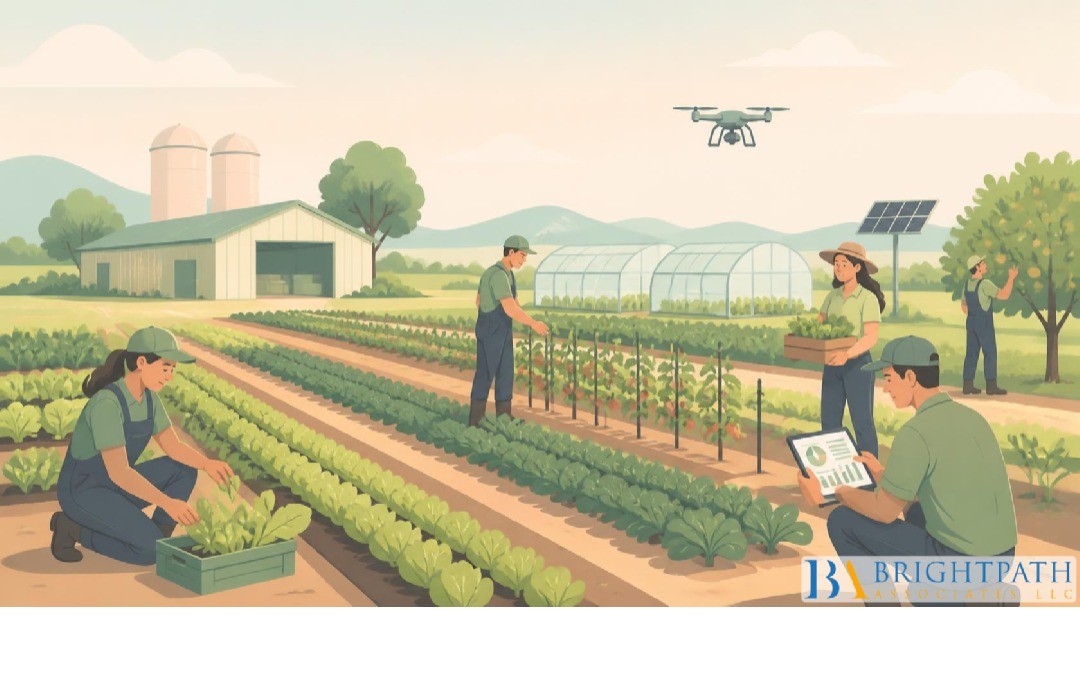
Modern Agricultural technology is making it easier for farmers to measure performance at a much more detailed level. Sensors, satellite imagery, connected equipment, automated machinery, weather monitoring, and field-level data can provide information that was previously difficult or expensive to collect.
Instead of treating an entire farm as one homogeneous production area, technology can reveal differences between individual fields, soil zones, irrigation areas, and crop varieties.
This information allows farmers to determine where inputs are generating strong returns and where resources may be producing diminishing economic benefits. Technology therefore becomes not just a production tool but a strategic #FarmTechnology platform for improving profitability.
Food Production and Economic Efficiency
The primary objective of modern agriculture remains reliable Food production, but producing more food does not necessarily mean creating more economic value. A farm can increase output while simultaneously experiencing declining margins if input costs rise faster than revenue.
This makes efficiency increasingly important. Farmers need to understand how additional fertilizer, irrigation, labor, machinery time, and crop protection contribute to incremental production and revenue.
A stronger understanding of #FoodEconomics allows agricultural businesses to determine whether increasing production is genuinely improving profitability. In some cases, reducing low-return production may strengthen the overall business by allowing resources to be redirected toward more profitable activities.
Sustainable farming is increasingly viewed not only as an environmental objective but also as an economic strategy. Soil degradation, water scarcity, excessive chemical dependence, and inefficient resource use can increase long-term production costs.
Practices that protect soil structure, improve water efficiency, increase biodiversity, and reduce unnecessary inputs can contribute to stronger long-term farm economics.
Sustainability should therefore be evaluated through both environmental and financial outcomes. A practice that improves soil productivity while reducing input costs can create measurable economic value through #SustainableFarming.
Precision Agriculture and Field-Level Profitability
Precision agriculture provides one of the strongest tools for moving from acreage-based thinking toward unit economics. GPS-guided machinery, variable-rate applications, field sensors, satellite imagery, and yield monitoring allow farmers to make decisions at increasingly precise levels.
Farmers can compare yield, input use, and profitability across different areas of the same field. This can reveal zones where fertilizer applications need adjustment or where irrigation resources generate better returns.
Precision agriculture can therefore help transform field data into economic decisions. The objective is not simply to increase technological sophistication but to improve #PrecisionProfitability through better resource allocation.
Organic farming can offer another pathway for improving unit economics when market demand supports premium pricing. Organic production often requires different management practices, certification processes, input strategies, and labor requirements.
The economic value of organic production depends on the relationship between these additional costs and the price premium received. Farmers should therefore evaluate organic production based on actual margins rather than assuming that a higher selling price automatically creates greater profitability.
Strong market positioning, reliable buyers, and efficient production practices can improve the economics of #OrganicFarming.
Agricultural Innovation and the Post-Growth Model
Agricultural innovation is increasingly focused on doing more with existing resources rather than simply expanding physical capacity. Robotics, automation, biotechnology, controlled-environment agriculture, improved genetics, and digital platforms can increase productivity without requiring proportional increases in acreage.
This creates a different definition of growth. A farm may become more valuable by improving its yield consistency, labor efficiency, water productivity, or crop quality without acquiring additional land.
Innovation therefore becomes a mechanism for increasing #FarmProductivity rather than simply increasing farm size.
Sustainable agriculture investment is becoming increasingly important as investors, lenders, food companies, and consumers evaluate environmental performance alongside financial results.
Capital may be directed toward irrigation efficiency, renewable energy, soil management, precision equipment, water recycling, digital systems, or low-impact production technologies.
However, sustainability investments must still demonstrate economic logic. Agricultural businesses should evaluate payback periods, operating savings, productivity improvements, risk reduction, and potential market benefits before committing capital.
The most effective investments can align environmental improvements with financial performance, creating stronger #SustainableInvestment outcomes.
Digital Farming and Better Decision-Making
Digital Farming is helping agricultural businesses replace intuition-based decisions with more measurable management systems. Digital platforms can integrate field data, weather information, equipment performance, inventory, labor, financial results, and market information.
This integration allows farmers to connect operational decisions with financial outcomes. For example, managers can examine whether increased irrigation improved crop quality enough to justify the additional energy and water costs.
Digital systems can therefore strengthen #FarmDecisionMaking by connecting production information with business performance.
Farm management software is becoming increasingly important as farms become more data-intensive. These platforms can help organizations manage planting schedules, input applications, field activities, labor, machinery, inventory, compliance, and financial information.
For larger agricultural businesses, integrated software can provide executives with visibility across multiple production units. Instead of reviewing acreage alone, managers can compare the profitability and performance of different fields, crops, locations, or production systems.
This creates a foundation for more accurate #FarmManagement decisions and supports the transition toward unit-level economic analysis.
Measuring Farm Unit Economics
Unit economics requires a clear understanding of revenue and cost at the appropriate production level. Depending on the business, the relevant unit might be an acre, crop block, greenhouse section, livestock unit, or production cycle.
Revenue should be evaluated alongside variable costs, labor, equipment usage, water, energy, fertilizer, crop protection, transportation, storage, and financing costs.
Once these factors are understood, managers can compare production units and identify which activities create the strongest returns. This helps shift the organization from measuring #AcreageValue to measuring economic contribution.
Labor and machinery represent major costs for modern farms. Larger acreage can require additional equipment capacity and labor, creating a cycle in which expansion increases overhead as well as revenue.
Automation can help break this relationship. Autonomous machinery, robotic systems, automated irrigation, and digital monitoring can reduce repetitive labor requirements while increasing consistency.
However, technology should be evaluated according to measurable productivity gains. The goal should be to improve #ResourceEfficiency rather than simply acquire advanced equipment.
Water as an Economic Constraint
Water is becoming one of the most important constraints affecting agricultural economics. Irrigation costs, water availability, regulatory requirements, and climate variability can significantly influence farm profitability.
Precision irrigation, soil moisture monitoring, automated systems, and drought-resistant crop varieties can help improve water productivity.
Farmers should increasingly evaluate water not simply as an input but as a scarce economic resource. Measuring crop output and profitability relative to water consumption can create a stronger basis for #WaterEfficiency decisions.
Climate variability can make traditional acreage-based planning more challenging. Droughts, heat waves, floods, storms, and changing growing conditions can affect yields and input requirements.
A farm that spreads its resources across a large acreage base may still face significant financial risk if environmental conditions reduce productivity across that area.
Unit-level analysis can help farmers identify which production systems are more resilient. Diversification, improved soil health, water management, crop selection, and technology adoption can strengthen #ClimateResilience.
Agricultural Sustainability and Long-Term Value
Agricultural sustainability is increasingly connected to long-term financial performance. Soil health, biodiversity, water efficiency, and responsible resource use can influence future productivity and operating costs.
A farm that protects its productive capacity may create greater long-term value than one that maximizes short-term output at the expense of soil and resource health.
The post-growth model therefore emphasizes durability. The objective is to create production systems capable of generating consistent returns while protecting the resources that support future agriculture.
The shift toward unit economics requires stronger management capabilities. Agricultural businesses need leaders who understand production, finance, technology, sustainability, supply chains, and workforce development.
#ExecutiveSearchRecruitment can help agricultural organizations identify executives capable of managing this increasingly complex environment. Leaders must be comfortable using data to challenge traditional assumptions about growth and determine where capital can generate the greatest returns.
The right leadership can connect #AgriculturalLeadership with operational performance, ensuring that technology investments and sustainability initiatives support measurable business objectives.
Transitioning away from acreage-based growth requires a cultural shift. Farmers and agricultural managers must become comfortable evaluating performance through detailed operational and financial metrics.
Employees should understand why data is being collected and how it will influence decisions. When field teams, agronomists, equipment operators, financial managers, and executives share a common understanding of unit economics, the organization can make better decisions.
This creates a culture in which growth means improving the quality and profitability of operations rather than simply increasing their physical scale.
Conclusion
The post-growth era does not represent the end of agricultural expansion. Instead, it represents a change in how expansion and success are measured. Raw acreage is becoming less useful as a standalone indicator of business performance as farms face increasing pressures from input costs, labor availability, water constraints, climate variability, and capital requirements.
The future will increasingly favor agricultural businesses that understand the economics of every production unit. Agricultural technology, Precision agriculture, Digital Farming, and Farm management software can provide the data needed to evaluate these economics, while Sustainable farming, Organic farming, and Agricultural sustainability can help protect long-term productive capacity.
At the leadership level, Executive Search Recruitment can support the development of management teams capable of combining technology, finance, sustainability, and operational expertise.
Ultimately, the strongest agricultural businesses may not be those that control the most acres. They may be the organizations that generate the greatest value from every acre they operate. By prioritizing efficiency, resilience, innovation, and measurable returns, farms can build sustainable growth models suited to the economic realities of the next generation of agriculture.
Find your next leadership role in Farming Industry today!