
Introduction
Junior mining companies often face a difficult path between discovering a commercially viable mineral deposit and generating revenue from production. Large-scale mining projects can require substantial capital investment, lengthy engineering studies, complex permitting, extensive #InfrastructureDevelopment, and years of construction before the first saleable product is produced. For smaller operators, these challenges can create significant financial and operational pressure.
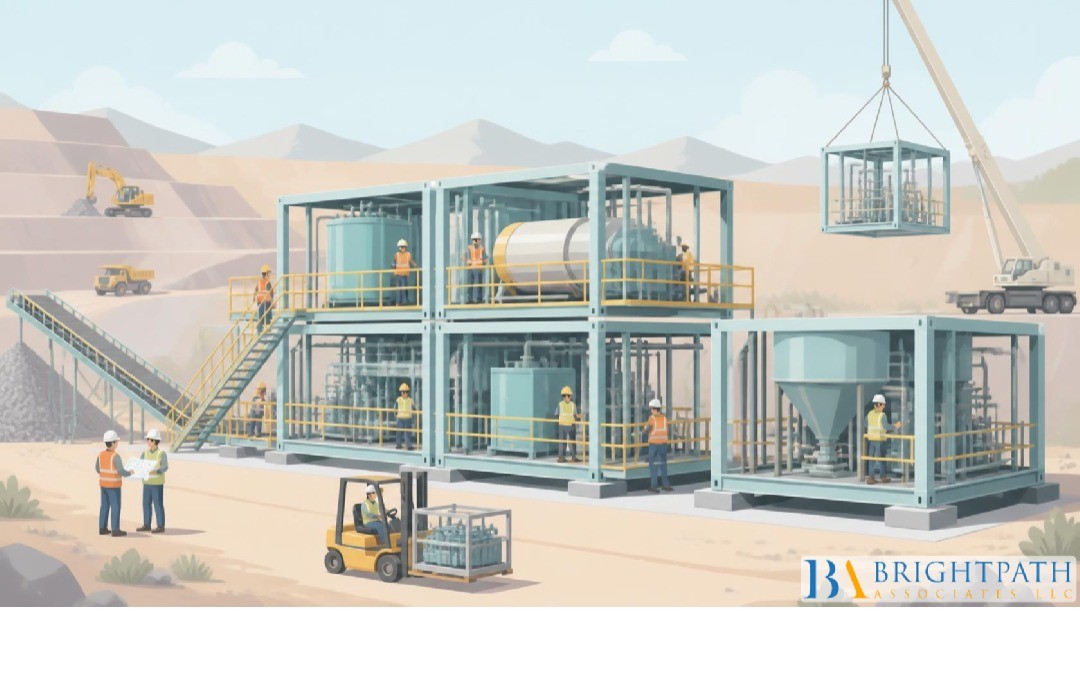
Modular processing plants offer an alternative approach by allowing mining companies to deploy processing capacity in standardized, scalable, and transportable configurations. Instead of constructing an entire processing facility from the ground up, junior miners can integrate prefabricated processing modules designed for specific stages of mineral treatment. This approach can shorten project schedules, improve capital flexibility, and allow companies to respond more quickly to market opportunities.
As #MiningTechnology continues to evolve, modular processing is becoming increasingly relevant to companies seeking faster project development without compromising operational reliability, environmental performance, or future expansion potential.
The Time-to-Market Challenge for Junior Miners
For junior mining companies, time is closely connected to financial survival. Exploration programs, feasibility studies, permitting, financing, infrastructure development, equipment procurement, and construction can consume substantial resources before production begins.
Delays can increase project costs and create additional exposure to changing commodity prices. A project that appears economically attractive during feasibility studies may face very different market conditions several years later when production finally begins.
Modular processing can help address this challenge by moving some engineering and fabrication activities away from the mine site. Equipment can be manufactured, assembled, and tested in controlled environments before being transported to the project location, potentially reducing installation time and supporting faster #ProjectDevelopment.
A modular processing plant consists of individual equipment packages or processing units that can be assembled into a complete mineral-processing system. Depending on the ore type, modules may support crushing, screening, grinding, separation, concentration, dewatering, or other processing stages.
The modular concept allows companies to design facilities around current production requirements while maintaining the ability to add capacity later. This scalability can be particularly valuable for junior miners that may not have sufficient capital to build a large processing plant at the beginning of a project’s life.
Instead of making the maximum possible investment immediately, operators can create a phased development strategy based on #ProcessingCapacity requirements.
The Role of Metals Industry Trends
Changing Metals industry trends are influencing how mining companies approach project development. Demand for critical minerals, energy-transition materials, specialty metals, and industrial commodities is encouraging exploration and development in new regions.
At the same time, investors are increasingly examining capital efficiency, environmental performance, project timelines, and operational flexibility. Junior miners must therefore demonstrate not only that their deposits are economically viable but also that they can move efficiently from development to production.
Modular processing can provide an attractive response to these expectations because it allows companies to align investment with production milestones and market conditions.
Successful modular plant deployment begins with understanding the orebody. Metallurgy determines how minerals behave during crushing, grinding, separation, concentration, and recovery.
A processing solution that works effectively for one deposit may not perform equally well for another. Ore variability, mineral composition, particle size, moisture content, hardness, and liberation characteristics can all influence equipment selection.
Metallurgical testing should therefore be conducted before finalizing the modular design. Laboratory and pilot-scale testing can help determine the appropriate #ProcessDesign and identify potential recovery challenges before equipment is purchased.
Improving Ore Extraction and Processing Integration
Ore extraction and mineral processing should not be treated as separate activities. The characteristics of material delivered from the mine directly influence processing performance.
Changes in ore hardness, grade, moisture, and mineral composition can affect throughput and recovery. A modular processing facility can provide some flexibility, but it still needs to be designed around realistic ore characteristics.
Better integration between mining and processing teams can improve production planning. Real-time geological information, stockpile management, and process monitoring can help operators maintain consistent feed quality and improve #OreProcessing performance.
Modern Mining technology is improving the ability of junior miners to operate smaller and more efficient processing facilities. Digital sensors, remote monitoring, automation, advanced control systems, and process analytics can provide greater visibility into equipment performance.
Automation can also reduce the number of manual interventions required in certain processing stages. Remote monitoring can allow technical teams to identify abnormal operating conditions before they become major failures.
For junior miners operating in remote regions, technology-enabled monitoring can be particularly valuable because bringing specialized personnel to site can be expensive and time-consuming. Connected systems can support #DigitalMining capabilities while improving operational visibility.
Metal Processing Efficiency
The objective of Metal processing is not simply to move ore through a plant. It is to maximize recovery while controlling energy consumption, water usage, reagent requirements, maintenance costs, and product quality.
Modular facilities can support efficiency by using equipment specifically sized for the expected production volume. Oversized equipment can create unnecessary capital and operating costs, while undersized systems can restrict production.
A carefully engineered modular plant can therefore create a better relationship between capacity and investment. Operators can also add modules when production increases, supporting #ProcessingEfficiency.
Environmental performance is becoming increasingly important across the mining sector. Sustainable mining requires companies to consider energy consumption, water management, waste generation, land disturbance, emissions, and community impacts.
Modular processing facilities can potentially reduce construction waste and simplify certain aspects of site development. Smaller initial facilities may also reduce the amount of permanent infrastructure required during early-stage operations.
However, modular does not automatically mean sustainable. Environmental performance depends on equipment efficiency, power sources, water systems, waste management, process chemistry, and site design. Sustainability must therefore be integrated into #MiningOperations from the beginning.
Mining Innovation and Project Development
Mining innovation increasingly focuses on reducing development costs, improving recovery, increasing automation, and shortening project timelines. Modular processing aligns with this broader innovation agenda by changing how processing infrastructure is designed and deployed.
Rather than treating a processing plant as a single large construction project, companies can approach it as a collection of integrated systems. This allows engineering teams to identify opportunities for standardization and repeatability.
For junior miners, this approach can support #MiningInnovation by making advanced processing technologies more accessible at smaller production scales.
One of the most important benefits of modular processing is capital flexibility. Junior miners frequently operate under tighter financial constraints than large mining companies.
A conventional processing plant may require a substantial upfront investment before the company has generated significant operating revenue. Modular facilities can allow businesses to deploy a smaller initial capacity and expand as production and cash flow increase.
This staged approach can reduce initial capital exposure while creating a pathway for future growth. It can also help companies demonstrate operational performance to investors before committing to larger expansion projects.
Mining Policy and Regulatory Considerations
Mining policy and permitting requirements can significantly influence project timelines. Even when modular processing reduces construction complexity, the project may still require environmental approvals, water permits, land-use permissions, safety certifications, and other regulatory clearances.
Companies should therefore integrate regulatory planning into the modular development strategy from the beginning. Equipment selection and plant configuration should account for applicable environmental and operational requirements.
Early engagement with regulators and local stakeholders can reduce uncertainty and help companies develop a more realistic #RegulatoryStrategy.
Modular processing depends heavily on reliable equipment manufacturing and transportation. Standardized modules can simplify procurement, but mining companies still need to consider supplier lead times, equipment availability, shipping requirements, spare parts, and site access.
Remote mining locations can create logistical challenges, particularly when large modules must be transported over difficult terrain.
Procurement planning should therefore begin early. Companies can also evaluate suppliers based on technical support, maintenance capabilities, commissioning expertise, and long-term service availability rather than focusing exclusively on purchase price.
Workforce Requirements and Technical Expertise
Although modular plants can simplify certain construction activities, they still require skilled employees to operate and maintain them. Automation may reduce some manual tasks, but it increases the importance of controls, instrumentation, process engineering, maintenance, and data-analysis capabilities.
This creates a growing need for specialized mining professionals who can work across engineering and operational disciplines. Mining executive search can help organizations identify leaders capable of managing modern processing environments and building technically capable teams.
The right leadership can ensure that technology investment is supported by appropriate workforce development.
The Role of Mining and Metals Recruiters
As mining technology becomes more sophisticated, talent requirements are changing. mining and metals recruiters can help junior miners identify engineers, metallurgists, processing specialists, maintenance leaders, automation professionals, and operational executives with relevant experience.
For smaller companies, recruitment can be particularly challenging because they may compete with larger mining organizations for specialized talent.
A strong employer proposition, career development opportunities, and exposure to innovative projects can help junior miners attract professionals interested in working in flexible and technologically advanced environments.
The success of a modular processing strategy ultimately depends on leadership. Senior executives must coordinate financing, engineering, procurement, regulatory requirements, construction, commissioning, operations, and workforce planning.
#ExecutiveSearchRecruitment can support junior miners by identifying leaders with experience in mining operations, metallurgy, project development, technology implementation, and commercial strategy.
The ideal executive should understand how to balance speed with technical rigor. Accelerating construction is valuable only when the resulting facility can operate safely, reliably, and economically.
Modular Processing as a Strategic Advantage
Modular processing should not be viewed simply as a construction technique. It can become part of a broader business strategy.
A junior miner can use modular infrastructure to test production assumptions, establish early revenue, demonstrate operational capability, and create a foundation for future expansion. If market conditions change, modular capacity can potentially provide greater flexibility than a fixed large-scale facility.
This adaptability can become a competitive advantage in markets where commodity prices, customer requirements, technology, and regulatory conditions are evolving rapidly.
The future of modular processing is likely to involve greater automation, improved sensors, advanced process controls, remote operations, digital twins, predictive maintenance, and data-driven optimization.
As equipment becomes more connected, operators may gain greater visibility into plant performance and recovery rates. Artificial intelligence and advanced analytics could further improve process optimization and maintenance planning.
These developments may allow junior miners to operate smaller facilities with greater efficiency and technical sophistication. The combination of modular infrastructure and advanced technology could support a new generation of #FutureMining projects.
Conclusion
Modular processing plants provide junior miners with a practical approach to reducing time-to-market while maintaining flexibility for future expansion. By using prefabricated and scalable processing systems, companies can potentially shorten construction timelines, manage capital more effectively, and respond more quickly to changing market conditions.
However, modular processing is not a substitute for careful geological evaluation, metallurgical testing, regulatory planning, workforce development, and operational discipline. The technology must be matched to the orebody, production strategy, environmental requirements, and long-term business objectives.
As Metals industry trends, Mining technology, Sustainable mining, Metal processing, and Mining innovation continue to evolve, junior miners will need strategies that combine speed with reliability. Strong technical leadership and specialized talent will remain central to this transformation.
By combining modular infrastructure with thoughtful Mining executive search, effective mining and metals recruiters, and strategic Executive Search Recruitment, junior mining companies can build teams capable of turning innovative processing concepts into commercially viable operations. The result can be a more agile mining model in which faster development, scalable infrastructure, technological innovation, and responsible resource management work together to create sustainable long-term value.
Find your next leadership role in Mining & Metals Industry today!
Stay informed with the latest insights on Mining & Metals Industry!