
Introduction
Manufacturing is no longer defined only by machines, production lines, and human operators. Across forestry, paper, pulp, timber, and #WoodProductManufacturing, industrial organizations are moving toward increasingly connected environments where artificial intelligence, robotics, automation, sensors, analytics, and human expertise operate together. This transition is creating a new workforce requirement: professionals who can coordinate people and intelligent machines rather than simply operate one system.
The rise of the human-machine orchestrator reflects a fundamental shift in how industrial work is organized. Traditional automation focused on replacing repetitive manual activities or improving individual production steps. Modern industrial automation focuses on connecting multiple systems, interpreting real-time data, managing exceptions, and continuously improving operations.
For companies working with Forest product innovation, Paper recycling solutions, Sustainable materials, and advanced Paper and pulp technology, this distinction is becoming increasingly important. The next generation of industrial leaders will need to understand both technology and people. They must know how automated systems work, while also understanding production economics, workforce capabilities, safety requirements, quality standards, and customer expectations.
A human-machine orchestrator is a professional who coordinates the interaction between employees, automated equipment, artificial intelligence systems, robotics, and industrial software. Instead of focusing exclusively on a single machine or department, this role looks at the entire operational ecosystem.
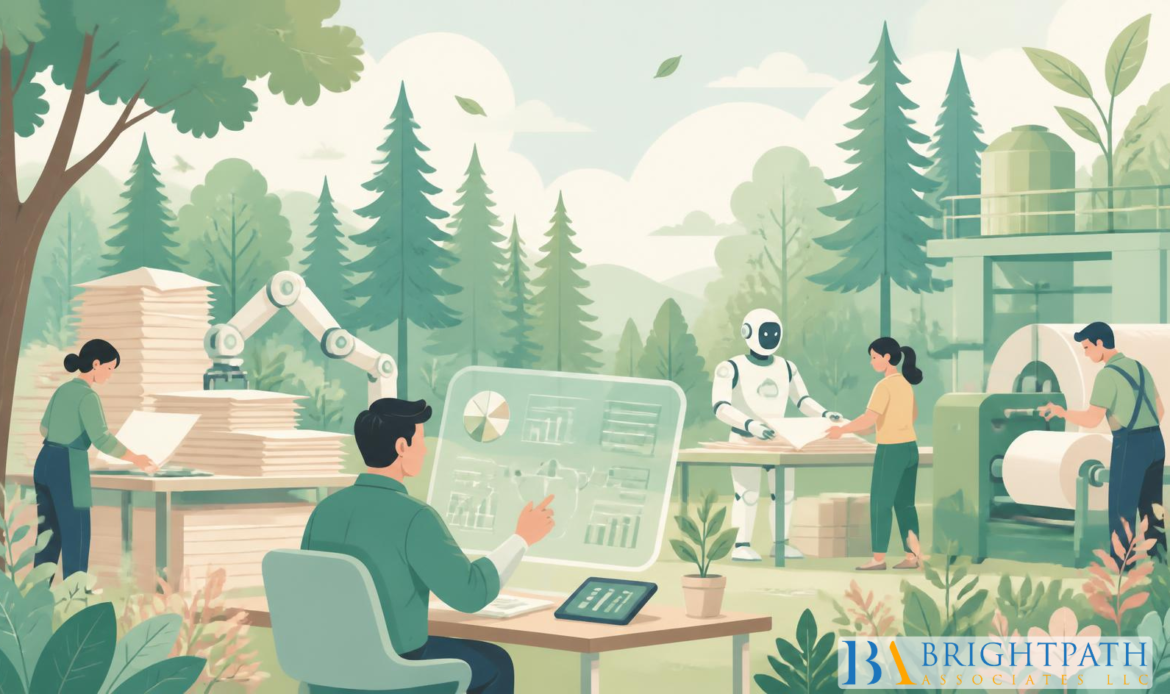
In a modern paper mill, for example, automated inspection systems may detect quality variations while sensors continuously monitor moisture, temperature, pressure, and machine performance. Artificial intelligence may identify potential equipment failures, while production software adjusts scheduling according to demand. Human workers still make critical decisions, particularly when unusual conditions occur.
The orchestrator connects these capabilities. They determine where automation should be applied, where human judgment remains essential, how information should move between systems, and how employees should respond when technology identifies an operational issue.
This makes the position particularly valuable in industries where production environments are complex and capital-intensive.
Why Traditional Automation Skills Are No Longer Enough
#IndustrialCompanies have invested heavily in automation for decades. However, purchasing advanced machinery does not automatically create an intelligent manufacturing operation. Organizations can have robotics, sensors, enterprise software, artificial intelligence, and automated inspection systems while still struggling to connect them effectively.
The challenge is increasingly organizational rather than purely technological.
A company may introduce robotic equipment into a converting operation, for example, but employees may not understand how to interpret the data produced by that equipment. Similarly, an AI-powered maintenance system can identify an emerging equipment problem, but someone must determine whether production should be stopped, whether maintenance should be scheduled immediately, or whether the issue can be monitored.
A human-machine orchestrator provides that layer of coordination.
This role is particularly relevant to Automation in Paper industry operations because paper manufacturing involves interconnected processes where a small disruption in one area can affect production, energy consumption, quality, inventory, and delivery schedules throughout the plant.
The value of a human-machine orchestrator comes from combining technical knowledge with practical industrial experience. The person filling this position does not necessarily need to be a software engineer. Instead, they need a strong understanding of how technology affects production decisions.
In the paper and pulp sector, this could involve understanding pulp quality, fiber characteristics, machine performance, energy requirements, water consumption, chemical usage, and production scheduling. In timber operations, the same professional may need to understand Timber harvesting processes, equipment utilization, transportation logistics, forest conditions, and safety requirements.
The role becomes even broader when organizations consider Lumber industry trends and changing customer requirements. Demand for traceable, sustainable, and efficiently produced materials is increasing the importance of data across the supply chain.
The orchestrator therefore becomes a bridge between engineering, operations, IT, maintenance, sustainability, and management.
The Role in Forest Product Innovation
#ForestProductInnovation increasingly depends on the ability to transform raw materials into higher-value products while improving resource efficiency. Companies are exploring engineered wood, recyclable materials, bio-based products, lightweight packaging, and new fiber applications.
These opportunities require experimentation, data analysis, and rapid decision-making.
A human-machine orchestrator can help coordinate these activities by connecting research and development teams with manufacturing operations. Data collected from production equipment can help identify process improvements, while machine learning can reveal relationships between raw-material characteristics and finished-product quality.
For companies pursuing Forest product innovation, this creates a more integrated approach to product development. Instead of developing products separately from manufacturing capabilities, organizations can use real-world production data to determine what can be produced efficiently and consistently.
Paper recycling is another area where human-machine coordination can create significant operational value. Modern Paper recycling solutions increasingly rely on automated sorting, optical inspection, material tracking, contaminant detection, and process monitoring.
However, automated systems still encounter unusual materials and unpredictable conditions. Recycled fiber streams can vary considerably depending on their source and contamination levels.
A human-machine orchestrator can establish the decision-making framework around these technologies. Automated systems can identify patterns and anomalies, while experienced employees determine how the plant should respond.
This combination can improve consistency without removing human expertise from the process. It also allows workers to move away from repetitive inspection tasks and toward higher-value activities involving process optimization, troubleshooting, and quality management.
Managing the Economics of Modern Paper Production
#TechnologyInvestment must ultimately translate into measurable business value. This is where an understanding of Paper industry economics becomes essential.
An advanced automation system may improve machine uptime but require significant capital investment. An AI platform may reduce maintenance costs but require data infrastructure and employee training. Robotics may improve productivity but change staffing requirements.
The human-machine orchestrator must therefore understand more than technical performance. They need to evaluate how technology affects operating costs, labor utilization, production capacity, energy consumption, waste, maintenance expenses, product quality, and overall profitability.
This financial perspective prevents organizations from adopting technology simply because it is available. Instead, automation becomes a strategic tool aligned with measurable business objectives.
Sustainability is also changing the requirements for industrial leadership. Companies increasingly need to evaluate raw materials, production processes, waste streams, energy consumption, emissions, and product lifecycles.
The move toward Sustainable materials creates new opportunities for automation and data analytics. Digital systems can track material flows, identify waste, monitor energy usage, and provide information that supports sustainability reporting.
A human-machine orchestrator can connect these systems with operational decision-making. Instead of treating sustainability as a separate corporate initiative, the organization can integrate environmental objectives directly into manufacturing processes.
For example, production teams can use real-time data to identify excessive material waste or inefficient equipment operation. Management can then evaluate whether process changes, equipment upgrades, or employee training could improve both environmental and financial performance.
Navigating Forestry Regulations and Compliance
The forestry and wood-products sectors operate within complex regulatory environments. #ForestryRegulations can affect harvesting practices, land management, transportation, environmental protection, traceability, and sourcing requirements.
Technology can help organizations collect and organize compliance data, but technology alone cannot interpret every operational situation.
A human-machine orchestrator can coordinate digital monitoring systems with compliance teams and field personnel. Data from harvesting equipment, geographic information systems, supply-chain platforms, and inventory systems can be combined to improve visibility.
This becomes increasingly important as customers demand greater transparency regarding the origin and sustainability of wood and fiber products.
Wood product manufacturing is also becoming increasingly automated. Computer-controlled machinery, machine vision, robotics, digital production planning, and predictive maintenance systems are changing how lumber and engineered wood products are processed.
Yet automation creates new challenges. Machines may become faster and more sophisticated while production teams become more dependent on accurate data and reliable software.
The human-machine orchestrator helps manage this transition. They can identify bottlenecks, coordinate equipment upgrades, establish human intervention protocols, and ensure that operators receive the training needed to work effectively alongside automated systems.
The objective is not simply to automate more tasks. It is to create a production environment where humans and machines perform complementary functions.
Why This Role Matters for Workforce Development
Introducing advanced technology without preparing employees can create resistance, confusion, and underutilized equipment. Workforce development therefore becomes a central part of industrial transformation.
Human-machine orchestrators can help identify which tasks should remain human-led, which can be automated, and which require collaboration between people and machines. They can also help define new training requirements.
Employees may need to learn data interpretation, digital troubleshooting, machine-interface management, robotics supervision, or AI-assisted decision-making. Experienced operators remain valuable because their practical knowledge can help identify conditions that algorithms may not recognize.
The future workforce is therefore not necessarily less human. It is more #DigitallyConnected.
Finding the Right Candidate Through Executive Search Recruitment
Because this position combines multiple disciplines, finding the right professional can be challenging. Traditional recruitment approaches may focus too narrowly on engineering qualifications or technology experience.
#ExecutiveSearchRecruitment can help organizations identify candidates with a broader combination of capabilities. The ideal candidate may have experience in manufacturing operations, automation, engineering management, digital transformation, maintenance, supply-chain systems, or industrial technology.
More importantly, they should demonstrate the ability to communicate across departments. A successful orchestrator must be able to explain technical concepts to executives, operational requirements to technology teams, and business objectives to plant personnel.
Leadership, adaptability, analytical thinking, and practical industrial judgment can be just as important as technical credentials.
Building the Industrial Organization of Tomorrow
The emergence of the human-machine orchestrator signals a larger change in industrial employment. Companies are moving from isolated automation projects toward interconnected production ecosystems.
In this environment, success depends on coordination. Machines generate information. Artificial intelligence identifies patterns. Robotics performs physical tasks. Software connects processes. Employees provide judgment, creativity, contextual understanding, and accountability.
The human-machine orchestrator brings these capabilities together.
For organizations involved in forestry, pulp and paper, lumber, recycling, and wood product manufacturing, this role can support a more integrated approach to modernization. It can help companies evaluate technology investments, improve workforce capabilities, strengthen operational resilience, and connect sustainability objectives with commercial performance.
Conclusion
The industrial organizations of the future will not necessarily be those with the greatest number of machines. They will be those that can coordinate technology, people, information, and processes effectively.
From Forest product innovation and Paper recycling solutions to Timber harvesting and advanced Wood product manufacturing, technology is changing the way industrial companies operate. At the same time, Paper industry economics, Forestry regulations, Sustainable materials requirements, and evolving Lumber industry trends are creating additional pressure for organizations to become more adaptable.
The human-machine orchestrator is designed for this environment. By connecting human expertise with automation and intelligent systems, this professional can help companies move beyond basic automation toward coordinated industrial intelligence.
For #ExecutivesPlanning their next strategic hire, the question is no longer simply whether a candidate understands machines or people. The more important question is whether that person can make both work together effectively. That capability may become one of the defining leadership requirements of the next generation of manufacturing.
Find your next leadership role in Paper & Forest Industry today!
Stay informed with the latest insights on Paper & Forest Industry!