
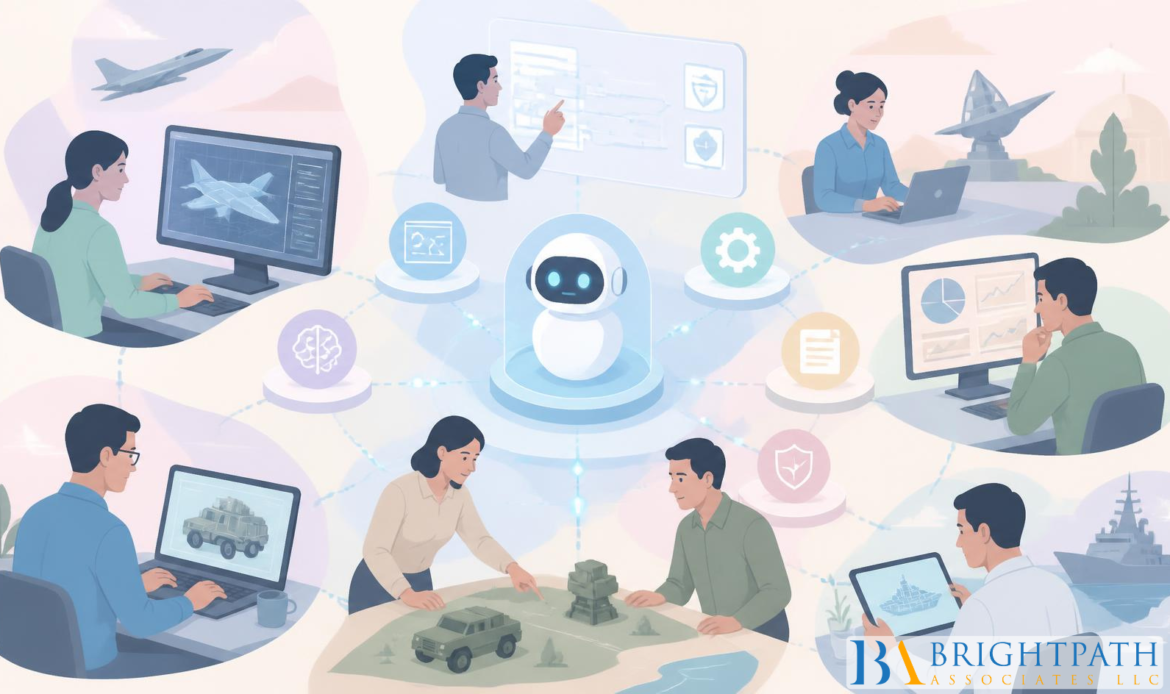
[Bethany, Connecticut – 15 September 2026] — BrightPath Associates has released new insights highlighting how AI Agents can help aerospace, defense, and advanced manufacturing organizations improve engineering productivity while controlling development costs. The analysis examines how carefully deployed AI Agents can support documentation, design analysis, simulation preparation, testing, data processing, and knowledge management. For C-Suite leaders managing increasingly complex programs, the approach offers a practical path toward measurable savings while maintaining human oversight, security, and engineering accountability.
AI Agents Create New Engineering Efficiency Opportunities
Engineering organizations across the Defense and Space sector manage enormous volumes of technical documentation, requirements, simulations, testing records, design iterations, and regulatory information. These activities are essential, but many involve repetitive information-processing work that can consume valuable engineering time.
BrightPath Associates’ latest analysis, Integrating AI Agents into Your Engineering Workflow, explains how organizations can identify workflows where intelligent automation can deliver measurable value. AI Agents can organize requirements, summarize test results, compare technical documents, retrieve information, support simulation workflows, and prepare preliminary reports while experienced engineers retain responsibility for critical decisions.
The article emphasizes that a successful savings plan should begin with a baseline rather than technology adoption alone. Organizations can evaluate engineering documentation time, simulation preparation, testing administration, requirements management, quality reviews, and technical research to identify areas with the greatest automation potential. Measuring workflow duration and productivity before and after implementation can provide a clearer return-on-investment picture.
Defense Space Systems Demand Secure AI Adoption
The opportunity is particularly significant for Defense Space Systems, where engineering teams must coordinate complex structures, propulsion, communications, sensors, power systems, software, and mission operations. AI Agents can help organize technical information, review requirements, support testing activities, and prepare simulation inputs, allowing engineers to focus more time on architecture, validation, problem-solving, and innovation.
However, security remains central to AI adoption. Space Cybersecurity must be incorporated into the implementation strategy from the beginning because AI systems may introduce risks involving unauthorized access, data leakage, malicious inputs, or manipulation. Access controls, authentication, monitoring, data-classification policies, and human approval requirements can help protect sensitive technical information.
The same principle applies to Space Electronics and Space Robotics, where engineering teams work with highly specialized systems and multidisciplinary data. AI Agents can assist with requirements traceability, documentation, design-review preparation, testing workflows, and simulation activities. In robotics programs, faster design and testing cycles can help teams move more efficiently from concepts to prototypes and validation.
Simulation and Manufacturing Gain Strategic Value
Defense Simulation represents another important opportunity for AI-assisted engineering. Simulations can generate significant amounts of structured and unstructured information, requiring engineers to prepare models, configure scenarios, analyze results, and document findings. AI Agents can support these repetitive activities by organizing inputs, comparing outputs, identifying unusual results, and preparing preliminary summaries for expert review.
In Defense manufacturing, AI-enabled workflows can connect engineering intelligence with production information. Agents can assist with production documentation, work instructions, quality-data analysis, inventory information, and maintenance workflows. This connection can create a feedback loop in which manufacturing experience informs future engineering and design decisions.
These capabilities align with broader Aerospace industry trends, including digital engineering, model-based systems engineering, advanced simulation, autonomous systems, additive manufacturing, and data-driven development. For C-Suite executives, the strategic question is increasingly not whether AI should be considered, but where it can deliver measurable operational value without compromising quality or security.
Building an AI-Ready Defense and Space Workforce
The long-term opportunity is to create engineering environments where AI Agents become trusted productivity tools rather than standalone technology projects. Successful implementation requires continuous monitoring, employee training, cybersecurity controls, governance, and regular evaluation of AI-generated outputs.
BrightPath Associates’ Defense and Space industry insights provide additional context for organizations navigating leadership, workforce, and technology priorities. As aerospace and defense programs become more digitally connected, organizations that combine intelligent automation with strong leadership and disciplined governance can position themselves for greater productivity, innovation, and long-term competitiveness.
About BrightPath Associates
BrightPath Associates is an executive recruitment and talent solutions firm helping organizations identify the leadership and specialized professionals needed for sustainable growth. The company supports workforce planning and strategy, leadership development, retention strategies, design and optimization, and workplace initiatives across multiple industries. Its mission is to connect organizations with the right talent while helping businesses build stronger teams and improve long-term performance.
Media Contact:
Name: Corporate Communications Team
Company: BrightPath Associates
Email: media@brightpathassociates.com
Website: https://brightpathassociates.com