
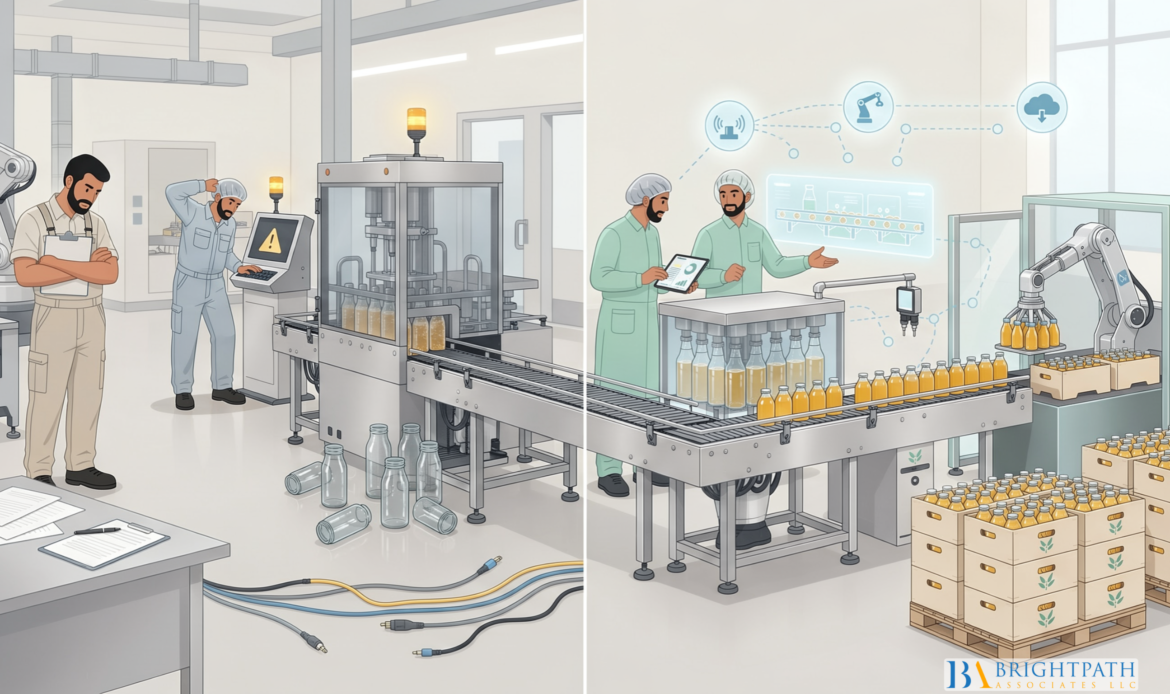
Why Industry 4.0 Failed for Some F&B Leaders And How to Succeed for Industrial Automation Industry is not mainly a story about sensors, robotics, or AI. It is a story about execution. Food and beverage manufacturers often invested in connected equipment before they had stable processes, usable machine data, clear ownership, or the #TechnicalLeaders needed to turn alerts into better operating decisions.
Industry 4.0 combines industrial automation, connectivity, data analysis, and intelligent decision support. In F&B manufacturing, that promise can be compelling: less downtime, stronger traceability, more consistent quality, and faster responses to process variation. Yet the technology can disappoint when a plant treats it as a purchase rather than an operating model.
Table of Contents
• Why F&B Industry 4.0 Programs Stalled
• Use a Readiness Gate Before Funding Automation
• Build the Business Case and Scale What Works
• Treat Leadership and Talent as Operating Requirements
• Key Takeaways
• FAQ Section
Why F&B Industry 4.0 Programs Stalled
Technology Was Installed Before the Operating Model Changed
The most common mistake is sequencing. A manufacturer buys IIoT sensors, upgrades SCADA systems, or launches machine vision without first deciding which production decision the new information should improve. The result is often more data, not more control.
Automation is the execution of a task. Connectivity is the movement of information. Intelligence is the use of information to improve a decision. These are related, but they do not create value in the same way.
A connected temperature sensor may report a refrigerator temperature every few minutes. That is useful visibility. It becomes operational value only when someone owns the alert, knows the acceptable range, has authority to act, and documents the response. The Rochester Institute of Technology’s craft cannery case study shows that machine monitoring can warn operators or maintenance teams about abnormal behavior or approaching failure, helping reduce quality losses and unplanned downtime.
That distinction matters because many failed initiatives measured installation rather than use. A dashboard may be technically complete while supervisors still make decisions through spreadsheets, phone calls, and #OperatorMemory. In that situation, the plant has added another system without changing how work gets done.
Food Manufacturing Is Not a Generic Automation Environment
F&B plants operate under constraints that make standard automation templates unreliable. Hygiene requirements, batch traceability, temperature control, shelf life, allergen segregation, sanitation cycles, and variable agricultural inputs all affect process control.
Raw material variability is especially important. A controller tuned for one lot of ingredients may not behave the same way when moisture, viscosity, sugar content, fat content, or particle size changes. A food automation case study reported that seasonal raw material changes required frequent controller retuning and increased operating costs. This is not simply a PLC programming issue. It is a control strategy, data history, and workforce capability issue.
A plant that relies on experienced operators to make constant low level adjustments may maintain output in the short term. But it also creates dependence on individual knowledge. If that operator leaves, the line may lose performance faster than leadership expects.
Machine telemetry means time stamped operating data generated by equipment. Without historical telemetry, teams cannot easily compare a current quality deviation with similar events from prior runs, shifts, lines, or facilities. This makes root cause analysis slower and makes cross plant learning difficult.
Fragmented Systems Created Automation Islands
Many plants have equipment from several vendors, installed over decades. Some machines can share data easily; others have proprietary interfaces, aging controls, or no meaningful digital record at all. Connecting every machine is not automatically the right answer. Connecting the machines that govern a major quality, downtime, throughput, or energy decision usually is.
A 2021 food manufacturing case study examined a traditional manufacturer transitioning toward Industry 4.0 while using machinery more than 100 years old. The practical lesson is that legacy equipment does not automatically require replacement. It requires an honest evaluation of reliability, safety, data access, maintainability, and integration cost.
The decision is usually between three options:
| Option | Best Fit | Main Risk | Leadership Question |
|---|---|---|---|
| Retrofit legacy equipment | The machine is mechanically reliable and data access is feasible | Hidden integration effort and limited support | Can the retrofit produce usable, secure data? |
| Replace the asset | Reliability, safety, or maintainability is poor | Large capital outlay and production disruption | Does replacement solve a business constraint beyond connectivity? |
| Isolate the asset temporarily | The machine is not central to the initial use case | A permanent data blind spot | Can the pilot work without this machine’s data? |
Leaders should resist a false choice between total replacement and doing nothing. A #TargetedRetrofit can be appropriate when it supports a defined business outcome. It is less appropriate when it merely adds another disconnected dashboard.
Use a Readiness Gate Before Funding Automation
Approve Projects Only When the Plant Can Use the Output
Before approving a major industrial automation investment, we should apply a readiness gate. This is not a universal scoring model, and available research does not establish a validated U.S. standard. It is a practical decision method for preventing a pilot from becoming an expensive demonstration.
A project should pass six conditions before it moves from concept to implementation:
- Stable process baseline: The plant can define current downtime, scrap, yield, quality events, labor effort, or energy use for the targeted process.
- Clear data ownership: A named role is accountable for data definitions, access, accuracy, retention, and escalation.
- Actionable workflow: Operators, maintenance staff, and supervisors know what they will do when an alert or recommendation appears.
- Technical fit: Equipment interfaces, network capacity, SCADA systems, cybersecurity controls, and data storage can support the proposed design.
- Workforce capability: The plant has a realistic plan to train operators, technicians, engineers, and managers for their distinct responsibilities.
- Business metric: The project has one primary outcome, a baseline, a target, and a review date.
If a team cannot describe the response to an alert, it is not ready to automate the alert.
This discipline addresses a recurring weakness in F&B adoption. A 2024 Bangladesh study identified and prioritized 20 barriers to Industry 4.0 adoption in food and beverage manufacturing. The study highlights that obstacles are not limited to equipment. Financial constraints, management support, workforce skills, digital strategy, resource limitations, and employee resistance can all interact.
Define Cybersecurity and Continuity Before Connection
Operational technology is different from ordinary office IT. A production line may have safety, sanitation, quality, and delivery consequences if a networked control system fails or becomes unavailable. Connectivity should therefore be designed with access control, network segmentation, backups, patching responsibilities, vendor access rules, and incident response in mind.
Business continuity also matters. A system should not make the plant less resilient by concentrating too much control in a single point of failure. For example, a centralized system may provide better coordination across lines, but operators may still need defined local procedures if a network, server, or site connection is lost.
This is where executive accountability matters. The chief operating officer may own the operating result, the automation leader may own technical delivery, the plant manager may own adoption, and IT or OT security leadership may own system protection. A shared project with no named decision owner is usually a delayed project.
Build the Business Case and Scale What Works
Separate Automation ROI From Visibility ROI
Not every digital project should be justified by labor reduction. In #FoodManufacturing, value may come from avoiding a quality hold, detecting a refrigeration issue before product loss, improving changeover discipline, reducing maintenance response time, or improving yield consistency.
Leaders should separate the sources of value rather than presenting one blended Industry 4.0 return estimate.
| Investment Type | Primary Value Mechanism | Useful Metric | Common Mistake |
|---|---|---|---|
| Automation | Reduces manual execution or improves repeatability | Cycle time, labor hours, throughput | Assuming every automated task removes a full role |
| Connectivity | Improves visibility across machines or sites | Data completeness, reporting time, response time | Treating data collection as a finished outcome |
| Analytics or AI | Improves prediction or recommendations | Forecast accuracy, false alert rate, avoided downtime | Using weak or inconsistent data for complex models |
| Centralized control | Coordinates line or plant decisions | Yield, line balance, quality consistency | Optimizing one machine while weakening total line performance |
The right ROI measure is tied to the constraint the project removes, not to the technology category on the purchase order.
Financial pressure is real. A 2025 study of Tanzanian F&B manufacturers reported that new equipment, sensors, analytics, ROI assessment, technical talent, maintenance, repair, and training all created financial challenges. The same reported finding is indexed by the study’s open access record. Those findings are international rather than U.S. benchmarks, but the cost categories are relevant questions for U.S. leaders evaluating a capital request.
A credible business case should quantify at least four categories:
• Capital and implementation cost, including integration, validation, downtime, and vendor support
• Recurring cost, including software, connectivity, calibration, cybersecurity, maintenance, and training
• Measurable operating benefit, such as prevented product loss, lower downtime, improved yield, or fewer manual interventions
• Adoption cost, including supervisor time, operator training, revised procedures, and temporary productivity disruption
Use a Pilot Stop Rule
Pilots are useful only when they create evidence for a scale decision. A pilot that improves visibility but does not improve a business KPI should not be scaled automatically.
Set a stop rule before launch. For example, a monitoring pilot might continue only if it produces accurate alerts, timely responses, and measurable improvement in a selected outcome over an agreed review period. If alerts are ignored, false alarms are frequent, or the data does not change a decision, redesign the workflow before buying more sensors.
This does not mean every early project must show immediate #FinancialReturn. Some projects are foundational, such as creating secure machine connectivity or standardizing data tags. But foundational work should be labeled honestly. Do not promise a direct labor reduction when the actual purpose is data continuity.
For broader context, leaders can review trends and challenges in industrial automation alongside their own plant economics and operating constraints.
Scale by Repeating the Decision System, Not Just the Hardware
A successful pilot is not merely a sensor configuration that worked on one line. It is a repeatable management system: common data definitions, alert thresholds, escalation rules, training materials, cybersecurity standards, maintenance procedures, and KPI reviews.
Scale is harder when every line has different tags, every plant uses different terminology, or every vendor provides a separate portal. Interoperability is the ability of systems from different sources to exchange and use data. It should be treated as a scale requirement, not a technical preference.
A practical scale review should ask whether the next line has the same failure mode, data quality, operator workflow, and economic opportunity. If not, the organization may be copying hardware rather than transferring a proven operating method.
Treat Leadership And Talent As Operating Requirements
The Executive Role Has Expanded
#IndustrialAutomationLeadership now sits across production, engineering, maintenance, quality, data, cybersecurity, and finance. A plant can have strong controls engineers and still struggle if no executive can align these groups around a shared business priority.
The executive requirement is not “technology enthusiasm.” It is the ability to translate operational constraints into an adoption sequence.
For a small or midsized manufacturer, that may mean hiring a plant leader who understands continuous improvement and control systems, an automation director who can manage systems integration, or an operations executive who can make capital decisions under quality and staffing pressure. The right profile depends on the operating problem.
| Hiring Need | Capabilities to Test | Warning Sign |
|---|---|---|
| Plant or operations leader | KPI ownership, change management, food safety coordination, line performance | Focuses on technology without defining the business constraint |
| Automation leader | PLC programming service oversight, SCADA systems, OT architecture, vendor management | Can integrate machines but cannot build operator adoption |
| Engineering executive | Robotics integration, industrial machine vision, capital planning, reliability | Treats every legacy asset as a replacement candidate |
| Digital transformation leader | Data governance, analytics prioritization, cybersecurity coordination | Builds dashboards without operational decision rights |
Why Conventional Recruiting Can Miss the Mark
A job description that asks for PLC programming, robotics integration, AI, manufacturing automation, food safety awareness, cybersecurity, and enterprise leadership may describe several roles, not one realistic candidate. Employers should distinguish essential capabilities from desirable exposure.
A specialized search should begin with the operating problem, not the title. If the immediate problem is recurring downtime, a reliability oriented automation leader may be a better fit than a broad digital executive. If the problem is disconnected production data across multiple sites, a systems integration leader with governance skills may matter more than a robotics specialist.
Long vacancies can create operational risk when key decisions depend on a small number of technical employees. Knowledge remains undocumented, capital plans are delayed, vendors receive weak direction, and projects can lose momentum. That does not prove executive search is always necessary. It does show why a structured market map, competency based assessment, and succession plan can be more useful than posting a broad job description.
When evaluating how digital transformation drives automation, leaders should also assess whether their organizational structure supports the technology. A new platform cannot resolve unclear authority between IT, engineering, and plant operations.
Involve Operators Without Handing Over the Strategy
Operators and maintenance technicians should help design workflows because they understand abnormal conditions, workarounds, sanitation realities, and equipment behavior. Their involvement does not slow a project when it is structured well. It reduces costly rework later.
Ask frontline teams three practical questions:
- Which alarm conditions require immediate action, and which can wait?
- What information is missing when a line problem occurs?
- Which manual decision consumes time but follows a repeatable rule?
Training should be role specific. Operators need to interpret alerts and follow escalation procedures. Maintenance teams need condition monitoring and troubleshooting skills. Engineers need data architecture and controls integration knowledge. Executives need enough understanding to challenge ROI assumptions and governance gaps.
The same people strategy applies to broader strategies for fostering manufacturing innovation: innovation lasts when accountability, skills, and process discipline grow alongside technology.
Key Takeaways
• Industry 4.0 failures in F&B often begin with poor sequencing: technology is purchased before processes, data ownership, workforce roles, and KPIs are ready.
• Food process variability means controls, models, and machine vision systems may require more adjustment than generic manufacturing templates assume.
• A readiness gate should test baseline performance, data quality, ownership, cybersecurity, workflow, workforce capability, and a measurable business outcome.
• Automation ROI, data visibility ROI, and analytics ROI should be calculated separately because they create value through different mechanisms.
• A pilot should stop, pause, or be redesigned when visibility does not produce a better decision or a measurable operating result.
• Industrial automation executive search is most useful when the company has defined the #OperationalProblem and the leadership capabilities required to solve it.
FAQ Section
Why Do Industry 4.0 Projects Fail In Food And Beverage Manufacturing?
They often fail because leaders treat them as equipment projects rather than operating model changes. Weak data, unclear accountability, legacy integration problems, poor workflow design, and skill gaps can prevent a technically sound system from improving production results.
Is Technology Or Leadership The Bigger Problem?
Neither is sufficient alone. Technology can fail without leadership ownership, and leadership cannot create value from systems that produce incomplete or unusable data. The key issue is alignment between the business problem, technical design, workforce process, and decision rights.
What Should An F&B Plant Automate First?
Start with a process that has a measurable and recurring constraint, such as frequent unplanned downtime, temperature excursions, manual inspection bottlenecks, or repeated changeover errors. Avoid starting with a broad platform purchase when the use case is still unclear.
Should A Company Retrofit Or Replace Legacy Equipment?
Retrofit when the asset is mechanically sound, safe, maintainable, and able to provide useful data at a reasonable integration cost. Replace when reliability, safety, supportability, or capacity constraints make retrofit a temporary and costly compromise.
What Data Is Needed Before Predictive Maintenance Can Work?
The plant needs reliable time stamped #MachineTelemetry, maintenance records, failure history, operating context, and a clear definition of the failure event being predicted. A small amount of inconsistent data is rarely enough to support a dependable predictive model.
How Should Leaders Handle Employee Resistance To Automation?
Explain the operating problem, involve affected employees in workflow design, provide role specific training, and show how decisions will change. Resistance often increases when automation is introduced without clarity about job impact, alert ownership, or new performance expectations.
When Should An Industry 4.0 Pilot Be Stopped?
Stop or redesign it when it cannot produce reliable data, actionable alerts, timely response, or movement in the stated business metric. Continuing a pilot because the technology is interesting can turn a small experiment into a permanent cost.
Resources And Citations
• emerald.com: https://www.emerald.com/insight/content/doi/10.1108/BIJ-06-2023-0371/full/html?skipTracking=true
• onlinelibrary.wiley.com: http://onlinelibrary.wiley.com/doi/10.1002/eng2.70168
• doaj.org: https://doaj.org/article/86aeda243faa404182f2d260c8a71b8f
• BrightPath Associates, Industrial Automation Article: https://brightpathassociates.com/industrial-automation-trends-challenges-and-the-future-of-smart-manufacturing/
Find your next leadership role in Industrial Automation Industry today!
Stay informed with the latest insights on Industrial Automation Industry!