
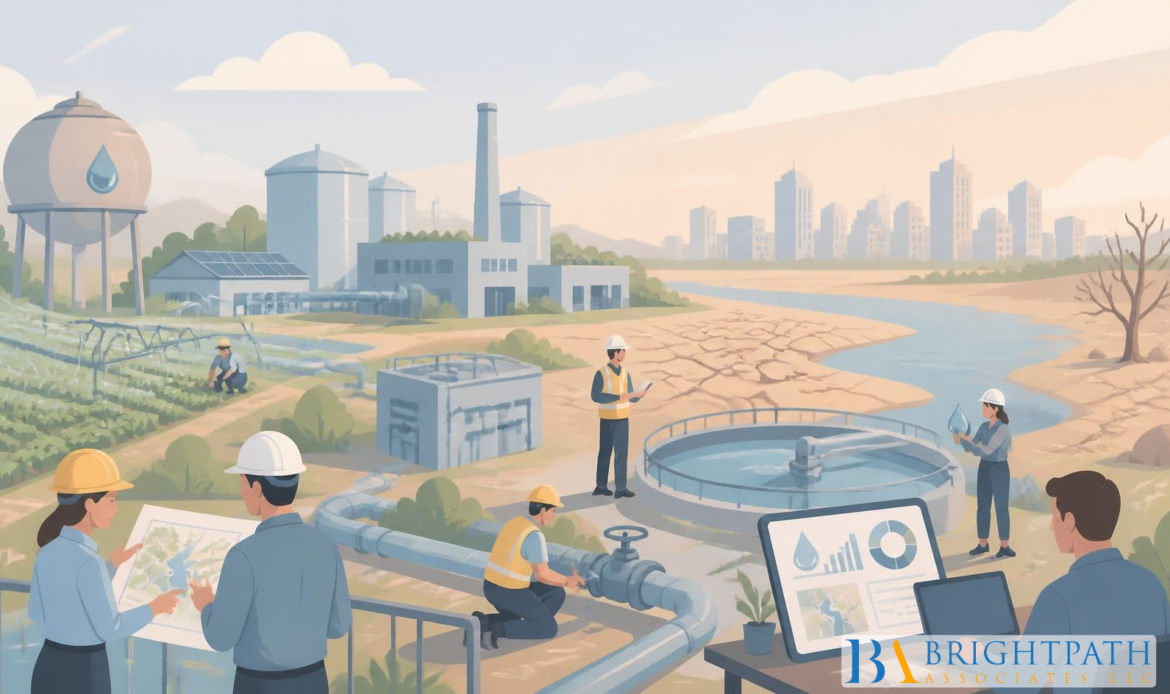
[Bethany, Connecticut – 01 October 2026] — BrightPath Associates has highlighted water scarcity as a growing macro-economic concern for agricultural businesses and food producers preparing for the 2030s. Its latest industry analysis examines how declining water availability, changing climate patterns, and rising resource competition could affect farm productivity, food production, supply chains, and long-term investment decisions. The analysis calls on C-Suite leaders to incorporate water resilience into business planning through agricultural technology, precision agriculture, sustainable farming practices, and stronger operational risk management.
Water Scarcity Moves From Environmental Issue to Business Risk
For agricultural organizations, water availability is directly connected to production capacity. Drought, groundwater depletion, irregular rainfall, and changing weather patterns can influence crop yields, input costs, land productivity, and the reliability of food supply. These pressures can extend beyond individual farms, affecting processors, distributors, retailers, and other businesses across the agricultural value chain.
BrightPath Associates’ analysis, “Water Scarcity: The Macro-Economic Threat and Resilience Planning for the 2030s,” examines why water should increasingly be considered a strategic economic issue rather than only an environmental concern. The article emphasizes the importance of moving from reactive responses to proactive resilience planning, particularly as agricultural businesses make long-term decisions involving land, technology, infrastructure, workforce, and supply networks.
The issue is particularly important for executives responsible for agricultural sustainability and business continuity. A recent assessment by the UK’s Climate Change Committee found that water scarcity already creates significant economic losses across agriculture, industry, and power generation, with losses projected to increase without additional adaptation. The assessment also identified measures such as improved irrigation scheduling and drought-resistant crops as potential responses.
Technology Can Strengthen Agricultural Resilience
Technology is becoming an important component of water management. Precision agriculture can help producers use field-level data to determine when and where crops need water, while sensors, satellite imagery, weather information, and automated irrigation systems can support more efficient resource use. These capabilities can make Digital Farming an important part of long-term resilience strategies.
Farm management software can also help executives and farm operators bring operational, financial, weather, irrigation, and crop information into a more connected decision-making environment. When combined with agricultural data, these platforms can help organizations identify resource-use patterns and plan responses before water constraints become severe.
The broader opportunity extends to Agricultural technology and Agricultural innovation. Investments in drought-resistant crops, efficient irrigation, water recycling, soil-moisture monitoring, and predictive analytics can support more resilient production systems. Research on future water scarcity also indicates that drought-driven water shortages could emerge in multiple regions during the 2020s and 2030s, reinforcing the need for forward-looking planning.
Sustainable Farming Becomes a Strategic Priority
Water resilience is closely connected to Sustainable farming, Organic farming, and other approaches designed to protect soil, improve resource efficiency, and maintain long-term productivity. For agricultural executives, the objective is not simply to reduce water consumption but to develop production systems capable of maintaining performance under changing environmental conditions.
The financial implications can also influence Sustainable agriculture investment. Companies may increasingly evaluate irrigation infrastructure, water storage, soil management, crop diversification, renewable energy, and digital monitoring according to their ability to reduce operational exposure. Such investments can become part of broader business continuity and agricultural sustainability strategies rather than being treated as isolated environmental projects.
The challenge also reaches beyond the farm. Water shortages can disrupt raw-material availability, affect food processing capacity, increase commodity price volatility, and create pressure across food supply networks. Businesses operating across the Farming Industry therefore have an interest in developing coordinated resilience strategies that connect agricultural production with processing, logistics, suppliers, and customers.
Leadership and Workforce Planning for the 2030s
Technology alone cannot solve the challenges associated with water scarcity. Agricultural businesses also need executives and specialized professionals who can connect environmental risks with financial planning, technology adoption, operations, and growth strategies. This makes Executive search recruitment increasingly relevant for organizations seeking leaders with experience in agricultural technology, sustainability, supply chain management, and transformation.
Future-ready agricultural leadership will require an understanding of both traditional production practices and emerging technologies. Executives may need to evaluate investments in precision irrigation, digital platforms, data analytics, sustainable production methods, and resilient infrastructure while maintaining commercial performance.
BrightPath Associates’ analysis encourages leaders to view water resilience as part of long-term strategic planning. The full Water Scarcity Macro-Economic Threat and Resilience Planning analysis explores the issue in greater detail and provides a strategic framework for organizations preparing for changing water conditions.
About BrightPath Associates
BrightPath Associates is an executive recruitment and talent solutions firm serving organizations across the United States. The company helps businesses identify leadership and specialized professionals who can support growth, transformation, and long-term organizational performance. Its mission is to connect companies with the talent required to address evolving business challenges and build stronger teams.
Media Contact:
Name: Corporate Communications Team
Company: BrightPath Associates
Email: media@brightpathassociates.com
Website: https://brightpathassociates.com