
Introduction
Environmental, Social, and Governance (ESG) considerations are becoming increasingly important across the global construction materials sector. #ConcreteManufacturing sits at the center of modern infrastructure development, supporting residential buildings, commercial facilities, transportation networks, industrial plants, and large-scale public projects. However, the sector also faces growing expectations to reduce environmental impacts, improve resource efficiency, strengthen workforce practices, and establish more transparent governance systems.
The importance of ESG in concrete manufacturing extends beyond corporate reporting. Environmental considerations can influence raw-material sourcing, energy consumption, emissions, water use, waste management, and product development. Social factors involve worker safety, skills development, community relationships, and responsible employment practices. Governance encompasses compliance, supply-chain oversight, data management, risk controls, and ethical decision-making.
These considerations are developing alongside significant technological changes. Advanced concrete technology, automation, alternative materials, digital monitoring, and process optimization are creating new opportunities to improve sustainability while maintaining performance. Understanding these developments requires manufacturers to consider concrete not simply as a construction commodity but as part of a broader, increasingly interconnected industrial ecosystem.
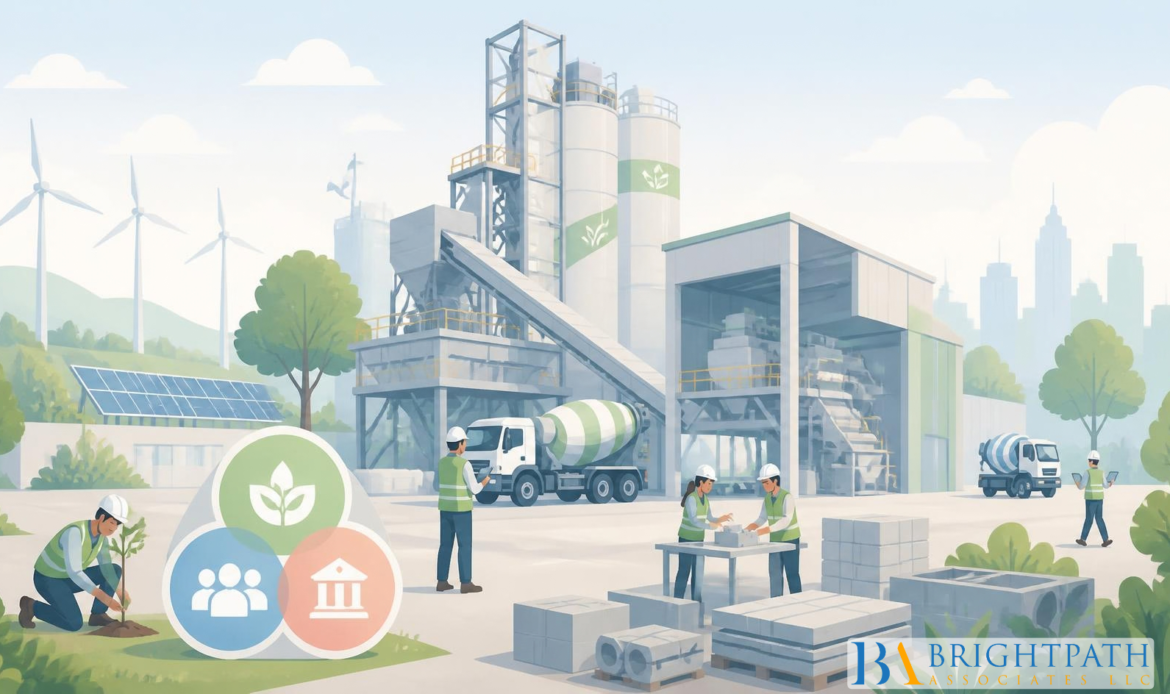
ESG provides a framework for evaluating how an organization manages environmental, social, and governance responsibilities. For concrete manufacturers, the environmental dimension is particularly significant because production involves energy consumption, raw-material extraction, transportation, water use, and greenhouse-gas emissions.
The social component encompasses the people involved throughout the production and supply chain. Manufacturing facilities must maintain safe working environments, provide appropriate training, and develop skilled workforces capable of operating increasingly sophisticated equipment.
Governance determines how organizations establish accountability around these activities. Transparent reporting, regulatory compliance, supplier standards, environmental monitoring, and responsible capital allocation are all components of effective governance.
Integrating these three dimensions into daily operations allows concrete manufacturers to move ESG from a reporting exercise toward a practical management framework.
Concrete Industry Trends and ESG Expectations
Current Concrete industry trends demonstrate that sustainability is becoming increasingly connected with manufacturing competitiveness. Customers, contractors, developers, investors, and regulators are placing greater emphasis on the environmental characteristics of construction materials.
Manufacturers are consequently examining ways to reduce the environmental footprint of concrete while maintaining strength, durability, cost effectiveness, and reliability. This includes optimizing mix designs, improving energy efficiency, reducing material waste, increasing the use of supplementary materials, and improving transportation efficiency.
Digital technologies are also influencing these trends. Sensors, automated process controls, production analytics, and predictive maintenance systems can provide manufacturers with greater visibility into resource consumption and operational performance.
The combination of ESG expectations and technology development is encouraging manufacturers to reconsider how concrete is produced, monitored, and evaluated.
Cement production is a major focus of sustainability discussions within the construction materials sector. Cement is an essential ingredient in conventional concrete, but its manufacturing process involves significant energy requirements and process-related emissions.
Cement industry sustainability therefore has become a major strategic issue for producers and concrete manufacturers. Organizations are exploring measures such as alternative fuels, energy-efficient kilns, supplementary cementitious materials, clinker reduction, process optimization, carbon-management technologies, and alternative formulations.
Concrete manufacturers can contribute to this effort by optimizing mix designs and evaluating materials that reduce dependence on high-emission components while meeting required technical specifications.
ESG provides a framework for connecting these technical initiatives with broader corporate objectives. Environmental improvements can be measured, monitored, and incorporated into investment decisions and operational targets.
Advanced Concrete Technology and Material Innovation
Advanced concrete technology is expanding the possibilities for improving performance while addressing resource and sustainability requirements. New formulations can be designed to improve durability, strength, workability, curing behavior, and service life.
Longer-lasting concrete can have sustainability benefits because infrastructure that remains functional for longer periods may require fewer repairs and replacements. Advanced formulations can also enable engineers to achieve required performance using optimized material quantities.
#DigitalSimulation and automated testing can further support material development. Manufacturers can evaluate different formulations before conducting extensive physical trials, potentially reducing development time and material waste.
The environmental value of advanced concrete technology must nevertheless be assessed across the full lifecycle. A product should not be considered sustainable solely because it uses less material if its manufacturing process creates other significant environmental impacts.
Concrete production efficiency is a critical component of ESG performance because inefficient production can increase material consumption, energy use, waste, and operating costs.
Modern manufacturing facilities can use automated batching, real-time quality monitoring, predictive maintenance, optimized scheduling, and digital inventory systems to improve production efficiency.
Accurate batching can reduce raw-material waste and improve product consistency. Better production scheduling can reduce equipment idle time and unnecessary transportation. Predictive maintenance can help prevent unexpected equipment failures that disrupt production and create additional resource consumption.
Operational data can also support continuous improvement. By measuring production rates, material usage, energy consumption, and waste generation, manufacturers can identify areas where processes can be improved.
Sustainable Building Materials and Market Expectations
The broader shift toward Sustainable building materials is influencing how concrete manufacturers position their products. Developers and construction companies increasingly need materials that support environmental objectives without compromising structural requirements.
Concrete manufacturers can respond by developing lower-impact products, improving transparency around material composition, and providing reliable environmental performance data.
This trend also creates opportunities for collaboration between material producers, architects, engineers, contractors, and researchers. Product development can increasingly focus on lifecycle performance rather than simply initial cost.
Manufacturers that understand customer sustainability requirements can integrate them into research, production, and commercial strategies.
Although concrete, ceramics, and other construction materials have different production characteristics, there are useful parallels in their approach to process optimization. Advanced ceramic manufacturing increasingly relies on automation, precision processing, digital quality control, advanced materials, and energy-efficient production methods.
These approaches demonstrate how traditional material industries can combine process engineering with digital technologies to improve consistency and efficiency.
#ConcreteManufacturers can similarly explore opportunities to automate repetitive processes, improve measurement accuracy, and use data to control production variability.
Cross-industry learning can also encourage innovation in areas such as material formulation, quality assurance, energy management, and waste reduction.
Glass Industry Innovation and Sustainable Construction
Glass is another important construction material undergoing significant technological development. Glass industry innovation includes improvements in manufacturing efficiency, material performance, recycling, coatings, and energy-related applications.
Glass market analysis can provide insights into how construction material sectors respond to changing customer expectations and sustainability requirements. The growing interest in energy-efficient building envelopes, recyclable materials, and high-performance architectural products illustrates the connection between material innovation and broader environmental objectives.
Concrete manufacturers can learn from these developments by examining how product performance, sustainability information, and technological differentiation influence customer decision-making.
The construction industry increasingly evaluates materials as components of integrated building systems rather than isolated products.
Ceramic industry growth is also influenced by technological advancements and changing industrial requirements. Advanced ceramics are being used in applications where high-temperature resistance, durability, electrical performance, or specialized mechanical properties are required.
The sector’s development highlights the importance of combining material science with manufacturing technology. Concrete companies can apply similar principles by investing in research, process engineering, digital systems, and advanced testing capabilities.
The broader construction-materials ecosystem is becoming more technology-intensive. This means manufacturers must continuously evaluate whether their production capabilities are aligned with emerging market requirements.
Social Responsibility in Concrete Manufacturing
The social component of ESG is equally important. Concrete manufacturing involves heavy equipment, industrial facilities, transportation activities, and potentially hazardous working environments. Worker safety must therefore remain a central operational priority.
Companies can strengthen social performance through comprehensive training, appropriate protective measures, equipment safeguards, incident monitoring, and continuous safety improvement.
#WorkforceDevelopment is another important consideration. As manufacturing becomes more automated and digital, employees need new technical capabilities. Training programs can help workers transition into roles involving equipment monitoring, data analysis, automation management, and digital quality control.
Strong relationships with local communities are also relevant, particularly where manufacturing facilities operate near residential areas. Transparent communication regarding environmental performance, traffic, noise, employment, and community investment can support constructive relationships.
Effective ESG governance requires organizations to understand not only their internal operations but also their supply chains. Concrete manufacturing depends on aggregates, cementitious materials, chemicals, energy, equipment, transportation, and other inputs.
Supplier management can therefore influence environmental and social performance. Companies can establish standards for responsible sourcing, environmental compliance, workplace practices, and data transparency.
Governance systems should also establish clear accountability for ESG objectives. Senior management needs reliable information to evaluate whether sustainability initiatives are delivering measurable results.
Transparent data can help organizations identify gaps, manage risks, and communicate performance accurately to stakeholders.
Construction Materials Recruitment and Future Skills
ESG transformation is changing the talent requirements of the construction materials industry. Manufacturers increasingly require professionals with expertise in sustainability, materials science, process engineering, digital manufacturing, environmental compliance, data analytics, and supply chain management.
Construction materials recruitment must therefore evolve beyond conventional production roles. Companies need people who can connect technical knowledge with commercial and sustainability objectives.
Leadership positions may require experience managing capital-intensive manufacturing operations while simultaneously implementing environmental initiatives and technology transformation.
#ExecutiveSearchRecruitment can help organizations identify senior professionals capable of navigating these increasingly complex requirements.
The importance of ESG in concrete manufacturing ultimately lies in its ability to connect environmental responsibility with operational and strategic decision-making. Manufacturers can use ESG frameworks to evaluate energy consumption, material efficiency, worker safety, supply-chain performance, technology investment, and governance practices.
When integrated into business strategy, ESG can support long-term planning rather than functioning as a separate reporting activity.
Companies can establish measurable objectives for reducing waste, improving production efficiency, increasing resource utilization, strengthening safety performance, and developing more sustainable products.
Conclusion
ESG is becoming an important component of modern concrete manufacturing as the construction materials sector responds to environmental expectations, technological change, regulatory developments, and evolving customer requirements. Concrete manufacturers must increasingly consider sustainability alongside quality, cost, productivity, and long-term performance.
Concrete industry trends are driving investment in Advanced concrete technology and improved Concrete production efficiency, while Cement industry sustainability remains central to reducing the environmental impact of the broader concrete value chain. Developments in Advanced ceramic manufacturing, Glass industry innovation, Glass market analysis, and Ceramic industry growth demonstrate how other material sectors are also responding through technology and process innovation.
The growing demand for Sustainable building materials creates opportunities for manufacturers that can combine material performance with credible environmental improvements. At the same time, ESG requires attention to worker safety, workforce development, supply-chain responsibility, and governance.
These changes are also reshaping talent requirements. Construction materials recruitment increasingly needs to identify professionals who understand manufacturing, sustainability, technology, and business strategy. Through targeted Executive Search Recruitment, organizations can strengthen the leadership capabilities required to manage this transformation.
Ultimately, ESG should be viewed as an integrated part of modern concrete manufacturing strategy. By connecting sustainable production, technological innovation, operational efficiency, responsible workforce practices, and accountable governance, manufacturers can build capabilities that support both present operational requirements and the evolving needs of the construction industry.
Find your next leadership role in Glass, Ceramic, Concrete Industry today!
Stay informed with the latest insights on Glass, Ceramic, Concrete Industry!