
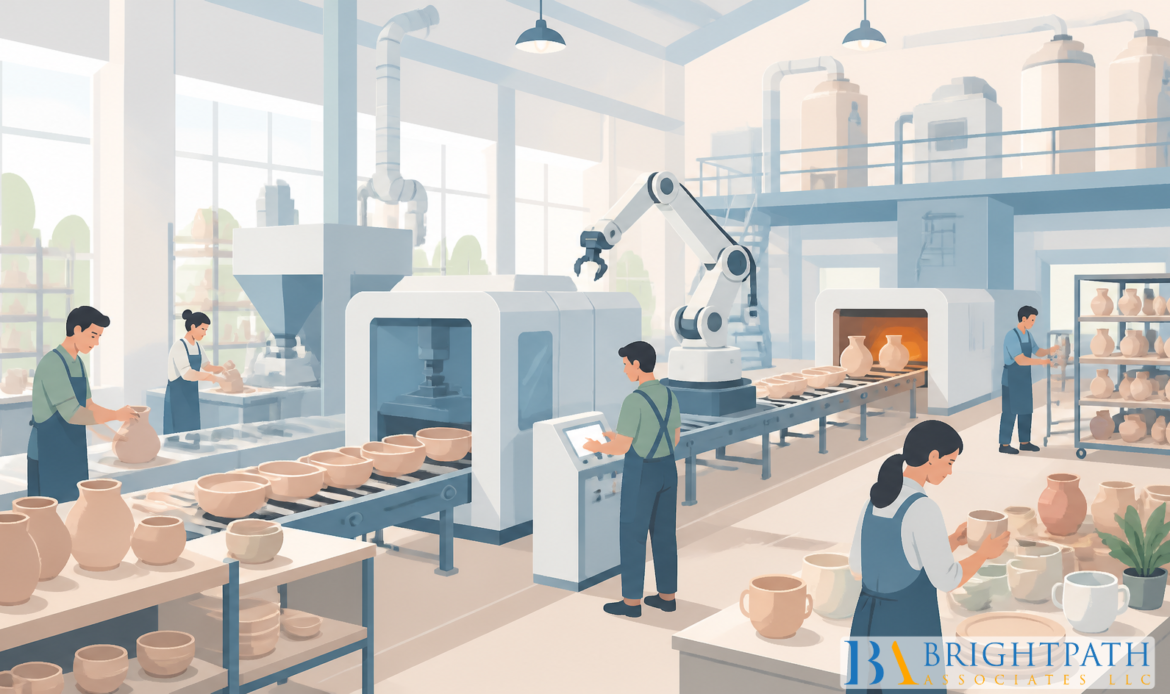
Transforming Ceramic Manufacturing: A Case Study in Automation and Efficiency for Glass, Ceramics & #ConcreteIndustry is not mainly a robotics story. It is a management story. The strongest results occur when leaders redesign material flow, quality control, maintenance, workforce roles, and production data before asking a robot to move faster.
For U.S. manufacturers, the practical question is not whether automation can improve efficiency. It can. The harder question is whether a specific automation investment will remove the plant’s real constraint or simply automate work around it. A robot that feeds a kiln faster does little if glazing defects, changeovers, or finished goods handling remain the bottleneck.
Table Of Contents
- What The Case Evidence Actually Shows
- Where Ceramic Plants Should Automate First
- How To Measure Value And Build A Payback Case
- Implementation, Safety, And Leadership Requirements
- Frequently Asked Questions
- Resources And Citations
Key Takeaways
• Automation produces the best returns when it addresses a verified constraint such as handling damage, unstable glazing, excessive changeover time, or weak production visibility.
• #LeanManufacturing improvements and automation improvements should be measured separately. Better flow can create major gains before a robot is installed.
• High mix, low volume ceramic production often favors flexible cobots, vision systems, modular tooling, and disciplined programming rather than fully dedicated lines.
• A credible business case includes quality, energy, maintenance, training, safety, uptime, and integration costs, not labor savings alone.
• Automation changes leadership requirements. Plants need executives and managers who can connect operations, controls, quality, maintenance, workforce planning, and capital discipline.
What The Case Evidence Actually Shows
Ceramic automation can improve speed and repeatability, but published case results should be read as plant specific evidence rather than universal benchmarks. Product geometry, firing schedules, workforce structure, line balance, equipment age, and customer mix all affect results.
Cobot Flexibility In A High Mix Plant
One useful example comes from Pentik Oy, a ceramic manufacturer operating in a high mix, low volume environment. In its published case story, Universal Robots reports that Pentik used two UR10 cobots for glazing and molding and achieved a reported tenfold increase in workstation efficiency. The value of the example is not that every plant should expect a tenfold result. It is that flexible automation can work where product variety makes a dedicated high speed line hard to justify.
That distinction matters for advanced ceramic manufacturing. A plant producing many shapes, finishes, and batch sizes may need quick tooling changes, recipe controls, and operators who can intervene safely. A cobot can support repetitive work while employees manage exceptions, inspect surface quality, load different product families, and maintain process knowledge.
This is also where #ExecutiveHiring becomes more consequential. A production leader who understands only output targets may approve equipment that looks productive in a demonstration but cannot tolerate frequent changeovers. A stronger leader asks different questions: How many variants will run through the cell? How often will tooling change? What is the acceptable breakage rate? Who owns programming revisions? What happens when a camera lens becomes coated with glaze dust?
Lean Flow Is Not The Same As Automation
Automation often receives credit for improvements produced by better plant design. That can lead to weak capital decisions.
A Springer case study of lean manufacturing in a medium sized ceramic operation reported lower waiting time, inventory, defects, manpower, and annual cost after implementation. The study reported a 32% reduction in waiting time, a 36% inventory reduction, an average defect reduction of 40.51%, a 6.85% manpower reduction, and US$0.61 million in annual cost savings. The ceramic lean manufacturing case published by Springer is especially useful because it links improvement to flow redesign, including one piece flow between finishing steps.
For example, a plant may add an automated transfer system between dry finishing and inspection. If batches still wait for manual quality release, the transfer system may raise work in process instead of shortening lead time. The better first move may be to establish clear inspection criteria, reduce batch size, and balance labor around the true constraint. Automation can then reinforce a better flow.
Production Data Is An Operations Tool
A manufacturing execution system, or MES, coordinates production records, schedules, material use, quality information, equipment events, and traceability. It is not automatically valuable because it is digital. It becomes valuable when supervisors, maintenance teams, and leaders use the same information to make faster decisions.
At Incepa, Siemens reports that a production integration project resulted in a 9% productivity increase at one factory and an 81% increase in overall service level. The Siemens case study on Incepa’s Opcenter integration supports a narrower but important conclusion: production integration can improve visibility for scheduling, resource use, and #ServicePerformance.
For executives reviewing glass market analysis, concrete industry trends, or sustainable building materials demand, that visibility has strategic value. It helps a plant distinguish a demand problem from a capacity problem. It can show whether delivery failures stem from kiln downtime, missing materials, late quality holds, or poor scheduling discipline.
Where Ceramic Plants Should Automate First
The best first project is usually not the most technically impressive one. It is the process with measurable pain, stable enough inputs, a manageable safety design, and a clear owner after commissioning.
A Practical Automation Decision Matrix
| Process Area | Strong Candidate When | Avoid Or Delay When | Typical Controls Needed |
|---|---|---|---|
| Raw material dosing and mixing | Recipes are stable and dosing variation causes quality loss | Material properties shift frequently without reliable testing | Recipe management, dust control, batch traceability |
| Molding and greenware handling | Repetitive lifting creates damage or ergonomic strain | Parts lack consistent pickup surfaces or fixtures | Compliant grippers, breakage detection, fixture validation |
| Glazing | Coverage and material use vary by operator or line | Glaze viscosity and cleaning routines are poorly controlled | Flow monitoring, viscosity checks, washdown design |
| Kiln loading and unloading | Product geometry and thermal conditions are controlled | Heat exposure exceeds equipment limits or access is constrained | Heat shields, robust sensors, guarded transfer zones |
| Vision inspection | Defects have visible, repeatable signatures | Quality standards are subjective or lighting is unstable | Controlled lighting, reference samples, human review |
| Packaging and palletizing | Repetition, lifting, or label changes create downtime | Packaging formats change without digital specifications | Vision guidance, PLC controls, label verification |
Packaging May Be The Better First Move
Plants sometimes begin with casting or glazing because those processes appear central to ceramic quality. Yet packaging can be the better early project when the core process is unstable and the shipping area has predictable work.
At Gruppo Romani, OMRON reports that an automated package labeling system reduced format change downtime by up to 70%. The system combined a collaborative robot, integrated vision, PLC control, and MES supervision. The OMRON automated package labeling case illustrates a useful principle: changeover flexibility and traceability can justify automation even when raw cycle speed is not the main objective.
For a small or mid sized manufacturer, packaging automation can create a safer proving ground for controls integration, operator training, and data discipline. It may also free skilled employees for more complex tasks such as process troubleshooting and quality improvement. That is not a promise of headcount reduction. It is a workforce design decision.
Glazing Requires Process Discipline
#GlazingAutomation can reduce handling, centralize distribution, and create better material consumption records. It can also fail quietly. Nozzle wear, contaminated filters, changes in glaze viscosity, inconsistent greenware moisture, and incomplete cleaning can turn a precise dispensing system into a precise way to repeat defects.
Before automating glazing, establish acceptable ranges for viscosity, pressure, flow, coverage, reclaim content, and cleaning intervals. Then validate the system on representative products, including difficult shapes and low volume designs. A good pilot should include intentional process variation to test the cell’s limits, not only ideal production conditions.
For related thinking on connected manufacturing systems, Ceramics 4.0: Powers of Smart Manufacturing examines the broader role of smart manufacturing in ceramic operations.
How To Measure Value And Build A Payback Case
Automation projects often fail at the approval stage because the baseline is vague. “The line is inefficient” is not a business case. Leaders need a before and after measurement plan that isolates the source of improvement.
Start With A Defensible Baseline
Track a representative period long enough to include normal variation in product mix, maintenance, and demand. For many operations, this means several production cycles rather than a single strong week.
Use the following measures:
• Availability: Scheduled production time minus downtime, separated into planned and unplanned causes.
• Performance: Actual output compared with the demonstrated or engineered rate for the product mix.
• Quality: Good units divided by total units, with scrap, rework, breakage, and downgraded products tracked separately.
• Changeover: Time from the last acceptable unit of one run to the first acceptable unit of the next.
• Material intensity: Glaze, energy, water, packaging, and raw material consumption per accepted unit.
• Labor content: Direct labor hours per accepted unit, while also #TrackingMaintenance, controls, and supervisory time added by the new system.
Overall equipment effectiveness, or OEE, combines availability, performance, and quality. It is useful only if the definitions remain constant. If a plant excludes quality holds after automation but included them before, the apparent OEE improvement is not trustworthy.
Separate Causes Before Claiming Results
We recommend a simple attribution map. Record what changed, when it changed, and which metric it was expected to affect.
| Change | Expected Primary Effect | Measurement Risk | Verification Method |
|---|---|---|---|
| One piece flow | Lower waiting and work in process | Crediting the gain to robotics | Compare flow changes before cell launch |
| Robot handling | Lower handling damage and cycle variation | Ignoring fixture related breakage | Track breakage by product and transfer point |
| MES integration | Better traceability and schedule response | Treating data visibility as output gain | Review decision time, adherence, and service levels |
| Vision inspection | Earlier defect detection | Counting rejected output as quality improvement | Track defect escape rate and false rejects |
| Automated dosing | Lower material variation | Missing raw material variability | Compare batch records and accepted output |
Payback should be expressed as a range, not a single confident number. Include capital cost, integration, guarding, tooling, software, training, lost production during installation, planned maintenance, spare parts, energy use, scrap reduction, and credible labor redeployment benefits. If the economics only work under perfect uptime and full labor elimination, the proposal is fragile.
Sustainability should follow the same discipline. Automation may reduce overspray, breakage, rework, transport, and energy per accepted unit. But it may also increase compressed air, cleaning needs, or electricity demand. Measure resource use per good unit, not merely per shift.
For manufacturers considering vision based inspection, AI and Ceramic Quality Control provides additional context on quality control applications and their operational implications.
Implementation, Safety, And Leadership Requirements
Technology selection is only one part of implementation. U.S. manufacturers should treat a robotic cell as an operational change that requires engineering, safety, quality, maintenance, HR, and plant #LeadershipAlignment.
Build Safety Into The Cell Design
A safe deployment should address machine guarding, electrical safety, lockout and tagout procedures, emergency stops, safe access for cleaning, robot reach, pinch points, and recovery after faults. Collaborative robots do not remove the need for risk assessment. Tooling, payloads, sharp edges, conveyors, and unexpected motion can create hazards even when a cobot is used.
Ceramic conditions add complexity. Dust can foul sensors. Slurry can affect traction and cleaning requirements. Abrasive materials can wear grippers and fixtures. Kiln adjacent zones can expose electronics, lubricants, and operators to heat. The right response is not to reject automation. It is to design for the actual environment, test abnormal conditions, and assign clear ownership for maintenance.
Workforce Redesign Is A Core Workstream
The labor discussion should not start and end with fewer hands at a workstation. Automation often shifts work toward setup, quality validation, equipment recovery, preventive maintenance, controls support, and data interpretation.
A practical workforce plan should identify:
- Which manual tasks will disappear, shrink, or become less physically demanding.
- Which new tasks will require training in PLCs, machine vision, robot programming, or data review.
- Which employees can be developed into cell leads, maintenance technicians, or process specialists.
- Who owns recipe changes, tooling approval, and quality thresholds.
- How supervisors will handle production targets during the learning period.
This is where #ConstructionMaterials recruitment becomes a strategic issue rather than an administrative one. The strongest operations executives increasingly combine capital project judgment with practical leadership across maintenance, quality, engineering, safety, and workforce development. Hiring a leader who understands only one of these functions can leave the plant dependent on outside integrators long after commissioning.
When Executive Search May Be Justified
Conventional recruiting can struggle when a company needs a plant leader, operations executive, engineering leader, or quality executive with a rare combination of ceramics knowledge, automation fluency, financial judgment, and change leadership. That does not mean an external search is always necessary. Internal succession may be stronger when the company already has leaders who understand its products and culture.
An executive search process becomes more defensible when the role is business critical, the required capabilities are unusually specialized, the vacancy threatens a capital program or customer commitments, and the company lacks the internal reach to identify passive candidates. The brief should describe operating problems to solve, not just list technologies. “Lead a new MES” is weaker than “improve schedule adherence, quality traceability, and maintenance response while protecting plant uptime.”
For a parallel perspective in an #AdjacentSector, Automation-led Transformation in Glass Manufacturing explores how automation changes operating and workforce requirements in glass manufacturing.
Frequently Asked Questions
What Does Automation Mean In Ceramic Manufacturing?
Automation means using controls, robotics, sensors, software, and connected equipment to perform or guide production tasks. In ceramics, it can include dosing, molding, glazing, internal material transport, inspection, labeling, packaging, kiln handling, and production data capture.
Which Ceramic Processes Should Be Automated First?
Start with the process that has a measurable and #RecurringConstraint. Packaging is often a strong first project when lifting, labeling, or format changes cause downtime. Glazing may be a stronger priority when material variation or overspray is the main source of waste. Avoid automating a process whose inputs, quality criteria, or workflow are still unstable.
Are Collaborative Robots Suitable For Fragile Ceramic Parts?
They can be, provided the application has validated grippers, controlled acceleration, stable presentation, and breakage monitoring. Fragility alone does not rule out cobots. Inconsistent product orientation, poor fixturing, and excessive grip force are usually larger concerns than the robot category itself.
How Can Automation Reduce Glazing Defects And Material Waste?
It can control dosing, travel paths, coverage patterns, and material records more consistently than manual application in some settings. Results depend on stable glaze properties, cleaned equipment, reliable product positioning, and quality checks. Automation will repeat an incorrect recipe with great consistency if these controls are weak.
Can An MES Improve Ceramic Production Planning And Traceability?
Yes, when it connects usable information across scheduling, materials, equipment, quality, and maintenance. An MES alone does not improve output. The improvement comes when employees use the information to resolve delays, manage constraints, and preserve traceability from batch through finished goods.
How Should A Plant Calculate Automation Payback?
Calculate annual benefits from verified improvements in accepted output, scrap, rework, material use, energy, changeover time, labor redeployment, and downtime. Then subtract the full annualized cost of capital, integration, safety systems, maintenance, software, training, and production disruption. Test conservative, expected, and adverse cases rather than relying on one estimate.
What Leadership Skills Matter Most In An Automated Ceramic Plant?
The priority is cross functional leadership. #EffectiveLeaders need enough operational, quality, maintenance, safety, and financial understanding to make tradeoffs across the full production system. They also need the discipline to separate vendor projections from measured plant outcomes.
Resources And Citations
- Universal Robots — Pentik Oy Cobot Case Story: https://www.universal-robots.com/case-stories/pentik-oy/
- Springer — Lean Manufacturing Implementation in Ceramic Industry: https://link.springer.com/chapter/10.1007/978-3-030-44248-4_3
- OMRON — Automated Package Labelling with Cobots Cuts Downtime by 70%: https://robotics.omron.com/case-studies/automated-package-labelling-cobots/
- Siemens — Incepa Uses Opcenter to Improve Integration: https://resources.sw.siemens.com/vi-VN/case-study-incepa/
- BrightPath Associates — Ceramics 4.0: Powers of Smart Manufacturing: https://brightpathassociates.com/ceramics-4-powers-future-of-smart-manufacturing/
Find your next leadership role in Glass, Ceramic, Concrete Industry today!
Stay informed with the latest insights on Glass, Ceramic, Concrete Industry!