
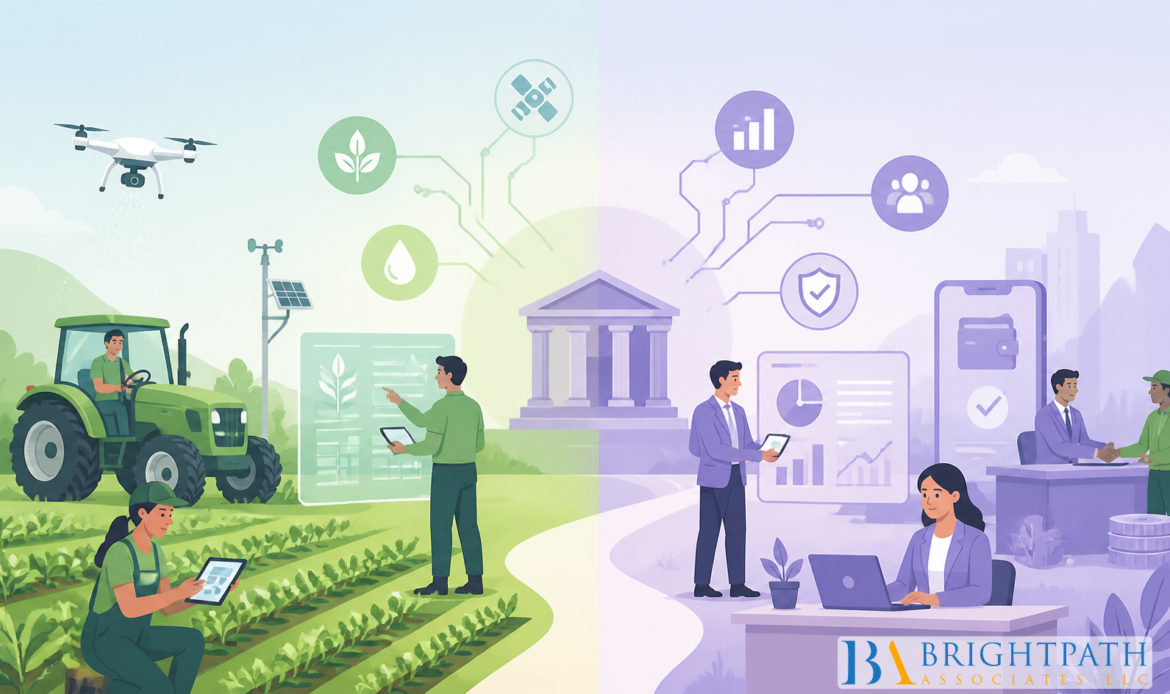
The Intersection of Ag-Tech and Fintech: The Future of Agricultural Banking for farming industry is not mainly about putting loan applications online. It is about whether lenders can turn farm operations, seasonal cash flow, and production data into fair, useful #FinancialDecisions without treating a farm like an ordinary small business.
For agricultural executives, lenders, and technology leaders, the tension is clear: more data can improve visibility, but more data can also create privacy, validation, cybersecurity, and staffing problems. We believe the strongest agricultural banking models will combine better digital systems with disciplined credit judgment and experienced relationship lending.
Table Of Contents
• Why Agricultural Banking Needs A Different Digital Model
• Turning Farm Data Into Lending Decisions
• Who Owns The Agricultural Finance Relationship?
• Leadership And Talent Requirements For Agricultural Finance
• Key Takeaways
• Frequently Asked Questions
Why Agricultural Banking Needs A Different Digital Model
Agriculture has always been data dependent. Producers track acres, input costs, weather, yields, equipment, inventory, livestock, contracts, and payments. Precision agriculture now adds field-level records from sensors, machinery, farm-management information systems, and satellite imagery. Fintech adds digital payments, account connectivity, automated reporting, digital wallets, and lending workflows.
The opportunity is not simply more information. It is timely, reconciled information that helps a lender understand whether a farm can meet its obligations through an uneven production and sales cycle.
Seasonal Cash Flow Changes The Underwriting Question
A conventional small-business lender may expect monthly sales and recurring payroll patterns. A farm often faces a very different sequence:
- Cash leaves the business during land preparation, seed, feed, fertilizer, labor, fuel, and equipment maintenance.
- Production risk accumulates through weather, disease, commodity-price movements, and operational disruption.
- Revenue may arrive after harvest, delivery, processing, or contract settlement.
- Inventory decisions can delay or accelerate sales depending on storage capacity and #MarketConditions.
That pattern means a bank should not interpret a low cash balance in planting season the same way it would interpret persistent liquidity stress at a year-round service business. Digital underwriting must model the timing of expenses, crop insurance proceeds, contract payments, and debt service.
This is why agriculture-specific financial tools matter. Farm accounting platforms can organize transaction records into balance sheets, cash-flow summaries, income statements, and Schedule F-related information. In one vendor example, FarmRaise describes connected financial-data tools for lender-ready farm reports. That is a practical workflow example, not independent proof that connected data improves loan outcomes.
Public-Sector Modernization Offers A Useful Benchmark
Agricultural banking modernization is also occurring in public programs. The U.S. Department of Agriculture has stated that it plans to modernize more than 130 Farm Service Agency and Rural Development loan and grant systems into a platform with a single customer file, online payments, and capacity for about 1.2 million active files. The scope is described in USDA’s modern loan-platform update.
The important lesson is architectural. A lender cannot create a dependable borrower experience when customer records, servicing records, payment data, and eligibility information sit in disconnected systems. Consolidation does not eliminate underwriting complexity, but it can reduce duplicate entry and make the loan process more legible to both producers and staff.
USDA has also said its modernization effort is intended to let producers apply for loans and interact with loan staff from different devices and locations, as outlined in USDA’s announcement on producer access across devices. The agency’s plans should not be read as proof of a measured reduction in approval times. Still, they show that digital access is becoming a baseline expectation for agricultural finance.
Digital Service Must Not Assume Perfect Connectivity
#RuralBroadband and cellular access remain practical constraints. A digital product that assumes an always-on smartphone, clean accounting records, and instant document uploads can exclude the farms it aims to serve.
For this reason, banks and fintech providers should design for exceptions:
• Offline-capable field tools that synchronize later.
• Branch, phone, and loan-officer support for document collection.
• Printable summaries for farmers who prefer paper review.
• Clear permission screens that explain what data is being accessed and why.
• Human escalation for incomplete records, unusual ownership structures, or disaster-related disruptions.
Precision Agriculture: The Next Frontier in Farm Efficiency provides useful context on the operational systems producing much of this new farm data. The financial value of those systems depends on whether their records can be accurately connected to lending decisions.
Turning Farm Data Into Lending Decisions
Not all farm data answers the same credit question. This distinction is often missed when lenders group satellite imagery, accounting records, weather information, and yield data under the broad label of “alternative data.”
Match The Data To The Decision
| Data Category | Appropriate Lending Use | Important Limitation |
|---|---|---|
| Bank transactions and accounting records | Cash-flow analysis, expense patterns, debt-service capacity | May be incomplete if accounts are not connected or transactions are miscategorized |
| Tax returns and financial statements | Income history, assets, liabilities, and repayment analysis | Often backward-looking and may not reflect current production conditions |
| Crop plans and input records | Operating-loan planning and projected cost analysis | Plans can change because of weather, prices, or supply constraints |
| Yield and production records | Historical operating performance and production trends | Past performance does not guarantee current output |
| Satellite imagery and weather data | Risk monitoring and contextual review of crop conditions | Should not be treated as a substitute for full borrower review or physical verification |
| Insurance, contract, and inventory records | Revenue protection, market commitments, and collateral context | Terms, coverage, and ownership details require careful interpretation |
The core discipline is simple: use each data source for the decision it can reasonably support. Transaction data may help explain cash flow. Crop insurance records may help clarify risk protection. Remote sensing may add context about field conditions. None of these sources, alone, establishes that a borrower is creditworthy.
Build The Data Plumbing Before Building The Model
For agri-finance to work at scale, lenders need more than an application programming interface and a dashboard. They need reliable data plumbing:
- Interoperability: Farm-management software, accounting tools, payment systems, and loan platforms must exchange usable information.
- Data lineage: Staff should be able to identify where a value came from, when it was collected, and whether it was changed.
- Standardized units: Acres, bushels, head counts, crop varieties, land descriptions, and expense categories must be consistently labeled.
- Reconciliation: Field records and financial records should not contradict each other without an explanation.
- Consent controls: Producers need a clear way to authorize, limit, and withdraw data access.
Consider a #LenderReviewing an operating line for a diversified farm. The accounting system may show fertilizer purchases, while the farm-management system shows acres planted. If acreage falls sharply but input spending remains high, an automated system should flag the inconsistency for review rather than assume fraud or deny the loan. The correct response may be as simple as a timing difference, a prepaid input purchase, or a reporting error.
Alternative Data Requires Validation, Not Enthusiasm
AI-assisted underwriting can help staff prioritize files, detect missing documents, and identify financial patterns. Yet lenders should be cautious about using models trained on data that do not represent the farms being evaluated.
Before deploying a model, a lender should test it on a representative sample of borrowers and ask:
• Does it perform consistently across crop types, regions, farm sizes, and ownership structures?
• How does it handle missing, delayed, or incorrect data?
• Can credit staff explain why the model produced a recommendation?
• Are there clear thresholds for human review and override?
• Does ongoing monitoring detect performance drift after drought, commodity-price shocks, or changing insurance conditions?
There is not enough independent, high-authority evidence to conclude that satellite imagery or AI models reliably replace farm inspections or traditional underwriting across U.S. agricultural lending. The sensible near-term role is augmentation: faster triage, better monitoring, and more organized questions for credit teams.
Who Owns The Agricultural Finance Relationship?
Agricultural finance can be delivered through banks, fintech firms, farm-management platforms, input marketplaces, and partnerships among them. Each approach distributes accountability differently.
Bank-Led, Fintech-Led, And Embedded Models
| Model | Customer Relationship | Typical Strength | Key Risk |
|---|---|---|---|
| Bank-led digital lending | Bank owns borrower relationship and credit decision | Stronger integration with deposits, servicing, and relationship lending | Legacy systems may slow implementation |
| Fintech-led lending | Fintech often controls digital workflow and customer experience | Faster product design and specialized software | Funding, compliance, and servicing responsibilities can be unclear |
| Embedded agricultural finance | Farm platform, marketplace, or input provider presents financial offer during a transaction | Finance appears where purchase or production decisions occur | Borrowers may not understand data sharing, pricing, or who makes the credit decision |
Embedded finance is especially relevant when a producer is buying seed, fertilizer, equipment services, or farm inputs through a digital platform. The credit offer may be useful because it appears at the point of need. But convenience should not obscure the structure of the product. A producer should be able to identify the lender, interest rate or fee structure, repayment timing, collateral terms, and data permissions.
The agricultural-fintech provider base remains fragmented. News Dakota’s report on agricultural fintech activity discussed the limited number of providers focused on farm banking, including Tillable, Oxbury, and Figured, along with a Bremer Bank accelerator initiative. Those examples show experimentation, not a validated ranking of providers or outcomes.
Consent Is A Product Design Issue
Data consent is not a legal footnote. It affects adoption and credit risk.
A farm may be comfortable sharing transaction history for a single loan application but unwilling to permit ongoing access to field data, yield records, or sales information for marketing, cross-selling, or third-party analytics. Vague consent language can cause farmers to disengage or withhold useful data. Overly rigid controls can make digital workflows impractical.
A workable consent design should state:
• What data is collected.
• Which organization can access it.
• Why it is needed for a specific product or service.
• Whether access is one-time or ongoing.
• How a farmer can revoke access.
• Whether information may be shared with vendors or used beyond servicing the loan.
#FarmRaise has described a workflow involving bank-linked transaction history, organized financial reports, and a partnership with BTC Bank. Its lender-producer data workflow example illustrates the appeal of giving borrowers more organized reports to share with participating lenders. As with any vendor account, executives should independently review security, permissions, contracts, and system integration before relying on the workflow.
Leadership And Talent Requirements For Agricultural Finance
The convergence of Agricultural technology, food production, sustainable farming, organic farming, precision agriculture, and finance changes executive requirements. It does not mean every farm bank needs a large data-science department. It does mean leadership teams need the ability to connect credit judgment, technology governance, and farm operations.
Roles Are Becoming More Hybrid
#AgriculturalLenders may need leaders who can translate between credit policy, product design, technology vendors, compliance teams, and producers. Relevant capabilities increasingly include:
• Agricultural credit and collateral knowledge.
• Seasonal cash-flow underwriting.
• Data governance and cybersecurity oversight.
• Vendor management and systems integration.
• Consumer and commercial lending compliance awareness.
• Change management for loan officers and operations teams.
• Plain-language communication with borrowers.
The hiring challenge is that these capabilities rarely appear in one conventional resume. An executive with strong commercial fintech experience may not understand crop cycles, collateral practices, or farm operating risk. A respected agricultural lender may not have led a data-governance program or evaluated automated decisioning tools.
Why Data Scientist Hiring is Transforming Modern Farming explores why technical talent is becoming more relevant to agricultural decision-making. For employers, the key question is not whether to hire for technical skills. It is which decisions truly require in-house expertise and which should remain with vetted technology partners.
When To Build, Partner, Or Pause
A smaller rural bank may be better served by partnering with a specialized provider when it lacks the budget to maintain integrations, cybersecurity controls, model monitoring, and user support internally. A larger lender with a distinct operating model and enough technical governance may have a stronger case for building selected capabilities in-house.
We would advise leadership teams to pause before launching a major platform initiative if they cannot answer three questions:
- What borrower or staff problem will this solve better than current processes?
- Which data is necessary, and who is accountable for its quality?
- Who will own model oversight, vendor performance, exceptions, and borrower support after launch?
A prolonged vacancy in a chief credit, chief information, product, risk, or operations role can delay these decisions. It can also leave implementation to vendors without enough internal challenge. That does not prove executive search is always required. It does suggest that specialized leadership searches should evaluate decision-making range, not just industry keywords.
Sustainable Ag-Tech Reshapes Agricultural Lending examines the connection between sustainability-related farm data and lending considerations. For hiring teams, this reinforces the need for leaders who can distinguish promising data from bankable, governable evidence.
Key Takeaways
• #DigitalAgricultural banking works best when it reflects seasonal cash flow rather than forcing farms into standard monthly-income models.
• Financial data, agronomic data, and remote-sensing data should serve different underwriting purposes. No single source should determine a credit decision.
• Data quality, interoperability, consent, and explainability are operational requirements, not technical extras.
• Embedded finance can improve convenience, but borrowers should understand who is lending, servicing, pricing, and using their data.
• AI and satellite tools may support triage and monitoring, but available evidence does not justify treating them as universal replacements for inspections or relationship lending.
• Agricultural finance leaders increasingly need both domain knowledge and technology-governance capability.
Frequently Asked Questions
What Does The Intersection Of Ag-Tech And Fintech Mean For Agricultural Banking?
It means combining farm operational data, digital payment tools, connected accounting, and lending technology to improve financial workflows. The goal is better visibility into farm cash flow and risk, not simply a digital application form.
Can Satellite Imagery Help A Bank Evaluate A Farm Loan?
It can provide context about crop conditions and field activity, but it should be used carefully. Satellite information may support monitoring or prompt follow-up questions; it does not independently establish repayment ability, ownership, collateral value, or the accuracy of #FinancialRecords.
Can Digital Lending Reduce Farm Loan Approval Time?
It can reduce manual data entry and document collection when records are organized and permissions are clear. However, verified sources do not establish a universal approval-time reduction. Complex ownership, collateral, weather events, and incomplete records can still require human review.
How Should Lenders Handle Seasonal Farm Income?
Lenders should assess cash flow across the production cycle, including operating costs, harvest timing, inventory, contracts, insurance, and debt payments. Monthly averages can hide the difference between normal seasonal spending and genuine repayment stress.
Can Alternative Data Help Beginning Farmers?
Potentially. Organized transaction records, production plans, contracts, and operating data may help supplement limited conventional credit history. Lenders should still apply consistent credit standards and avoid models that disadvantage borrowers with incomplete digital records.
What Is Embedded Finance In Agriculture?
Embedded finance places a payment, insurance, financing, or credit option inside a farm platform, marketplace, or input-purchase workflow. It can be convenient, but producers should review pricing, repayment dates, lender identity, and data-sharing terms.
What Are The Biggest Data Risks For Farmers?
The main risks include unclear consent, unauthorized sharing, #CybersecurityIncidents, inaccurate data, and limited ability to correct records. Farmers should ask whether access is ongoing, whether data can be revoked, and whether vendors may use it for secondary purposes.
Should A Rural Bank Build Its Own Ag-Fintech Platform?
Only if it can support integration, security, model governance, servicing, and borrower assistance over time. Many smaller institutions may benefit more from a partner-led approach with strong vendor oversight and clear accountability.
Resources And Citations
• U.S. Department of Agriculture — Delivering a Modern Loan Platform for USDA: https://www.usda.gov/about-usda/news/blog/2026/03/17/delivering-modern-loan-platform-usda
• U.S. Department of Agriculture — USDA Announces Loan Modernization Effort: https://www.usda.gov/about-usda/news/press-releases/2026/06/04/usda-announces-loan-modernization-effort
• FarmRaise — Building Trust Through Tech: How Banks Can Empower Producers: https://www.farmraise.com/blog/2025-building-trust-through-tech-how-banks-can-empower-producers-with-farmraise
• FarmRaise — Why Banks Should Invest in the Future with Agriculture Accounting Tech: https://www.farmraise.com/blog/2025-why-banks-should-invest-in-the-future-with-agriculture-accounting-tech
• News Dakota — Fintech Firms Supporting Farmers Gain Momentum, but Improvements Needed: https://www.newsdakota.com/2023/06/01/fintech-firms-supporting-farmers-gain-momentum-but-improvements-needed/
• BrightPath Associates — Sustainable Ag-Tech Reshapes Agricultural Lending: https://brightpathassociates.com/sustainable-ag-tech-reshapes-agricultural-lending/
Find your next leadership role in Farming Industry today!