
Introduction
The #CeramicIndustry has historically depended on skilled operators, laboratory testing, visual inspection, and tightly controlled production parameters to maintain product quality. While these methods remain valuable, increasing customer expectations, production complexity, energy costs, and competitive pressure are encouraging manufacturers to adopt more intelligent quality-control systems.
Artificial intelligence is emerging as one of the most important technologies in this transformation. By combining computer vision, machine learning, sensor data, automation, and predictive analytics, AI can identify defects faster, detect subtle process variations, and help manufacturers prevent quality problems before they become expensive production failures.
The impact extends beyond inspection. AI can connect quality information with raw-material preparation, forming, drying, firing, glazing, and finishing. This creates an opportunity to move from reactive quality control toward continuous and predictive quality management.
As Ceramic industry growth continues across construction, infrastructure, consumer products, electronics, healthcare, and advanced industrial applications, AI-enabled quality control can become an important source of competitive advantage.
Ceramic manufacturing involves multiple interconnected variables. Raw-material composition, moisture content, particle size, forming pressure, drying conditions, kiln temperature, firing duration, glaze composition, and cooling rates can all influence the final product.
Traditional inspection processes can identify defects after they occur, but determining the exact cause may require additional testing and investigation. Human inspection can also be affected by fatigue, lighting conditions, workload, and differences in individual judgment.
For high-volume manufacturers, even a small defect rate can translate into significant material waste, rework, energy consumption, and customer returns. Manufacturers therefore need quality systems capable of operating continuously while processing large quantities of production data.
AI addresses this challenge by allowing quality systems to analyze information at a scale and speed that would be difficult to achieve through manual processes alone.
AI-Powered Machine Vision for Defect Detection
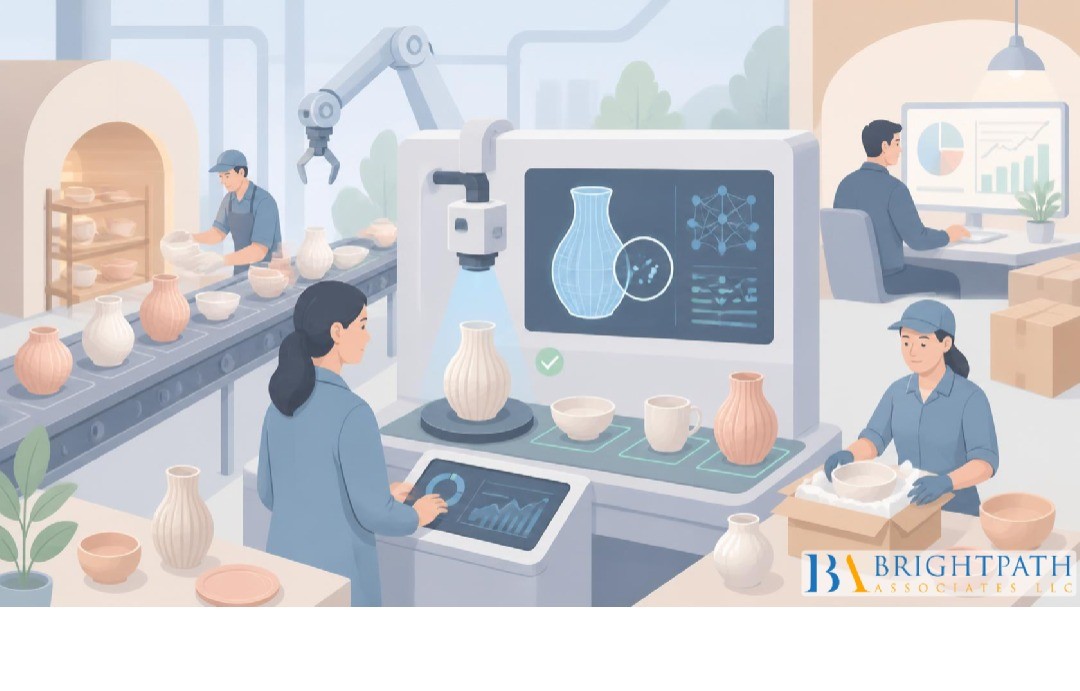
One of the most practical applications of AI in #CeramicQualityControl is machine vision. High-resolution cameras can capture images of ceramic surfaces as products move through production lines. AI models can then analyze these images for cracks, chips, discoloration, glaze irregularities, dimensional inconsistencies, pinholes, warping, and other defects.
Unlike conventional rule-based inspection systems, machine-learning models can be trained using large datasets containing examples of acceptable and defective products. Over time, these systems can become capable of recognizing complex visual patterns that may be difficult to define through simple programming rules.
AI-based inspection can also improve consistency. Every product can be evaluated according to the same digital criteria, reducing variations associated with manual inspection.
For manufacturers producing tiles, sanitaryware, tableware, technical ceramics, or specialized components, this can significantly improve production visibility and quality assurance.
The greatest value of AI may come from identifying the causes of defects before finished products reach inspection.
Manufacturing processes generate large amounts of data from temperature sensors, pressure controls, moisture monitoring systems, kiln equipment, material measurements, and production machinery. AI can analyze relationships among these variables to identify conditions associated with quality failures.
For example, if a specific combination of kiln temperature, firing duration, moisture level, and material composition consistently results in warping, an AI system can identify the pattern. Operators can then adjust the process before large quantities of defective products are produced.
This transforms quality control from a detection function into a predictive capability.
Advanced Ceramic Manufacturing and Data-Driven Production
Advanced #CeramicManufacturing increasingly requires greater precision because products are being developed for demanding applications. Technical ceramics can be used in electronics, medical equipment, aerospace components, automotive systems, energy technologies, and industrial machinery.
In these applications, quality requirements can be significantly more stringent than those associated with conventional ceramic products.
AI can support these requirements by connecting production data with quality outcomes. Manufacturers can establish digital relationships between raw materials, process conditions, machine settings, and final product characteristics.
This data-driven approach can also support continuous process improvement. Instead of relying exclusively on periodic audits, manufacturers can continuously evaluate production performance and identify emerging deviations.
Quality improvement and sustainability are increasingly interconnected. Defective ceramic products consume raw materials, energy, labor, packaging, and transportation resources without generating equivalent commercial value.
AI-driven quality control can help reduce this waste by identifying process problems earlier. When defects are detected during production rather than after completion, manufacturers may be able to correct the process before additional material is consumed.
This supports the broader objective of developing Sustainable building materials. Manufacturers that reduce scrap, energy consumption, water use, and unnecessary processing can improve both environmental performance and operating efficiency.
The same principle is relevant to other construction-material industries. Advanced concrete technology, cement manufacturing, glass production, and ceramic manufacturing are all increasingly exploring digital systems that connect operational efficiency with sustainability.
Connecting Ceramic Quality Control With Construction Materials
Ceramics are an important component of the broader construction-material ecosystem. Tiles, sanitary products, bricks, roofing products, decorative materials, and specialized ceramic components can all contribute to modern construction projects.
As customers demand greater consistency, durability, aesthetic quality, and environmental performance, ceramic manufacturers need to strengthen their quality systems.
AI can provide a common analytical foundation for manufacturing environments where multiple product specifications and production conditions must be managed simultaneously.
The technology can also help manufacturers adapt production to changing customer requirements. AI-supported systems can identify which process conditions produce the strongest quality outcomes for different product categories, allowing factories to become more responsive.
Concrete industry trends demonstrate how data and automation are reshaping traditional construction-material production. Concrete manufacturers are increasingly using sensors, digital monitoring, predictive analytics, and automation to improve consistency and resource efficiency.
Ceramic manufacturers can adopt similar principles. The objective is not to copy another industry’s technology directly but to recognize the broader shift toward intelligent manufacturing.
In both industries, quality depends on controlling multiple variables simultaneously. AI can help identify relationships between process conditions and final product performance.
This cross-industry learning is becoming increasingly important as manufacturers look for ways to improve operational efficiency without relying exclusively on additional labor or physical expansion.
Glass Industry Innovation and AI-Based Inspection
#GlassIndustry innovation provides another useful comparison. Glass manufacturers have long used automated inspection systems to identify surface imperfections, thickness variations, optical defects, and dimensional problems.
AI is expanding these capabilities by enabling systems to recognize increasingly complex patterns.
Ceramic manufacturers can similarly use AI to move beyond basic pass-or-fail inspection. Instead, inspection systems can potentially classify defects, determine their severity, identify recurring patterns, and connect those patterns with production conditions.
This creates a feedback loop in which inspection data becomes a source of manufacturing intelligence rather than simply a final quality checkpoint.
Cement industry sustainability is another area where predictive technologies are gaining importance. Cement production is energy-intensive, and manufacturers are under increasing pressure to reduce emissions and improve resource efficiency.
While ceramics and cement have different production processes, they share important challenges related to energy use, raw materials, process control, and quality consistency.
AI can help identify opportunities to optimize production parameters while maintaining product specifications.The broader lesson is that quality optimization can contribute directly to sustainability when it reduces waste and prevents unnecessary energy consumption.
Integrating AI With Existing Manufacturing Systems
AI adoption does not necessarily require manufacturers to replace their entire production infrastructure. In many cases, AI systems can be integrated with existing sensors, cameras, programmable controllers, manufacturing execution systems, and enterprise software.
The first step is usually establishing reliable data collection. AI models are only as effective as the information used to train and operate them. Manufacturers therefore need consistent data from production equipment and quality processes.
Once a reliable data foundation exists, manufacturers can introduce AI into specific areas where the business case is strongest. Surface inspection may be the first application, followed by predictive quality monitoring, process optimization, predictive maintenance, and production planning.
This gradual approach can reduce implementation risk while allowing companies to measure tangible results.
AI does not eliminate the need for experienced ceramic professionals. Instead, it changes how their expertise is used.
Experienced quality engineers understand the physical behavior of materials and manufacturing processes. AI can analyze enormous quantities of production data, but human specialists are still needed to interpret results, validate recommendations, investigate unusual conditions, and make strategic decisions.
The future factory is therefore likely to combine machine intelligence with human judgment. Operators may spend less time performing repetitive inspections and more time managing process improvement and exception handling.
This transition will increase demand for professionals who understand both manufacturing technology and data-driven decision-making.
Talent and Leadership in the Ceramic Industry
Technology transformation also creates a leadership challenge. Companies need executives capable of connecting manufacturing strategy, technology investment, workforce development, sustainability, and commercial objectives.
This is where #ExecutiveSearchRecruitment can become important for organizations undergoing digital transformation. Leaders in ceramic and construction-material businesses increasingly need experience with automation, analytics, operational excellence, and technology-enabled manufacturing.
Construction materials recruitment is also evolving as companies seek professionals who can manage increasingly sophisticated production environments. Technical knowledge remains essential, but digital literacy and strategic leadership are becoming equally important.
The next stage of AI adoption will likely move beyond identifying defects toward predicting and preventing them. AI systems could increasingly connect raw-material characteristics with production conditions and final product performance.
Digital twins, edge computing, advanced computer vision, generative analytics, and increasingly sophisticated machine-learning models could provide manufacturers with near-real-time simulations of production behavior.
Such systems could allow production teams to test process changes digitally before implementing them on the factory floor. This could reduce experimentation costs while accelerating process optimization.
As Ceramic industry growth continues and product requirements become more demanding, these capabilities may become standard components of competitive manufacturing operations.
Conclusion
AI is fundamentally changing the role of quality control in ceramic manufacturing. Instead of treating inspection as the final stage of production, manufacturers can use artificial intelligence to create a continuous feedback system that connects raw materials, machinery, process conditions, inspection data, and final product quality.
The benefits extend beyond defect detection. AI can reduce waste, improve production consistency, support energy efficiency, strengthen Advanced ceramic manufacturing, and contribute to the development of Sustainable building materials.
The broader manufacturing ecosystem is moving in the same direction. Concrete production efficiency, Glass industry innovation, Advanced concrete technology, and Cement industry sustainability all demonstrate the growing importance of data-driven industrial processes.
For ceramic manufacturers, the opportunity is clear: AI can turn quality control from a reactive cost center into a strategic manufacturing capability. Organizations that combine technology with experienced people and effective leadership will be better positioned to compete as the industry becomes more intelligent, efficient, and sustainable.
Find your next leadership role in Glass, Ceramic, Concrete Industry today!
Stay informed with the latest insights on Glass, Ceramic, Concrete Industry!