
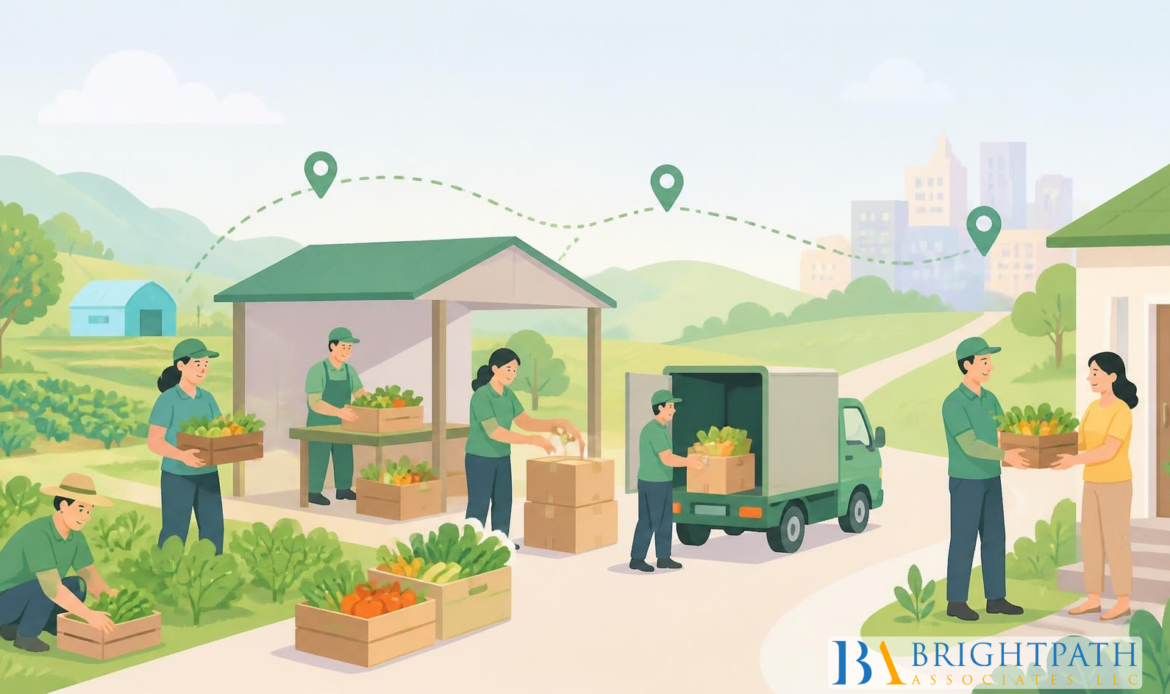
Introduction
Direct-to-consumer (DTC) agricultural sales are transforming the relationship between farmers and consumers. Instead of relying entirely on multiple intermediaries, producers can increasingly sell fresh produce, grains, dairy products, processed foods, and specialty agricultural products directly to households, restaurants, retailers, and institutional buyers. This model can improve market access, strengthen farmer-consumer relationships, and create opportunities for higher-value food production. However, the success of DTC agriculture depends on more than production and #CustomerAcquisition. The most persistent challenge is often the last mile.
The last mile represents the final stage between a farm, collection center, or distribution hub and the customer. In agricultural supply chains, this stage is particularly complex because products can be perishable, geographically dispersed, temperature-sensitive, and difficult to standardize. High delivery costs, unpredictable demand, inefficient routing, inadequate storage, and fragmented orders can quickly reduce the economic benefits of direct sales. Solving these bottlenecks requires a combination of Agricultural technology, logistics planning, Digital Farming, data management, and operational discipline.
For producers building modern DTC businesses, the objective should not simply be faster delivery. The objective should be to create a reliable, economically sustainable, and scalable distribution system that connects Food production with consumer demand while minimizing waste.
Traditional agricultural supply chains were designed around aggregation. Farmers generally deliver products to traders, wholesalers, processors, or centralized markets where large volumes can be consolidated before reaching consumers. DTC models reverse part of this structure. Instead of moving large quantities to a few buyers, producers may need to move smaller quantities to many individual customers.
This creates a fundamental logistics problem. A farm may efficiently harvest hundreds of kilograms of vegetables, but distributing those products to hundreds of households can require substantially more coordination. Each delivery introduces transportation costs, handling requirements, packaging requirements, and administrative work.
Perishability makes the problem more difficult. Fresh vegetables, fruits, dairy products, eggs, meat, and other temperature-sensitive goods have limited shelf lives. Delays can affect quality and customer satisfaction while increasing food waste. A delivery model that works for durable grains may therefore be unsuitable for leafy vegetables or fresh dairy.
Weather and seasonal production also create uncertainty. Agricultural output can fluctuate because of rainfall, temperature, pests, disease, and other production conditions. At the same time, consumer demand can vary by season, holidays, weekends, local events, and changing prices. A successful DTC model must manage both sides of this uncertainty.
Technology as an Enabler of Last Mile Efficiency
Agricultural technology can help producers transform fragmented delivery operations into data-driven systems. Digital platforms can consolidate customer orders, monitor inventory, coordinate delivery schedules, and identify demand patterns. When these functions are integrated, farmers and agricultural enterprises can make decisions based on actual market information rather than assumptions.
Farm management software is becoming increasingly relevant because production planning and distribution planning are closely connected. If a producer understands expected harvest volumes, crop maturity, customer orders, and available inventory, the business can coordinate harvesting with dispatch more efficiently.
Digital Farming systems can also connect field-level information with commercial operations. Precision agriculture technologies generate information about crop conditions, irrigation requirements, soil characteristics, and expected yields. Combining these insights with sales data can help businesses anticipate supply availability and adjust customer commitments.
The value of technology is therefore not limited to automation. Its larger role is creating visibility across the agricultural value chain.
One of the most effective approaches to reducing last-mile costs is geographic consolidation. Instead of treating every customer as an independent delivery destination, DTC agricultural businesses can organize customers into defined delivery zones.
For example, a producer serving an urban market can establish specific delivery days for different neighborhoods. Orders from customers within the same area can then be consolidated into a single route. This increases vehicle utilization, reduces unnecessary travel, and improves delivery predictability.
Local collection points can provide another solution. Customers may collect orders from community stores, residential complexes, farmers’ markets, or partner businesses. Such models reduce the number of individual doorstep deliveries while preserving direct access to consumers.
Micro-distribution hubs can also be established closer to major demand centers. These facilities can receive consolidated farm shipments and coordinate shorter local delivery routes. For businesses operating across larger regions, this approach can reduce the distance between inventory and consumers.
Demand Forecasting and Order Consolidation
A major source of last-mile inefficiency is uncertainty around demand. Agricultural producers may harvest based on expected demand, only to discover that actual orders differ significantly. This can result in either excess inventory or insufficient supply.
#DemandForecasting can reduce this imbalance. Historical sales information, customer purchasing behavior, seasonal patterns, weather data, and promotional activity can help producers estimate future demand. Agricultural innovation increasingly involves combining production intelligence with market intelligence.
Subscription-based purchasing is another useful mechanism. Weekly vegetable boxes, monthly grain deliveries, dairy subscriptions, and other recurring models provide greater demand visibility. Producers can plan harvesting and packing according to confirmed or expected orders rather than relying entirely on spot sales.
Order cut-off times can further improve operational efficiency. Customers who place orders before a defined deadline can be grouped into the following delivery cycle. This gives warehouse and farm teams adequate time to harvest, sort, package, and dispatch products.
For perishable agricultural products, transportation efficiency cannot be separated from product quality. A delivery that reaches the customer quickly but arrives with damaged or deteriorated products is not operationally successful.
Cold-chain infrastructure is particularly important for temperature-sensitive goods. Appropriate pre-cooling, insulated packaging, refrigerated storage, and temperature-controlled transportation can extend product quality. However, these systems can be expensive, especially for smaller producers.
Businesses should therefore match cold-chain investment with product characteristics and market economics. Not every product requires the same temperature-control strategy. Some products may benefit from simple insulated packaging and rapid local distribution, while others require continuous refrigeration.
Packaging design also influences last-mile performance. Strong but lightweight packaging can reduce product damage while controlling transportation weight. Standardized packaging sizes can make stacking and vehicle loading easier. Reusable crates and containers can also support Agricultural sustainability by reducing dependence on disposable materials.
Reducing Food Waste Through Better Coordination
Food waste represents both an economic and environmental challenge. When agricultural products remain unsold or deteriorate during distribution, farmers lose potential revenue while the resources used for production are effectively wasted.
Better coordination between harvesting and orders can significantly reduce this problem. DTC businesses should attempt to harvest closer to actual dispatch whenever product characteristics allow. This approach can preserve freshness and reduce unnecessary storage.
Dynamic pricing can also help move products approaching the end of their preferred selling window. Products that are still safe and high quality but have limited remaining shelf life can be offered through time-sensitive promotions.
Secondary channels provide another solution. Products that do not meet cosmetic requirements for premium DTC sales can potentially be redirected toward processing, food-service customers, animal feed, or other suitable markets. Such approaches support Agricultural sustainability by maximizing the value recovered from agricultural output.
Transportation is frequently one of the largest costs in last-mile agriculture. Route optimization can help reduce fuel consumption, driver time, vehicle wear, and delivery delays.
Modern routing systems can group deliveries according to geography, customer availability, vehicle capacity, and delivery priorities. Instead of sending drivers across an entire city, businesses can create compact delivery clusters.
The benefits become more significant as order volumes grow. A manual delivery system may work for a small number of customers, but it becomes increasingly inefficient as the customer base expands. Technology-supported routing can provide the operational foundation required for scale.
Electric delivery vehicles and low-emission transportation options can further support Sustainable farming and Agricultural sustainability objectives, particularly for short urban routes. However, the economic feasibility of these options depends on vehicle costs, charging infrastructure, route length, and delivery density.
Connecting Producers With Urban Demand
Urbanization is creating new opportunities for direct agricultural marketing. Consumers increasingly seek information about where food comes from, how it is produced, and how it reaches their households. This creates an opportunity for producers to differentiate their products through transparency and traceability.
#DigitalPlatforms can provide customers with information about farms, production methods, harvest dates, certifications, and product origins. For producers practicing Organic farming or other sustainability-oriented methods, this transparency can help communicate the value behind their products.
However, transparency must be supported by reliable operational systems. A compelling digital storefront cannot compensate for inconsistent delivery, poor packaging, or unreliable inventory. DTC agricultural businesses must therefore treat customer experience as an integrated process extending from field management to final delivery.
Sustainable agriculture investment should increasingly consider distribution infrastructure alongside production capacity. Expanding farm output without developing adequate post-harvest and delivery systems can create new bottlenecks.
Investment may be required in aggregation centers, storage facilities, sorting equipment, packaging systems, transportation, digital platforms, and workforce training. The appropriate investment depends on product type, geographic market, customer density, and business model.
Small and medium-sized producers may benefit from shared infrastructure rather than building every capability independently. Cooperatives, producer organizations, logistics providers, and local distribution partnerships can spread infrastructure costs across multiple businesses.
This collaborative model can make sophisticated logistics more accessible while allowing producers to retain greater control over customer relationships.
Developing the Workforce Behind Modern Agricultural Logistics
Technology cannot solve the last-mile challenge without skilled people managing the underlying processes. Modern agricultural businesses require professionals who understand production, logistics, data, customer operations, procurement, and supply-chain management.
This is where #ExecutiveSearchRecruitment can become strategically important for agricultural organizations undergoing digital transformation. Companies may need leaders capable of connecting farm operations with commercial distribution, technology implementation, sustainability objectives, and customer expectations.
The future agricultural workforce will increasingly require hybrid capabilities. Agricultural managers may need greater familiarity with digital systems, while logistics professionals may need a deeper understanding of perishability and seasonal production. Building this cross-functional capability can be as important as purchasing new technology.
A successful direct-to-consumer agricultural model must balance customer convenience with economic and environmental realities. Delivering a single low-value order over a long distance may provide convenience but create poor logistics economics and unnecessary emissions.
Businesses should therefore design delivery models around density and efficiency. Minimum order values, delivery windows, subscription models, neighborhood routes, collection points, and consolidated shipments can all improve unit economics.
Sustainability should also extend beyond transportation. Producers can examine packaging materials, food waste, water consumption, energy use, storage requirements, and returnable-container systems. Precision agriculture can help optimize resource use at the production stage, while digital logistics can improve efficiency after harvest.
The result is a more integrated approach to Agricultural technology in which production, distribution, and consumption are managed as connected components rather than separate activities.
Conclusion
The last-mile bottleneck is one of the most significant barriers to scaling direct-to-consumer agricultural sales. The challenge comes from the combination of fragmented demand, geographic dispersion, perishability, seasonal production, transportation costs, and quality requirements. Solving it requires more than simply adding delivery vehicles or creating an online ordering platform.
The next generation of agricultural businesses will increasingly combine Precision agriculture, Digital Farming, demand forecasting, route optimization, cold-chain management, order consolidation, and modern farm management software. These capabilities can improve coordination between what farms produce and what consumers actually demand.
At the same time, Agricultural innovation must remain commercially practical. Technology investments should be matched with appropriate distribution models, workforce capabilities, infrastructure, and customer economics. Producers who successfully integrate these elements can create more resilient DTC operations while supporting Sustainable farming and Agricultural sustainability.
Ultimately, the goal is to make the journey from farm to consumer more predictable, efficient, and economically viable. By treating the last mile as a strategic part of Food production rather than simply a delivery function, agricultural businesses can build distribution networks capable of supporting long-term growth in an increasingly digital food economy.
Find your next leadership role in Farming Industry today!