
Introduction
#ManufacturingCompanies are under increasing pressure to improve productivity, reduce operational costs, strengthen equipment reliability, and respond quickly to changing market demands. While new digital technologies offer significant opportunities, replacing entire production systems is often expensive and disruptive. Many businesses continue to rely on legacy Industrial machinery that remains mechanically reliable but lacks the connectivity and monitoring capabilities required for modern manufacturing.
Smart sensor integration offers a practical solution to this challenge. By installing sensors on existing machines and connecting them to digital monitoring platforms, manufacturers can collect valuable operational data without necessarily replacing their established equipment. Information about vibration, temperature, pressure, energy consumption, and machine performance can help organizations identify developing problems, optimize operating conditions, and make more informed maintenance decisions.
This transformation is central to the Industrial Internet of Things (IIoT), which connects physical equipment with digital systems to improve industrial visibility and decision-making. For US Machinery manufacturers and other industrial businesses, sensor integration provides an opportunity to modernize existing assets while protecting previous capital investments.
However, successful implementation requires more than installing sensors. Companies must select appropriate technologies, integrate reliable data systems, train employees, and establish clear operational objectives. When these elements work together, legacy equipment can become a valuable part of a connected, data-driven manufacturing environment.
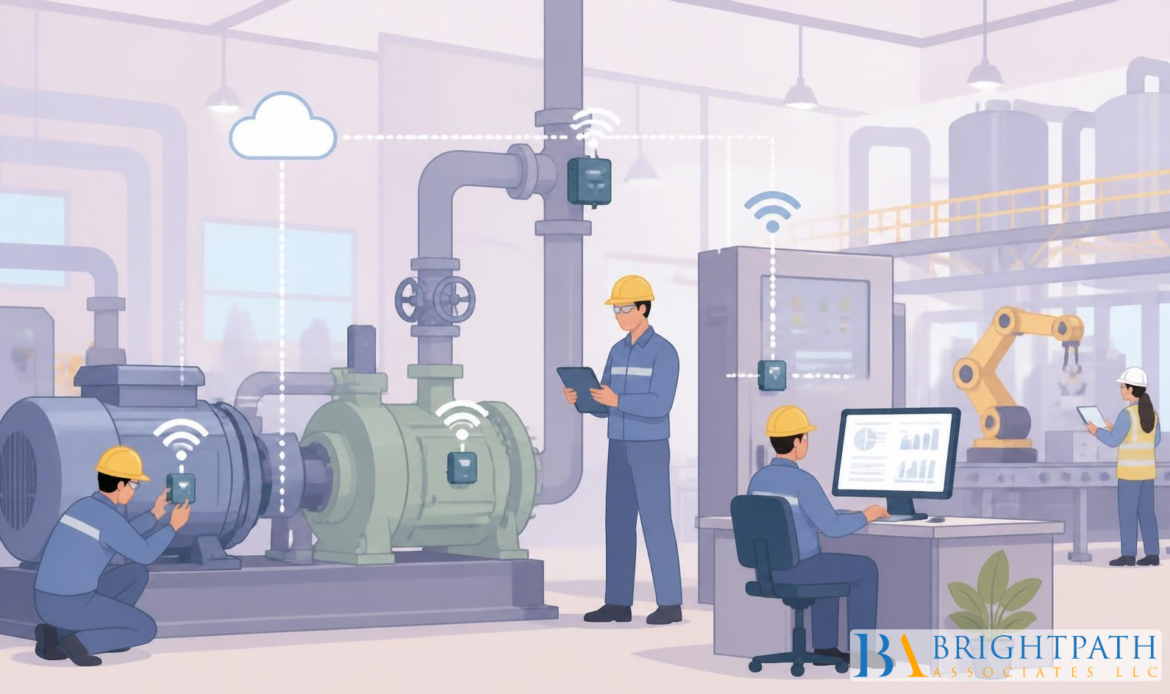
Smart sensors capture physical measurements and convert them into information that industrial systems can analyze. Depending on the application, sensors may monitor vibration, temperature, humidity, pressure, electrical current, rotational speed, fluid levels, or acoustic signals.
In conventional manufacturing environments, operators often depend on manual inspections and scheduled maintenance to evaluate machine conditions. Although these methods remain useful, they may not identify developing problems between inspection intervals. Smart sensors provide more frequent visibility into equipment behavior, allowing maintenance teams to detect abnormal conditions earlier.
For example, a sensor installed on a motor can monitor vibration patterns that may indicate bearing wear or mechanical imbalance. Temperature sensors can identify overheating, while electrical monitoring can reveal unusual power consumption associated with deteriorating performance.
The collected information can be transmitted to local gateways, industrial networks, or cloud-based platforms, depending on the equipment and system architecture. Analytics software can then compare measurements with established operating limits and historical performance patterns.
For companies operating complex Industrial machinery, this information can improve maintenance planning and reduce unexpected interruptions. Nevertheless, sensors must be selected according to the specific machine, operating environment, and failure modes being monitored. Poor sensor placement, unreliable measurements, or inappropriate alert thresholds can produce misleading results.
A successful integration strategy begins by identifying the operational problems that monitoring is expected to solve.
Transforming Legacy Equipment into Industrial IoT Assets
Legacy equipment frequently remains productive long after its original control systems become outdated. Replacing these machines can require substantial investment, production downtime, operator retraining, and modifications to factory infrastructure.
Smart sensor integration allows manufacturers to add digital monitoring capabilities while retaining much of their existing equipment. Sensors can be installed externally on machine housings, motors, pumps, gearboxes, and other components without requiring extensive modifications to the original control architecture.
Industrial gateways can collect information from sensors and convert it into formats compatible with modern monitoring systems. Where existing programmable controllers already expose useful operating data, manufacturers may be able to combine controller information with additional sensor measurements.
This approach can help businesses modernize gradually instead of committing to a complete factory-wide replacement program. It is particularly useful when machinery remains mechanically sound but lacks modern connectivity.
However, not every legacy machine is a suitable candidate. Equipment with severe mechanical deterioration, inadequate safety systems, or obsolete components that cannot be maintained reliably may require refurbishment or replacement. Sensor integration should not be used to conceal fundamental equipment problems.
Manufacturers should evaluate the remaining useful life of each asset, the cost of modernization, the availability of spare parts, and the expected operational benefits. A structured assessment helps determine whether connectivity will create meaningful value or merely add expense to an asset nearing the end of its productive life.
Industrial automation solutions increasingly combine sensors, controllers, industrial communication networks, and analytical software to create more responsive manufacturing environments. Smart sensor integration strengthens these systems by providing additional information about the condition and performance of physical assets.
In an automated production line, for example, sensors can monitor conveyor speed, motor temperature, pneumatic pressure, and machine vibration. When measurements move outside expected operating ranges, monitoring systems can alert operators or maintenance teams before the problem affects production.
Integration with existing control systems requires careful engineering. Older machines may use communication protocols that differ from those supported by modern industrial networks. Gateways, protocol converters, or dedicated interfaces may be necessary to exchange information reliably.
Manufacturers must also distinguish between monitoring functions and machine control. Collecting data for analysis is generally less intrusive than modifying real-time control logic. Changes that affect machine operation or safety functions require appropriate engineering validation and established safety procedures.
Cybersecurity is another critical consideration. Connecting previously isolated equipment can introduce new risks if networks, devices, and remote access systems are not adequately protected. Businesses should implement appropriate network segmentation, access controls, software updates, and monitoring practices.
When integration is planned carefully, sensor-enabled automation can improve visibility without unnecessarily disrupting established production processes.
Precision Machining: Improving Quality and Process Stability
#PrecisionMachining depends on maintaining tight tolerances, consistent cutting conditions, and stable equipment performance. Even small variations in spindle vibration, temperature, tool condition, or machine alignment can affect dimensional accuracy and surface finish.
Smart sensors can help machining facilities monitor these variables and identify conditions that may contribute to defects. Vibration monitoring can reveal developing spindle or bearing problems, while temperature measurements can help engineers understand thermal changes that affect machining accuracy.
Sensors can also support tool-condition monitoring by identifying changes in vibration, acoustic emissions, or cutting forces. When these measurements are interpreted correctly, manufacturers can investigate tool wear before it produces excessive scrap or damages expensive workpieces.
For manufacturers producing high-value components, the benefits extend beyond machine reliability. More consistent process conditions can reduce inspection failures, improve production repeatability, and strengthen customer confidence.
However, sensor data must be interpreted in context. A vibration increase may reflect a change in cutting parameters rather than a mechanical defect, and temperature variations may be normal during certain operating cycles. Effective monitoring therefore combines sensor information with process knowledge, machine specifications, and quality records.
Integrating sensor insights into precision machining workflows helps manufacturers make more informed decisions about maintenance, process adjustments, and production quality.
Traditional maintenance strategies often rely on fixed service intervals or repairs performed after equipment failure. Although preventive maintenance reduces some risks, it may result in unnecessary servicing when equipment remains in good condition or fail to identify problems that develop between scheduled inspections.
Smart sensor integration supports condition-based maintenance by providing information about the actual state of equipment. Predictive maintenance takes this approach further by using historical and current data to estimate how equipment performance may change and when intervention could be necessary.
For example, vibration trends may help maintenance specialists investigate bearing deterioration, while temperature and pressure measurements may reveal developing problems in pumps or hydraulic systems. Energy consumption patterns can also provide clues about changing machine efficiency.
These insights allow organizations to prioritize maintenance according to equipment condition, production criticality, and potential failure consequences. Maintenance teams can prepare replacement parts, schedule technicians, and coordinate repairs with planned production stops.
Nevertheless, predictive maintenance is not a guarantee that failures will be prevented. Sensor coverage may be incomplete, models may generate false alarms, and some failure modes develop too quickly for early detection. Regular inspections and manufacturer-recommended maintenance procedures remain important.
Manufacturers should evaluate performance using measures such as unplanned downtime, maintenance expenditure, mean time between failures, and equipment availability. These indicators help determine whether sensor investments are delivering measurable operational benefits.
Manufacturing Efficiency and the Business Case for Sensor Adoption
Manufacturing efficiency depends on how effectively a company uses its machinery, labor, materials, energy, and production time. Smart sensors can improve this efficiency by revealing operational losses that may otherwise remain hidden.
For instance, a manufacturer may discover that a production line experiences repeated short stoppages that operators do not consistently record. Sensors can identify recurring interruptions and help determine whether they originate from material handling, machine settings, component wear, or process coordination.
Energy monitoring can reveal equipment that consumes excessive power during idle periods or operates inefficiently under particular conditions. Production data can also help managers compare cycle times, identify bottlenecks, and improve equipment utilization.
The financial case should consider the complete cost of implementation, including sensors, installation, connectivity, software, maintenance, training, and cybersecurity. Expected benefits may include lower downtime, reduced scrap, improved energy efficiency, and better maintenance planning.
A phased implementation approach is often appropriate. Businesses can begin with a small group of critical machines, establish baseline performance, and compare results after integration. Successful projects can then be expanded to other assets.
This approach reduces financial risk and gives employees time to develop the skills needed to interpret sensor information. It also helps management avoid investing in large technology platforms before demonstrating their practical value.
Smart sensor integration creates new opportunities for businesses that purchase or operate Used machinery. Secondhand equipment can provide an affordable way to expand production capacity, but buyers may face uncertainty regarding operating history, component wear, energy performance, and future maintenance requirements.
Where technically feasible, sensor installation can improve visibility into the condition of used assets after acquisition. Buyers may monitor vibration, temperature, operating hours, and energy consumption to establish performance baselines and identify maintenance priorities.
However, sensors cannot replace a thorough pre-purchase inspection, mechanical assessment, or review of service records. They provide information about monitored conditions rather than a complete guarantee of equipment quality.
Machinery financing decisions can also benefit from a clearer understanding of asset performance. Businesses evaluating equipment investments should compare purchase price, installation costs, financing expenses, maintenance requirements, expected productivity, and remaining useful life.
For lenders and equipment owners, reliable operational data may support more informed asset-management decisions, although its usefulness depends on data quality and the specific financing arrangement.
Manufacturers should therefore assess sensor integration as one element of an overall asset strategy. Combining physical inspections, maintenance documentation, and digital monitoring can help businesses manage equipment investments more responsibly.
US Machinery Manufacturers and the Changing Industrial Machinery Industry
The Industrial machinery industry is increasingly influenced by digital manufacturing, automation, supply chain resilience, and customer demand for dependable equipment performance. US Machinery manufacturers face opportunities to differentiate their products by combining mechanical engineering expertise with connected monitoring capabilities.
#EquipmentManufacturers can design new machines with built-in sensors while offering retrofit packages for older installations. These services may help customers improve reliability without replacing entire production systems, creating additional opportunities in aftermarket support and lifecycle management.
Sensor-enabled equipment can also improve communication between manufacturers and customers. With appropriate authorization, diagnostic information can help service teams investigate faults remotely, recommend maintenance actions, and prepare the necessary parts before visiting a facility.
However, equipment providers must establish clear data ownership policies and protect commercially sensitive information. Customers should understand which data are collected, how they are used, and who can access them.
Manufacturers that develop practical retrofit solutions and dependable support services can strengthen customer relationships while expanding beyond traditional equipment sales.
The broader opportunity lies in treating machinery as a long-term service relationship rather than a product delivered once and maintained entirely by the customer.
Smart sensor integration is changing the skills required across manufacturing operations. Traditional maintenance technicians remain essential, but they increasingly benefit from knowledge of digital monitoring, sensor calibration, industrial communication systems, and data interpretation.
Electrical engineers, automation specialists, reliability engineers, and industrial data analysts may work together to design and maintain connected equipment. Production supervisors also need to understand how sensor alerts relate to quality, machine availability, and daily operating targets.
These developments are influencing Manufacturing jobs by increasing the importance of multidisciplinary skills. Employers must invest in training that helps existing workers adapt rather than assuming that digital systems can operate effectively without experienced personnel.
Training programs should include practical instruction in sensor installation, fault diagnosis, cybersecurity awareness, and maintenance analytics. Employees also need clear procedures for responding to alarms and escalating issues that require specialist intervention.
Manufacturers that involve technicians in implementation can benefit from their knowledge of recurring machine problems and operating conditions. Their participation can improve sensor placement, reduce false alarms, and make monitoring systems more useful.
Technology adoption is most effective when it strengthens employee capabilities and creates a culture of continuous improvement.
Executive Search Recruitment and Leadership for Industrial Transformation
Successful smart sensor integration requires leadership that connects engineering priorities with operational performance and financial objectives. Organizations need executives who understand manufacturing processes while recognizing the opportunities and limitations of digital technologies.
Leaders responsible for operations, engineering, maintenance, and digital transformation must coordinate investments, establish performance targets, and ensure that technology projects address genuine business needs. They must also guide workforce development and maintain appropriate safety and cybersecurity standards.
#ExecutiveSearchRecruitment can help industrial organizations identify senior professionals with experience in manufacturing modernization, industrial automation, reliability management, and digital transformation. Candidates should demonstrate the ability to translate technical opportunities into measurable improvements in productivity, quality, and profitability.
For growing manufacturers, the right leadership team can help determine which assets should be modernized, how investments should be prioritized, and how new capabilities can be scaled across facilities.
Effective executives also recognize that sensor integration is not solely an engineering project. It requires collaboration between IT, operational technology, maintenance, production, finance, and human resources.
By developing the right leadership capabilities, companies can improve implementation outcomes and establish a sustainable foundation for connected manufacturing.
Conclusion
Smart sensor integration provides manufacturers with a practical pathway to modernize legacy equipment and participate in the Industrial Internet of Things without automatically replacing established machinery. By monitoring equipment conditions, identifying operational inefficiencies, and improving maintenance planning, businesses can strengthen reliability and make better use of existing capital investments.
For the Industrial machinery industry, the combination of Industrial automation solutions, Precision machining, and data-driven Machinery maintenance can improve production visibility and support higher Manufacturing efficiency. US Machinery manufacturers can also use retrofit technologies and connected services to strengthen customer relationships and create additional value throughout the equipment lifecycle.
However, long-term success depends on selecting appropriate sensors, maintaining reliable data, protecting connected systems, and developing employees who can interpret operational insights. Careful financial planning and effective leadership are equally important.
With a phased implementation strategy and the right technical expertise, manufacturers can transform suitable legacy equipment into valuable digital assets. Supported by strategic Executive Search Recruitment and continuous workforce development, this approach can help industrial businesses improve competitiveness, extend equipment usefulness, and prepare for a more connected manufacturing future.
Find your next leadership role in Machinery Industry today!
Stay informed with the latest insights on Machinery Industry!