
Introduction
The #ConstructionIndustry is experiencing significant changes as companies face rising material costs, labor shortages, tighter project schedules, evolving customer expectations, and increasing sustainability requirements. For mid-sized firms, these pressures create an important strategic question: should they adopt modularization to improve consistency and efficiency, or continue relying on custom fabrication to meet specialized project requirements?
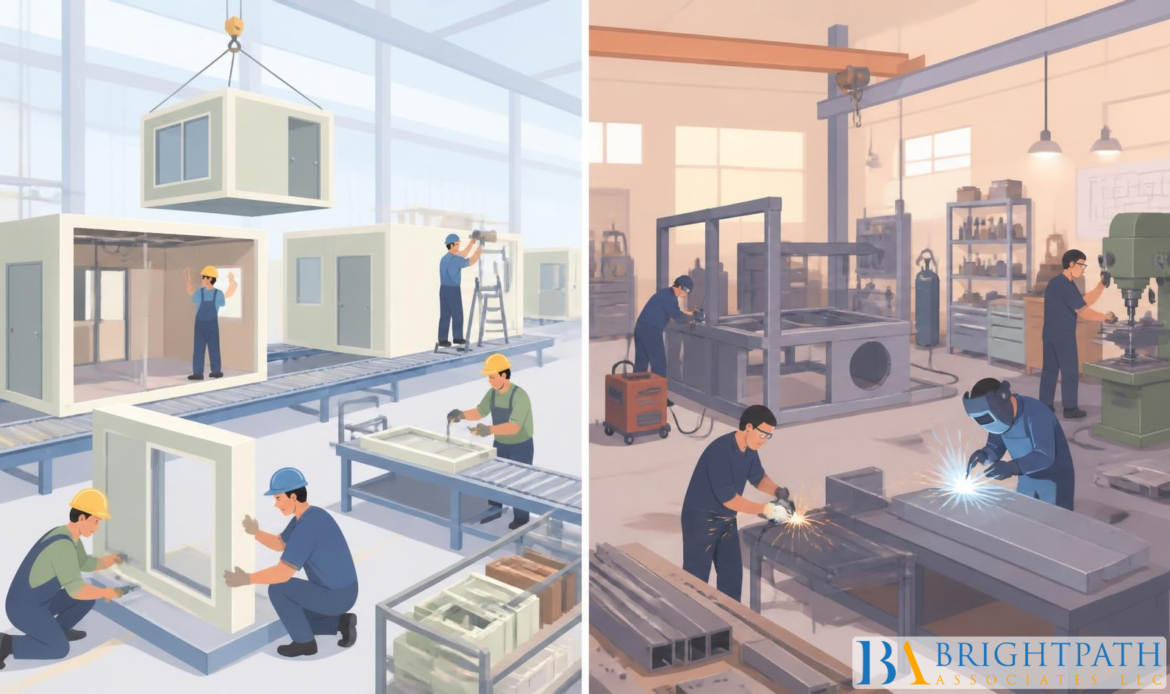
Both approaches offer distinct advantages. Modularization involves producing standardized components or assemblies that can be manufactured repeatedly and integrated into different projects. Custom fabrication, by contrast, focuses on creating components according to specific architectural, engineering, or customer requirements. The right choice depends on project complexity, production capacity, financial resources, and the competitive position of the business.
For companies working with Construction materials, Building supplies, structural systems, and prefabricated components, the decision influences more than manufacturing methods. It affects procurement, workforce planning, quality control, project delivery, and profitability. Mid-sized firms must therefore evaluate modularization and customization as strategic operating models rather than isolated production techniques.
A carefully designed approach can help businesses improve productivity, control costs, and respond to changing market requirements without sacrificing quality or flexibility.
Modularization is based on designing and manufacturing repeatable components that can be assembled into larger systems. These components may include prefabricated wall panels, structural frames, mechanical service modules, bathroom pods, electrical assemblies, and standardized building sections.
Manufacturing components in controlled environments can improve dimensional accuracy, reduce exposure to weather-related delays, and establish consistent quality procedures. Repetition also allows manufacturers to refine production methods, improve material utilization, and reduce unnecessary variation.
For mid-sized construction firms, modularization can create opportunities to serve multiple projects using a common component platform. A company producing residential developments, for example, may standardize selected wall assemblies, structural connections, or service modules while adjusting other features to meet individual project requirements.
Modular construction can also improve coordination between design, procurement, manufacturing, and on-site installation. When components are designed around consistent interfaces, teams can plan installation sequences more accurately and identify potential conflicts earlier.
However, modularization requires upfront planning. Standardized components must be compatible with project specifications, transportation limitations, site conditions, and applicable Building regulations. Firms may also need investments in design software, specialized equipment, storage facilities, and production processes.
The financial benefits become more compelling when components are used frequently across multiple projects. For companies handling highly variable or infrequent projects, the cost of developing standardized systems may outweigh the benefits.
Custom Fabrication: Flexibility for Specialized Projects
Custom fabrication allows construction companies to produce components tailored to specific dimensions, materials, structural conditions, and design requirements. It remains particularly valuable for projects involving unusual architectural features, complex renovations, specialized industrial facilities, and nonstandard structural configurations.
Unlike highly standardized production, custom fabrication accommodates changes that arise from site-specific constraints or individual customer preferences. Fabricators can adapt steel assemblies, timber structures, concrete elements, and other Construction materials to meet distinctive technical requirements.
This flexibility can provide a competitive advantage when customers value specialized engineering, unique designs, or solutions that standard products cannot deliver. Mid-sized firms may also differentiate themselves by responding quickly to unusual requests that larger standardized manufacturers are less equipped to handle.
Nevertheless, custom fabrication can introduce operational complexity. Each new design may require additional engineering, material calculations, production planning, quality inspections, and coordination with project teams. Frequent design changes can increase waste, extend lead times, and create uncertainty in cost estimates.
The dependence on skilled workers is another consideration. Specialized fabricators, engineers, and technicians may be difficult to recruit, particularly when demand for experienced construction professionals is high.
Custom fabrication therefore works best when its additional costs are supported by customer value, technical complexity, or a clear market opportunity. Businesses should avoid treating customization as automatically superior simply because it offers greater design freedom.
Construction economics plays a central role in deciding whether modularization or custom fabrication is more appropriate. Both methods involve direct and indirect costs, but they distribute these costs differently.
Modularization often requires higher initial expenditure for engineering, tooling, equipment, standardized designs, and production facilities. Once a repeatable system is established, however, the business may benefit from lower unit costs, more predictable production schedules, and reduced material waste.
Custom fabrication generally requires less investment in standardization but may involve higher engineering and labor costs for individual projects. Production times can vary significantly, making it harder to estimate costs and maintain consistent margins.
The most useful comparison considers total project economics rather than manufacturing costs alone. Modular components may reduce on-site labor, accelerate installation, and limit weather-related delays. These benefits can be particularly valuable when project schedules are tight or site access is restricted.
Conversely, transportation expenses, lifting equipment, storage requirements, and coordination between factory production and site readiness can reduce the financial benefits of modularization.
Mid-sized firms should calculate expected costs across design, purchasing, manufacturing, logistics, installation, rework, and maintenance. They should also examine how frequently a component will be reused and whether the anticipated project pipeline can support the investment.
By measuring total cost of delivery rather than individual production expenses, firms can make more accurate decisions about profitability and resource allocation.
Construction Materials and Building Supplies: Managing Procurement Strategically
The choice between modularization and custom fabrication significantly influences purchasing strategies. Modular production benefits from predictable material specifications and repeatable procurement requirements. Companies can negotiate supply agreements, consolidate orders, and maintain standardized inventories for frequently used components.
This approach can improve purchasing efficiency and reduce the administrative burden associated with sourcing numerous specialized products. Standardized material requirements may also make it easier to qualify alternative suppliers when availability changes.
#CustomFabrication requires a more adaptable procurement process because individual projects may involve unique dimensions, grades, finishes, or technical specifications. Procurement teams must balance material availability with engineering requirements while minimizing excess stock and purchasing delays.
Building supplies such as fasteners, insulation, connectors, reinforcement products, and finishing materials must also be compatible with the selected production approach. Standardization can simplify inventory management, but excessive standardization may restrict design options or create unnecessary material substitutions.
Supplier reliability is important for both strategies. A modular manufacturer may experience significant production delays if a critical standardized component becomes unavailable. A custom fabricator may face even greater challenges when a project depends on specialized materials with long lead times.
Mid-sized firms should therefore evaluate suppliers based on quality, delivery consistency, technical support, and flexibility, rather than price alone. Strong procurement management helps protect project schedules and maintain cost control under either operating model.
Advances in Building technology are making modularization and custom fabrication more compatible than they once were. Building information modeling, digital manufacturing systems, automated cutting equipment, and computer-aided design tools allow firms to coordinate complex building components with greater precision.
Building information modeling can help architects, engineers, manufacturers, and contractors work from coordinated digital representations of a project. Potential clashes between structural elements, service routes, and architectural features can be identified before components enter production.
For modular projects, digital models support standardized component libraries and repeatable manufacturing instructions. Engineers can modify approved configurations while preserving critical dimensions and connection requirements.
For custom fabrication, the same tools can automate parts of the design-to-production process. Digital cutting files, machine-controlled fabrication, and integrated quality records can reduce manual errors while preserving the flexibility needed for specialized work.
Mid-sized firms do not necessarily need to develop a fully automated factory to benefit from these capabilities. They can begin with digital estimating, standardized design templates, shared project data, and improved coordination between engineering and production.
The greatest value emerges when digital tools are integrated into consistent workflows. Technology cannot compensate for unclear specifications, poor communication, or uncontrolled design changes. Businesses must establish reliable data standards and clear approval procedures before expanding their digital manufacturing capabilities.
Sustainable Construction and Material Recycling
Sustainability is becoming an important factor in construction procurement and manufacturing decisions. Customers, regulators, and project owners increasingly consider material efficiency, waste reduction, energy use, and the environmental effects of building products.
Modularization can support Sustainable construction by improving cutting accuracy, standardizing material quantities, and reducing waste generated by repetitive on-site activities. Manufacturing in controlled environments may also improve quality and reduce the need for rework.
Custom fabrication can contribute to sustainability when designs use materials efficiently, preserve existing structures, or meet specialized performance requirements that extend a building’s useful life. However, irregular production runs and frequent design changes may increase offcuts and unused materials.
Material recycling should be considered within both strategies. Steel offcuts, suitable timber, concrete waste, and selected construction products may be recoverable or reusable depending on their condition, contamination, processing requirements, and local regulations.
The use of recycled materials also requires technical evaluation. Recycled inputs must meet relevant strength, durability, fire performance, and other applicable requirements. Firms should not assume that a material is suitable simply because it reduces waste.
Businesses can strengthen environmental performance by tracking material yield, waste volumes, energy consumption, and opportunities for reuse. They should also evaluate transportation and manufacturing impacts when comparing modular and custom solutions.
A well-managed strategy connects sustainability with commercial efficiency, helping firms reduce avoidable costs while meeting customer and regulatory expectations.
The advantages of modularization and custom fabrication vary according to the materials involved. In Concrete production, precast components such as beams, columns, wall panels, and floor units can be manufactured under controlled conditions before being transported to construction sites.
Precast concrete may offer consistent quality, predictable production cycles, and faster installation when designs are repeatable and site logistics are suitable. However, molds, reinforcement arrangements, lifting requirements, transportation limits, and connection details must be considered carefully.
Custom concrete fabrication may be more appropriate when structures require unusual geometries, specialized reinforcement, complex interfaces, or unique architectural finishes. In such cases, the additional design and production effort may be justified by project requirements.
The Lumber industry presents a different set of opportunities. Standardized timber framing, engineered wood panels, and prefabricated roof assemblies can support efficient production and faster installation. Digital cutting systems can improve precision and reduce unnecessary material loss.
Custom timber fabrication remains valuable for architectural structures, restoration projects, and buildings requiring specialized dimensions or distinctive design features.
In both sectors, the decision should reflect material behavior, production volumes, transportation constraints, and the availability of qualified installers. Firms that understand these differences can choose manufacturing strategies that deliver practical benefits without creating avoidable technical or financial risks.
Building Regulations, Quality Assurance, and Project Risk
Compliance with #BuildingRegulations is essential regardless of whether components are modular or custom fabricated. Structural integrity, fire resistance, energy performance, accessibility, moisture control, and other requirements may affect design, manufacturing, and installation.
Modularization can improve consistency by allowing repeatable inspection procedures and controlled manufacturing conditions. Standardized designs may also simplify documentation when the same approved configurations are used across multiple projects.
However, standardization does not remove the need for project-specific approval. Site conditions, building height, environmental exposure, local requirements, and the intended use of a structure can influence the suitability of a component.
Custom fabrication requires careful documentation because unique designs may involve additional calculations, testing, engineering reviews, and inspection procedures. Design changes must be communicated clearly to prevent discrepancies between approved drawings and manufactured components.
Mid-sized firms should establish quality assurance systems that cover design review, material verification, production inspections, traceability, and installation checks. Responsibilities must be clearly defined among designers, manufacturers, contractors, and project owners.
Effective quality management protects workers and building occupants while reducing rework, disputes, and delays. It also strengthens customer confidence, particularly when firms compete for complex or high-value projects.
The choice between modularization and custom fabrication influences workforce requirements. Modular production may increase demand for production planners, digital design specialists, equipment operators, quality technicians, and installation teams trained to work with prefabricated components.
Custom fabrication continues to require skilled tradespeople, experienced fabricators, engineering specialists, and workers capable of interpreting complex project drawings. In many businesses, these skills are difficult to replace because they depend on practical experience and specialized technical judgment.
The broader landscape of Construction jobs is therefore changing rather than simply shifting from manual work to automation. Firms must develop employees who can work effectively with digital tools while retaining the practical capabilities necessary for safe and accurate construction.
Training programs can support this transition through equipment instruction, digital modeling, quality management, and cross-functional collaboration. Companies should also document production knowledge so that critical expertise is not concentrated in a small number of employees.
Mid-sized firms benefit from aligning workforce planning with their chosen manufacturing strategy. Standardization can simplify training for repetitive activities, while custom fabrication may require a deeper pool of specialized expertise.
A balanced approach allows businesses to improve productivity while maintaining the skills needed to meet changing customer requirements.
Executive Search Recruitment and Strategic Leadership
Choosing between modularization and custom fabrication is ultimately a leadership decision involving finance, engineering, operations, procurement, and business development. Executives must understand customer demand, production capabilities, investment risks, and the competitive implications of each approach.
Companies pursuing modularization may need leaders experienced in manufacturing operations, process standardization, digital production, and supply chain coordination. Businesses emphasizing custom fabrication may prioritize expertise in project engineering, specialized manufacturing, customer relationships, and complex project delivery.
#ExecutiveSearchRecruitment can help mid-sized construction and building materials firms identify leaders who combine technical knowledge with commercial judgment. Candidates should demonstrate the ability to evaluate investment opportunities, improve operational performance, manage organizational change, and develop effective teams.
Leadership teams must also avoid treating modularization and customization as mutually exclusive choices. A company may standardize core components while preserving customization in finishes, interfaces, dimensions, or selected technical features.
Executives who can identify where standardization creates value and where flexibility remains essential are better positioned to develop profitable operating models.
Strategic recruitment becomes particularly valuable when businesses are expanding production capacity, adopting new technologies, entering unfamiliar markets, or preparing for leadership succession. The right talent can help translate manufacturing strategy into measurable business performance.
Conclusion
Modularization and custom fabrication offer different pathways to competitiveness in the construction sector. Modularization can improve repeatability, quality control, production efficiency, and scheduling predictability, while custom fabrication provides flexibility for specialized designs and complex project requirements.
For mid-sized firms, the strongest decision depends on production volume, customer expectations, capital availability, material characteristics, and the ability to coordinate manufacturing with installation. Construction economics, supplier reliability, Building technology, and regulatory requirements should all inform the evaluation.
Companies should also consider how Sustainable construction, Material recycling, and workforce development influence their long-term operating models. Investments in digital systems, efficient production processes, and skilled employees can strengthen performance under either strategy.
Ultimately, success does not require choosing standardization at the expense of customization. It requires understanding where repeatable processes generate efficiency and where tailored solutions create meaningful customer value.
With disciplined planning, effective leadership, and targeted Executive Search Recruitment, mid-sized firms can develop a balanced manufacturing strategy that improves profitability, strengthens resilience, and supports sustainable growth in an increasingly competitive construction market.
Find your next leadership role in Building Material Industry today!
Stay informed with the latest insights on Building Material Industry!