
Introduction
The #DairyIndustry is undergoing a significant transformation as farms and processing operations increasingly adopt digital technologies to improve animal health, productivity, efficiency, and sustainability. Among these technologies, computer vision is emerging as a valuable tool for observing livestock behavior and identifying changes that may otherwise be difficult to detect through routine manual inspection.
Computer vision uses cameras, image-processing techniques, artificial intelligence, and machine-learning models to interpret visual information. In livestock environments, these systems can continuously observe animals and analyze characteristics such as movement, posture, feeding behavior, body condition, and activity patterns. This creates opportunities for earlier identification of potential health problems while reducing dependence on occasional visual inspections.
The application of computer vision also connects closely with broader Dairy industry digital transformation. As farms adopt automated monitoring, connected sensors, robotics, and data platforms, visual information can become another important source of operational intelligence. When integrated appropriately, computer vision can support animal welfare, productivity, Dairy product development, and long-term Dairy industry growth strategies.
Traditional livestock monitoring depends heavily on farmers and farm workers observing animals during routine activities. Experienced personnel can recognize changes in behavior, but continuous observation of every animal is difficult, particularly on larger farms.
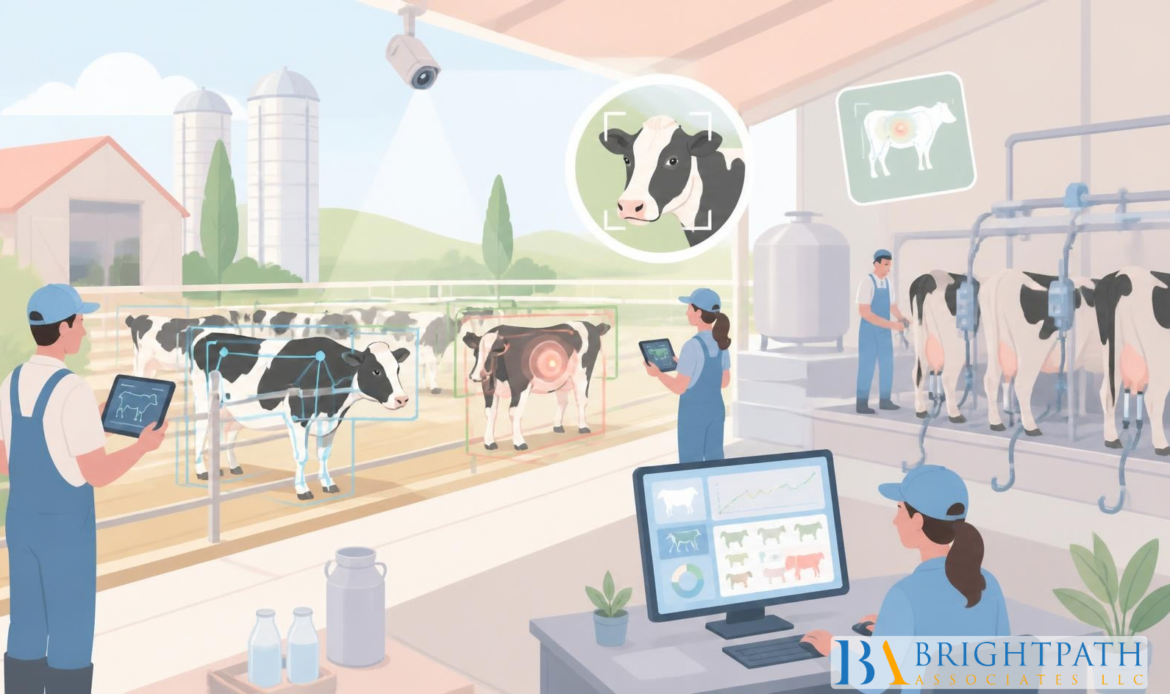
Computer vision provides an additional layer of monitoring. Cameras positioned in barns, milking areas, feeding zones, or walking paths can capture images or video throughout the day. Software then analyzes these visual inputs to identify patterns associated with movement, posture, activity, and physical appearance.
The objective is not necessarily to replace farmers or veterinarians. Instead, computer vision can help identify animals that require closer attention. By generating alerts when behavior deviates from an established baseline, technology can potentially help farm personnel investigate issues earlier.
Locomotion Analysis and Animal Health
Locomotion is an important indicator of livestock health. Changes in the way an animal walks or stands can sometimes be associated with discomfort, injury, hoof problems, or other health conditions.
Computer vision systems can analyze movement patterns by tracking an animal’s body position as it walks. Cameras can capture parameters such as stride characteristics, walking speed, weight-bearing behavior, and posture. Artificial intelligence models can then compare observed movement with normal patterns.
A gradual change in locomotion may be difficult to identify during a busy working day, particularly when personnel are responsible for many animals. Automated monitoring can provide a more consistent method of identifying deviations.
Early identification does not establish a diagnosis by itself. Instead, it can indicate that an animal may require physical examination by appropriately trained personnel or a veterinarian.
Animal posture can provide additional information about health and comfort. Computer vision can distinguish between standing, walking, lying, and other behaviors. By establishing individual or group-level activity patterns, systems can identify unusual changes.
For example, an animal that spends substantially more or less time lying down than its normal pattern may warrant additional observation. Similarly, changes in the frequency of movement between feeding and resting areas may provide useful information.
Combining posture data with other measurements can make monitoring more meaningful. Computer vision may therefore work alongside wearable sensors, environmental monitoring systems, milk-production data, and veterinary records.
Early Illness Detection Through Behavioral Changes
One of the most promising applications of computer vision is early identification of behavioral changes associated with potential illness.
Animals may display subtle changes before a condition becomes obvious to human observers. Reduced activity, altered posture, changes in feeding behavior, or unusual movement can sometimes act as early warning signals.
Machine-learning systems can analyze large quantities of visual data to identify patterns that correlate with previously identified health events. Over time, these models can help farms create individualized behavioral baselines.
This approach shifts livestock management from purely reactive intervention toward more proactive monitoring. However, computer vision should be viewed as a screening and decision-support technology rather than a standalone diagnostic system.
Computer vision can also support assessment of an animal’s physical condition. Three-dimensional cameras and image-analysis technologies can estimate changes in body shape and condition without requiring frequent manual scoring.
Consistent body-condition monitoring can help farmers evaluate whether nutritional and management strategies are achieving their intended results. Changes over time can provide useful information for herd management and feeding decisions.
These capabilities have relevance to #MilkProductionTechnologies because animal health and nutritional status can influence productivity. By combining physical-condition information with production data, farms may develop more comprehensive approaches to herd management.
Computer vision becomes more powerful when integrated with broader Dairy automation technologies. Modern dairy operations may already use automated milking systems, robotic feeding equipment, electronic identification, environmental sensors, and digital herd-management platforms.
A computer vision system can add visual intelligence to these technologies. For example, an automated system may identify an animal approaching a milking area while simultaneously evaluating movement characteristics. Another system may correlate activity patterns with feeding and milk-production information.
The resulting ecosystem can provide a more complete picture of individual animal conditions and farm operations.
Supporting Sustainable Dairy Farming Practices
Sustainability in dairy production involves more than environmental considerations. Efficient resource use, animal welfare, productivity, and responsible herd management are also important components of sustainable operations.
Early identification of potential health problems may help farms respond before conditions become more severe. Earlier intervention can potentially support animal welfare while reducing avoidable losses and resource use associated with prolonged illness.
Computer vision can also contribute to more precise management by helping farmers understand how animals use facilities and resources. This information may support improvements in barn design, feeding management, movement patterns, and overall farm efficiency.
As farms pursue Sustainable dairy farming practices, digital monitoring technologies can become part of a broader strategy for using data to improve operational decisions.
Computer vision’s role does not end at livestock monitoring. The technology can potentially contribute to the broader dairy value chain.
Within processing facilities, computer vision can support quality inspection, packaging verification, equipment monitoring, and production-line analysis. These applications connect computer vision with Food technology and Dairy product development.
Automated visual inspection can help identify packaging inconsistencies or production anomalies at high speeds. When combined with other quality-control systems, computer vision can contribute to more consistent manufacturing processes.
The technology therefore has applications across both primary dairy production and downstream processing.
Connecting Computer Vision With Dairy Supply Chain Management
#DigitalTransformation is increasingly connecting farms, processors, distributors, retailers, and customers. Computer vision-generated information can become another data source within this connected ecosystem.
Health and production data collected at the farm level can contribute to improved planning and forecasting. When integrated responsibly with Dairy supply chain management platforms, digital information can support better coordination between production and downstream operations.
Reliable data can help organizations understand production patterns and respond to changes more efficiently. However, data governance and interoperability remain important challenges. Different systems need to communicate effectively, and organizations must establish appropriate standards for collecting, storing, and sharing information.
The effectiveness of computer vision depends heavily on data quality. Camera positioning, lighting, animal identification, environmental conditions, image resolution, and movement patterns can all affect system performance.
A model trained in one farm environment may not perform identically in another. Breed differences, housing systems, camera angles, and management practices can influence visual characteristics.
Consequently, farms should evaluate computer vision systems under their actual operating conditions. Performance should be monitored over time, and alerts should be reviewed by trained personnel.
Technology should complement practical expertise rather than operate without human oversight.
Privacy, Security, and Responsible Data Management
The expansion of cameras and connected digital systems introduces data-management considerations. Farms and dairy businesses need appropriate cybersecurity measures to protect systems from unauthorized access.
Organizations should understand what information is being collected, where it is stored, who can access it, and how long it is retained. When systems are connected to cloud platforms or third-party applications, contractual and technical controls should be evaluated carefully.
Responsible deployment also requires transparency about how technology affects workers and farm operations. Employees should understand how monitoring systems function and how their responsibilities may change as automation increases.
Although Dairy e-commerce may appear distant from livestock monitoring, both are part of the same broader digital ecosystem. Modern dairy businesses increasingly depend on data-driven systems extending from production through distribution and customer engagement.
As businesses improve traceability and operational visibility, digital technologies can help connect information across the value chain. Computer vision may contribute indirectly by improving production monitoring and quality processes that support downstream digital operations.
The broader objective is to create an integrated data environment in which technology supports decision-making from farm management to the consumer-facing side of the dairy business.
Dairy industry growth strategies increasingly involve technology investment, productivity improvement, workforce development, sustainability, and data-driven decision-making.
Computer vision can support this transformation by providing continuous observations that would be difficult to obtain manually. The value of the technology, however, depends on how effectively organizations integrate it into existing workflows.
Investment decisions should therefore consider more than the capabilities of a camera or software platform. Dairy businesses should evaluate infrastructure requirements, employee training, system integration, maintenance, cybersecurity, data quality, and measurable operational outcomes.
A carefully implemented system can become part of a broader digital strategy rather than functioning as an isolated technology experiment.
The Changing Workforce and Dairy Industry Executive Search
#DigitalTransformation is also changing the skills required across the dairy sector. Dairy businesses increasingly need professionals who understand both traditional agricultural operations and emerging technologies.
Leaders may need knowledge of artificial intelligence, automation, data analytics, animal health, food processing, supply-chain systems, and sustainability. This creates new requirements for Dairy industry executive search as organizations seek leadership capable of managing increasingly technology-driven operations.
#ExecutiveSearchRecruitment can support this transition by helping organizations identify professionals with multidisciplinary experience. The future dairy workforce will increasingly require collaboration between veterinarians, farmers, engineers, data scientists, technology specialists, and business leaders.
As artificial intelligence and imaging technologies continue to develop, computer vision systems may become increasingly capable of analyzing complex animal behaviors and physical characteristics.
Future systems could combine visual information with sensor data, environmental conditions, production records, and historical health information. Such integration could provide increasingly detailed decision-support capabilities.
However, successful adoption will depend on practical implementation. Technologies must be reliable, affordable, explainable, and compatible with farm workflows. Farmers and veterinarians will remain essential to interpreting alerts and making appropriate decisions.
Conclusion
Computer vision represents an important development in the continuing Dairy industry digital transformation. By monitoring locomotion, posture, activity, body condition, and other visual characteristics, the technology can provide valuable information that supports earlier investigation of potential health concerns.
Its value extends beyond animal monitoring. Integration with Dairy automation technologies, Milk production technologies, Food technology, Dairy product development, and Dairy supply chain management can create broader opportunities for data-driven decision-making.
For dairy businesses pursuing Sustainable dairy farming practices and long-term Dairy industry growth strategies, computer vision can become one component of a larger technology ecosystem. Its success will depend on reliable data, appropriate system integration, responsible implementation, and continued involvement from experienced agricultural and veterinary professionals.
The evolution of computer vision demonstrates a broader shift in dairy production: technology is moving from simply automating individual tasks toward creating continuous intelligence across the production environment. As this transition continues, organizations that combine technological capabilities with practical expertise and strong leadership will be better positioned to understand and respond to the increasingly complex demands of modern dairy operations.
Find your next leadership role in Dairy Industry today!