
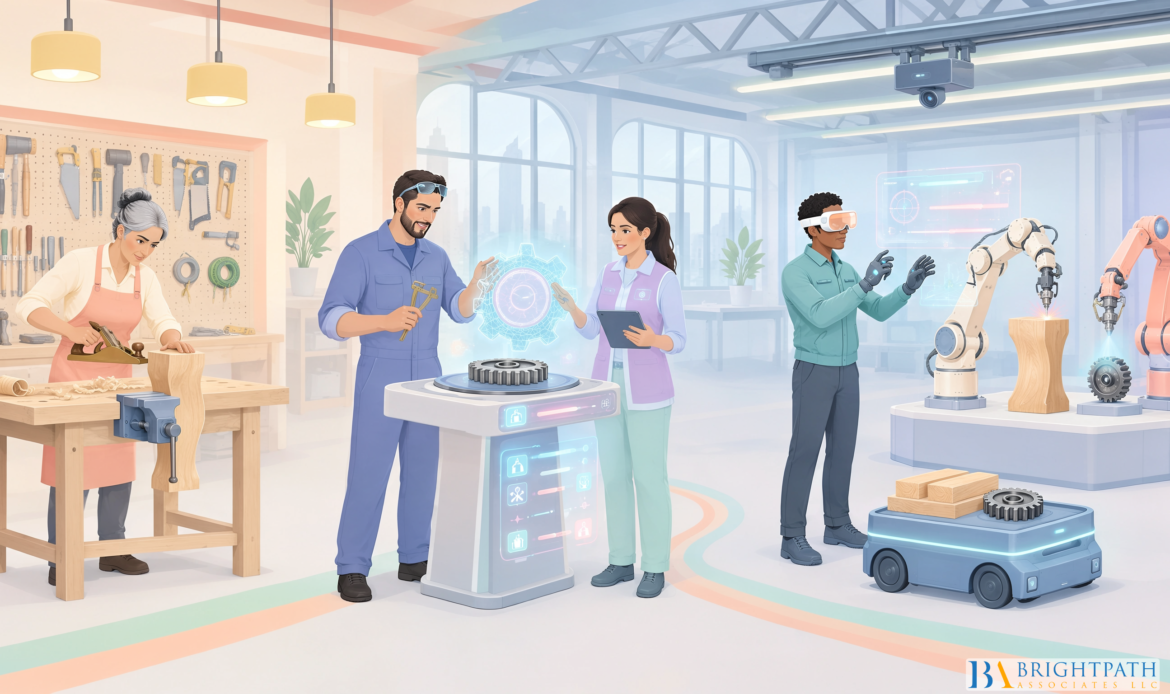
Reskilling for the Future: Transitioning Craft Workers into Tech-Augmented Roles for #BuildingMaterialsIndustry is not mainly an IT training challenge. It is a workforce design challenge. Building materials companies need people who understand concrete production, lumber industry operations, quality standards, equipment limits, and jobsite realities while also using digital tools, sensors, automation, and production data.
For executives, the question is not whether technology will affect construction materials and building supplies. It already is. The harder question is whether the company can move experienced craft workers into new roles without losing the practical judgment that keeps production safe, reliable, and profitable.
Table Of Contents
- Why Reskilling Is a Leadership Issue
- Mapping Craft Skills to Tech-Augmented Roles
- Building a Reskilling Path That Works on the Plant Floor
- Leading the Workforce Transition
- Frequently Asked Questions
Key Takeaways
• Reskilling works best when employers build from existing craft capability rather than treating experienced workers as technology beginners with no relevant knowledge.
• The most practical early skills are digital measurement, device use, file control, basic data entry, equipment-interface literacy, and cybersecurity habits.
• Training completion is not enough. Leaders should measure independent task readiness, safety, quality, scrap, downtime, and retention.
• Tech-augmented work should preserve human accountability for exceptions, safety decisions, material quality, and complex troubleshooting.
• Executive hiring needs are changing as companies seek leaders who can connect plant operations, workforce development, automation, and sustainable construction priorities.
Why Reskilling Is a Leadership Issue
#TechnologyAdoption can create a misleading divide between “traditional” craft work and “digital” work. In a building-materials plant, that divide rarely holds. A machine vision system may flag surface defects in precast concrete, but someone still needs to understand whether the issue is a sensor error, a mold problem, a mix inconsistency, or a handling failure. A robotic saw can cut engineered lumber to programmed dimensions, but the operator must recognize tool wear, wood variation, unsafe conditions, and production bottlenecks.
That is why the strongest transition model is not craft worker or technician. It is craft worker plus digital capability.
Cedefop’s analysis of changing construction skills identifies prefabrication, remote-controlled equipment, drones, smart tools, and smart sensors as technologies that are changing worker skill requirements. The implication for building materials leaders is practical: new equipment should come with a role redesign plan, not just a vendor training session.
The Real Risk Is Not Automation Alone
A prolonged vacancy in a production leadership, maintenance, quality, or digital operations role can delay more than hiring. It can slow equipment commissioning, weaken data discipline, increase reliance on a few technical employees, and leave supervisors managing workarounds instead of improving the process.
For a small or mid-sized manufacturer, the risk is often concentrated. One plant manager, controls technician, maintenance leader, or quality director may hold crucial knowledge about legacy equipment and process exceptions. If that individual leaves before knowledge is documented, technology projects can become dependent on outside support or stalled altogether.
We recommend that executives treat reskilling and succession planning as connected decisions. The company does not need every operator to become a programmer. It does need enough people who can reliably operate, diagnose, document, and escalate issues in a more digital production environment.
Sustainable Construction Raises the Stakes
Sustainable construction can add complexity to material selection, traceability, energy use, waste reduction, and customer reporting. These requirements may create a need for better process records and stronger collaboration between production, quality, engineering, sales, and supply chain teams.
This is one reason green investment in the building materials industry should be viewed as a workforce issue as well as a capital investment issue. A company can purchase energy-efficient equipment or introduce lower-carbon products, but the investment may underperform if supervisors and operators cannot interpret the new process requirements or record reliable production data.
The executive question is simple: What work is changing, who will perform it, and what capability must exist before the equipment goes live?
Mapping Craft Skills to Tech-Augmented Roles
The most credible reskilling plans start with a #SkillsInventory. Not a generic list of jobs, but a close look at what experienced workers already know: tolerances, sequencing, equipment behavior, material variation, inspection, lockout procedures, repairs, and the early signs of an abnormal process.
PwC’s review of engineering and construction trends notes that prefabrication facilities need technicians, data analysts, and robotics operators alongside traditional welders and electricians. That distinction matters. The job categories may be new, but much of the operating judgment can come from incumbent craft workers.
A Practical Role-Transition Matrix
The following framework is a planning tool, not a validated industry-wide competency standard. Each plant will need to adjust it for its equipment, safety requirements, union environment, product mix, and local labor market.
| Existing Craft Experience | Tech-Augmented Role | Skills That Transfer | New Skills to Build | Best Early Proof of Readiness |
|---|---|---|---|---|
| Equipment operator | Smart-factory operator | Process sequencing, safe equipment use, shift handoffs | Human-machine interface use, digital work instructions, alarm response | Runs a supervised shift using digital checklists and escalation rules |
| Welder or fabricator | Robotic cell operator | Fixtures, tolerances, tool condition, quality inspection | Robot teach-pendant basics, program verification, safeguarding | Completes setup and identifies unsafe or out-of-spec conditions |
| Maintenance mechanic | Maintenance technologist | Mechanical diagnosis, preventive maintenance, repairs | Sensor basics, computerized maintenance systems, controls awareness | Creates accurate work records and resolves defined sensor-related faults |
| Quality inspector | Quality-data technician | Sampling, visual inspection, root-cause thinking | Digital traceability, dashboards, data-entry discipline | Reconciles production records and flags a credible quality variance |
| Carpenter, mason, or detail-oriented installer | BIM or digital fabrication support | Plan reading, dimensions, field constraints | Model navigation, digital markups, file management | Produces accurate markups or verifies a fabrication package |
The point is not to force every worker into the same pathway. A skilled maintenance mechanic may be an excellent candidate for condition monitoring and maintenance systems but have little interest in BIM. A detail-focused carpenter may adapt well to digital fabrication layout but not want responsibility for a robotic cell.
Start With Minimum Viable Digital Skills
One common failure is beginning with artificial intelligence, robotics, or analytics before workers can comfortably use the systems around them. Advanced tools do not compensate for weak basics.
A minimum foundation often includes:
- Device and account use: Logging in securely, using shared devices, and understanding access limits.
- File and version control: Finding current work instructions, avoiding outdated drawings, and recognizing approved records.
- Digital measurement and data entry: Recording measurements consistently and understanding why incomplete entries damage quality analysis.
- Equipment-interface literacy: Reading alarms, responding to prompts, and knowing when to stop rather than override a warning.
- Cybersecurity basics: Recognizing that a shared password, unknown USB device, or suspicious message can affect plant operations.
This sequencing is particularly important in concrete production and lumber industry facilities with legacy equipment. A company may install sensors on older machinery, yet still rely on paper-based work orders, inconsistent network coverage, or manual shift logs. In that situation, a data-analytics course is premature. The first upgrade may need to be reliable digital records and supervisor routines.
Do Not Confuse Data With Understanding
Production-data quality is a #LeadershipResponsibility. If operators are asked to enter defect codes, downtime reasons, or material batch details, the codes must be clear and usable. Otherwise, dashboards can show false patterns that drive bad decisions.
Consider a line where “equipment delay” is selected for everything from a jam to missing raw material. Management may conclude that maintenance is the main problem when the root cause is actually scheduling or inventory control. Training should therefore explain the operational purpose of each data field, not merely how to fill it in.
Building a Reskilling Path That Works on the Plant Floor
The best training design depends on the work being changed. Companies should avoid copying a training model simply because it sounds modern. A robotics rollout, a new manufacturing execution system, and a new CAD workflow call for different delivery methods.
Choose the Right Delivery Model
| Training Option | Best When | Strength | Watch-Out |
|---|---|---|---|
| Internal academy | Processes and equipment are highly company-specific | Connects learning directly to plant work | Requires committed trainers and protected training time |
| Vendor training | New equipment or proprietary software is being installed | Fast access to system-specific knowledge | Often focuses on functions, not daily operating judgment |
| Community college | Workers need broader technical foundations | Can build credentials and longer-term mobility | Course schedules may not fit rotating shifts |
| Apprenticeship or JATC pathway | Skills need formal progression and employer recognition | Structured learning with practical application | May be too slow for an immediate equipment launch |
| Blended model | Multiple capabilities are changing at once | Combines context, credentials, and equipment practice | Needs clear ownership to prevent duplication |
NABTU and Microsoft’s skilled-trades initiative shows that AI education is being integrated into Joint Apprenticeship Training Committee structures and hands-on trade training. The broader lesson is useful even outside union settings: technology instruction is more credible when it is tied to the actual work people perform.
Design for Shift Work and Production Reality
Training that exists only in a conference room often fails on the floor. Workers need repeated practice with the real interface, real materials, real safety controls, and real exceptions. Yet production deadlines make lengthy release time difficult.
A workable approach is staged:
- Select a narrow task. For example, teach operators to use a digital quality checklist for one product line rather than launching a plant-wide system all at once.
- Train before and during use. Combine a short lesson with supervised practice on the shift.
- Assign a qualified peer coach. The coach should be respected for craft competence, not simply chosen because they are comfortable with software.
- Verify independent performance. Confirm that the worker can complete the task, recognize exceptions, and escalate appropriately.
- Review the process after several weeks. If workers bypass the system, determine whether the training, interface, workflow, or incentive is at fault.
Fair warning: downtime, poor connectivity, and legacy equipment can make a technically sound program impractical. If a tablet loses connection near a production line or workers must walk across the plant to access a terminal, adoption will suffer. The recovery step is not to blame workers. It is to fix the workflow friction before expanding the program.
Measure Operational Outcomes, Not Attendance
Course completion and credentials are useful inputs, but they are not proof of #OperationalValue. Pearson and NCCER’s guidance on structured training and digital learning platforms supports the use of credentials and digital tools for more consistent onboarding and upskilling. Employers should still ask whether the training changed performance.
A scorecard can include:
• Independent-task readiness by role
• First-pass quality or rework rates for the affected process
• Scrap and material waste connected to setup or operating errors
• Unplanned downtime and the quality of recorded downtime reasons
• Safety observations, near misses, and adherence to safety interlocks
• Internal promotions, retention, and time required to fill technical openings
Avoid claiming that one metric proves success. Lower downtime, for example, may result from a new maintenance schedule rather than training. Compare results with the timing of equipment changes, staffing shifts, material changes, and production volume.
Leading the Workforce Transition
Reskilling programs succeed or fail partly through job design and trust. Experienced workers may reasonably worry that automation will reduce headcount, monitor every movement, or transfer responsibility to them without giving them authority. Those concerns should be addressed directly.
Keep Human Judgment Where It Belongs
AI and automation can support inspection, scheduling, predictive maintenance, and documentation. They should not quietly erase accountability lines.
Human judgment remains especially important when:
• A safety interlock is triggered or bypassed
• A material quality result conflicts with the production system’s recommendation
• A model or algorithm produces an unexplained output
• A customer specification, regulatory requirement, or jobsite condition falls outside the standard process
• An experienced worker recognizes a recurring pattern that available data does not capture
This last point is tacit craft knowledge: the know-how that is hard to write down, such as recognizing abnormal vibration, inconsistent curing, unusual grain behavior, or the early signs of tool failure. Companies should capture it through structured interviews, supervised task observation, exception logs, and training videos reviewed by experienced workers. A digital system is stronger when it records expertise instead of pretending to replace it.
The Executive Hiring Implication
Leadership roles are becoming harder to define cleanly. A plant leader may need strong safety and operations credentials but also enough digital fluency to sponsor automation decisions. A quality executive may need to understand both testing discipline and traceability data. A human resources leader may need to connect workforce planning to technology implementation rather than treat training as a separate initiative.
This creates a specialized recruiting challenge. Conventional hiring often searches for a perfect candidate with deep building technology expertise, full manufacturing experience, automation knowledge, and proven people leadership. That candidate may be scarce, expensive, or unavailable in the required location.
A more realistic search strategy separates essential capabilities from trainable ones. For example, a vice president of operations may need demonstrated leadership of safety, production, and change management, while a specific software platform can be learned. Conversely, if a company is commissioning highly automated equipment within months, the ability to lead technical implementation may be nonnegotiable.
This is where strategic talent solutions for manufacturing growth can support a more disciplined workforce plan: define the role around #BusinessRisk, identify adjacent-industry talent, and build internal successors rather than relying on a single difficult external hire.
Engineering News-Record’s report on the Future Builders initiative stated that the initiative aimed to support training for up to 50,000 skilled craft workers over five years. The scale of that ambition reinforces a basic point: employers cannot assume the external market will supply every technician, supervisor, or digital operator they need. (building resilient supply chains through digital transformation)
Build Trust Before Buying More Technology
Workers are more likely to engage when leaders can answer four questions clearly:
- What task is changing, and why?
- What new skill is expected?
- What authority and career opportunity come with the new responsibility?
- What work will remain under human judgment?
If leadership cannot answer those questions, the technology rollout is not ready. Reskilling should lead to credible role progression, such as operator to digital operator, digital operator to technician, or technician to data-enabled supervisor. Without that connection, training can feel like added work with little benefit.
Frequently Asked Questions
What Does a Tech-Augmented Role Look Like for a Building Materials Craft Worker?
It is a role where hands-on knowledge is combined with digital tools. Examples include a concrete operator using digital batch records, a fabricator operating a robotic cell, a quality inspector managing digital traceability, or a maintenance mechanic using sensor data and computerized maintenance records.
Which Craft Skills Transfer Most Easily?
Plan reading, measurement, tolerances, equipment diagnosis, material inspection, safety procedures, sequencing, and troubleshooting usually provide strong foundations. The most transferable workers are not necessarily the most computer-savvy at the start. They are often the people who understand process variation and know when something does not look right.
Can Workers Learn Robotics or BIM Without Becoming Software Developers?
Yes. Most tech-augmented roles require operational fluency, not software engineering. A robotics operator may need to set up equipment, verify a program, monitor safeguards, and escalate faults. A #BIMSupport worker may need model navigation, markups, and file discipline. Programming expertise is needed for some positions, but not all.
How Long Does It Take to Become Productive?
There is no reliable universal timeframe. It depends on the worker’s starting skills, the complexity of the equipment, the quality of coaching, and how often the skill is used. A narrow digital checklist task may be learned quickly, while controls troubleshooting or advanced robotics requires sustained supervised practice. Employers should define readiness by demonstrated task performance rather than calendar time alone.
Should Employers Use Vendor Training, Apprenticeships, or Internal Programs?
Use #VendorTraining for proprietary equipment, apprenticeship or JATC pathways for structured craft progression, community colleges for broad technical foundations, and internal programs for company-specific processes. A blended approach is often best when automation changes multiple roles at once.
How Can Leaders Prevent AI From Alienating Experienced Workers?
Explain where AI is being used, what data it collects, who remains accountable, and how workers can challenge incorrect outputs. Involve experienced workers in testing workflows and documenting exceptions. Do not present AI as a substitute for craft judgment when it is actually dependent on that judgment.
Resources And Citations
- Cedefop — Construction workers: skills opportunities and challenges (2023 update)
https://www.cedefop.europa.eu/en/data-insights/construction-workers-skills-opportunities-and-challenges-2023-update - North America’s Building Trades Unions and Microsoft — NABTU and Microsoft expand nationwide initiative to strengthen AI training and career pathways across the skilled trades
https://nabtu.org/press_releases/nabtu-and-microsoft-expand-nationwide-initiative-to-strengthen-ai-training-and-career-pathways-across-the-skilled-trades/ - PwC — What’s next in engineering and construction
https://www.pwc.com/us/en/industries/industrial-products/library/engineering-and-construction-trends.html - Pearson/NCCER — From Training to Crew
https://www.pearson.com/content/dam/global-store/en-us/resources/Pearson-NCCER-FromTrainingToCrew-guide.pdf - ENR — Infrastructure Investor BlackRock Makes $100M Pitch to Train More Craft Workers
https://www.enr.com/articles/62669-infrastructure-investor-blackrock-makes-100m-pitch-to-train-more-craft-workers - BrightPath Associates — Green Investment Is Redefining Future of Building Material Industry
https://brightpathassociates.com/green-investment-is-redefining-future-of-building-material-industry/