
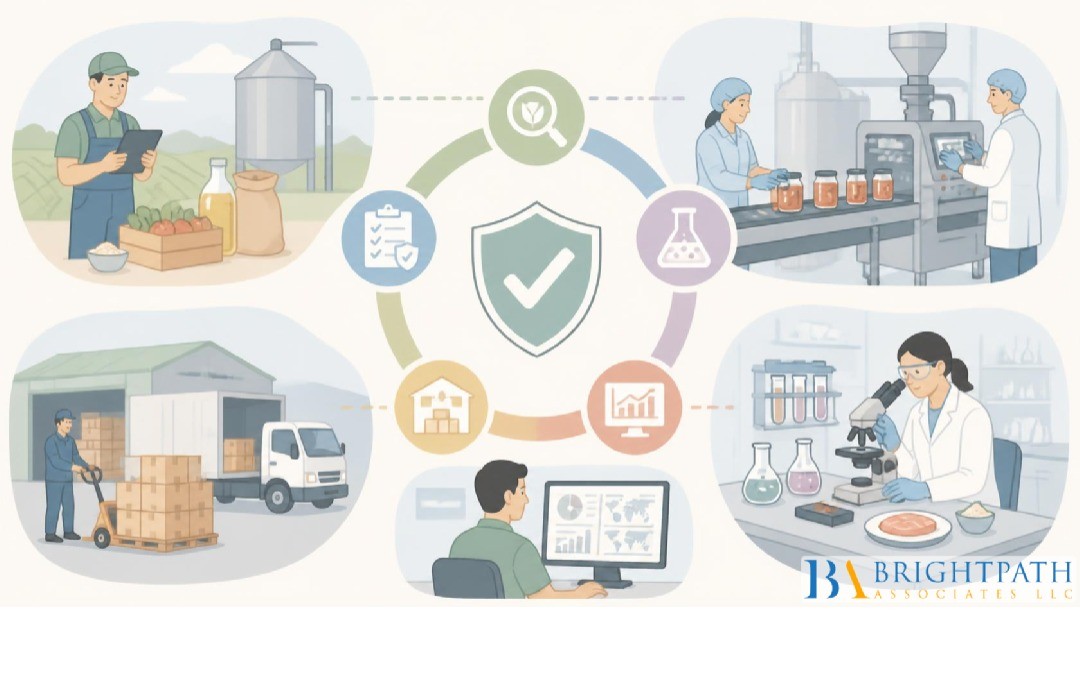
Introduction
#FoodFraud is no longer a niche compliance topic; it is a brand and revenue risk that scales with globalization, price volatility, and complex supplier networks. Substitution, dilution, counterfeiting, origin misrepresentation, and document falsification can turn a trusted label into a liability in a single news cycle. The operational reality is that many fraud events are not discovered by a single test or audit, but through patterns that emerge across ingredients, lots, process data, and distribution records over time.
This whitepaper presents a practical framework for food fraud detection built around traceability, verification, monitoring, and operational controls. It is designed for manufacturers and brand owners who want a clear approach that can be deployed incrementally and measured consistently. The emphasis is industrial and execution-focused: how to build reliable signals, reduce ambiguity, and increase the cost of deception without slowing production or overwhelming teams with manual checks.
Why Food Fraud Is a Brand Protection Problem, Not Just a Quality Issue
Food fraud directly threatens the promise a brand makes to customers, retailers, and regulators. When a label claims a certain species, origin, production method, or purity level, the brand is effectively selling trust. Fraud breaks that trust, and the resulting impact is rarely limited to the affected product line; it can spill into adjacent categories through consumer perception and retailer risk policies. Even when there is no immediate safety hazard, the long-term damage can include delisting, contract penalties, increased testing requirements, and a higher cost of capital due to perceived operational risk.
The economics of fraud are also shifting. Digital marketplaces, third-party logistics, and rapid supplier switching can create opportunities for counterfeit or diverted goods to blend into legitimate channels. At the same time, tighter margins can drive more aggressive ingredient sourcing decisions that increase vulnerability. Effective food fraud detection therefore requires a system that connects commercial decisions to operational signals, so that risk is managed as a normal part of running the plant, not as a reactive investigation after a complaint or inspection.
Traceability as the Backbone: Establishing “One Story” for Every Lot
Traceability is the ability to reconstruct what happened to a product from supplier to finished goods using records that are timely, complete, and consistent. For #FraudDetection, traceability is more than a recall tool; it is the backbone that allows anomalies to be seen and validated. When lot genealogy is incomplete, fraud indicators become unresolvable “maybes,” forcing teams into expensive blanket actions such as broad holds or redundant testing. When traceability is strong, the organization can narrow investigations quickly, isolate exposure, and protect unaffected inventory and customer relationships.
In practice, strong traceability means aligning physical flows with digital records at every handoff. Receiving, staging, batching, rework, packaging, and warehousing all create opportunities for mislabeling or substitution if controls are not explicit. Many sites improve traceability by using data capture and integration patterns common in Industrial automation, where time stamps, equipment states, and material movements are treated as process facts. When traceability data is created automatically and consistently, the system is less dependent on memory and manual transcription, which are frequent entry points for both error and manipulation.
Verification That Scales: Combining Tests, Documents, and Process Signals
Verification is the disciplined practice of confirming that ingredients and finished goods match their stated identity and claims. The strongest verification programs do not rely on a single method, because fraudsters adapt to the easiest barrier. Instead, they combine targeted analytical tests, supplier documentation checks, and process-based signals that are hard to fake at scale. This layered approach reduces false confidence and allows the organization to focus laboratory spend where it produces the most risk reduction.
Operational verification can be strengthened by connecting quality requirements to how the facility actually runs. In many plants, Control systems already capture temperature profiles, mixing times, flow rates, and equipment utilization, but the data is not routinely used to support authenticity. When a process window is stable and well-characterized, unusual parameter patterns can indicate ingredient changes or unauthorized rework, even before product testing is completed. This is where Manufacturing automation becomes a brand protection asset, turning production data into corroborating evidence that supports, challenges, or prioritizes more traditional verification activities.
Monitoring for Anomalies: Turning Plant Data into Food Fraud Detection Signals
Monitoring is the continuous observation of signals that indicate elevated fraud risk or a developing event. It can include supplier performance trends, complaint patterns, inventory discrepancies, yield shifts, and unexpected process variability. The objective is not to create an alarm for every deviation; it is to detect meaningful patterns early enough to act while the exposure is still small. Monitoring works best when it is designed like an industrial reliability program: define normal behavior, quantify variance, and escalate only when thresholds and context indicate material risk.
#ModernMonitoring increasingly uses plant connectivity and sensing that originated in industrial productivity initiatives. SCADA systems can provide near real-time visibility into line behavior, and Industrial machine vision can add an additional layer of evidence by validating labels, package integrity, and sometimes product appearance attributes that correlate with identity. These technologies are typically adopted to reduce defects and improve throughput, but they also support food fraud detection by making it harder to introduce counterfeit packaging, misapply labels, or move unauthorized product through a line without creating a detectable signature in the data trail.
Operational Controls That Reduce Opportunity and Increase Accountability
Operational controls are the day-to-day mechanisms that prevent fraud opportunities from turning into incidents. Strong controls clarify who can change formulations, who can approve substitutions, how rework is managed, and how exceptions are documented and reviewed. They also define physical and digital access boundaries around high-risk materials and high-impact steps, such as dispensing, relabeling, and scrap handling. The goal is to make the correct path the easiest path, while ensuring that deviations are both visible and explainable.
Automation can support these controls when it is implemented with intent. Facilities that invest in Automation solutions manufacturing often focus on speed and consistency, but the same engineering discipline can be used to lock in authenticity controls. For example, recipe enforcement, electronic signatures, and controlled change workflows can be embedded into batch execution and packaging operations so that unauthorized actions are blocked or captured with clear accountability. When these mechanisms are well-designed, they reduce the chance that a single individual can alter product identity or documentation without leaving a trace that triggers review.
Implementation in the Real World: Integrating Systems Without Creating Gaps
Food fraud controls can fail when systems are improved in isolation. A plant may automate batching while leaving receiving paperwork manual, or it may strengthen supplier onboarding without connecting the requirements to what happens during production and warehousing. Implementation should therefore focus on continuity across steps, so that every lot has a coherent identity story from inbound to outbound. Consistent master data, harmonized lot naming, and aligned transaction timing are unglamorous details, but they determine whether traceability and monitoring produce reliable conclusions or contradictory narratives.
Integration often requires specialized skills that sit between operations and information technology. Some organizations rely on a PLC programming service to implement recipe enforcement, equipment interlocks, and reliable event capture at the machine level. Others prioritize #RoboticsIntegration to reduce manual handling and relabeling exposure points that can introduce both error and fraud opportunity. The best programs treat integration work as part of risk reduction, with clear acceptance criteria for data completeness, auditability, and exception handling rather than focusing only on cycle time or equipment utilization.
People, Roles, and Capability: Making Food Fraud Detection Sustainable
Even the best technical framework will degrade if roles and incentives are unclear. Sustainable food fraud detection programs define ownership across procurement, quality, operations, and supply chain, and they set expectations for how anomalies are investigated and resolved. Training should focus on practical behaviors: what “good documentation” looks like, how to escalate supplier concerns, and how to handle exceptions without creating workarounds that weaken controls. When the program is treated as part of brand stewardship, it earns attention even when schedules tighten.
Talent and leadership matter because fraud detection spans disciplines. Organizations modernizing their monitoring and traceability may find that they need hybrid profiles who understand production realities and data governance. In some cases, Executive search industrial automation is used to hire leaders who can connect plant digitalization to risk management outcomes, while internal teams look for Automation jobs candidates who can operate and maintain increasingly data-driven lines. For broader leadership needs, #ExecutiveSearchRecruitment can help brands secure cross-functional program owners who can align suppliers, plants, and commercial stakeholders around measurable controls and rapid response routines.
Conclusion: A Simple, Defensible Framework That Protects the Brand
Protecting a brand from food fraud requires more than occasional testing or a supplier questionnaire; it requires a system that produces defensible evidence, quickly isolates exposure, and continuously reduces opportunity. Traceability creates a reliable story for every lot, verification adds proof points that scale, monitoring detects patterns early, and operational controls make manipulation difficult and visible. When these elements reinforce each other, the organization is not only better at catching fraud, but also better at preventing it through clarity, accountability, and consistent execution.
As supply chains evolve and scrutiny increases, brands that treat food fraud detection as an operational capability will move faster with fewer disruptions. The most effective programs borrow the rigor of industrial operations, using production data and engineered controls to make authenticity measurable rather than assumed. In that model, brand protection is not an after-the-fact investigation; it is designed into how the product is received, made, verified, and shipped every day.
Find your next leadership role in Industrial Automation Industry today!
Stay informed with the latest insights on Industrial Automation Industry!