
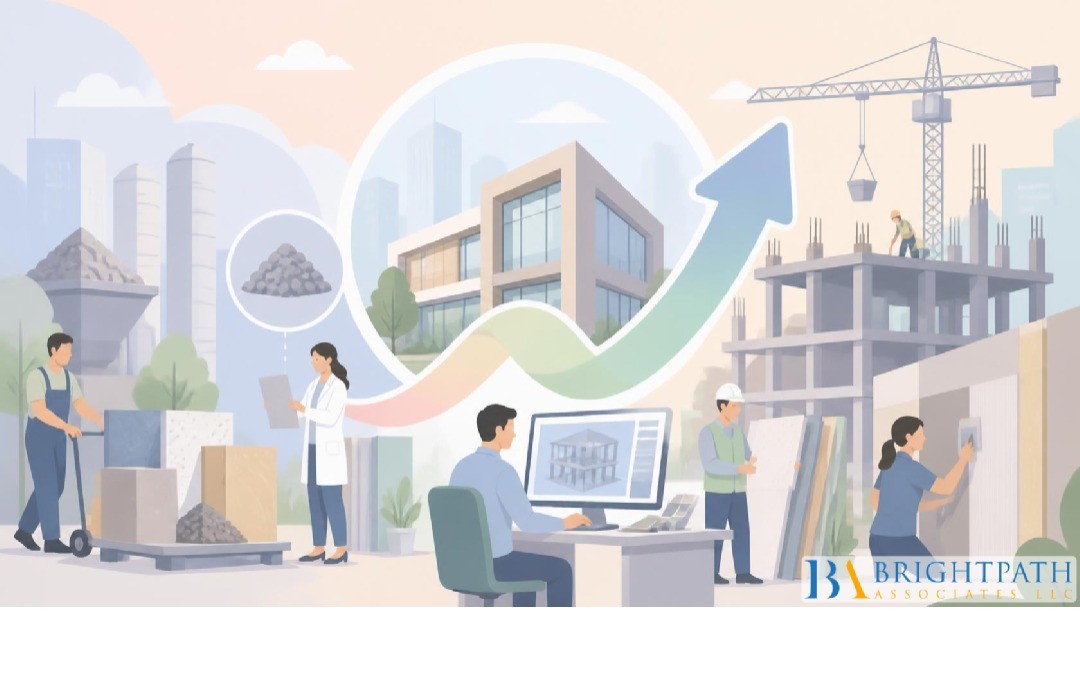
Introduction
For decades, many #ConstructionMaterialMarkets have operated around a relatively straightforward commercial model: manufacturers produce standardized products, distributors compete on availability and price, and contractors select materials based largely on cost, specifications, and project requirements. While this commodity-driven approach remains important, increasing competition, regulatory pressure, sustainability expectations, labor shortages, and technological advancement are changing how value is created across the construction ecosystem.
Construction materials are increasingly being evaluated according to performance rather than simply purchase price. Customers want products that improve durability, reduce installation time, lower maintenance requirements, improve energy efficiency, support sustainability goals, or simplify compliance with increasingly complex building standards.
This shift creates an opportunity for manufacturers and suppliers to move from selling materials as commodities toward selling measurable performance. Instead of asking only how much a product costs per unit, customers are increasingly asking what that product contributes to the total economics of a building over its useful life.
For manufacturers, this represents more than a pricing opportunity. It requires investment in research, product development, manufacturing capabilities, technical support, marketing, and talent.
Commodity pricing places manufacturers under constant pressure because competing products can appear interchangeable. When differentiation is limited, purchasing decisions often become heavily influenced by price.
This can create a cycle in which manufacturers reduce prices to protect market share, distributors demand better margins, and producers search continuously for lower production costs. While operational efficiency remains essential, cost reduction alone has limits.
Performance-driven materials provide another path. Manufacturers can differentiate products through characteristics such as improved strength, longer service life, faster installation, lower environmental impact, thermal performance, fire resistance, moisture resistance, or enhanced durability.
The commercial conversation consequently changes from “What does this material cost?” to “What value does this material create?”
From Building Supplies to Performance Solutions
The traditional Building supplies market includes a wide range of standardized products such as cement, concrete, lumber, insulation, roofing products, structural components, fixtures, and finishing materials. Many of these products are still purchased according to unit price.
However, manufacturers can create stronger differentiation by packaging materials with technical expertise, performance guarantees, digital tools, installation guidance, testing information, and lifecycle data.
A higher-priced product can become commercially attractive when it reduces labor requirements, extends service life, minimizes waste, or lowers maintenance expenses.
For example, a material that costs more initially but installs significantly faster may reduce total project costs when labor represents a substantial portion of the construction budget. This is particularly relevant in markets facing skilled-worker shortages.
Sustainable construction is one of the strongest forces accelerating the move toward value-added materials. Developers, contractors, architects, investors, and building owners are increasingly examining the environmental impact of construction projects.
This includes embodied carbon, energy efficiency, resource consumption, waste generation, recyclability, product longevity, and material sourcing.
Manufacturers that can demonstrate measurable sustainability benefits can differentiate themselves from suppliers competing primarily on price.
However, sustainability claims increasingly need credible evidence. Customers want to understand how a material affects the overall environmental performance of a building rather than simply seeing broad environmental marketing statements.
This creates an opportunity for manufacturers to develop products with clearly documented lifecycle benefits.
Building Technology Is Changing Material Expectations
#BuildingTechnology is also transforming the materials market. Digital design tools, building information modeling, connected construction equipment, automated fabrication, advanced sensors, and data analytics are changing how materials are selected and installed.
Materials increasingly need to integrate with digitally enabled construction processes.
Manufacturers that provide accurate digital product information can make it easier for architects and engineers to specify their products. Digital models, technical specifications, performance data, and installation information can become part of the value proposition.
The material itself remains important, but the information surrounding that material increasingly contributes to its commercial value.
Concrete production illustrates the transition from commodity materials to performance-driven solutions particularly well. Conventional concrete has historically been sold according to specifications such as strength, mix design, and volume.
Modern concrete solutions increasingly emphasize durability, reduced carbon intensity, faster curing, improved workability, recycled content, and application-specific performance.
Manufacturers can differentiate products by developing concrete formulations tailored to specific project requirements.
Advanced admixtures, alternative binders, recycled aggregates, supplementary cementitious materials, and improved production controls can potentially enhance performance while addressing sustainability objectives.
The opportunity is therefore not simply to sell more concrete. It is to provide concrete solutions that help customers achieve specific structural, economic, and environmental goals.
The Lumber Industry Faces a Similar Transformation
The Lumber industry has traditionally experienced significant exposure to commodity pricing because many wood products are traded based on standardized grades and market conditions.
However, manufacturers are increasingly exploring opportunities to differentiate lumber through engineered products, improved dimensional stability, certified sourcing, specialized treatments, prefabrication, and application-specific performance.
Engineered wood products can provide advantages in structural applications where consistency and predictable performance are particularly important.
As construction methods become more sophisticated, lumber suppliers can move beyond selling raw material and instead provide engineered solutions designed around specific building requirements.
This can create greater customer value while reducing exposure to purely commodity-based competition.
Building regulations are becoming increasingly influential in material selection. Requirements related to energy efficiency, fire performance, structural safety, emissions, accessibility, environmental performance, and resilience can significantly influence what materials are appropriate for a project.
Manufacturers that anticipate regulatory changes can gain an advantage by developing products before new standards become mandatory.
Regulatory expertise can itself become part of the value proposition. Contractors and developers may prefer suppliers that can provide reliable technical documentation and help project teams navigate complex requirements.
In this environment, compliance is no longer simply a cost of doing business. It can become a differentiating capability.
Construction Economics and the Total Cost of Ownership
#ConstructionEconomics provides an important framework for understanding why performance-driven materials can command premium pricing.
The initial material purchase represents only one component of a building’s overall cost. Labor, transportation, installation, maintenance, energy consumption, repairs, replacement, downtime, and disposal can significantly affect total project economics.
A material that reduces installation time may generate labor savings. A more durable product may reduce maintenance costs. A material with better thermal characteristics may contribute to lower energy consumption.
Manufacturers need to quantify these benefits wherever possible.
When suppliers can demonstrate total cost of ownership advantages, purchasing decisions become less dependent on unit price.
Material recycling is another area where value-added opportunities are emerging. Construction and demolition generate enormous quantities of material waste, creating both environmental and economic challenges.
Manufacturers can respond by incorporating recycled content into new products, designing materials for easier recovery, developing take-back programs, or creating products that can be reused at the end of their service life.
Circular construction models can create new revenue opportunities while reducing dependence on virgin raw materials.
However, recycling must be integrated into product design and supply-chain planning. Simply using recycled materials is not enough if performance, quality, and availability cannot be maintained.
The most successful companies will treat circularity as a product-development and business-model opportunity rather than merely a waste-management initiative.
Turning Premium Products Into Quantifiable Value
One of the biggest challenges in value-added material strategies is proving that customers should pay more.
A premium product must provide benefits that customers can understand and measure.
Manufacturers can build stronger business cases by connecting product characteristics with outcomes. Faster installation can be translated into labor savings. Longer product life can be connected to reduced replacement costs. Improved thermal performance can be connected to energy savings. Lower material waste can be connected to reduced disposal expenses.
This requires manufacturers to understand the economics of their customers.
The strongest sales organizations therefore do more than describe product specifications. They demonstrate how those specifications influence project outcomes.
Performance-driven products require manufacturing capabilities that can deliver consistency at scale. Manufacturers may need advanced production controls, automation, quality systems, material science expertise, and sophisticated testing capabilities.
Automation can improve precision and reduce variability. Digital monitoring can help identify production problems earlier. Advanced analytics can reveal relationships between manufacturing conditions and final product performance.
These capabilities can become difficult for competitors to replicate, creating a stronger basis for differentiation.
Manufacturing innovation therefore supports commercial strategy directly. A company cannot sustainably sell performance if its manufacturing process cannot consistently deliver that performance.
Customer Education Becomes Part of the Value Proposition
Moving away from commodity pricing also changes how manufacturers communicate with customers.
Customers need to understand why a performance-driven product is different and why that difference matters. Technical documentation, demonstrations, testing data, case studies, lifecycle analysis, and application guidance can help establish this understanding.
Sales teams must increasingly combine technical knowledge with #CommercialAwareness.
This is especially important when the person selecting the material is not the person ultimately paying for maintenance or operating costs. Manufacturers must demonstrate value across the entire decision-making chain, from architects and engineers to contractors, distributors, developers, and building owners.
The transition toward performance-driven materials is also changing Construction jobs. The industry needs professionals who understand advanced materials, digital technologies, sustainability, manufacturing processes, regulatory requirements, and data.
Traditional technical expertise remains essential, but organizations increasingly require employees who can work across disciplines.
Manufacturers may need materials scientists who understand commercial applications, engineers who can interpret customer requirements, sales professionals who understand lifecycle economics, and managers capable of leading digital transformation.
This shift is increasing competition for specialized talent across the construction materials sector.
Leadership and Executive Search Recruitment
As material companies move toward value-added business models, leadership becomes particularly important. Executives must make decisions about product innovation, manufacturing investments, sustainability, technology, market positioning, and talent simultaneously.
#ExecutiveSearchRecruitment can support organizations looking for leaders with experience in industrial transformation and specialized materials markets.
The ideal executive may not simply be someone with years of experience selling construction products. Companies increasingly need leaders who understand how to transform commodity businesses into differentiated, performance-driven organizations.
Leadership teams must be capable of identifying emerging customer needs, investing strategically in innovation, and translating technical improvements into measurable commercial value.
The shift toward performance-driven materials is ultimately about building a competitive advantage that is harder to reproduce.
Price can be matched. Product availability can often be replicated. But a combination of proprietary technology, manufacturing expertise, customer data, technical support, sustainability credentials, regulatory knowledge, and trusted relationships can create a much stronger competitive position.
Companies that successfully build these capabilities can reduce their dependence on commodity pricing cycles.
They can also create deeper relationships with customers because their products become integrated into project planning, engineering decisions, construction processes, and long-term asset management.
Conclusion
The construction materials sector is entering an era in which material selection is increasingly influenced by performance, sustainability, technology, regulation, and lifecycle economics.
Construction materials manufacturers can no longer depend solely on producing standardized products at competitive prices. The opportunity lies in developing solutions that help customers build faster, safer, more efficiently, and more sustainably.
From innovations in concrete production and the Lumber industry to advances in Material recycling and Building technology, manufacturers have multiple pathways for creating differentiated value.
Sustainable construction and evolving Building regulations will continue to push the market toward better-performing materials, while changing Construction economics will encourage customers to evaluate total cost rather than initial purchase price alone.
The strategic challenge is clear: manufacturers must demonstrate why their products are worth more.
Those that successfully combine material science, manufacturing excellence, sustainability, technology, customer education, and strong leadership can move beyond commodity competition and establish durable value-based businesses.
In the next phase of the construction industry, the winning question will not simply be how cheaply a material can be produced. It will be how much measurable value that material can create across the entire life of a project.
Find your next leadership role in Building Material Industry today!
Stay informed with the latest insights on Building Material Industry!