
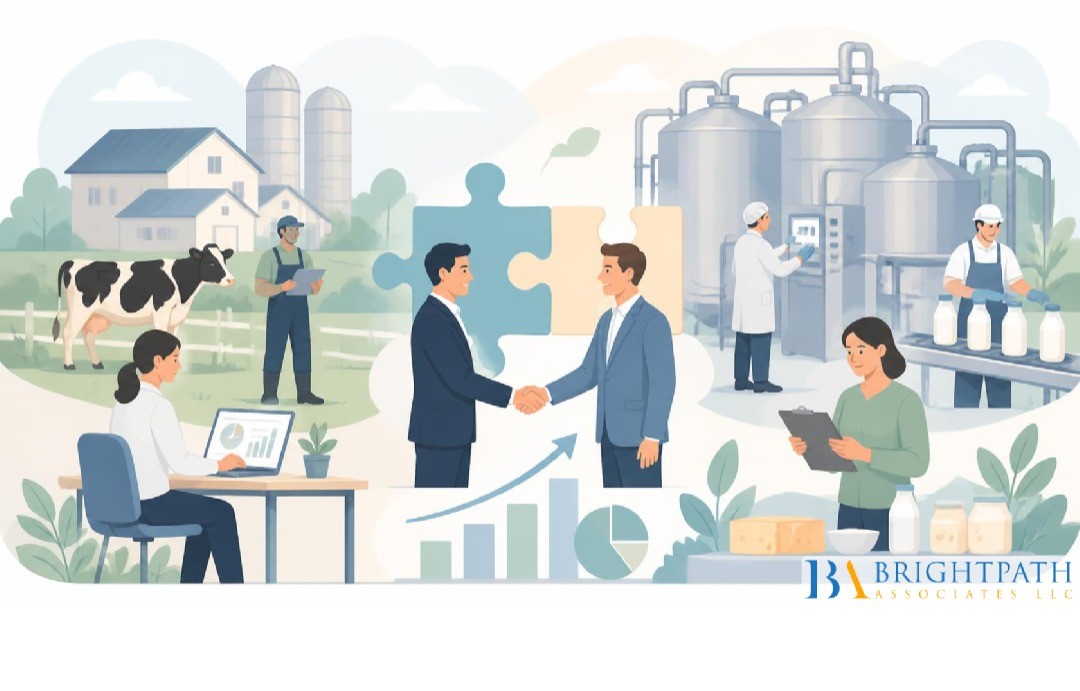
Introduction: Preparing for the Next Phase of Dairy Industry Growth
Mergers and acquisitions are becoming increasingly important strategic tools across the #DairySector. For established dairy companies, an acquisition can provide access to new markets, processing capabilities, product categories, technologies, distribution networks, and specialized talent. For smaller or mid-sized businesses, being acquired can provide capital, operational expertise, and opportunities to accelerate growth beyond what could be achieved independently.
However, successful Dairy industry M&A is rarely determined by the transaction itself. The quality of the business being acquired, its operational infrastructure, financial discipline, technology capabilities, supply-chain resilience, and leadership strength can significantly influence valuation and integration outcomes.
Dairy companies preparing for acquisition or expansion therefore need to think beyond short-term revenue growth. They must build organizations capable of demonstrating sustainable performance, scalable operations, and a clear strategic position within an increasingly competitive food industry.
From Dairy product development and Milk production technologies to Dairy automation technologies, digital commerce, and sustainable farming, today’s dairy companies have numerous opportunities to increase enterprise value before entering an M&A process.
Potential acquirers typically evaluate more than production capacity or annual revenue. They want to understand whether the target company has a sustainable competitive advantage and whether its operations can support future growth.
Product diversification can be an important factor. A dairy company dependent on a narrow range of commodity products may face greater exposure to price fluctuations than a business with differentiated products, established brands, specialized formulations, or higher-margin categories.
Dairy product development can therefore become a significant value driver. Companies that consistently develop new products aligned with changing consumer preferences can demonstrate greater growth potential.
A strong customer base, reliable supplier relationships, efficient manufacturing operations, documented processes, and experienced leadership can further strengthen an acquisition proposition.
Strengthening Dairy Product Development Before M&A
Innovation is increasingly central to the economics of the dairy industry. Consumers are seeking products that offer convenience, nutrition, functionality, sustainability, and differentiated experiences.
Dairy product development allows companies to move beyond traditional milk, butter, and cheese categories into specialized and value-added products. High-protein products, functional dairy beverages, premium products, convenient formats, and products designed around specific nutritional preferences can create opportunities for higher margins.
For companies preparing for acquisition, a credible innovation pipeline can demonstrate that future growth will not depend entirely on existing products.
Acquirers may also place value on intellectual property, formulations, product-development capabilities, testing infrastructure, and experienced technical teams that can accelerate innovation after integration.
Operational efficiency begins with the raw-material base. Milk production technologies are advancing through improved monitoring, herd management systems, data analytics, automated milking equipment, and precision-management tools.
For vertically integrated dairy businesses, these technologies can improve visibility into production performance, animal health, feed efficiency, and milk quality.
Even dairy processors that do not directly operate farms can benefit from stronger relationships with technologically advanced suppliers. Reliable sourcing is increasingly important as processors seek consistent quality and greater supply-chain resilience.
Before an M&A transaction, companies should be able to demonstrate that their sourcing strategy is scalable and capable of supporting future production requirements.
Dairy Automation Technologies and Manufacturing Efficiency
Manufacturing efficiency can have a major impact on acquisition value. Dairy processing is highly dependent on consistent production, sanitation, temperature control, packaging, quality assurance, and equipment reliability.
#DairyAutomationTechnologies can improve consistency while reducing manual intervention in repetitive processes. Automated filling, packaging, cleaning systems, quality monitoring, material handling, and production controls can help companies increase throughput and reduce operational variability.
Automation can also address labor challenges. As skilled manufacturing labor becomes more difficult to recruit and retain, dairy companies that have invested strategically in automation may be better positioned to maintain production capacity.
For potential acquirers, an efficient and scalable manufacturing environment can reduce the complexity and cost associated with post-acquisition expansion.
Dairy supply chains are particularly sensitive to disruptions because raw materials are perishable and production schedules often depend on precise timing.
Dairy supply chain management therefore deserves significant attention before an acquisition or expansion.
Companies should understand their exposure to individual suppliers, transportation constraints, packaging availability, energy costs, cold-chain requirements, and geographic concentration.
Supply-chain visibility can also improve negotiating power. Companies with accurate information about purchasing patterns, supplier performance, inventory levels, and logistics costs can identify inefficiencies before they become major problems.
During due diligence, supply-chain weaknesses may become a source of valuation pressure. Strengthening these systems before an M&A process can therefore protect enterprise value.
Sustainable Dairy Farming Practices and Corporate Value
Sustainability is increasingly influencing investment decisions throughout the food industry. Sustainable dairy farming practices can improve resource efficiency while helping companies respond to changing customer, retailer, investor, and regulatory expectations.
Areas such as water management, feed efficiency, waste reduction, energy use, emissions management, soil health, animal welfare, and responsible sourcing are becoming increasingly relevant.
For dairy companies preparing for acquisition, sustainability should be connected to measurable operational outcomes rather than treated exclusively as a marketing initiative.
Reducing energy consumption can lower operating costs. Improving resource efficiency can reduce waste. Responsible sourcing can strengthen supply-chain relationships. These improvements can contribute simultaneously to sustainability objectives and financial performance.
Successful M&A transactions require a clear growth thesis. Buyers need to understand why acquiring a particular company creates greater value than simply investing organically.
Dairy industry growth strategies can include geographic expansion, product diversification, vertical integration, manufacturing capacity expansion, new distribution channels, private-label opportunities, strategic partnerships, and technology investments.
A company preparing for acquisition should be able to articulate where future growth will come from and what capabilities are required to achieve it.
Growth should also be realistic. Aggressive expansion without sufficient manufacturing capacity, working capital, talent, or supply-chain infrastructure can create operational problems that reduce rather than increase enterprise value.
Dairy E-Commerce and New Routes to Market
#ConsumerPurchasing behavior is also reshaping dairy businesses. Dairy e-commerce has created additional routes to market for brands that can manage product freshness, packaging, fulfillment, and customer expectations effectively.
Digital channels can provide companies with greater access to consumer data. Rather than relying entirely on retailers and distributors, brands can gain direct insight into purchasing behavior, customer preferences, repeat purchases, and product demand.
For an acquirer, a well-developed digital channel can represent an attractive growth asset.
However, e-commerce economics must be evaluated carefully. Refrigerated transportation, fulfillment costs, packaging requirements, returns, customer acquisition expenses, and geographic limitations can significantly affect profitability.
Dairy industry digital transformation is increasingly connecting production, supply chains, sales, quality, and management information.
Modern dairy businesses can use enterprise systems, industrial sensors, analytics platforms, cloud technologies, automation, and artificial intelligence to improve decision-making.
Digital transformation can also improve M&A readiness by creating better data visibility. Financial information, production metrics, inventory records, customer data, quality information, and supplier performance can be organized more systematically.
This reduces the uncertainty that often complicates due diligence.
A digitally mature organization is also generally easier to integrate because standardized processes and accessible data can be transferred into broader corporate systems more efficiently.
Food Technology as a Competitive Advantage
Food technology is expanding the possibilities available to dairy companies. Advances in processing, packaging, preservation, fermentation, ingredient science, quality monitoring, and product formulation are enabling manufacturers to create differentiated products and improve production efficiency.
Companies that have developed specialized technical capabilities can become attractive acquisition targets because buyers may be purchasing expertise as much as physical assets.
Technology can also help companies respond to consumer demand faster. Shorter product-development cycles, improved testing capabilities, and flexible manufacturing can allow businesses to bring new concepts to market more efficiently.
The strategic question for management is not simply whether technology should be adopted, but which technologies create a defensible advantage within the company’s specific market.
A strong operational business can still struggle during an acquisition process if its data is incomplete or inconsistent.
Potential buyers need confidence in financial performance, customer concentration, margins, inventory, capital expenditure, production capacity, contracts, intellectual property, and operational risks.
Dairy companies should therefore establish disciplined reporting systems before entering negotiations.
Operational data should support financial results. Management should be able to explain changes in production costs, product margins, inventory levels, labor expenses, energy consumption, and customer profitability.
The more transparent and organized the information, the easier it becomes for potential buyers to understand the underlying economics of the business.
Leadership as a Critical M&A Asset
Technology and equipment can be acquired, but experienced leadership is much harder to replicate. A dairy company with strong executives and managers can be significantly more attractive than a business whose performance depends heavily on a small number of individuals.
Leadership teams must be capable of managing operations, innovation, regulatory requirements, supply chains, customer relationships, technology investments, and organizational change.
This is where Dairy industry executive search becomes increasingly relevant. As companies expand or prepare for transactions, they may require executives with experience in M&A integration, manufacturing transformation, commercial growth, supply-chain management, and food technology.
#ExecutiveSearchRecruitment can help organizations identify leaders capable of navigating the complexities of expansion while preserving operational performance.
Acquisition readiness is not only about attracting a buyer. It is also about ensuring that the organization can successfully operate after the transaction.
Integration can affect systems, employees, suppliers, customers, manufacturing operations, product portfolios, and organizational structures.
Companies with clearly documented processes generally have an advantage because their operations are less dependent on informal knowledge.
Standard operating procedures, management reporting, quality systems, technology infrastructure, and defined responsibilities can make integration more manageable.
A business that is well organized before acquisition is more likely to maintain momentum afterward.
Managing Culture During Expansion
Cultural compatibility is frequently underestimated in M&A planning. Dairy businesses often have strong organizational identities built around family ownership, regional relationships, production expertise, or long-standing customer connections.
An acquisition can create uncertainty among employees and suppliers. Poor communication can result in talent loss, operational disruption, and customer concerns.
Management should therefore consider culture as part of strategic planning.
Leadership teams need to communicate the purpose of the transaction, explain expected changes, and identify the capabilities that must be preserved. Experienced employees often possess valuable operational knowledge that cannot be easily replaced.
M&A should not be viewed as an isolated event. It can become part of a broader corporate growth strategy.
A dairy company may use acquisitions to enter new geographic markets, obtain specialized manufacturing capabilities, strengthen distribution, acquire technology, expand product categories, or gain access to new customer segments.
The most successful strategies usually begin with a clear definition of what capabilities the organization needs.
Instead of asking, “What company can we buy?” leadership should ask, “What capability, market position, technology, or customer access do we need to accelerate our strategy?”
This shift can lead to more disciplined acquisition decisions.
Conclusion: Preparing Today for Tomorrow’s Dairy Transaction
#DairyIndustry M&A is becoming an increasingly important mechanism for growth, consolidation, innovation, and market expansion. However, the companies that attract strategic interest are rarely built around revenue alone.
They demonstrate operational efficiency, product innovation, supply-chain resilience, digital maturity, sustainability, strong customer relationships, and scalable leadership.
Dairy product development can create differentiated revenue opportunities, while Milk production technologies and Dairy automation technologies can improve efficiency and scalability. Dairy supply chain management can strengthen resilience, while Dairy e-commerce can create new routes to consumers. At the same time, Food technology and Dairy industry digital transformation can help companies develop new capabilities and strengthen their competitive position.
For organizations preparing for acquisition, these investments can improve both current performance and future valuation. For companies pursuing expansion through acquisitions, they provide a framework for identifying targets that complement existing capabilities.
Ultimately, successful M&A is about more than completing a transaction. It is about building an organization capable of creating greater value before, during, and after the deal. With disciplined strategy, reliable operations, advanced technology, sustainable practices, and strong leadership, dairy companies can position themselves for a more resilient and scalable future.
Find your next leadership role in Dairy Industry today!