
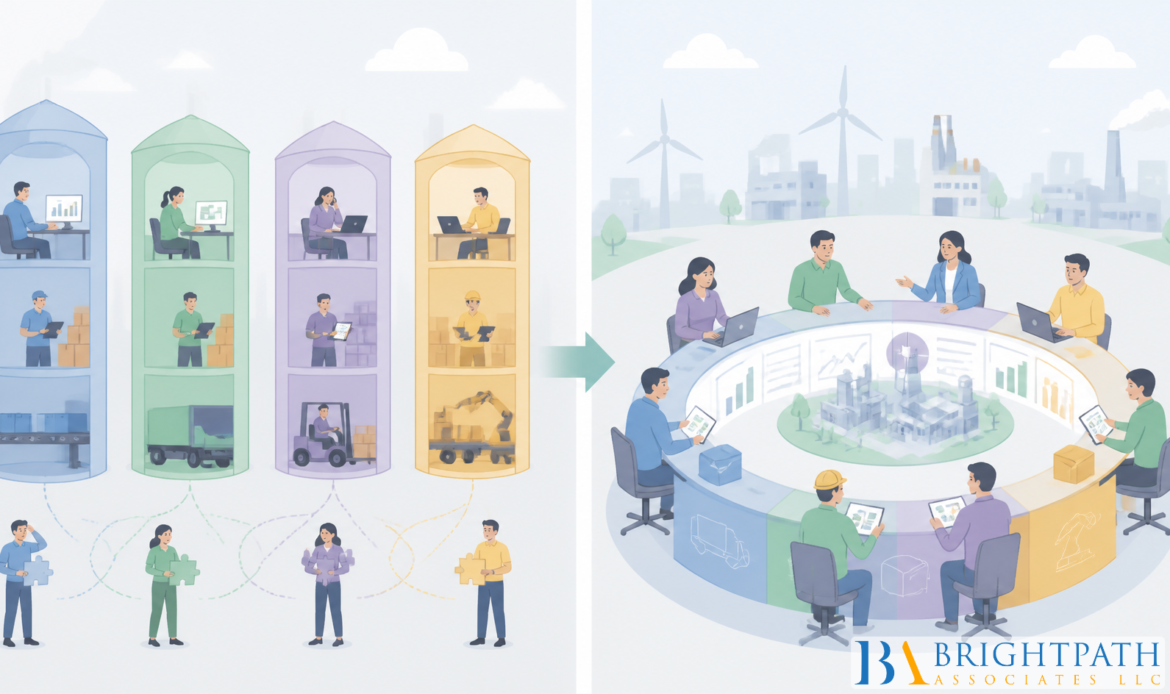
Operational Silos vs. Integrated Planning: Fixing the Structural Problem for #IndustrialAutomationIndustry is not mainly a software question. It is a structural question: can planning, production, quality, maintenance, materials, and leadership teams make decisions from compatible information and shared priorities?
For many manufacturers, the answer is only partly yes. ERP may hold demand and purchasing data. MES may track work orders and execution. SCADA may capture machine states. WMS may manage inventory movement. Yet each system can operate with different timestamps, item definitions, schedule assumptions, and owners. Automation then speeds up individual steps while the overall operating model remains fragmented.
Table Of Contents
• The Structural Cost Of Operational Silos
• Designing The Planning-To-Execution Architecture
• Leadership And Talent Requirements For Integrated Operations
• A Phased Implementation Roadmap
• Key Takeaways
• Frequently Asked Questions
The Structural Cost Of Operational Silos
Automation Can Accelerate A Broken Workflow
#OperationalSilos occur when departments, systems, or sites optimize their own work without a reliable way to reconcile decisions across the enterprise. In industrial automation, this can mean production running to an MES schedule that no longer matches the ERP plan, quality holding material that the scheduler still treats as available, or maintenance planning downtime that has not been reflected in a capacity model.
The immediate issue is often visible as manual work: spreadsheets, email approvals, phone calls, duplicate records, and end of shift reconciliation. The deeper issue is conflicting authority. If production, supply chain, and quality use different definitions of a feasible plan, no dashboard can create alignment by itself.
Siemens notes that separate automation and manufacturing operations management projects can create redundant work and additional integration effort. That matters because a manufacturer can spend heavily on PLC programming service, robotics integration, or new equipment controls and still create more interfaces to maintain later.
Consider a constrained production line. Planning releases an order based on nominal capacity. The MES dispatches the order, but a quality hold affects a critical component and maintenance has scheduled a short outage. None of these facts is necessarily wrong. The failure is that the planning assumptions were not updated through a governed workflow. Operators then resort to local workarounds, which may protect output for the day but obscure the true constraint from leaders.
The Failure Modes Leaders Should Recognize
Silos are not all alike. Executives should distinguish between data gaps, decision gaps, and incentive gaps before buying another integration tool.
| Failure Mode | What Happens Under The Hood | Business Risk | Better Response |
|---|---|---|---|
| Stale master data | Material, routing, unit, or equipment records differ across systems | Schedules appear feasible but cannot execute | Assign authoritative owners and reconciliation rules |
| Conflicting schedules | ERP, APS, and MES issue overlapping priorities | Expedites, changeovers, and poor schedule adherence | Define schedule ownership by planning horizon |
| Unmanaged exceptions | Teams use email and spreadsheets to override system logic | Leaders lose traceability and root cause visibility | Capture exceptions as structured events |
| Point solution sprawl | Each automation project adds custom interfaces | Rising support burden and fragile changes | Reuse integration patterns and data contracts |
| Quality isolation | Nonconformance data does not influence capacity decisions | Plans ignore holds, rework, and release timing | Connect quality status to planning rules |
The quality issue deserves special attention. The International Engineering and Operations Management Society explains that separating quality management from production planning can disconnect quality insights from capacity decisions. A rejected lot, revised specification, or recurring defect is not just a quality event. It can change available supply, labor needs, machine time, and customer commitments.
Why More Automation Is Not Always The Answer
#AutomationSolutionsManufacturing teams often assume that speed is the central problem. Sometimes it is. But automating a poor handoff can make the wrong decision arrive faster and at greater scale.
A workflow is a poor candidate for automation when the business cannot answer basic questions: Who owns the decision? Which record is authoritative? What should happen when data conflicts? What event closes the loop? If a planner changes a production priority, for example, the organization should know whether MES must accept, reject, queue, or escalate that change.
This is why executives should treat automation industry trends as operating model questions as well as technology questions. New robotics, sensors, analytics, and connected controls increase the volume of decisions. Without clear ownership, they can also increase exception volume.
Designing The Planning-To-Execution Architecture
Start With Decisions, Not Applications
Integrated planning does not mean forcing ERP, MES, SCADA, WMS, quality, and maintenance platforms into one database. It means defining which decisions require shared context and designing dependable exchanges around them.
A useful starting point is to map the decisions that affect production performance:
- Demand and order priority
- Available material and inventory location
- Capacity, labor, and maintenance constraints
- Quality release, hold, and rework status
- Production dispatch and actual completion
- Customer promise dates and financial impact
For each decision, identify the decision owner, the source system, the required latency, and the acceptable fallback if an interface fails. A machine interlock may need deterministic local control. A weekly production plan does not. Treating both as the same integration problem is a common design error.
Use Data Contracts To Prevent Semantic Drift
A #DataContract is an explicit agreement about what an exchanged record or event means. It should define fields, units, ownership, timestamps, version numbers, validation rules, and exception handling. This sounds administrative, but it is where many integration programs either become reliable or become permanently dependent on human cleanup.
For a production order, a practical contract might specify:
• ERP owns customer demand, commercial priority, and the released order identifier.
• APS or MES owns the detailed sequence inside a defined scheduling window.
• WMS owns on hand and location status, while quality status determines whether inventory is usable.
• MES owns actual start, completion, scrap, downtime reason, and operator confirmation.
• SCADA or control systems provide equipment signals but do not become the source of commercial planning data.
ISA 95 can help frame exchanges between enterprise and control domains. OPC UA can help structure and secure machine communication. Neither standard settles governance by itself. Leadership must still decide what each event means and what action follows it.
Choose The Architecture That Matches The Problem
There is no universal best architecture. The right choice depends on the number of systems, rate of change, latency requirements, and the organization’s ability to govern interfaces.
| Architecture | Best Fit | Advantages | Limits |
|---|---|---|---|
| Point To Point Interfaces | Small number of stable, low risk connections | Fast to deploy and easy to understand at first | Becomes difficult to monitor and change as connections multiply |
| Integration Platform | Several applications and recurring workflow changes | Centralized monitoring, reusable connectors, clearer security controls | Requires operating discipline and skilled technical ownership |
| Common Manufacturing Data Layer | Multiple plants or systems with inconsistent definitions | Supports shared models, analytics, and cross site planning | Can become an expensive abstraction if use cases are vague |
Point to point integration can be reasonable for a single ERP to MES exchange with stable requirements. It becomes less attractive when the same work order needs to feed WMS, quality, maintenance, customer service, and plant reporting. At that point, every change can trigger a cascade of regression testing.
A common data layer can help when sites use different source systems but need shared reporting and planning definitions. Fair warning: it should not become a project to copy every signal from every machine. Start with decisions that have measurable operational consequences.
Leadership And Talent Requirements For Integrated Operations
Integration Is A Leadership Design Problem
The most difficult part of integrated planning is usually not selecting technology. It is deciding who can resolve tradeoffs. A production leader may favor schedule stability. A sales leader may favor #CustomerExpedites. Quality may require a hold. Maintenance may require downtime. Each position can be rational in isolation.
An integrated operating model needs decision rights that are visible before the conflict occurs. We recommend establishing a cross functional planning forum with authority to resolve defined exceptions, not a broad meeting that merely reports status. Its scope should cover priority changes, constrained materials, quality holds, planned downtime, and customer commitment risk.
The operating model should also separate policy from daily execution:
• Executives set service, inventory, margin, safety, and risk priorities.
• Process owners define scheduling rules, escalation paths, and data standards.
• Plant teams execute within those rules and flag exceptions quickly.
• Technology leaders maintain system interoperability, access controls, and recovery procedures.
This structure gives local teams room to act without allowing every site or shift to invent a different planning process.
The Executive Profile Is Broadening
Industrial automation executive search is becoming more complex because leaders increasingly need to connect OT, IT, operations, supply chain, quality, finance, and workforce decisions. A strong controls background remains valuable. So does deep plant leadership. But neither alone guarantees the ability to lead integrated planning.
For roles such as VP of Operations, Director of Manufacturing Systems, Plant Manager, CIO, or automation leader, boards and owners may need to assess a wider set of evidence:
| Capability | Why It Matters In Integrated Planning | Interview Evidence To Seek |
|---|---|---|
| Cross Functional Leadership | Planning failures cross departmental boundaries | Examples of resolving competing production, quality, and supply priorities |
| Data Governance | Bad master data defeats accurate automation | Clear approach to ownership, standards, and exception control |
| OT And IT Judgment | Connectivity must not weaken safety or security boundaries | Ability to explain segmentation, access, and recovery tradeoffs |
| Change Leadership | New workflows alter authority and daily habits | Specific adoption plan, not only a system implementation plan |
| Commercial Awareness | Planning decisions affect customer promises and margin | Understanding of tradeoffs beyond equipment utilization |
#ConventionalRecruiting may struggle when job descriptions ask for every capability in one person: controls expert, ERP architect, cybersecurity leader, supply chain strategist, and plant operator. That profile may be unrealistic, especially for small and mid sized companies. The better question is which capability must sit in the executive role and which gaps can be covered by a team, advisor, or project leader.
This is where an executive search process can be useful when it tests for decision making across functions rather than matching keywords alone. We would advise employers to define the operating problem first. A company that needs better maintenance planning requires a different leader than one trying to standardize planning across multiple plants.
Staffing Risk Is An Operational Risk
A prolonged vacancy can create more than leadership inconvenience. Without a clear owner, integration decisions may default to vendors, isolated technical teams, or temporary workarounds. Projects then move forward without agreed data ownership, adoption planning, or governance.
That does not mean every gap requires an immediate permanent executive hire. A time bounded systems integration program may need contract leadership, a project based manufacturing systems specialist, or a temporary operations leader while the business defines the permanent role. The hiring model should follow the duration and strategic importance of the problem.
A Phased Implementation Roadmap
Phase One: Establish The Baseline And Boundaries
Do not begin with a broad promise of a single source of truth. Begin by measuring how work currently moves. Baseline metrics should reflect both planning quality and execution reality:
• Schedule adherence by line, plant, and product family
• Frequency and cause of manual schedule changes
• Inventory accuracy for production critical materials
• Time from quality hold to planning response
• Data latency between source event and decision use
• Manual touches required to release, change, or close an order
These metrics do not prove a future return on investment. They make the present failure visible and give leaders a way to test whether changes are working.
At this stage, identify boundaries that should remain local. Safety functions, emergency shutdown logic, and deterministic machine control should not depend on enterprise network availability. OT cybersecurity requirements should also shape the design: #NetworkSegmentation, least privilege access, controlled remote connections, asset visibility, patching windows, and incident response all become more important as systems exchange more data.
Phase Two: Prove One Closed Loop
Choose one high value workflow that crosses functions and can be measured. Examples include quality hold to production rescheduling, material shortage to dispatch adjustment, or maintenance outage to capacity revision. Avoid starting with a massive enterprise data model.
The workflow should be closed loop. If MES reports an actual completion, planning should receive it, evaluate the consequence, and create a visible response when needed. If a planner changes an order, the execution system should acknowledge whether the change is feasible. Silence is not confirmation.
SAP describes how connecting OT, IT, production, quality, and planning data can enable coordinated manufacturing workflows. The executive question is narrower: which connection changes a decision that currently causes cost, delay, or customer risk?
Phase Three: Scale Patterns, Not Customizations
Once one workflow is stable, reuse its data contract, exception process, security review, monitoring standards, and training approach. This is more durable than treating each line, plant, or robotics integration project as a separate integration effort.
Leaders should require a recovery plan before scaling. If the integration platform becomes unavailable, can the plant continue safely? Can supervisors see the last approved schedule? How are transactions reconciled when connectivity returns? A graceful manual fallback is not a failure. It is part of resilient design.
For organizations exploring digital manufacturing solutions, the practical test is whether a proposed capability reduces a specific decision delay or only adds another dashboard.
Phase Four: Add Advanced Analytics Carefully
AI and optimization tools can improve forecasting, anomaly detection, sequencing, and maintenance planning when source data is governed and users understand the output. They cannot compensate for inconsistent routings, unlabeled downtime, or unresolved #OwnershipConflicts.
A useful first application may be flagging likely schedule risks for human review rather than allowing an algorithm to issue production priorities automatically. For higher consequence decisions, retain clear approval rights and auditability. The case for leveraging AI in manufacturing strengthens when data quality, escalation rules, and operating accountability are already in place.
Key Takeaways
What Executives Should Do Now
• Treat silos as a combination of disconnected data, unclear decision rights, and misaligned incentives.
• Integrate systems around decisions with measurable consequences, not around a vague centralization goal.
• Define data contracts for orders, inventory, quality status, capacity, and actual production events before scaling interfaces.
• Preserve local autonomy for safety critical and deterministic control functions.
• Hire and assess leaders for cross functional decision making, governance, and change leadership alongside technical expertise.
• Measure schedule adherence, exception volume, inventory accuracy, data latency, and manual touches before claiming improvement.
The Core Decision
Integrated planning should be judged by whether it makes the next operational decision more accurate, timely, and accountable. If a connection does not improve a decision, reduce risk, or eliminate recurring manual reconciliation, it may not deserve priority.
Frequently Asked Questions
What Is The Difference Between Operational Silos And Integrated Planning?
Operational silos separate information and decisions by department, site, or system. Integrated planning connects the planning and execution decisions that must agree, such as material availability, capacity, quality status, and production priorities. It does not require one centralized system for every task.
Should ERP Or MES Own The Production Schedule?
Usually, ERP should own demand, order release, and broader #PlanningParameters, while MES or APS manages detailed sequencing within a defined execution window. The exact split depends on the plant’s complexity. The key requirement is that both systems have clear authority boundaries and a defined method for handling changes.
Which Systems Should Be Integrated First?
Start with the systems involved in a high impact recurring exception. For a material constrained plant, ERP, WMS, and MES may be the first workflow. For a defect prone process, quality and MES may be more urgent. Do not integrate based only on application names or vendor recommendations.
Can Automation Make A Silo Problem Worse?
Yes. Automation can make flawed master data, incorrect priorities, or ungoverned exceptions move faster. For example, an automated scheduling tool may repeatedly dispatch orders to a line that lacks released material if inventory and quality statuses are not reconciled.
When Is Point To Point Integration Acceptable?
It can be acceptable when there are few systems, the interface is stable, the consequences of failure are limited, and the organization can monitor and support it. An integration platform becomes more attractive as interfaces multiply, workflows change often, or audit and recovery needs increase.
What Should Remain Locally Autonomous?
Safety functions, emergency controls, deterministic machine behavior, and immediate operator interventions should remain local. Enterprise planning tools should inform operations without becoming a dependency for safe machine control.
How Can Leaders Measure Whether Integrated Planning Is Working?
Track the metrics tied to the workflow being changed. Common measures include schedule adherence, manual overrides, time to respond to quality holds, inventory accuracy, planning data latency, and the number of unresolved exceptions. Compare results against the baseline and investigate whether changes reflect real process improvement rather than reporting changes.
Why Does Integrated Planning Affect Executive Hiring?
It expands the leadership challenge. Companies need leaders who can connect #OperationalGoals, data governance, workforce adoption, technology architecture, and customer commitments. A candidate may be technically capable yet still be a poor fit if they cannot lead tradeoffs across those functions.
Resources And Citations
• Siemens Digital Industries Software — How integrated MOM and automation accelerate manufacturing transformation: https://blogs.sw.siemens.com/consumer-products-retail/2026/06/03/integrated-mom-and-automation-cpg/
• SAP — How SAP Integration Suite Tackles the Manufacturing Challenge: https://www.sap.com/blogs/transforming-manufacturing-excellence
• Rockwell Automation — Production Logistics: https://literature.rockwellautomation.com/idc/groups/literature/documents/sp/motion-sp012_-en-p.pdf
• International Engineering and Operations Management Society — Automating Cross-Functional Planning Workflows for Manufacturing: https://ieomsociety.org/proceedings/ankara2026/161.pdf
• Eclipse Automation — Systems Integration in Manufacturing Automation: https://www.eclipseautomation.com/resource/articles/systems-integration-in-manufacturing-automation/
• BrightPath Associates — Automation Industry Trends: https://brightpathassociates.com/automation-industry-trends-staying-ahead-in-a-rapidly-evolving-landscape/
Find your next leadership role in Industrial Automation Industry today!
Stay informed with the latest insights on Industrial Automation Industry!