
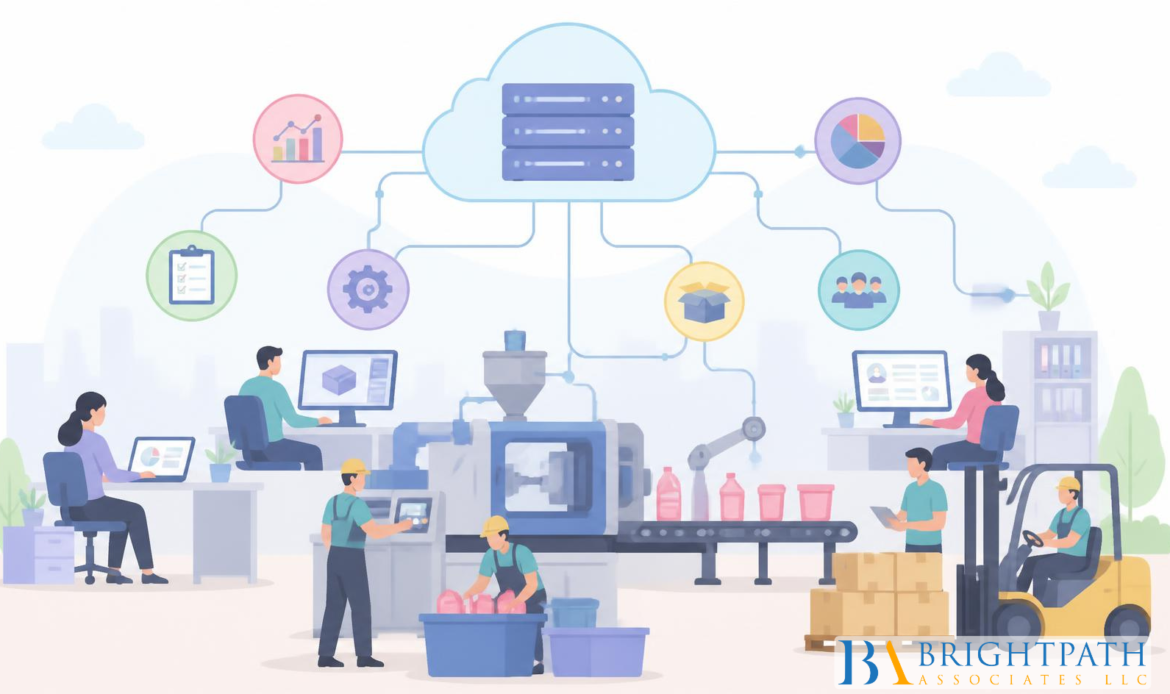
In an environment defined by fluctuating resin costs, demanding customer lead times, and complex quality mandates, small and mid-sized #PlasticsProcessors face constant operational pressure. Modernizing plant operations requires digital control systems capable of handling hybrid manufacturing models, material degradation, and intricate tooling constraints. Implementing Cloud-Based ERP: Backbone of Agility-Focused Plastic SME for Plastics Industry provides small and mid-sized enterprises (SMEs) with the operational visibility, dynamic scheduling capabilities, and automated quality controls needed to sustain high margins and market responsiveness.
Table of Contents
• Key Takeaways
• The Agility Imperative for Small and Mid-Sized Plastics Manufacturers
• Core Plastics ERP Architecture: Resin, Regrind, and Recipe Control
• Architecture Selection: ERP, MES, or Integrated Hybrid
• Implementation Roadmap and Governance for Plastics SMEs
• Quantifying ERP ROI and Performance Benchmarks
• FAQ Section
• Sources/References
Key Takeaways
• Cloud Agility: Modern cloud architectures eliminate local server overhead while giving shop-floor managers real-time visibility into machine status, resin stock, and active job costing.
• Hybrid Manufacturing: #PlasticsManufacturing demands systems that seamlessly combine process manufacturing (blending recipes, compounding, batch control) with discrete manufacturing (assembly, multi-cavity molding, secondary finishing).
• Material Genealogy: Full forward and backward lot tracking from raw resin and regrind to finished goods is essential for satisfying strict industry quality compliance.
• Tooling Integration: Machine and mold tracking within ERP schedules prevents tool over-use, reduces unplanned downtime, and automatically calculates cavity-specific scrap rates.
• Strategic Talent Alignment: Successful digital transformation relies on pairing robust ERP platforms with skilled operations, supply chain, and IT leadership.
The Agility Imperative for Small and Mid-Sized Plastics Manufacturers
Why Generic Systems Fail Plastics Processors
Standard manufacturing ERP systems often view raw materials as uniform, discrete parts that undergo linear assembly. In contrast, plastics manufacturing relies on variable raw materials, complex multi-cavity molds, and continuous process parameters. When an SME attempts to adapt generic ERP software, severe gaps emerge in inventory accuracy, production scheduling, and product costing.
In our analysis of shop-floor workflows, generic inventory platforms fail to account for fractional material consumption, purge loss, or variable runner scrap. A press consuming virgin resin alongside color concentrates and regrind cannot be accurately tracked using simple single-item bill of materials (BOM) logic. Without industry-specific features, plant operators resort to off-system spreadsheets, leading to inventory discrepancies, stockouts, and unreliable lead times.
Process Hybridity: Blending Discrete and Process Operations
Plastics processing occupies a unique structural position in manufacturing logic. As industry research highlights, a cloud plastics solution may combine process and discrete manufacturing while addressing encryption, access control, backups, and recoverability. This hybrid requirement stems directly from how plastics move through production stages:
- Formula-Based Process Stage: Compounding, masterbatch mixing, and melt-temperature controls act as process operations governed by recipes, heat dynamics, and precise chemical ratios.
- Discrete Execution Stage: Injection molding, blow molding, or extrusion produces discrete units tracked by piece count, mold cycles, and cavity usage.
- Secondary Operations: Downstream assembly, sonic welding, pad printing, and custom packaging add structured discrete steps with distinct labor and machine standards.
| Operational Requirement | Generic Manufacturing ERP | Specialized Cloud Plastics ERP |
| Material Structure | Fixed single-item BOMs | Dynamic recipe control with variable regrind ratios |
| Resource Scheduling | Machine-only capacity planning | Dual-constraint planning (Machine + Tool/Mold) |
| Scrap Accounting | Gross scrap percentages | Discrete breakdown (Runner, Purge, Startup, Quality Rejects) |
| Unit of Measure (UOM) | Single inventory UOM | Multi-UOM conversion (Pounds to Shots to Pieces) |
| Lot Genealogy | One-to-one component tracking | Complex parent-child material-to-cavity genealogy |
Financial and Operational Impact of Unplanned Downtime
For a mid-sized plastics SME running 20 to 50 molding presses, unplanned downtime directly erodes net margins. When a press sits idle due to missing raw materials, unscheduled mold repair, or uncalibrated color feeders, fixed operating costs continue to accumulate. A cloud-based enterprise platform mitigates these risks by connecting demand signals from sales orders directly with real-time resin inventory and mold maintenance schedules.
When #MachineTelemetry is linked to central planning, maintenance alerts trigger automatically before catastrophic tool failure occurs. Dynamic scheduling modules instantly re-route job tickets to alternative qualified presses when an unexpected outage strikes, maintaining delivery commitments and preserving customer trust.
Core Plastics ERP Architecture: Resin, Regrind, and Recipe Control
Material Genealogy from Polymer to Part
Achieving complete visibility across raw resin receipts, masterbatch additions, intermediate compounding, and finished product packaging is a core operational mandate. As verified by technical documentation, Plastics ERP can track resin, additives, regrind, batches, genealogy, yield, scrap, and production resources.
Forward and backward material genealogy provides an unbroken digital chain of custody. If a lot of virgin polypropylene exhibits melt-flow instability during production, quality teams can rapidly execute a backward search to locate every lot number received from that supplier. Simultaneously, a forward genealogy search reveals every finished medical or automotive part created using that specific resin batch, enabling targeted containment rather than blanket product recalls.
Managing Regrind Edge Cases and Recipe Rules
Regrind utilization introduces complex engineering variables into ERP inventory and recipe modules. Because thermal processing alters polymer chain length and melt viscosity, manufacturers strictly limit regrind percentages based on customer specifications.
To ensure quality compliance, cloud ERP platforms enforce automated recipe controls:
• Approved Regrind Thresholds: The system blocks production releases if a work order recipe exceeds maximum allowable regrind percentages (e.g., maximum 15% virgin regrind blend).
• Generation Tracking: Regrind items carry multi-generational attributes (Generation 1 regrind vs. Generation 2 regrind) to prevent #PolymerDegradation in structural components.
• Dynamic BOM Rebalancing: When regrind availability drops, the system automatically recalculates raw resin and colorant requirements to balance batch consistency without manual operator calculations.
Tooling, Mold, and Cavity Lifecycle Management
In injection and blow molding, tooling represents a massive capital investment. Molds undergo wear, thermal stress, and mechanical fatigue across every cycle. A robust plastics enterprise system treats tooling as a active co-resource rather than passive auxiliary equipment.
Tooling lifecycle management features include:
- Shot-Count Tracking: The system records exact machine cycles via direct press integration or operator logs, triggering preventive maintenance work orders when mold stroke counts hit pre-set thresholds.
- Cavity Blockout Management: If Cavity #3 in an eight-cavity mold develops a surface defect, operators mark that specific cavity as blocked in the ERP interface. The system automatically recalculates piece-per-shot yields, cycle times, and raw material requirements for remaining work orders.
- Family Mold Optimization: When a single mold produces multiple distinct part numbers simultaneously, the system tracks individual part inventories and matches output against varying customer demand schedules.
Architecture Selection: ERP, MES, or Integrated Hybrid
Deciding Between Standalone ERP and ERP-Plus-MES
Selecting the right system architecture requires evaluating plant automation levels, cycle time sensitivity, and machine communication capabilities. Small plastics SMEs often struggle to choose between deploying an ERP platform alone, integrating a standalone Manufacturing Execution System (MES), or investing in a unified cloud platform.
We recommend applying clear criteria when choosing system architecture:
• Standalone Cloud ERP: Best suited for low-complexity plants with manual data capture, standard cycle times exceeding 60 seconds, and straightforward batch #ProductionSchedules.
• ERP-Plus-MES Best-of-Breed Architecture: Essential for high-speed precision operations (e.g., medical molding with cycle times under 5 seconds) where real-time cavity pressure data, automated vision inspection, and immediate machine alarms must operate independently of enterprise database latencies.
• Unified Cloud ERP/MES Platform: Ideal for growing mid-sized SMEs seeking end-to-end automation without the integration overhead and maintenance costs of separate middleware engines.
Minimum Data Model Requirements for Shop-Floor Real-Time Capture
To maintain reliable production visibility, an SME must establish a clean minimum data model before deploying shop-floor hardware. Without structured inputs, digital dashboards quickly display inaccurate shift reports.
Key components of a robust shop-floor data capture architecture include:
- Material Attributes: Grade, lot identification, moisture level, melt-flow index, supplier lot code, and bin location.
- Resource Identifiers: Press ID, mold ID, core-pull configuration, auxiliary unit IDs (chillers, dryers, thermolators).
- Recipe and Process Limits: Target cycle time, melt temperature range, injection pressure bounds, stroke speed, and cooling duration.
- Quality Data Points: First-piece inspection sign-offs, cavity-specific dimension measurements, and visual defect classifications.
As verified in operational software benchmarks, Plastics ERP can connect batch and lot management with quality inspection and forward/backward traceability.
Cloud Security, Infrastructure Risk, and Offline Resilience
Deploying core enterprise systems in the cloud introduces concerns around network uptime and cyber threat security. A internet outage must not halt active molding machines or stop barcode scanning at the shipping dock.
To safeguard operations, enterprise cloud providers utilize data encryption at rest and in transit, multi-factor authentication, and redundant off-site backups. On the shop floor, modern cloud platforms deploy edge-computing nodes. These local edge devices store local work orders, queue barcode transactions, and collect press telemetry during internet disconnections, automatically syncing back to the cloud database once connectivity re-establishes.
Implementation Roadmap and Governance for Plastics SMEs
Phased Rollout Strategy to Prevent Production Disruption
Attempting a single-date “big bang” ERP deployment across finance, purchasing, inventory, and shop-floor execution introduces unacceptable operational risk. A phased implementation schedule allows shop-floor operators and administrative teams to master new processes incrementally.
Phase 1: Core Financials, Purchasing, & Item Master Setup
│
▼
Phase 2: Warehouse Management System (WMS) & Barcode Tracking
│
▼
Phase 3: Production Planning, Recipe Control, & Tooling Setup
│
▼
Phase 4: Real-Time Machine Telemetry & Quality Inspection Rollout
This structured deployment sequence stabilizes foundational inventory and financial flows before exposing shop-floor operators to digital job execution interface controls.
Master Data Governance and Recipe Change Control
#DataErrors severely impede digital transformation efforts. If an item master contains incorrect runner weights or unverified mold shot capacities, material requirement planning (MRP) outputs will generate incorrect purchase orders.
Establishing governance rules protects system data integrity:
• Centralized Approval Rights: Only authorized process engineers can modify tooling configurations, cycle time benchmarks, or resin recipes.
• Version-Controlled BOMs: Historical recipes must remain archived. When resin grade substitutes occur, the platform creates a distinct BOM revision code with effective start and end dates.
• Mandatory Field Validation: Purchase order entry forms must require complete resin specifications—including color code and density metrics—before processing receipts.
Strategic Workforce Alignment and Executive Talent Roles
Advanced digital infrastructure yields optimal performance only when managed by competent operational leaders. Transitioning a traditional plastics plant to a data-driven cloud ecosystem demands experienced leaders capable of managing cross-functional supply chain planning, digital shop-floor execution, and advanced automation initiatives.
At BrightPath Associates, we assist plastics organizations in identifying, recruiting, and retaining executive and operational leadership. Specialized talent—such as VP of Operations, Plant Managers, Supply Chain Directors, and Engineering Leads—play a vital role in aligning cloud ERP deployments with corporate growth targets, operational safety standards, and long-term profitability goals.
Quantifying ERP ROI and Performance Benchmarks
Baseline KPIs Before and After ERP Rollout
To measure return on investment, plastics SMEs should establish clear quantitative baselines prior to system configuration. Evaluating key performance indicators (KPIs) before and after deployment reveals tangible operational improvements.
| Operational Metric | Pre-ERP SME Baseline | Targeted Post-Implementation Benchmark |
| Inventory Accuracy | 70% – 82% (Manual counts) | 98%+ (Real-time barcode tracking) |
| Schedule Adherence | 65% – 75% | 90%+ (Dynamic dual-constraint scheduling) |
| Traceability Response Time | 4 to 24 Hours (Paper searches) | Under 10 Minutes (Automated genealogy) |
| Scrap Rate (Purge & Rejects) | 6% – 10% of total throughput | 2% – 4% (Automated recipe & cavity tracking) |
| Mold Changeover Duration | Variable (Unstructured tools) | Reduced by 15% – 25% (Staged pre-heaters & tools) |
Calculating Total Cost of Ownership for Cloud Subscriptions
Evaluating cloud ERP costs requires reviewing software license pricing alongside full total cost of ownership (TCO) considerations. On-premises systems require heavy upfront capital expenditures for servers, backup hardware, database licensing, and dedicated IT staffing. Cloud models shift these costs to predictable operational expenditure (OpEx) structures.
SME decision-makers must account for all TCO variables over a 5-year cycle:
- Subscription Fees: Annual cloud user and machine connection licensing fees.
- Implementation & Data Migration: Professional service fees for data cleansing, workflow configuration, and system testing.
- Hardware & Infrastructure: Industrial barcode scanners, shop-floor touch tablets, and edge-computing network gateways.
- Internal Training & Change Management: Dedicated hours for training press operators, warehouse material handlers, and quality inspectors.
- Ongoing Support & Optimization: Post-go-live consulting, user training updates, and continuous integration adjustments.
FAQ Section
What is a cloud-based ERP system for a plastics manufacturer?
A cloud-based ERP for plastics manufacturing is a centralized software platform hosted on secure cloud servers. It unifies sales, finance, inventory management, production scheduling, shop-floor execution, and quality control into a single real-time database tailored for molding, extrusion, and compounding processes.
How does cloud ERP improve agility in a small plastics plant?
#CloudERP improves plant agility by delivering real-time visibility into resin inventory, active job statuses, and machine schedules from any location. When customer orders change or press breakdowns occur, production managers can instantly reschedule work orders, reallocate tooling resources, and adjust raw material purchases without delaying operations.
Can cloud ERP track resin, additives, and regrind genealogy?
Yes, specialized cloud ERP platforms track raw virgin resin, liquid colorants, masterbatch additives, and regrind ratios across every production stage. The system logs batch and lot numbers to create comprehensive forward and backward genealogy reports for full quality traceability.
Should a plastics SME select ERP, MES, or both?
Selection depends on process speed and real-time control requirements. Small facilities with standard cycle times often succeed with a unified cloud ERP platform that includes embedded shop-floor control. Precision molding plants operating high-speed presses require an integrated ERP-plus-MES setup to capture high-frequency machine metrics without lag.
How does cloud ERP handle tooling and multi-cavity molds?
Cloud ERP manages molds as co-resources alongside machines. It tracks cycle counts for preventive maintenance, manages family mold configurations, and allows operators to block out defective cavities while automatically adjusting scrap calculations and #Material Requirements.
What happens to production if the cloud ERP loses internet connectivity?
Modern cloud ERP systems use local edge-computing devices installed on the plant floor. These edge nodes store active work orders and buffer machine telemetry and barcode transactions during internet outages, syncing automatically with the cloud central database once connection resumes.
How long does a typical cloud ERP implementation take for a plastics SME?
A phased cloud ERP rollout for a small to mid-sized plastics manufacturer typically takes between 4 to 9 months, depending on data cleanliness, customization requirements, shop-floor hardware integration, and organizational change readiness.
Why are generic ERP platforms inadequate for injection molding?
Generic ERP platforms struggle with injection molding because they cannot accommodate dynamic recipe variations, fractional material conversion, dual-constraint scheduling (machine plus mold), or multi-cavity yield tracking without costly #CustomSoftwareCoding.
Sources/References
• Infor — Plastics Manufacturing ERP Software: https://www.infor.com/industries/industrial-manufacturing/plastics-manufacturing
• COSMO CONSULT — ERP for Plastics Processing: https://www.cosmoconsult.com/en/products/cosmo-erp-plastics
• COSMO CONSULT — Plastics Industry Software: https://www.cosmoconsult.com/en/solutions/industries/plastics-industry
Find your next leadership role in Plastics Industry today!
Stay informed with the latest insights on Plastics Industry!