
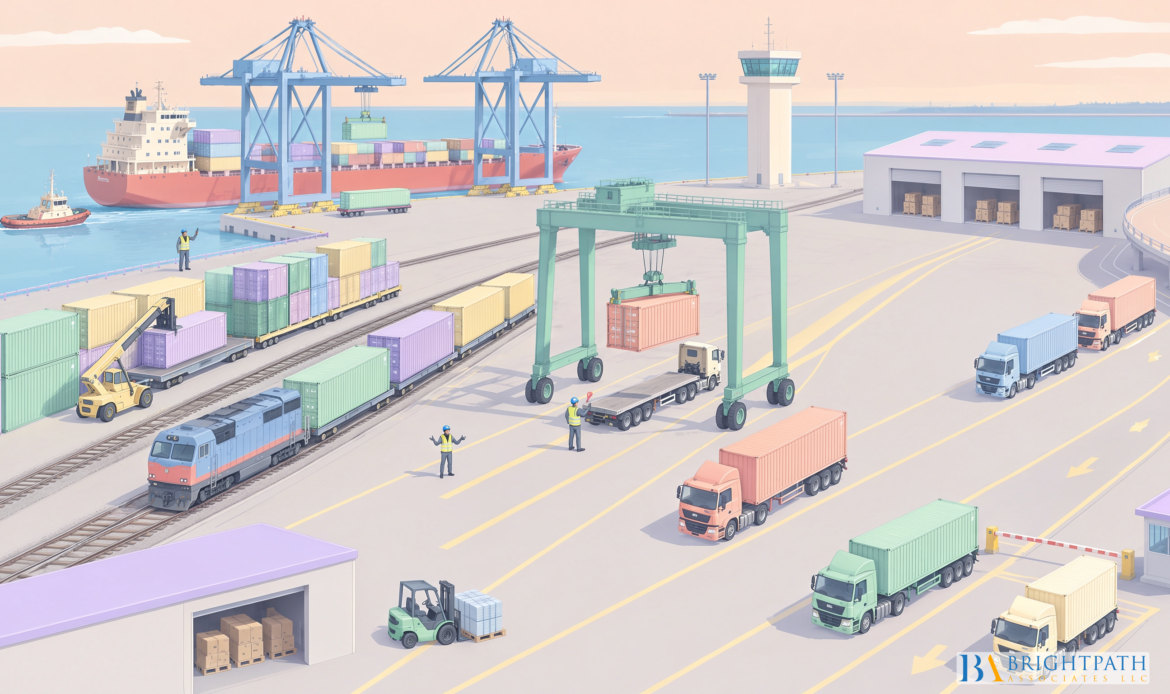
Parcel networks are built for efficiency, but efficiency can create a hidden weakness: too much volume may depend on one carrier, hub, gateway, or linehaul corridor. Multimodal Flexibility: Diversifying Freight Carriers to Hedge Against Disruption for Package Delivery Industry is not simply a procurement exercise. It is an operating model that helps shippers protect promised delivery dates when weather, labor constraints, port congestion, capacity shortages, #TechnologyFailures, or network disruptions affect a primary provider.
We see an important distinction that executives should make early. Adding carriers can reduce dependence on one provider. Adding modes can preserve freight movement when an entire transportation network is constrained. A company that uses several parcel carriers but injects most packages through the same airport, regional hub, or final mile partner may still face a common failure point.
Table of Contents
• Why Carrier Choice Alone Is Not Enough
• How To Build A Practical Resilience Portfolio
• Operational Readiness, Technology, And Leadership
• Key Takeaways
• Frequently Asked Questions
Why Carrier Choice Alone Is Not Enough
Multimodal transportation uses two or more transport modes within a freight plan. Intermodal transportation generally moves freight across modes in a common loading unit, such as a container moving by truck and rail. Synchromodality goes further by allowing the mode choice to change as operating conditions change.
The difference matters. A shipper may have three parcel carriers available, but if each relies on the same constrained airport gateway or regional linehaul corridor, the alternatives are less independent than they appear. The real question is not, “How many carriers do we have?” It is, “What disruption can this portfolio withstand?”
The OECD notes that multimodality and synchromodality can support freight diversion when one modal network or service is disrupted. That principle applies to parcel delivery, freight shipping, and international e commerce logistics alike. It does not mean every package should have an air, rail, ocean, and truck option. It means critical flows should have credible alternatives before disruption begins.
Carrier Diversification And Modal Diversification Solve Different Risks
#CarrierDiversification addresses provider specific risk. A carrier may impose volume limits, experience a labor disruption, suspend pickups, change surcharge structures, or suffer network congestion. Diversifying providers can limit the effect of those events.
Modal diversification addresses network specific risk. If an ocean gateway is delayed, an airfreight option may protect selected urgent replenishment orders. If truckload capacity is limited, rail or intermodal transportation may be viable for less time sensitive freight. If a parcel sort hub is constrained, a regional carrier or alternate injection point may preserve final mile delivery in a defined geography.
| Risk Type | Primary Exposure | Useful Response | Important Limitation |
|---|---|---|---|
| Carrier specific disruption | Pickup suspension, pricing action, capacity allocation | Shift volume to a qualified secondary carrier | Secondary carrier may share hubs or linehaul infrastructure |
| Mode specific disruption | Airspace limits, port delays, rail constraints | Use an alternative mode for selected freight | Modal changes can raise cost and handling requirements |
| Geographic disruption | Storm, wildfire, regional labor shortage | Redirect to a different gateway or regional provider | Delivery coverage may differ by ZIP code |
| Technology disruption | Label, tracking, tendering, or API outage | Activate manual or alternate routing workflows | Teams need tested procedures, not just contracts |
A portfolio should also account for shipment types that cannot move freely across all networks. PO Boxes, military addresses, rural delivery points, hazardous materials, oversized parcels, temperature sensitive products, and returns often have different eligibility rules. #MHWMagazine notes that parcel carrier portfolios may combine national, regional, and specialized providers because coverage, package restrictions, and injection points differ.
Measure Concentration Before It Becomes A Crisis
There is no universal percentage that defines excessive carrier concentration. A 70 percent allocation to one provider may be manageable for a business with tested alternatives and broad geographic coverage. The same allocation may be risky for a retailer shipping mostly time definite parcels through one metro gateway.
We recommend measuring concentration across several dimensions rather than using one network wide number:
• Volume concentration: What share of packages goes to one carrier?
• Revenue concentration: What share of high value or high margin orders relies on one carrier?
• Geographic concentration: Which ZIP codes, states, or metropolitan areas depend on one provider?
• Service concentration: How much next day, two day, residential, or rural volume has only one practical option?
• Infrastructure concentration: Which carriers share injection points, airports, ports, sort hubs, linehaul partners, or labor markets?
A useful executive exercise is to run a failure scenario. Assume the largest carrier cannot accept new pickups for five business days. Then calculate what volume can actually move through tested secondary capacity without missing customer promise dates. This reveals a practical resilience position, not a theoretical one.
How To Build A Practical Resilience Portfolio
A resilient routing guide is more detailed than a ranked carrier list. It identifies which provider can handle which package, lane, service level, and disruption condition. It also establishes the authority to spend more when service recovery requires premium transportation.
State of Logistics: Vision and Strategies for 2030 provides useful context for #LeadersAssessing how long term logistics strategy, operating capacity, and delivery expectations increasingly intersect. (State of Logistics: Vision and Strategies for 2030)
Assign Primary, Secondary, And Emergency Roles By Segment
The most workable design usually assigns roles rather than spreading volume evenly across every carrier. A primary carrier receives planned volume for a defined segment. A secondary carrier is prequalified, integrated, and tested for that same segment. An emergency or spot provider is reserved for exceptional circumstances where normal routing cannot meet the recovery objective.
| Shipment Segment | Primary Role | Secondary Role | Emergency Option | Decision Rule |
|---|---|---|---|---|
| Standard residential parcels | National or regional parcel carrier | Alternate carrier with proven ZIP code coverage | Premium parcel or expedited service | Shift when pickup or delivery performance misses defined thresholds |
| Rural, PO Box, or military shipments | Provider eligible for required address type | Approved alternate where available | Customer communication and revised promise date | Avoid routing to an ineligible carrier merely to save cost |
| High value or time definite parcels | Carrier with tracking and service controls | Pretested premium provider | Air or expedited ground | Escalate when delay risk exceeds approved margin or customer threshold |
| Oversized or special handling parcels | Specialized carrier | Alternate specialized provider | Brokered freight service | Confirm dimensional limits and claims processes before tendering |
| International inbound replenishment | Ocean or standard air service | Alternative gateway or carrier allocation | Airfreight or sea air service | Use only when inventory risk justifies added landed cost |
The allocation should reflect performance, capacity, and operating fit, not rate alone. C.H. Robinson explains that coordinated modal allocation, multiple ocean services, alternative ports, and predefined escalation triggers can reduce disruption exposure. The same discipline applies to parcel delivery: alternative capacity must be assigned in advance, not discovered after a service failure.
Use Triggers That Link Cost To Customer And Inventory Risk
A routing guide becomes useful when it tells teams what to do at a specific threshold. “Use air when needed” is not an #OperationalRule. It leaves warehouse staff, transportation managers, and customer service teams to interpret urgency differently.
Instead, executives can set decisions around four questions:
- What is the shipment criticality? A replacement part preventing a customer outage may justify a premium that a routine replenishment order does not.
- What is the missed promise risk? If the estimated delivery date is already beyond the customer commitment, the shipment may need an alternative service.
- What is the maximum approved premium? The company should define whether a higher transportation cost is allowed based on order value, margin, customer tier, or inventory consequence.
- What capacity is real today? A backup carrier with no confirmed pickup window is not available capacity.
C.H. Robinson advises that shippers can prepare alternative ocean, air, and ground options before disruption and use decision thresholds to preserve transit velocity. For package delivery leaders, the core lesson is to set rules before stress changes judgment.
Fair warning: modal substitution is not automatically the right response. Switching every delayed parcel to air can damage margins without solving a broader final mile bottleneck. If a weather event has closed local delivery operations, faster linehaul may only move inventory closer to an inaccessible destination. In that case, selective diversion, revised promise dates, and customer communication may be more rational than premium transportation.
Test For Common Mode Failure
Carrier contracts do not prove independence. A structured review should ask whether alternatives share any of the following:
• The same airport gateway or parcel injection facility
• The same regional sort center or contracted final mile provider
• The same highway corridor, rail ramp, port, or labor market
• The same technology platform, customs broker, or labeling workflow
• The same exposure to local weather and utility disruptions
Consider two carriers serving the same metropolitan area. Their brands and invoices may be different, but both may collect parcels at the same third party consolidator before injecting them into a single hub. That arrangement can improve routine efficiency while leaving disruption exposure largely unchanged. The solution may be a different injection point, a regional carrier, staged inventory, or a different mode for only the most critical orders.
Operational Readiness, Technology, And Leadership
A carrier is not a backup just because procurement has a signed agreement. Operational readiness determines whether capacity can be used under pressure.
Build Readiness Into The Warehouse And Technology Stack
Before assigning meaningful contingency volume, test the full workflow. This includes rate tables, labels, manifests, pickup schedules, package dimensions, dangerous goods rules, tracking events, exception codes, claims procedures, billing, and customer service scripts.
A #TransportationManagementSystem can help automate carrier selection, but automation should enforce business rules rather than obscure them. The system needs accurate service maps, package characteristics, cutoff times, landed cost data, and carrier capacity constraints. Otherwise, rate shopping may choose the lowest displayed price while overlooking accessorial charges, surcharges, failure risk, or an unavailable pickup window.
The total cost of adding a carrier also extends beyond freight spend. It can include warehouse sortation changes, printer and label configuration, API integration, training, reconciliation, claims management, reporting, and exception handling. These costs vary sharply by company, so there is no reliable universal estimate. A smaller shipper with a simple parcel profile may integrate a regional provider quickly. A large operation with multiple warehouses, strict customer promises, and customized order management workflows may face a much larger implementation burden.
For organizations evaluating logistics consulting services or freight brokerage services, the practical question is whether a prospective partner can help validate the operational details: service eligibility, linehaul access, pickup reliability, data exchange, and escalation responsibilities. Strategy without execution readiness simply moves risk from transportation procurement to the warehouse floor.
Strategic Transportation Consulting for Growth offers a related view of how transportation decisions can support broader operational growth plans.
Use Tail Risk Metrics, Not Only Averages
Average transit time can conceal service instability. A carrier might post an acceptable average while a small but commercially damaging share of shipments arrives far beyond the promised date. Resilience reporting should therefore include disruption period and high percentile measures.
Useful metrics include:
• On time delivery against the promised date, segmented by carrier and ZIP code
• Ninety fifth percentile transit time, especially for priority services
• Missed promise rate during peak periods and declared disruptions
• Recovery time, or the time needed to restore normal flow after a disruption
• Diversion success rate, meaning the percentage of rerouted volume tendered and delivered as planned
• Landed cost variance, including surcharges, claims, manual labor, and customer remediation
The dashboard should be reviewed by transportation, operations, finance, customer experience, and technology leaders. This cross functional view matters because a lower freight rate may create greater service recovery cost, while a premium contingency option may protect revenue or an important customer relationship.
The Leadership Requirement Is Broader Than Transportation Expertise
#DeliverySector tech talent and logistics leadership needs are changing as multimodal strategies become more data dependent. The strongest role design often combines transportation knowledge with commercial judgment, systems fluency, operational discipline, and cross functional influence.
That does not mean every transportation executive must be a software architect. It does mean leaders need to translate service commitments into routing rules, assess carrier data critically, and decide when a higher transportation cost is justified. They also need enough authority to coordinate procurement, warehouse operations, finance, customer service, and technology during an active disruption.
For small and mid sized businesses, this can create a specialized hiring challenge. Conventional recruiting may find candidates with carrier management experience or candidates with delivery technology backgrounds, but fewer candidates may have demonstrated capability across multimodal planning, analytics, network design, and disruption governance. A prolonged vacancy can leave an organization with contracts but no disciplined decision process for activating them.
Economics And Logistics Strategies Transforming Modern Delivery is relevant for executives considering how shipping optimization decisions affect cost discipline and delivery performance.
Key Takeaways
• Diversifying carriers and diversifying modes are related but different strategies. Multiple carriers do not eliminate risk if they depend on the same hubs, gateways, or partners.
• Concentration should be measured by volume, revenue, geography, service level, and shared infrastructure. A single network wide percentage is rarely enough.
• A practical routing guide defines primary, secondary, and emergency roles by shipment segment. It should include address restrictions, package limits, service promises, and escalation authority.
• Mode switching should be tied to customer commitments, inventory risk, capacity reality, and an approved cost premium. Not every delay requires airfreight or expedited service.
• Backup capacity must be operationally tested. Contracts, labels, pickups, tracking, billing, claims, and customer communication workflows all matter.
• Leadership teams should measure disruption period performance, not just average transit time. Tail risk and recovery time reveal whether a contingency plan works when conditions deteriorate.
Frequently Asked Questions
What Does Multimodal Flexibility Mean For A Package Delivery Company?
It means the company can use different transportation modes and routing options when conditions require it. For parcels, that can include ground, air, regional delivery networks, alternate injection points, and freight options for larger shipments. The goal is not constant switching. It is having viable, preplanned alternatives for important flows.
Can Using UPS, FedEx, USPS, And Regional Carriers Reduce Disruption Risk?
It can reduce provider concentration risk when the carriers serve the required addresses, package types, and service levels. The benefit is weaker if the alternatives rely on the same local hub, airport, consolidator, or final mile infrastructure. Companies should test each carrier by lane and shipment type instead of assuming broad #NetworkIndependence.
How Many Carriers Should An E Commerce Shipper Use?
There is no validated universal number. The right portfolio depends on shipment volume, geographic reach, service promises, product constraints, and warehouse capacity. A smaller business may need only a primary and tested secondary provider for major segments. A larger shipper may need specialized carriers for rural, oversized, international, or time definite shipments.
When Should A Company Switch A Shipment From Ground To Air?
Switch when the expected benefit exceeds the approved premium. This may occur when a missed delivery could halt a customer operation, trigger a contractual consequence, or create a greater inventory cost than the airfreight charge. Avoid automatic air upgrades when the delay is caused by a destination level problem that faster linehaul cannot solve.
How Can A Business Identify Shared Disruption Exposure?
Map each carrier’s pickup points, injection locations, sort hubs, linehaul routes, final mile partners, and major technology dependencies. Then examine whether two alternatives share a physical or operational dependency. This review should be updated when carriers change network design or when the shipper adds a new consolidation partner.
What Technology Is Needed For Multi Carrier Parcel Delivery?
A transportation management system, parcel management platform, or integrated rate shopping tool can help route orders across eligible services. The essential requirement is not a specific software category. It is accurate data, tested carrier connections, #BusinessRules, tracking visibility, and an exception workflow that teams can use during disruption.
How Should Leaders Test Backup Carriers Before A Real Disruption?
Run controlled volume tests across representative lanes, package sizes, and address types. Confirm label creation, pickup performance, tracking quality, billing accuracy, claims handling, and customer notifications. Testing only easy metropolitan parcels can create false confidence if the backup plan must also support rural deliveries or oversized orders.
Resources And Citations
• OECD — Balancing Efficiency and Resilience in Multimodal Supply Chains. https://www.oecd.org/content/dam/oecd/en/publications/reports/2018/10/balancing-efficiency-and-resilience-in-multimodal-supply-chains_f089d44f/c55d2768-en.pdf
• C.H. Robinson — Managing Ocean Freight Volatility. https://www.chrobinson.com/en-us/resources/resource-center/guides/managing-ocean-freight-volatility-guide/
• C.H. Robinson — Blank Sailings & Ocean Disruption Guide. https://www.chrobinson.com/en-us/resources/resource-center/guides/blank-sailings-and-ocean-freight-schedule-disruptions/
• mhwmag.com. https://www.mhwmag.com/podcasts/parcel-carrier-diversification-strategy-for-better-faster-delivery/
• BrightPath Associates — State of Logistics: Vision and Strategies for 2030. https://brightpathassociates.com/state-of-logistics-vision-and-strategies-for-2030/
Find your next leadership role in Packaging and Freight Industry today!
Stay informed with the latest insights on Packaging and Freight Industry!