
Introduction: Redefining Sustainability in the Dairy Industry
Sustainability in the modern #DairyIndustry is no longer limited to reducing environmental impact. As consumer expectations, regulatory requirements, technological innovation, and economic pressures continue to evolve, dairy businesses are being challenged to balance profitability with environmental responsibility and social value. This broader approach, often described as multi-dimensional sustainability, recognizes that long-term business success depends on much more than financial performance.For dairy organizations, sustainability increasingly involves responsible resource management, farmer welfare, animal health, employee development, community engagement, supply chain resilience, and transparent relationships with consumers. Companies producing and distributing Dairy products must therefore consider how their decisions influence the entire ecosystem surrounding dairy production. At the same time, the industry must remain commercially competitive. Rising input costs, changing consumer preferences, labor shortages, energy expenses, and increasingly complex supply chains make profitability essential. The challenge is to create business models in which sustainable practices strengthen competitiveness rather than becoming an additional financial burden.
The Three Dimensions of Dairy Sustainability
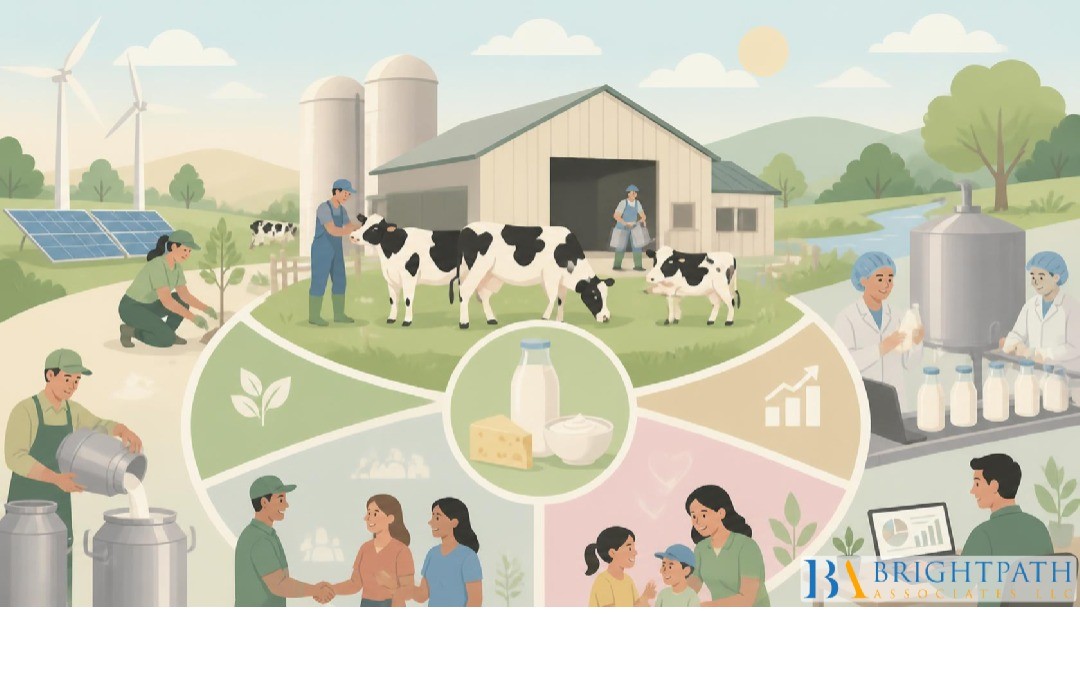
Multi-dimensional sustainability can be understood through three interconnected areas: economic resilience, environmental responsibility, and social capital. Economic sustainability ensures that dairy businesses can remain profitable and invest in future growth. Environmental sustainability focuses on resource efficiency, emissions, water conservation, waste reduction, and responsible land management. Social sustainability considers farmers, workers, communities, consumers, and other stakeholders. These dimensions are deeply interconnected. For example, improving farm productivity can increase profitability while reducing resource consumption. Better employee training can improve productivity while strengthening workforce retention. Stronger relationships between processors and farmers can improve raw-material quality while supporting rural communities. The objective is therefore not to choose between profit and sustainability. Instead, successful dairy organizations should identify opportunities where environmental and social investments contribute to long-term financial performance.
The sustainability journey begins at the farm level. Dairy farming depends heavily on land, water, feed, energy, animal health, and labor. Improving resource efficiency at this stage can influence the environmental and economic performance of the entire dairy value chain. Sustainable dairy farming practices can include efficient water management, responsible manure utilization, improved animal nutrition, renewable energy adoption, soil health management, biodiversity protection, and better herd management. These approaches can help farmers reduce unnecessary costs while improving productivity. Animal welfare is another important component. Healthy animals generally support consistent milk quality and productivity. Consequently, investments in veterinary care, appropriate housing, nutrition, disease prevention, and responsible herd management can support both ethical objectives and economic performance.
The adoption of sustainability practices must also account for the financial realities of farmers. Large dairy companies can support adoption by providing training, technical assistance, #FinancingMechanisms, and access to modern technologies. Technology is changing the way dairy farms approach productivity and sustainability. Modern Milk production technologies can provide farmers with better visibility into animal health, feed efficiency, milk quality, reproduction, and overall herd performance. Sensors and connected devices can collect data from individual animals and farm systems. This information can help identify changes in animal behavior, monitor health conditions, optimize feeding, and improve breeding decisions. Automation can also reduce repetitive manual activities. Dairy automation technologies are increasingly being used for milking, feeding, cleaning, monitoring, and environmental management. Automated systems can improve operational consistency while reducing dependence on labor-intensive processes. However, technology adoption must be economically practical. Dairy businesses should evaluate whether an investment can deliver measurable improvements in productivity, labor efficiency, animal welfare, energy consumption, or product quality. The most valuable technologies are those that solve real operational problems rather than simply adding digital complexity.
Food Technology and Sustainable Product Innovation
Food technology is creating new possibilities for dairy manufacturers seeking to improve both sustainability and consumer value. Advances in processing, packaging, preservation, formulation, and quality control are enabling companies to develop products that respond to changing consumer preferences. Consumers are increasingly interested in products that combine nutrition, convenience, quality, and responsible production. This is encouraging dairy companies to explore functional dairy products, high-protein offerings, reduced-sugar formulations, innovative packaging, and products designed for specific nutritional requirements. Packaging innovation is particularly important because dairy products often require packaging that protects freshness and safety. Companies are evaluating recyclable, lightweight, and resource-efficient packaging solutions while attempting to maintain product quality and shelf life. Sustainable product innovation can therefore become a commercial strategy rather than simply an environmental initiative. Companies that understand consumer expectations and invest in relevant food technology can differentiate themselves in competitive markets.
Dairy supply chain management has become increasingly complex. Fresh milk and many Dairy products have specific temperature, storage, transportation, and shelf-life requirements. Disruptions at any stage can result in product losses and financial costs. Sustainability requires companies to look at the entire supply chain rather than focusing only on production. Efficient transportation, cold-chain optimization, inventory management, local sourcing, demand forecasting, and waste reduction can improve both environmental performance and profitability. Digital systems can provide greater visibility across procurement, production, warehousing, distribution, and retail. Companies can use data to forecast demand and reduce overproduction. Better coordination between farmers, processors, distributors, and retailers can also reduce delays and improve product availability. A resilient supply chain is particularly important as dairy businesses face fluctuations in feed prices, energy costs, transportation expenses, weather conditions, and consumer demand. Companies that invest in flexible and transparent supply networks can respond more effectively to disruption.
Dairy Industry Digital Transformation
Dairy industry #DigitalTransformation is becoming a major driver of operational improvement. Digital technologies are connecting farms, manufacturing facilities, distribution networks, and customers in ways that were previously difficult to achieve. Cloud-based systems, artificial intelligence, Internet of Things devices, predictive analytics, and automated production platforms can help companies make faster and more informed decisions. Digital dashboards can provide managers with real-time information about production efficiency, quality, inventory, energy usage, and equipment performance. Predictive maintenance is another valuable application. Instead of waiting for machinery to fail, dairy manufacturers can use sensor data to identify potential equipment problems. This can reduce downtime, maintenance costs, and production interruptions. Digital transformation can also improve sustainability reporting. Companies can collect information about energy consumption, water usage, waste generation, emissions, and sourcing practices. This creates greater transparency for management and stakeholders.
Consumer purchasing behavior is changing rapidly, creating new opportunities for dairy businesses. Dairy e-commerce can help companies reach customers directly while developing stronger relationships with consumers. Online platforms can provide convenience and enable dairy brands to offer specialized products, subscription models, curated product selections, and direct-to-consumer experiences. Digital channels also generate valuable customer insights that can support product development and marketing decisions. However, selling Dairy products online presents operational challenges. Temperature control, delivery speed, packaging, inventory management, and product freshness must be carefully managed. Companies therefore need strong integration between e-commerce platforms and dairy supply chain management systems. The future of dairy e-commerce will likely depend on the ability to combine digital convenience with reliable cold-chain logistics and consistent product quality.
Profitability cannot be separated from people. Dairy organizations depend on farmers, production workers, engineers, food scientists, logistics professionals, sales teams, digital specialists, and business leaders. Building social capital means developing trust and long-term relationships across this workforce. Companies that invest in employee development, workplace safety, career progression, fair employment practices, and inclusive leadership can strengthen organizational resilience. The dairy industry is also facing changing workforce requirements. Modern farms and processing facilities increasingly need employees who understand automation, data analytics, equipment maintenance, food safety, and digital systems. This makes workforce development an essential part of dairy industry growth strategies. Companies should not view technology as a replacement for people alone. Instead, they should develop employees who can operate, interpret, and improve increasingly sophisticated technologies.
The Strategic Role of Dairy Industry Leadership
Leadership plays a central role in implementing sustainability across a #DairyOrganization. Executives must balance immediate financial pressures with long-term investments in technology, people, infrastructure, and environmental performance. Dairy industry executive search has therefore become increasingly important for organizations seeking leaders who understand both traditional dairy operations and emerging business models. Modern dairy executives may need expertise across manufacturing, agriculture, supply chain management, digital transformation, sustainability, consumer strategy, and innovation. Strong leadership is particularly important when sustainability initiatives require significant organizational change. Executives must establish clear priorities, allocate resources, communicate expectations, and create accountability across departments. #ExecutiveSearchRecruitment can help organizations identify leaders with specialized industry experience when conventional recruitment approaches are insufficient. Finding the right leadership can influence whether sustainability remains a corporate objective or becomes an integrated part of everyday operations.
Dairy industry growth strategies must increasingly integrate sustainability into commercial planning. Expansion based solely on production volume may not create long-term value if it increases resource consumption, operational complexity, or supply chain vulnerability. Companies can instead pursue growth through premium products, value-added dairy categories, technology-enabled efficiency, international markets, direct-to-consumer channels, strategic partnerships, and sustainable sourcing. Operational efficiency can also create growth opportunities. Reducing energy consumption, improving milk yields, minimizing waste, and optimizing transportation can improve margins while reducing environmental impact.
The strongest growth strategies are therefore those that create multiple forms of value simultaneously. A project that improves productivity, reduces waste, supports farmers, and strengthens brand reputation can deliver significantly greater long-term value than a narrowly defined cost-reduction initiative. Traditional financial metrics remain essential, but they do not capture the full value created by sustainable dairy operations. Organizations increasingly need broader performance indicators. Companies can evaluate resource efficiency, farmer participation, employee retention, product waste, energy consumption, water usage, supply chain performance, animal welfare, customer satisfaction, and community impact alongside profitability. These measures can help executives understand whether sustainability initiatives are producing meaningful outcomes. They also provide a basis for transparent communication with investors, customers, employees, farmers, and other stakeholders.Effective measurement should be integrated into business decision-making rather than treated as a separate reporting exercise. When sustainability data becomes part of operational management, organizations can identify opportunities for continuous improvement.
Conclusion: Building the Sustainable Dairy Enterprise of the Future
The future of the dairy industry will depend on its ability to balance profitability with #EnvironmentalResponsibility and social value. Multi-dimensional sustainability offers a framework for achieving this balance by recognizing that financial performance, people, technology, resources, and community relationships are interconnected. Sustainable dairy farming practices can improve resource efficiency at the farm level, while Milk production technologies and Dairy automation technologies can increase productivity and operational consistency. Food technology can support innovative products, while Dairy industry digital transformation can improve decision-making across the value chain. At the same time, stronger Dairy supply chain management, responsible workforce development, and carefully designed Dairy e-commerce strategies can improve resilience and customer value. Effective leadership will remain critical, making Dairy industry executive search and Executive Search Recruitment important components of long-term organizational development. Ultimately, sustainability should not be treated as a cost center or a marketing slogan. It should become a core business principle that guides investment, innovation, talent, production, sourcing, and customer engagement. Dairy companies capable of creating value for shareholders while strengthening their relationships with farmers, employees, communities, consumers, and the environment will be better positioned to achieve resilient and sustainable growth in the years ahead.
Find your next leadership role in Dairy industry today!