
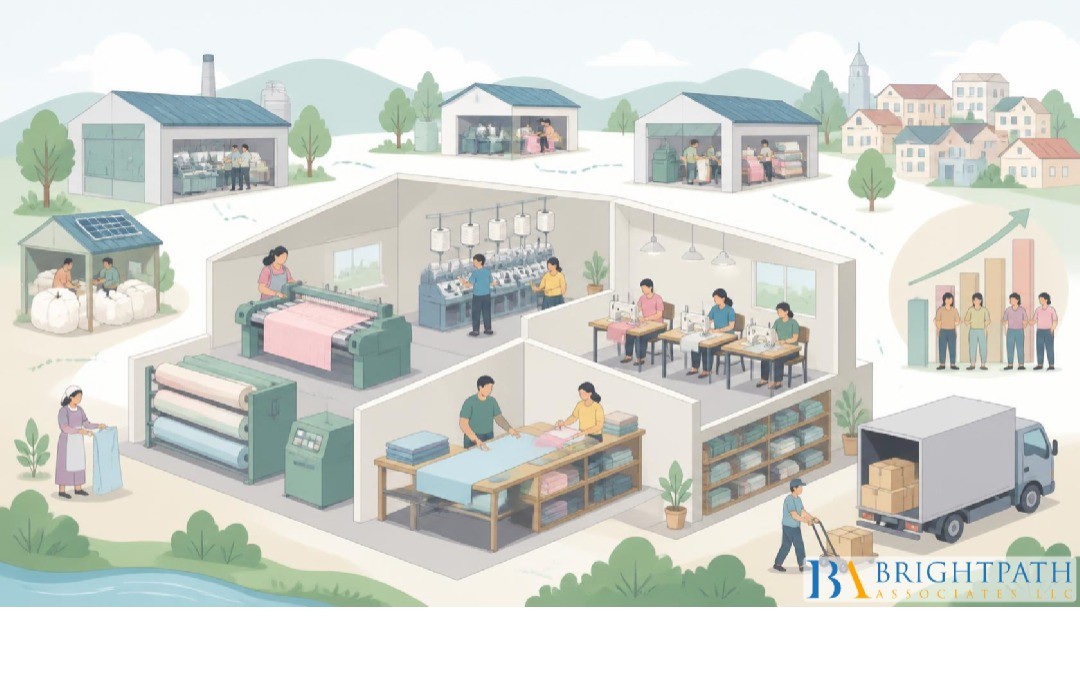
Micro-Factories Offer a More Flexible Manufacturing Model
The global textile sector has traditionally relied on centralized production facilities designed to achieve economies of scale. However, disruptions across international markets have highlighted the risks of depending too heavily on distant suppliers and production locations. Regional micro-factories offer an alternative by bringing selected manufacturing capabilities closer to customers, suppliers and distribution networks.
BrightPath Associates notes that micro-factories can support smaller production runs, customized orders, rapid prototyping, digital printing, specialized textiles and other products requiring greater flexibility. Rather than replacing large factories, these facilities can complement existing production networks and create a hybrid manufacturing structure.
The report states that “Their value lies in flexibility.” This flexibility can become particularly important as customer preferences become more fragmented and demand for product variety, customization and faster delivery continues to influence manufacturing decisions.
For executives, the opportunity is not simply about building smaller factories. It is about determining where regional production can create measurable business value. Textile business strategic planning should consider regional demand, production volumes, labor availability, transportation costs, energy prices, technology requirements and the role of each facility within the wider manufacturing network.
Resilience, Logistics and Sustainability Become Strategic Priorities
The textile sector continues to face Global textile industry geopolitical risks, including tariffs, trade restrictions, transportation disruptions, regional conflicts and changing international policies. Regional micro-factories cannot eliminate these risks because textile businesses may still depend on globally sourced fibers, chemicals, equipment and components. However, distributed production can reduce dependence on one manufacturing location and provide alternative capacity when disruptions occur.
The report also highlights Cognitive automation in textile logistics as a potential advantage. Artificial intelligence and advanced software can help determine where orders should be produced based on available capacity, equipment, materials and delivery requirements. This can create a more responsive logistics network while reducing unnecessary transportation and inventory exposure.
Sustainability provides another strategic opportunity. Regional production may shorten transportation requirements and make returns, repairs, remanufacturing and material recovery easier to manage. Textile industry closed-loop systems can help keep materials in productive use through recycling, fiber recovery, product disassembly and remanufacturing.
These developments are influencing Textile industry investment trends, as manufacturers increasingly evaluate automation, digitalization, nearshoring, sustainability and supply-chain resilience when making capital decisions. Incremental investment in regional facilities may provide companies with greater flexibility than committing all capital to a single large production project.
Executive Leadership Will Determine Long-Term Success
Technology and infrastructure alone will not guarantee successful micro-factory implementation. The report emphasizes the importance of Executive leadership in textiles to determine how regional facilities should fit into broader manufacturing and commercial strategies.
“Effective leadership can transform micro-factories from isolated facilities into strategic assets supporting long-term growth,” the analysis states.
This leadership challenge is creating demand for professionals who understand textile manufacturing while also bringing expertise in automation, supply-chain management, data analytics, digital manufacturing and sustainability. Through executive search recruitment for the Textile Industry, organizations can identify leaders capable of managing increasingly connected and geographically distributed manufacturing operations.
The analysis concludes that the future of textile manufacturing is unlikely to be based entirely on centralized factories or entirely on regional micro-factories. Instead, hybrid networks may become increasingly important, with large facilities producing high-volume standardized goods while micro-factories manage customized products, regional demand, rapid-response manufacturing, prototyping and circular-economy activities.
For textile executives, the strategic question is therefore not whether micro-factories will replace traditional manufacturing. It is how regional production can complement existing capacity to create a faster, more resilient, data-driven and sustainable business.
About BrightPath Associates
BrightPath Associates is an executive search recruitment firm helping organizations identify experienced leaders and specialized professionals across the Textile Industry and other sectors. The company supports businesses with talent acquisition, workforce planning, leadership development and strategic recruitment solutions. Its mission is to connect organizations with the right people to build stronger teams, improve business performance and support sustainable long-term growth.
Media Contact:
Name: Corporate Communications Team
Company: BrightPath Associates
Email: media@brightpathassociates.com
Website: https://brightpathassociates.com