
Introduction
The #TextileIndustry is entering a period in which flexibility, speed, regional resilience, and technology are becoming just as important as production scale. For decades, textile manufacturing has often depended on large centralized facilities capable of producing substantial volumes at competitive costs. While this model continues to play an important role, changing consumer expectations, supply-chain disruptions, geopolitical uncertainty, labor challenges, and demand for shorter production cycles are encouraging manufacturers to explore alternative operating structures.
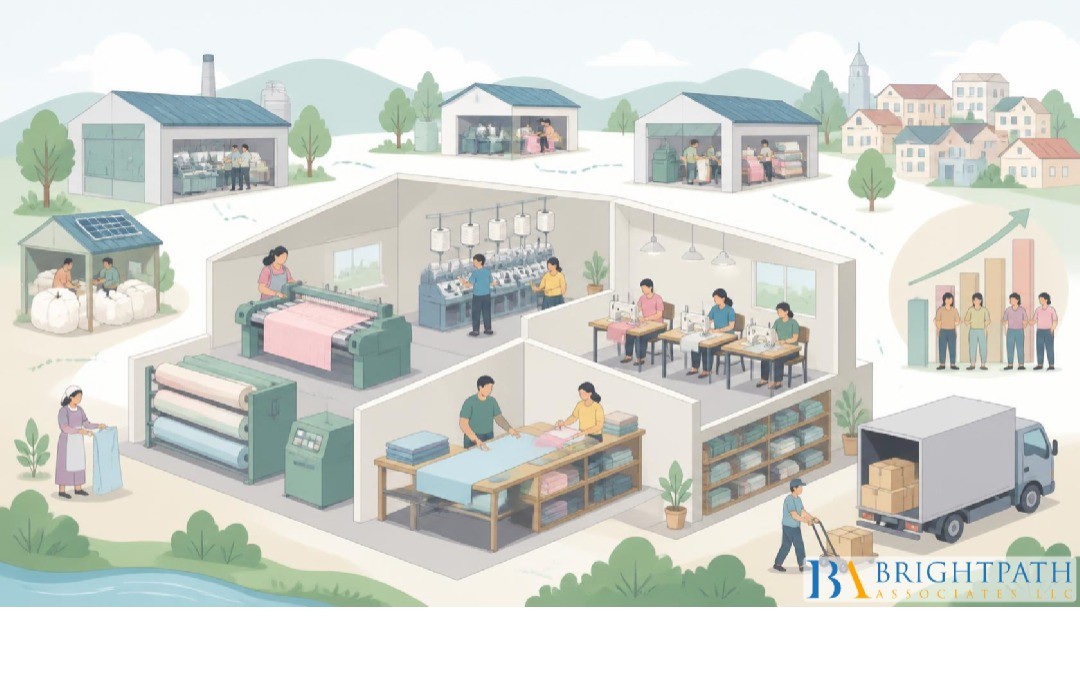
Micro-factories represent one such model. These smaller, highly specialized production facilities can bring manufacturing capabilities closer to regional markets, customers, raw-material suppliers, and distribution networks. Instead of relying entirely on a centralized factory serving distant markets, textile companies can establish smaller production units designed around specific products, technologies, or customer requirements.
The growing relevance of #MicroFactories is closely connected to the evolution of the Textile supply chain. Regional production can potentially shorten transportation distances, improve responsiveness, reduce inventory exposure, and create opportunities for more localized manufacturing.
Understanding the Micro-Factory Model
A micro-factory is a relatively small manufacturing facility designed to produce specific products or perform selected production processes with a high degree of flexibility. In textiles, this could include fabric production, digital printing, garment manufacturing, finishing, technical textile production, or specialized product assembly.
The model does not necessarily mean replacing large factories. Instead, micro-factories can complement existing manufacturing networks by handling smaller production runs, customized orders, rapid prototyping, or regional demand.
Their value lies in flexibility. A traditional large-scale facility may be optimized for high-volume production, while a micro-factory can be designed to respond quickly to changing customer requirements.
This distinction makes #FlexibleManufacturing increasingly important for textile companies competing in rapidly changing markets.
The modern Textile supply chain can stretch across multiple countries, with raw materials, yarns, fabrics, components, garments, and finished products moving between geographically distant suppliers and customers.
While global sourcing can provide cost advantages, it can also create exposure to transportation delays, trade restrictions, geopolitical instability, currency fluctuations, and unexpected disruptions.
Regional micro-factories can reduce dependence on long supply chains for selected product categories. By producing closer to customers, companies can potentially shorten lead times and respond more quickly to regional demand.
This creates a more diversified #SupplyChainStrategy, in which centralized production remains important while regional facilities provide additional flexibility.
Advanced Textile Manufacturing Technologies
Micro-factories become particularly powerful when combined with Advanced textile manufacturing technologies. Digital textile printing, automated cutting, robotics, computer-controlled knitting, advanced sewing systems, automated inspection, and connected production platforms can enable smaller facilities to achieve high levels of productivity.
Automation can reduce the dependence on large production teams while improving consistency and repeatability. Digital manufacturing can also support smaller batch sizes, making it easier to produce customized or limited-edition products.
The result is a production model that emphasizes technological capability rather than physical scale.
For textile manufacturers, #AdvancedManufacturing can therefore become a pathway to regional competitiveness.
Consumer preferences are becoming increasingly fragmented. Customers want more product variety, faster delivery, customization, and frequent product updates.
Large factories optimized for long production runs may struggle to respond efficiently to highly variable demand. Micro-factories can address this challenge by focusing on smaller batches and localized production.
Digital systems allow production instructions to be changed quickly, while automated machinery can reduce the time required for product changeovers.
This creates opportunities for #MassCustomization, where textile companies can offer more product variety without relying exclusively on large inventory volumes.
Textile Business Strategic Planning
Successful micro-factory deployment requires careful Textile business strategic planning. Establishing smaller production facilities without a clear commercial purpose can create unnecessary complexity.
Companies must determine which products are appropriate for regional manufacturing, which markets justify local capacity, and how micro-factories should interact with existing facilities.
Strategic planning should consider production volumes, customer density, labor availability, logistics costs, technology requirements, energy prices, and regional market characteristics.
The objective is not simply to build more factories. It is to create a manufacturing network in which each facility has a clearly defined strategic role.
Changing Textile industry investment trends are increasingly influenced by automation, digitalization, sustainability, nearshoring, and supply-chain resilience.
Investors and manufacturers are examining whether capital expenditures can create more flexible production systems while reducing exposure to global disruptions.
Micro-factories may appeal to businesses because they can allow investments to be deployed incrementally. Rather than constructing one extremely large facility, companies can develop regional capacity in stages based on market demand.
This can create a more flexible #InvestmentStrategy, particularly for textile businesses operating in uncertain markets.
Textile Industry Data Analytics
The effectiveness of a regional manufacturing network depends heavily on information. Textile industry data analytics can help companies understand customer demand, production performance, inventory levels, transportation costs, machine utilization, and regional market trends.
Data can determine where a micro-factory should be located and what products it should manufacture.
For example, a region with strong demand for customized technical textiles may justify a specialized production facility, while another market may be better served through centralized manufacturing.
Analytics therefore helps transform micro-factories from an experimental concept into a data-driven strategic decision.
Once a company operates multiple micro-factories, maintaining visibility becomes essential. Production schedules, inventory, quality information, supplier data, and customer orders must be coordinated across facilities.
Cloud-based manufacturing platforms and connected enterprise systems can provide centralized visibility while allowing each micro-factory to maintain operational flexibility.
Managers can compare production performance between facilities and identify bottlenecks or capacity constraints.
This supports #DigitalTextiles by creating an integrated manufacturing network rather than a collection of disconnected facilities.
Textile Industry Blockchain Applications
Textile industry blockchain applications may provide additional opportunities for improving supply-chain transparency. Blockchain-based systems can potentially support the recording and verification of information related to materials, suppliers, production stages, certifications, and product movement.
For regional micro-factories, traceability can become a competitive advantage, particularly when customers want greater visibility into where and how products are manufactured.
The technology should not be adopted simply because it is innovative. Its value depends on whether it solves a specific traceability, compliance, or information-sharing problem.
When appropriately implemented, #BlockchainTextiles can contribute to stronger supply-chain accountability.
The textile industry remains exposed to Global textile industry geopolitical risks. Trade restrictions, tariffs, regional conflicts, transportation disruptions, sanctions, and changing international policies can affect raw-material availability and production economics.
Regional micro-factories cannot eliminate these risks because textiles may still depend on globally sourced fibers, chemicals, machinery, and components.
However, a distributed manufacturing model can reduce dependence on a single production location. If one region experiences disruption, other facilities may provide alternative production capacity.
This creates a more resilient #GeopoliticalRiskStrategy.
Cognitive Automation in Textile Logistics
Micro-factories can also benefit from Cognitive automation in textile logistics. Artificial intelligence and advanced software can help manage inventory allocation, production scheduling, order prioritization, transportation planning, and warehouse operations.
Cognitive systems can analyze large quantities of data and recommend how production should be distributed across facilities.
For example, an order could potentially be assigned to the micro-factory with the shortest delivery distance, available capacity, appropriate equipment, and required materials.
This creates opportunities for #IntelligentLogistics, where logistics decisions become more responsive to real-time business conditions.
Sustainability is another area where micro-factories may create strategic opportunities. Shorter supply chains can potentially reduce transportation requirements, while localized production can make it easier to manage returns, repairs, remanufacturing, and material recovery.
The concept of Textile industry closed-loop systems focuses on keeping materials in productive use for longer periods. This can include recycling textile waste, recovering fibers, designing products for disassembly, and integrating returned products into manufacturing processes.
Regional production facilities may be particularly useful for these systems because collection, processing, and remanufacturing can occur closer to customers.
This supports a more circular #TextileEconomy.
Micro-Factories and Workforce Development
Technology does not eliminate the importance of skilled employees. Instead, it changes the types of capabilities textile manufacturers require.
Modern micro-factories may need automation engineers, production technologists, data analysts, digital manufacturing specialists, maintenance professionals, supply-chain managers, and sustainability experts.
Smaller facilities may also provide opportunities to create highly specialized teams rather than large labor-intensive production workforces.
This shift makes workforce planning an important part of regional manufacturing strategy.
The success of micro-factories ultimately depends on Executive leadership in textiles. Senior leaders must determine how regional facilities fit within the company’s broader manufacturing strategy.
Executives need to balance investment, technology, workforce requirements, supply-chain resilience, sustainability, and customer expectations.
They must also decide when a micro-factory should operate independently and when it should be integrated into a larger centralized production network.
Effective leadership can transform micro-factories from isolated facilities into strategic assets supporting long-term growth.
The Role of Executive Search Recruitment
Finding leaders with the right combination of textile knowledge, technology expertise, operational experience, and strategic thinking can be challenging.
#ExecutiveSearchRecruitment can help textile companies identify senior professionals capable of managing technologically advanced and geographically distributed manufacturing networks.
The ideal leaders may come from traditional textile manufacturing, industrial automation, supply-chain management, digital manufacturing, or related sectors. What matters is their ability to connect operational decisions with commercial objectives.
As micro-factories become more sophisticated, leadership quality will become increasingly important to their success.
The Future of Regional Textile Manufacturing
The future textile manufacturing landscape is unlikely to consist entirely of large centralized factories or entirely of small regional facilities. Instead, hybrid networks may become more common.
Large facilities can continue producing high-volume standardized products, while micro-factories handle customized orders, regional demand, rapid-response manufacturing, prototyping, specialized textiles, and circular-economy activities.
Digital connectivity can allow these facilities to operate as part of a single manufacturing ecosystem.
This hybrid approach creates #ManufacturingResilience while maintaining the economic advantages of scale where they remain appropriate.
Conclusion
Micro-factories are emerging as a strategic response to some of the textile industry’s most important challenges, including supply-chain disruption, demand volatility, customization requirements, geopolitical uncertainty, sustainability pressures, and technological transformation.
Their greatest value is not simply their smaller physical footprint. It is their ability to bring production closer to customers while enabling greater flexibility and responsiveness.
When supported by Advanced textile manufacturing technologies, Textile industry data analytics, intelligent logistics, and Textile industry closed-loop systems, micro-factories can become important components of regional manufacturing strategies.
However, technology and infrastructure alone will not determine success. Companies also need effective Executive leadership in textiles, disciplined Textile business strategic planning, and access to professionals capable of managing increasingly complex production environments.
Through strategic Executive Search Recruitment, textile organizations can build the leadership capabilities needed to connect regional manufacturing with broader business objectives.
The central question for textile executives is therefore not whether micro-factories will replace traditional manufacturing. It is how regional production can complement existing capacity to create a faster, more resilient, data-driven, and sustainable textile business.
Find your next leadership role in Textile Industry today!