
Introduction
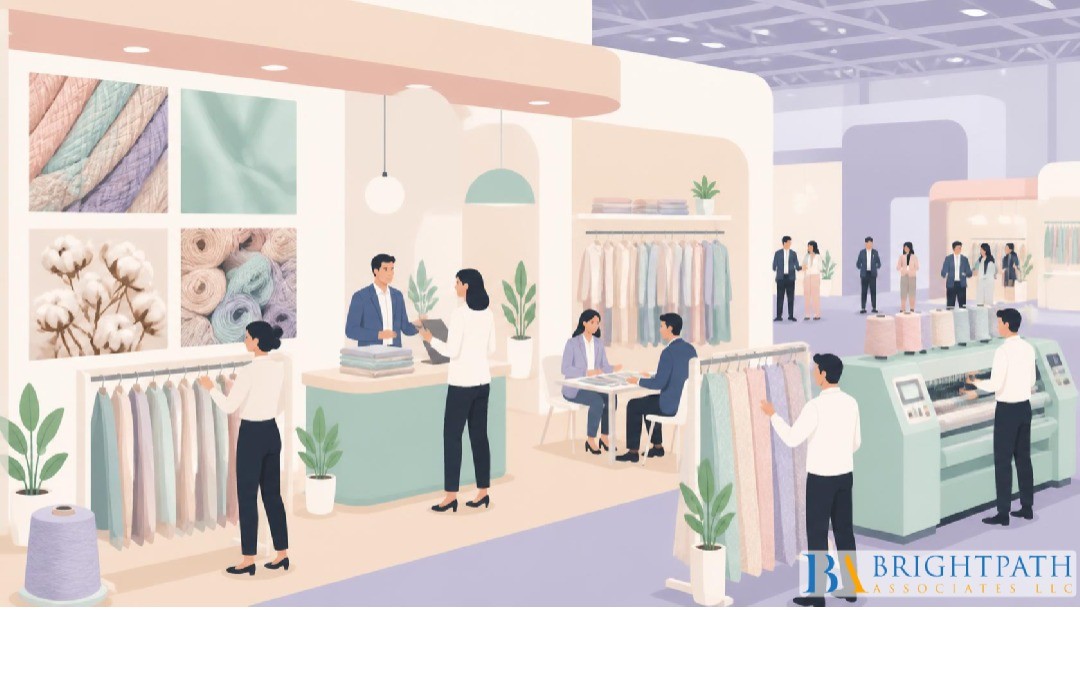
#TextileIndustry trade events have evolved far beyond traditional exhibitions where manufacturers display fabrics, machinery, and finished products. Today, these events have become strategic platforms where textile manufacturers, technology providers, investors, suppliers, logistics companies, designers, and executive leaders exchange ideas and identify opportunities across a rapidly changing global market. For companies operating within an increasingly competitive environment, simply attending a trade event is no longer enough. Organizations need a clear strategy for turning conversations, demonstrations, market intelligence, and industry relationships into measurable business outcomes.
The modern textile sector is experiencing significant transformation driven by automation, sustainability requirements, supply chain restructuring, changing consumer expectations, and geopolitical uncertainty. Trade events provide executives with a concentrated environment for understanding these changes. Companies that approach exhibitions with defined objectives can use them to strengthen their Textile supply chain, evaluate Advanced textile manufacturing technologies, identify partners, and refine long-term growth strategies.
Understanding the Strategic Value of Textile Trade Events
A major textile trade event can provide access to hundreds or even thousands of industry professionals within a short period. This creates an opportunity that would otherwise require months of individual meetings and market research. Manufacturers can observe emerging production technologies, compare suppliers, assess competitors, and understand where the industry is heading.
The greatest value, however, often comes from conversations rather than exhibition displays. Discussions with equipment manufacturers, raw material suppliers, technology companies, logistics providers, and other textile executives can reveal operational challenges and market developments that may not yet appear in formal industry reports.
Companies should therefore view trade events as strategic intelligence platforms. The objective should not simply be to collect brochures or product information, but to identify developments that could influence production, sourcing, investment, workforce planning, and competitive positioning.
Global textile operations depend on highly interconnected supply networks. Raw materials may originate in one country, be processed in another, manufactured elsewhere, and ultimately sold across multiple international markets. This complexity makes the Textile supply chain vulnerable to transportation disruptions, material shortages, regulatory changes, labor challenges, and geopolitical events.
Trade events offer manufacturers an opportunity to diversify these networks. Meeting alternative suppliers and logistics partners can reduce dependency on individual sources and provide greater flexibility during disruptions.
Executives can also use trade events to investigate new approaches to sourcing, inventory management, production scheduling, and distribution. Building relationships before a disruption occurs can give organizations greater resilience when market conditions change unexpectedly.
Exploring Advanced Textile Manufacturing Technologies
Technology is reshaping textile production at an accelerating pace. Automation, robotics, intelligent machinery, digital production monitoring, artificial intelligence, and connected equipment are becoming increasingly important components of modern manufacturing.
Trade exhibitions provide a practical environment for evaluating advanced #TextileManufacturingTechnologies. Instead of relying solely on marketing materials, executives can observe equipment demonstrations, discuss implementation challenges, and assess how new technologies may fit into existing production environments.
The evaluation process should consider more than machine speed or automation capability. Companies need to examine integration requirements, workforce implications, maintenance needs, scalability, energy consumption, data compatibility, and expected return on investment.
A technology that performs well in a demonstration may still require significant organizational preparation before it can deliver value within a real manufacturing environment.
Executive Leadership in Textiles and Strategic Networking
Strong participation at trade events requires executive involvement. Executive leadership in textiles plays an important role in determining whether industry relationships become meaningful strategic opportunities.
Senior leaders bring a broader perspective to conversations about technology, investment, supply chains, sustainability, and market expansion. Their participation also signals that an organization is serious about building long-term relationships rather than simply pursuing transactional purchases.
Executives should use trade events to engage with other decision-makers and explore shared industry challenges. Discussions between leaders can create partnerships involving technology adoption, manufacturing expansion, sourcing diversification, joint ventures, or market development.
These relationships can become particularly valuable when the industry experiences sudden changes that require rapid strategic responses.
Information gathered at trade events becomes valuable only when it influences business decisions. Companies should therefore connect event participation with Textile business strategic planning.
Executives can assess whether emerging technologies align with current production objectives, whether new suppliers could strengthen supply chain resilience, and whether changing consumer preferences require adjustments to product development.
Trade event insights can also influence workforce planning. If manufacturers observe rapid adoption of automation, for example, leadership teams may need to reconsider their requirements for engineers, maintenance professionals, production managers, data specialists, and technology leaders.
This creates a direct connection between market intelligence and organizational strategy. Trade events should become part of an ongoing strategic planning process rather than isolated annual activities.
Understanding Textile Industry Investment Trends
Investment patterns often provide valuable insight into the future direction of an industry. Textile industry investment trends can reveal which technologies, production capabilities, geographic markets, and sustainability initiatives are attracting capital.
Executives attending trade events can use conversations with investors, equipment manufacturers, technology providers, and industry consultants to understand where investment activity is accelerating.
For example, increasing investment in automation may indicate that manufacturers are prioritizing labor productivity and operational consistency. Growing interest in #RecyclingTechnologies may signal stronger demand for circular production systems.
Understanding these patterns helps companies make more informed capital allocation decisions. Instead of investing based solely on current operational needs, organizations can evaluate how an investment positions them for future market conditions.
Textile Industry Data Analytics and Smarter Decision-Making
Data is becoming one of the most valuable resources in modern textile manufacturing. Production systems can generate information related to machine performance, energy consumption, material usage, defect rates, production speed, and quality.
Textile industry data analytics enables manufacturers to transform this information into operational insights. Trade events provide an opportunity to explore emerging analytics platforms and understand how other companies are using data to improve manufacturing performance.
Executives should focus on practical applications rather than technology terminology alone. The key question is whether analytics can help the organization reduce waste, improve quality, optimize production schedules, predict equipment failures, or improve customer responsiveness.
Data-driven decision-making can become particularly powerful when combined with experienced operational judgment.
Blockchain technology has attracted attention within the textile industry because of its potential applications in traceability and supply chain transparency. Textile industry blockchain applications can support efforts to track materials through different stages of sourcing, processing, manufacturing, and distribution.
Trade events can provide opportunities to examine how companies are experimenting with blockchain-based traceability systems. For textile organizations facing growing expectations around sustainability and responsible sourcing, greater visibility into material origins can become an important competitive advantage.
However, blockchain should not be adopted simply because it is technologically fashionable. Organizations need to evaluate whether the underlying business problem requires blockchain and whether suppliers, manufacturers, and customers are prepared to participate in the system.
Global Textile Industry Geopolitical Risks
The textile sector operates within a complex geopolitical environment. Trade restrictions, tariffs, regional conflicts, transportation disruptions, sanctions, and changing international relationships can influence raw material costs and manufacturing strategies.
Understanding Global textile industry geopolitical risks should therefore be an important component of trade event participation. Industry discussions can reveal how manufacturers are responding to sourcing uncertainty, changing trade relationships, and regional manufacturing shifts.
Executives can use this intelligence to evaluate geographic diversification, supplier dependency, inventory strategies, and production footprints.
A company that understands geopolitical risk before it becomes an operational crisis is better positioned to respond quickly.
Cognitive Automation in Textile Logistics
Logistics is another area where technological transformation is creating opportunities. #CognitiveAutomation in textile logistics combines automation with data-driven decision-making to improve transportation planning, inventory coordination, warehouse management, and order fulfillment.
Trade events allow textile companies to explore how intelligent logistics platforms can integrate with existing enterprise and manufacturing systems. Cognitive technologies can potentially identify patterns in demand, optimize shipment schedules, predict delays, and improve warehouse utilization.
For textile manufacturers operating across multiple markets, these capabilities can contribute to greater supply chain visibility and responsiveness.
The most successful implementations will connect logistics automation with broader business objectives rather than treating logistics as an isolated technology function.
Textile Industry Closed-Loop Systems and Circular Manufacturing
Sustainability has become a major strategic priority for textile companies. Textile industry closed-loop systems represent one approach to reducing waste by keeping materials within productive use for longer periods.
Trade events are increasingly important venues for discovering technologies and business models supporting textile recycling, material recovery, waste reduction, and circular production. Manufacturers can evaluate equipment and partnerships that enable production waste or post-consumer textiles to re-enter the manufacturing cycle.
Closed-loop approaches can provide both environmental and commercial opportunities. Organizations that develop effective circular systems may reduce material costs, strengthen sustainability credentials, and respond to changing customer expectations.
The strongest benefits from trade events often emerge after the event itself. A promising conversation has little strategic value if there is no follow-up.
Companies should establish internal processes for evaluating potential partnerships, technology opportunities, supplier relationships, and market intelligence gathered during the event. The objective is to convert informal conversations into structured business opportunities.
Follow-up discussions can include technical evaluations, supplier assessments, pilot projects, investment analysis, or strategic partnership discussions. This creates continuity between the event and the organization’s broader growth strategy.
The Talent Factor Behind Textile Transformation
Technology, investment, and supply chain strategy all depend on people capable of executing them. Textile manufacturers increasingly require executives and senior professionals who understand manufacturing operations while also navigating digital transformation, sustainability, international markets, and technological change.
This makes talent strategy an essential component of trade event participation. Conversations about new technologies should naturally lead to questions about the skills required to implement and manage them.
Organizations pursuing advanced manufacturing strategies may need leaders with expertise in automation, supply chain management, data analytics, sustainability, engineering, and international operations.
As textile manufacturing becomes more technology-driven, identifying the right leadership talent becomes increasingly important. #ExecutiveSearchRecruitment can support organizations seeking executives capable of translating industry trends into measurable operational and commercial results.
Modern textile leaders must understand not only production and sourcing but also digital technologies, geopolitical risks, sustainability, analytics, investment priorities, and workforce transformation.
The right executive can turn insights gathered at industry events into strategic action. They can evaluate emerging technologies, develop resilient supply chains, identify investment opportunities, and build teams capable of executing long-term transformation.
Conclusion: Turning Trade Events Into Strategic Advantage
Textile industry trade events provide an exceptional opportunity to understand market developments, evaluate technologies, strengthen relationships, and identify strategic opportunities. However, their value depends on how deliberately organizations participate.
Companies that connect trade event intelligence with Textile business strategic planning, supply chain development, technology evaluation, investment decisions, and talent strategy can gain considerably more value than organizations that simply attend exhibitions.
The future textile industry will be shaped by interconnected forces including technology, data, sustainability, geopolitical change, automation, and leadership. By approaching trade events as strategic business platforms rather than conventional exhibitions, textile companies can identify these forces earlier and respond more effectively.
Ultimately, maximizing presence at textile industry trade events is not about being visible for a few days. It is about creating relationships, gathering intelligence, challenging assumptions, identifying opportunities, and converting industry insights into long-term competitive advantage.
Find your next leadership role in Textile Industry today!