
Introduction
The F&B industry operates within a highly #InterconnectedEnvironment where production, quality assurance, procurement, maintenance, logistics, compliance, and management must work together without interruption. Every stage of the operation depends on accurate and accessible documentation, from ingredient specifications and production procedures to equipment records, safety protocols, quality reports, and regulatory documentation. Yet many F&B organizations continue to manage critical information through disconnected systems, spreadsheets, paper files, emails, and department-specific databases.
These fragmented approaches create operational silos. When information remains trapped within individual departments, employees may work from outdated procedures, maintenance teams may lack access to equipment histories, and quality teams may struggle to obtain production records quickly. Document management therefore has become more than an administrative requirement. It is increasingly an operational capability that can influence productivity, compliance, traceability, and decision-making.
As F&B manufacturers adopt Industrial automation, connected production environments, and increasingly sophisticated digital infrastructure, document management must evolve alongside manufacturing technology. Organizations that connect operational documentation with production systems can establish a more transparent and responsive manufacturing environment.
Understanding Operational Silos in Food and Beverage Manufacturing
Operational silos develop when departments manage information independently without sufficient integration. In an F&B facility, procurement may maintain supplier documentation separately from quality assurance, while maintenance teams maintain equipment records in another system. Production personnel may rely on printed standard operating procedures, while management receives performance reports through separate digital platforms.
This creates information gaps. Employees may spend considerable time searching for documents, confirming the latest version of a procedure, or requesting information from another department. These delays can become especially costly in highly regulated environments where documentation must be accurate, current, and readily available.
The problem becomes more complex as manufacturers expand their operations. Multiple production lines, facilities, suppliers, products, and regulatory requirements can generate thousands of documents. Without centralized management, organizations face growing risks related to duplication, inconsistent information, limited visibility, and poor document control.
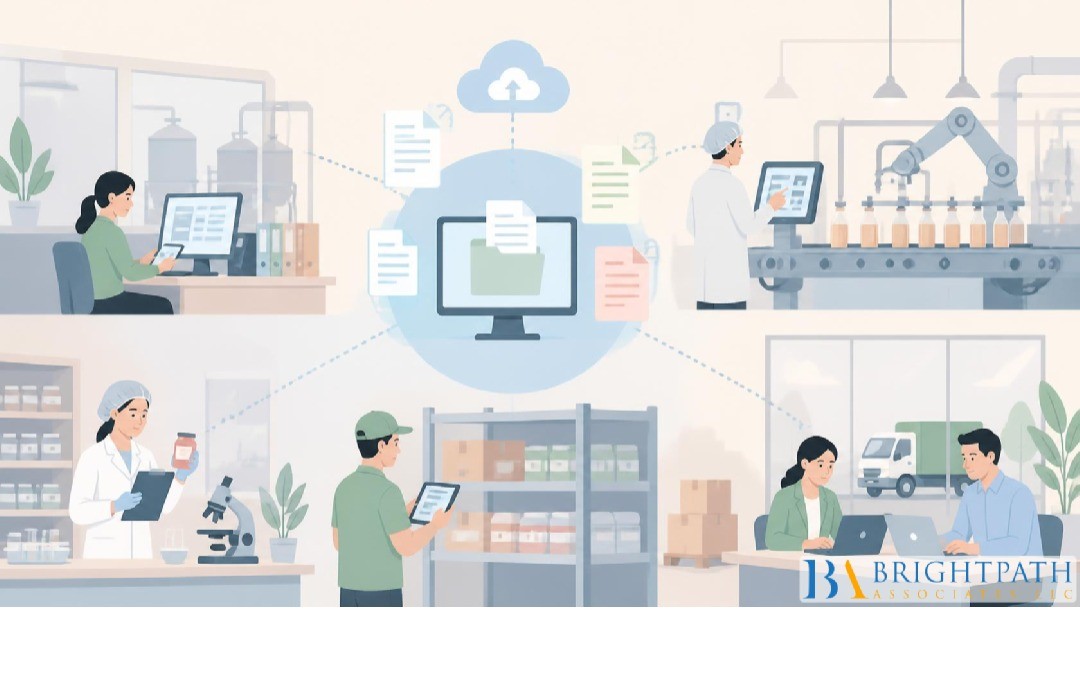
Modern document management should be viewed as an infrastructure layer connecting people, processes, and technology. A centralized system can organize production procedures, quality records, equipment manuals, inspection documents, maintenance histories, training records, and compliance information within a controlled environment.
For F&B organizations, this creates a single source of operational truth. Employees can access approved documentation while management can establish controls around revisions, permissions, approvals, and retention. This reduces the risk of employees relying on obsolete information.
The value becomes even greater when document management is connected to manufacturing systems. Production information generated through SCADA systems, control platforms, sensors, and automated equipment can be associated with relevant operating procedures and maintenance documentation. This connection creates greater visibility between what is happening on the production floor and the information required to manage it.
Connecting Automation with Documentation
The rise of #ManufacturingAutomation has changed the nature of information generated inside F&B facilities. Automated production lines can continuously collect operational data relating to equipment performance, production rates, temperatures, pressure, downtime, and quality parameters.
However, data alone does not create operational intelligence. Organizations also need structured documentation explaining how equipment should operate, how deviations should be handled, and how maintenance activities should be performed.
This is where Automation solutions manufacturing capabilities and document management can complement one another. When technical documentation is connected to automated systems, maintenance personnel can more quickly identify relevant manuals, procedures, and troubleshooting information. Production teams can access approved operating instructions without relying on individual employees to provide them.
The integration of documentation and automation can therefore reduce the gap between digital information and physical operations.
PLC Programming and Production Documentation
Programmable logic controllers are fundamental to automated manufacturing environments. A PLC programming service can support the development, modification, and optimization of automated equipment and production processes. However, PLC programs are only one component of a larger operational ecosystem.
Manufacturers also need accurate documentation covering program versions, control logic changes, system configurations, troubleshooting procedures, and equipment dependencies. Without proper documentation, organizations can become dependent on a small number of employees who understand the system’s architecture.
This creates operational risk. If an experienced automation engineer leaves the organization, undocumented knowledge can disappear with them. A structured document management strategy preserves institutional knowledge and allows authorized personnel to understand system configurations and historical changes.
Robotics is becoming increasingly important in food and beverage manufacturing, particularly for packaging, palletizing, material handling, inspection, and repetitive production activities. Robotics integration introduces another layer of technical complexity into manufacturing environments.
Robotic systems require documentation covering programming, safety procedures, maintenance schedules, equipment specifications, integration configurations, and operating instructions. When these documents are scattered across departments or stored locally on individual computers, troubleshooting can become unnecessarily difficult.
Centralized documentation enables maintenance teams, engineers, and production managers to access the information they need while maintaining appropriate version controls. This supports faster response times and helps organizations preserve technical knowledge as automation systems evolve.
SCADA Systems and Real-Time Operational Visibility
#SCADASystems provide manufacturers with real-time visibility into industrial processes. They can monitor equipment conditions, production parameters, alarms, and operational performance across manufacturing environments.
When SCADA information exists separately from document management, operators may identify an issue without having immediate access to the relevant response procedure. Integrating operational information with controlled documentation can improve this situation.
For example, when a production system generates an equipment alarm, authorized personnel could access the appropriate troubleshooting documentation, operating procedure, or maintenance instruction. This creates a more connected environment in which information supports action rather than simply being stored for reference.
Industrial Machine Vision and Quality Documentation
Quality control is another area where documentation silos can create significant challenges. Industrial machine vision systems can inspect products at high speed and identify defects that may be difficult to detect manually. These systems generate valuable information related to inspection criteria, equipment settings, quality thresholds, and production performance.
Quality teams need documentation that explains inspection standards, approved configurations, defect classifications, and corrective procedures. When machine vision technology is integrated with a controlled documentation environment, quality personnel can maintain better consistency across production operations.
This integration can also support traceability. When quality events occur, organizations can connect production records with inspection procedures, equipment configurations, and corrective-action documentation.
Modern Control systems connect machines, sensors, production equipment, and operational processes. Their increasing sophistication means that manufacturing organizations require stronger collaboration between automation engineers, maintenance professionals, production managers, quality teams, and IT departments.
Document management can provide the common information layer needed for this collaboration. Engineering teams can maintain technical specifications, maintenance teams can access equipment records, quality teams can review process documentation, and management can access controlled reports.
Instead of each department maintaining its own version of operational reality, a centralized system can create greater alignment. This does not eliminate departmental responsibilities. Rather, it ensures that departments work from consistent information.
Compliance, Traceability, and Risk Reduction
F&B manufacturers operate under extensive food safety, quality, environmental, and #WorkplaceRequirements. Documentation plays an essential role in demonstrating that processes are controlled and consistently followed.
A modern document management system can support compliance by controlling document versions, recording approvals, maintaining audit trails, and establishing appropriate access permissions. These capabilities can make it easier for organizations to demonstrate how procedures are developed, approved, implemented, and updated.
Traceability is particularly important when dealing with product quality incidents or recalls. Organizations need to identify relevant production records, supplier information, equipment histories, inspection results, and corrective actions. Fragmented documentation can make this process slower and more difficult.
Centralized document management can help reduce these risks by improving information accessibility and consistency.
Breaking the Knowledge Silo
Technology cannot completely eliminate operational silos unless organizations also address knowledge management. Experienced technicians, engineers, operators, and managers often hold critical knowledge that exists primarily in their experience rather than formal documentation.
This knowledge can include troubleshooting techniques, equipment behaviors, historical failures, process adjustments, and supplier-specific information. Organizations should create mechanisms for capturing this knowledge and converting it into accessible operational documentation.
This becomes especially important as experienced industrial workers retire or move to other organizations. Document management can help preserve institutional knowledge and reduce dependence on individual employees.
Successful document management requires people who understand both technology and industrial operations. As manufacturing becomes increasingly automated, demand is growing for professionals who can work across automation, engineering, data, maintenance, and production functions.
The market for #AutomationJobs reflects this transformation. Organizations require PLC specialists, robotics engineers, controls engineers, SCADA professionals, machine vision specialists, automation managers, and digital manufacturing leaders.
However, technical skills alone may not be sufficient for leadership positions. Executives need professionals who can connect technological investments with operational objectives, workforce capabilities, compliance requirements, and business strategy.
Executive Leadership and Industrial Transformation
The success of digital document management ultimately depends on leadership. Executives must recognize that fragmented information is not merely an administrative inconvenience but a potential operational risk.
Leadership teams need to establish clear ownership of documentation, define governance standards, invest in appropriate digital infrastructure, and encourage collaboration between technical and operational departments.
This is where Executive search industrial automation expertise can become valuable. Organizations undergoing automation transformation need leaders who understand complex manufacturing environments and can manage technology adoption while maintaining operational continuity.
Strong leadership can ensure that document management becomes part of a broader digital transformation strategy rather than another isolated software implementation.
The Role of Executive Search Recruitment in Digital Manufacturing
The transition toward connected manufacturing requires a workforce capable of operating sophisticated technology while maintaining disciplined processes. #ExecutiveSearchRecruitment can help organizations identify senior professionals with the combination of technical expertise, industrial experience, strategic thinking, and leadership capability required for these environments.
As manufacturing organizations integrate robotics, PLCs, SCADA, machine vision, and advanced control systems, leadership positions increasingly require cross-functional expertise. Executives must understand how technology influences productivity, quality, workforce development, cybersecurity, and long-term competitiveness.
The right leadership can help organizations turn fragmented information into a strategic advantage.
Conclusion: From Information Silos to Connected Operations
Document management is becoming an increasingly important component of modern F&B manufacturing. As organizations adopt Industrial automation, robotics, PLC-based controls, SCADA systems, machine vision, and other digital technologies, the amount and complexity of operational information will continue to grow.
Without effective document management, this information can remain fragmented across departments, systems, and individuals. With the right strategy, however, documentation can become a shared operational resource that improves collaboration, traceability, compliance, maintenance, and decision-making.
The future of F&B manufacturing will not depend solely on faster machines or more advanced automation. Competitive advantage will increasingly come from how effectively organizations connect technology, information, and people. By eliminating operational silos and creating a reliable information environment, manufacturers can build more resilient operations while preparing their workforce and leadership teams for the next generation of industrial transformation.
Find your next leadership role in Industrial Automation Industry today!
Stay informed with the latest insights on Industrial Automation Industry!