
Introduction
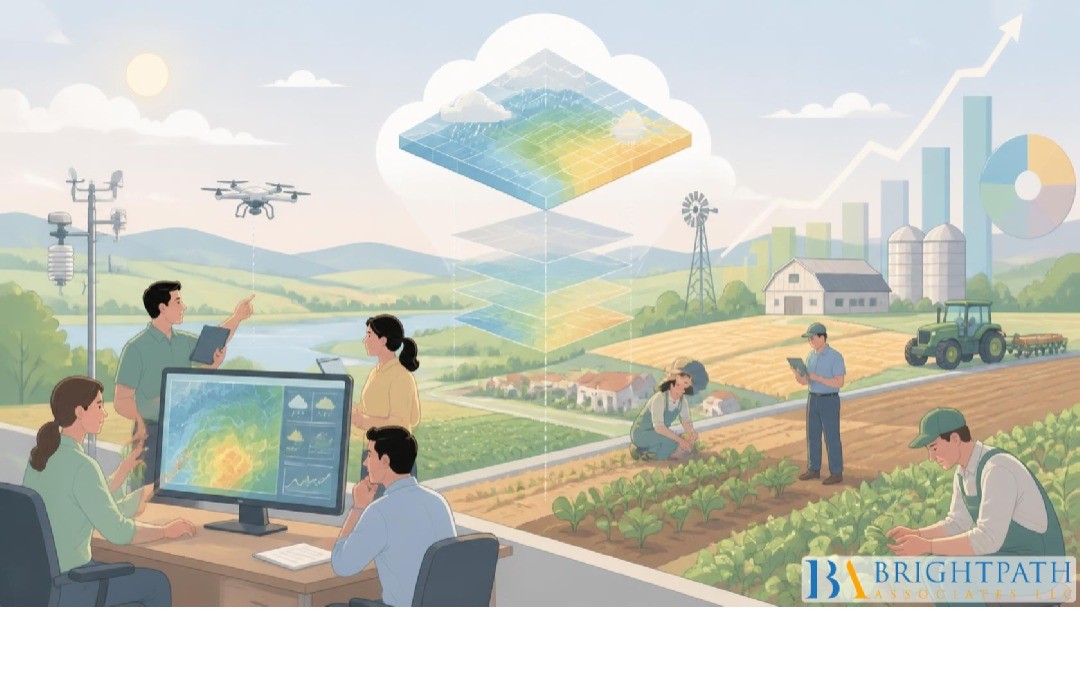
Weather has always influenced agriculture, but increasingly sophisticated weather modeling is changing how #AgriculturalBusinesses think about long-term investment. Traditional forecasts provide broad regional information, while hyper-local weather models can analyze conditions at much finer geographic scales. By combining localized atmospheric data, satellite observations, soil information, historical weather patterns, and machine-learning techniques, these models can provide agricultural operators with a more detailed understanding of environmental risks.
For businesses involved in farming, food production, agricultural infrastructure, and land management, this information can influence decisions that extend far beyond daily operations. Decisions involving irrigation infrastructure, crop selection, drainage systems, storage facilities, greenhouse investments, machinery, renewable energy, and land development can remain in place for decades.
The growing adoption of Agricultural technology is therefore creating a new connection between weather intelligence and capital allocation. Instead of treating weather as an uncontrollable operational variable, agricultural businesses can increasingly incorporate localized climate and weather information into investment planning.
This shift has implications for Sustainable farming, Precision agriculture, Digital Farming, and broader Agricultural sustainability strategies.
Why Hyper-Local Weather Data Matters for Capital Allocation
Capital allocation involves deciding where an organization should invest limited financial resources. Agricultural companies must continuously evaluate whether investments will generate acceptable returns while accounting for environmental uncertainty.
A regional weather forecast may indicate that an area is likely to experience increased rainfall, drought, heat, or frost. A hyper-local model can potentially reveal how those conditions may vary between individual fields or production zones.
This distinction matters because agricultural assets are rarely exposed to environmental conditions uniformly. Soil composition, elevation, terrain, drainage, proximity to water sources, vegetation, and local microclimates can create meaningful differences across relatively short distances.
For long-term investments, understanding these differences can improve decision quality. A farm may determine that one section requires additional drainage infrastructure while another would benefit more from irrigation or shade systems.
Capital can therefore be directed toward specific physical risks instead of being distributed uniformly across an entire operation.
Modern Agricultural technology increasingly combines physical infrastructure with digital information. Sensors, satellite imagery, connected machinery, weather stations, and analytical platforms generate increasingly detailed information about agricultural conditions.
Hyper-local weather modeling can add another layer to this ecosystem. Weather information can be combined with soil moisture readings, crop-development data, irrigation performance, and historical yield information.
This creates a more comprehensive picture of how environmental conditions influence production.
For capital planning, the value lies in transforming these observations into investment insights. If data consistently shows that a particular field experiences water stress during certain periods, management can evaluate whether irrigation infrastructure would provide an acceptable long-term return.
Similarly, recurring localized flooding may justify investment in drainage improvements.
Food Production and Climate-Related Capital Risk
#FoodProduction depends heavily on predictable access to suitable growing conditions. Extreme heat, drought, excessive rainfall, frost, storms, and changing seasonal patterns can affect yields and operating costs.
For food producers with long-lived assets, these risks can influence capital planning significantly. Processing facilities, storage warehouses, irrigation networks, cold-storage systems, and transportation infrastructure represent investments that may remain operational for many years.
Hyper-local weather models can help companies evaluate whether existing infrastructure remains appropriate under changing environmental conditions.
For example, increased heat exposure could affect refrigeration requirements or worker productivity. Changing rainfall patterns could influence water-storage capacity. More frequent extreme events could change the design requirements for buildings and logistics systems.
Weather modeling can therefore become part of long-term infrastructure planning rather than simply a tool for daily crop management.
Sustainable Farming and Infrastructure Decisions
Sustainable farming requires balancing productivity with responsible resource use. Capital investments can strongly influence whether that balance is achieved.
A poorly planned irrigation system may waste water, while insufficient irrigation capacity can expose crops to unnecessary stress. Hyper-local weather intelligence can help businesses evaluate where additional water infrastructure is likely to create the greatest benefit.
Similarly, soil conservation investments can be targeted toward areas most vulnerable to erosion.
The connection between weather intelligence and Sustainable farming is particularly important because sustainability investments often have long payback periods. Businesses need confidence that investments in water efficiency, soil health, energy systems, and climate resilience will remain useful over time.
Precision agriculture uses data and technology to manage agricultural resources with greater specificity. Instead of applying identical inputs across an entire farm, operators can adjust irrigation, fertilizer, crop protection, and other activities according to localized conditions.
Hyper-local weather modeling strengthens this approach by improving the environmental information available for each management zone.
The same principle can be applied to capital investment. Rather than replacing equipment across an entire operation, companies can identify where upgrades would generate the greatest return.
For example, localized weather and field-performance data may reveal that certain areas require improved irrigation technology while others would benefit more from drainage or soil-management investments.
This creates a more targeted capital-allocation strategy.
Organic Farming and Weather-Based Risk Management
#OrganicFarming can face specific environmental challenges because producers operate within particular requirements concerning inputs and production practices. Preventing crop losses through environmental management can therefore be especially important.
Weather intelligence can support decisions regarding planting windows, disease-risk periods, irrigation, soil moisture, and crop rotation.
For long-term capital allocation, organic producers can use localized environmental information when evaluating infrastructure such as protected cultivation, water-management systems, storage, and soil-improvement programs.
The goal is not to eliminate weather risk, which is impossible, but to design systems that are better prepared for known patterns of environmental variability.
Agricultural Innovation and the Rise of Predictive Investment
Agricultural innovation is increasingly moving from isolated technologies toward integrated decision systems. Weather models, artificial intelligence, remote sensing, connected machinery, and farm-management platforms can work together to create predictive insights.
This has important implications for investment decisions.
Historically, agricultural capital planning often relied heavily on historical averages. However, historical averages may not fully capture increasingly variable environmental conditions.
Predictive systems can allow businesses to evaluate multiple scenarios. Management may ask how an irrigation investment performs under normal conditions, moderate drought, or severe drought. Similarly, infrastructure can be evaluated against different rainfall or temperature scenarios.
Scenario-based planning can improve the resilience of capital decisions.
Sustainable agriculture investment requires more than identifying environmentally beneficial projects. Businesses must also determine whether those investments make economic sense.
Hyper-local weather modeling can help quantify potential risks and benefits. If a water-management system reduces exposure to drought-related losses, its value can be incorporated into investment analysis.
Likewise, investments in drainage, shade structures, storage, or protected growing environments can be evaluated against the frequency and severity of environmental risks.
This makes sustainability more closely connected to financial planning.
Instead of treating sustainability investments as separate from profitability, agricultural businesses can evaluate environmental resilience as a component of long-term asset performance.
Digital Farming and Capital Planning
#DigitalFarming is expanding the amount of information available to agricultural decision-makers. Farm-management platforms can integrate operational data, weather information, field observations, equipment performance, and production records.
When connected with hyper-local weather models, these platforms can support more sophisticated investment planning.
Management can examine relationships between weather events and historical production outcomes. If certain environmental conditions repeatedly correlate with lower yields or higher costs, the organization can evaluate whether infrastructure investment could reduce that exposure.
Digital records also make it easier to measure whether investments are delivering expected results.
Over time, businesses can compare forecasted risks with actual outcomes and improve their capital-allocation models.
The Role of Farm Management Software
Farm management software increasingly serves as the operational center for agricultural data. Modern platforms can provide information about field activities, crop conditions, inventory, equipment, labor, irrigation, and financial performance.
Integrating hyper-local weather information into Farm management software can make environmental intelligence more actionable.
Instead of requiring managers to consult separate weather platforms, weather insights can become part of routine operational and financial decision-making.
For capital allocation, this integration can help identify recurring problems and quantify their financial consequences.
A business may discover, for instance, that a particular production area consistently incurs higher irrigation costs during specific weather conditions. That information can support the business case for infrastructure improvements.
Agricultural sustainability increasingly involves preparing businesses for environmental uncertainty. Capital assets must remain productive under changing conditions.
Infrastructure designed for historical weather patterns may not perform optimally under future conditions. Storage systems, drainage networks, irrigation infrastructure, greenhouses, processing facilities, and energy systems may need to account for greater variability.
Hyper-local weather modeling provides a mechanism for incorporating localized risk into these decisions.
The objective is not to overbuild infrastructure based on worst-case scenarios. Overinvestment can be just as problematic as underinvestment. Instead, companies can use probabilistic information and scenario analysis to identify investments that provide an appropriate balance between resilience and financial return.
Improving Water Infrastructure Decisions
#WaterManagement is one of the clearest areas where localized weather intelligence can influence capital allocation.
Agricultural businesses face a complex combination of rainfall variability, irrigation demand, groundwater availability, water regulations, and crop requirements.
Hyper-local modeling can help estimate future water requirements and identify periods when natural precipitation may be insufficient.
This information can support decisions regarding reservoirs, irrigation systems, water recycling, pumping capacity, and precision irrigation technologies.
Better water infrastructure can improve both productivity and resource efficiency, reinforcing the objectives of Agricultural sustainability.
Managing Extreme Weather Exposure
Extreme weather events can create significant financial losses. Flooding, hail, heatwaves, storms, and drought can damage crops and infrastructure while disrupting supply chains.
Hyper-local modeling can help organizations identify locations and assets that are particularly exposed.
This can influence not only capital expenditure but also insurance decisions, facility design, emergency planning, and asset placement.
For example, an agricultural company considering a new storage facility may evaluate historical and modeled flood exposure before selecting a site.
The cost of relocating or redesigning infrastructure during the planning stage can be significantly lower than repairing an asset after repeated environmental damage.
Advanced models do not eliminate the need for experienced agricultural managers. Data can identify patterns, but human expertise remains essential for interpreting those patterns within operational and commercial contexts.
Agricultural leaders must understand crop systems, financial planning, technology, infrastructure, regulations, and workforce requirements.
This creates growing demand for professionals capable of combining agricultural knowledge with digital and analytical capabilities.
As Agricultural technology becomes more sophisticated, organizations will increasingly need leaders who can translate technical information into practical investment decisions.
Executive Leadership and Executive Search Recruitment
The transition toward data-driven agricultural investment requires leadership capable of managing technological change while maintaining financial discipline.
Executives must determine which technologies deserve investment, how digital systems should be integrated, and how environmental intelligence should influence broader corporate strategy.
#ExecutiveSearchRecruitment can help agricultural organizations identify leaders with experience across operations, technology, sustainability, finance, and strategic planning.
The strongest candidates may not come from traditional agricultural backgrounds alone. Increasingly, businesses may seek leaders who understand both physical agricultural systems and digital decision-making.
This combination can become a competitive advantage as weather intelligence becomes more deeply embedded in long-term capital strategy.
Hyper-local weather modeling is likely to become increasingly sophisticated as computing capabilities, satellite data, sensor networks, and machine learning improve.
Future systems may provide increasingly detailed assessments of environmental risk at the field, facility, or asset level.
This could transform the way agricultural businesses evaluate major investments. Instead of asking whether a project is profitable under average conditions, decision-makers may increasingly ask how it performs across multiple environmental scenarios.
Such analysis can improve resilience while reducing the risk of committing capital to infrastructure that may become poorly suited to changing conditions.
The combination of weather intelligence, Agricultural innovation, Precision agriculture, and Digital Farming could ultimately create a more adaptive agricultural investment model.
Conclusion
Hyper-local weather modeling is moving beyond its traditional role as a forecasting tool. For agricultural businesses, it is becoming a potential component of long-term capital allocation.
By providing more localized information about rainfall, temperature, soil moisture, extreme weather, and environmental variability, advanced weather models can help businesses determine where infrastructure investments are most necessary and where capital can generate the greatest resilience.
The technology supports Sustainable farming by improving resource allocation, strengthens Precision agriculture by adding more detailed environmental intelligence, and supports Sustainable agriculture investment by helping companies evaluate long-term environmental and financial risk.
Digital Farming and Farm management software can further integrate these insights into everyday decision-making, while Agricultural technology and Agricultural innovation provide the infrastructure needed to turn data into operational value.
Ultimately, the greatest opportunity lies in connecting environmental intelligence with financial strategy. Agricultural companies that understand where weather risk is concentrated can make more informed decisions about water systems, land development, storage, machinery, energy infrastructure, and production technologies.
As climate variability and resource constraints continue to influence agricultural economics, hyper-local weather modeling may become an increasingly important part of capital planning. Organizations that combine accurate environmental intelligence with strong operational leadership and strategic Executive Search Recruitment will be better positioned to allocate capital with greater confidence, resilience, and long-term discipline.
Find your next leadership role in Farming Industry today!