
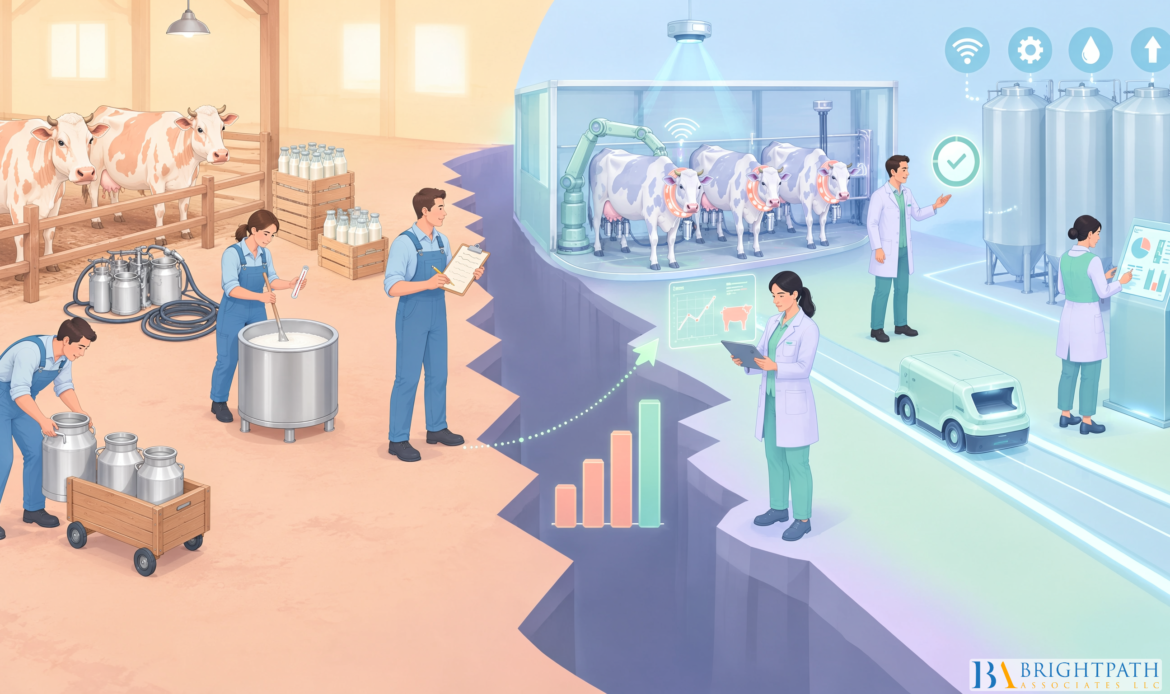
Great Transition: How Digital Transformation Is Widening Gap Between Dairies for #DairyIndustry is not simply a story about robots replacing manual work. It is a story about unequal capability. Some dairies can buy connected systems, hire technical talent, improve data quality, and act on insights quickly. Others may face the same labor, margin, animal health, and compliance pressures without the capital, connectivity, or staff needed to make digital tools useful.
Digital transformation can raise average performance across the sector while still widening differences between individual dairy businesses. That distinction matters for owners, cooperative leaders, processors, and executive teams making decisions about dairy product development, milk production technologies, automation, and leadership hiring.
Table Of Contents
- Why Digital Transformation Is Creating a Dairy Divide
- How Capability Gaps Become Competitive Gaps
- The Leadership And Talent Challenge Behind Dairy Technology
- A Practical Response for Dairy Executives
- Frequently Asked Questions
- Resources And Citations
Why Digital Transformation Is Creating A Dairy Divide
#DigitalTransformation in dairy means more than buying sensors or installing a robotic milking system. It involves collecting, validating, connecting, and using production, animal, labor, maintenance, and financial data to make better operating decisions. A farm-management platform, activity monitor, milk analyzer, automated sorter, and feeding system can all be useful. Yet the value comes from the decisions they improve, not from the number of dashboards a dairy owns.
The divide emerges because adoption is rarely a one-time purchase. A dairy that starts with reliable connectivity, clean animal records, capable supervisors, working maintenance routines, and available financing is better positioned to add the next tool. That next tool may produce better data, which supports better decisions and makes another investment easier to justify.
A dairy starting without those foundations faces a different reality. It may need to upgrade electrical systems, improve broadband access, standardize cow identifiers, retrain staff, and replace older software before an advanced tool can deliver reliable value. The purchase price is only the visible part of the investment.
The First Advantage Often Compounds
A well-resourced dairy can build a capability loop:
- It invests in a targeted technology tied to a known operational problem.
- Staff learn to interpret alerts, correct data errors, and adjust routines.
- Managers gain better records for labor planning, herd health, feed decisions, and capital budgeting.
- The dairy becomes more able to evaluate and implement its next system.
This is why herd size alone does not explain the gap. Two dairies with similar cow counts may have very different technology readiness. One may have a digitally capable operations manager, dependable vendor support, and integrated records. The other may have limited technical coverage and disconnected systems that require manual entry.
Cost Is More Than The Invoice
The 2026 Irish dairy-farmer study published by Frontiers in Animal Science on smart dairy technology adoption found that investment cost was a major barrier, particularly for milking robots. That is a narrow but important finding: cost remains a real adoption constraint even where the technology is familiar and its potential benefits are understood.
A stronger executive question is: What is the total cost of ownership over the useful life of this system? That calculation should include the items below, not just equipment acquisition.
| Cost Area | What It Can Include | Executive Risk If Ignored |
|---|---|---|
| Initial deployment | Hardware, installation, facility changes, integration | Budget shortfall before the system is operational |
| Ongoing operation | Software subscriptions, service contracts, calibration | Rising recurring cost without a clear owner |
| Workforce transition | Training, revised job design, technical support | Employees bypassing or underusing the tool |
| Infrastructure | Connectivity, power reliability, devices, cybersecurity | Outages or unusable real-time monitoring |
| Replacement and switching | Upgrades, data migration, vendor changes | Long-term vendor dependence and stranded data |
The University of Liège review on value-driven dairy farming notes that subscriptions, maintenance, and training can compound the financial burden across multiple tools. Its review also identifies low return on investment, inaccurate data, and poor system integration as separate reasons adoption can disappoint. The University of Liège review of value-driven dairy data systems is particularly useful because it moves the discussion beyond the initial purchase decision.
How Capability Gaps Become Competitive Gaps
Dairy automation technologies can reduce repetitive work and provide earlier signals of health, behavior, or process changes. But technologies do not create identical benefits for every dairy. Results depend on baseline management, staff follow-through, local infrastructure, and whether the dairy can act on what the system detects.
There is not enough evidence to claim a universal productivity increase from digital transformation across dairy sizes. A system that improves one operation may create little value in another if the underlying bottleneck is staffing instability, poor maintenance discipline, fragmented records, or a weak market position. Executives should be cautious when vendors or peers present a single outcome as broadly transferable.
Data Rich But Decision Poor
A dairy can own several modern systems and still struggle to make decisions. This happens when systems use different animal identifiers, report data at different intervals, or cannot exchange information. Staff may re-enter data manually, reconcile conflicting alerts, or rely on spreadsheets outside the formal system.
The result is a data-rich but decision-poor operation. More information does not automatically create better management.
The Animals review of IoT sensor use in dairy cattle farming identifies installation and maintenance costs, compatibility problems, broadband limits, and data-management complexity as significant barriers. These issues matter because poor interoperability shifts work back onto people. It may also make the dairy slower to respond when a cow-health, feed, or equipment alert requires attention.
Before adding a new platform, leadership should ask:
• Can the system import and export usable data without custom manual work?
• Which employee owns validation of data and alerts?
• Does the vendor provide documented interfaces, export rights, and migration support?
• What happens when the internet connection fails?
For rural locations with unreliable service, an offline-first or hybrid design may be more practical than a system that depends on continuous #CloudAccess. Local storage, delayed synchronization, clear alert escalation, and manual fallback procedures should be part of the operating plan. These options are not proven universal solutions, but they are sensible requirements where connectivity is a known constraint.
Sensor Quality Determines AI Quality
Artificial intelligence can identify patterns in large volumes of data, but it cannot correct every poor input. Missing records, uncalibrated sensors, delayed updates, or false alerts can produce recommendations that appear precise but are operationally weak.
Consider a dairy using activity data to flag possible estrus or illness. If the wearable devices are not consistently attached, if animal records are incomplete, or if staff do not log treatments promptly, the model may generate alerts that lack context. Workers then lose trust in the system, stop responding consistently, and the technology becomes an expensive notification tool rather than a decision aid.
The response is not to reject analytics. It is to establish sensor validation and data governance as operating disciplines. A manager should know who checks abnormal readings, how often devices are calibrated, what error rate is acceptable, and when human judgment overrides an automated recommendation.
Sustainability Can Also Become Uneven
#DigitalSystems may support better measurement of feed use, manure handling, energy consumption, and animal health. Yet measurement alone does not make a dairy more sustainable. Businesses need capital and technical capability to turn information into changed practices, maintenance plans, and investment decisions.
That is relevant to dairy waste management creating new revenue streams. Technologies that improve tracking or process control can help identify operational opportunities, but a dairy should not assume that monitoring automatically creates new revenue or lowers environmental risk. The commercial outcome depends on local markets, infrastructure, compliance obligations, and execution.
The Leadership And Talent Challenge Behind Dairy Technology
Digital transformation changes the work of dairy leadership. The most difficult roles are no longer limited to herd management, production, maintenance, finance, or food technology in isolation. Increasingly, dairy businesses need leaders who can connect operational realities with systems, data, workforce design, and capital discipline.
For small and mid-sized dairies, that creates a hiring challenge. A candidate who understands dairy production may not have experience with automation integration or data governance. A technology leader may understand systems architecture but lack credibility with production teams. The strongest candidate may need to translate between both worlds.
Automation Changes Skills More Than It Removes Work
It is tempting to frame automation as a simple labor-reduction strategy. In practice, it can move labor demand toward higher-skill work: configuring systems, troubleshooting equipment, validating data, interpreting exceptions, managing vendors, and coaching employees through new routines.
The Animal Frontiers review of the Dairy Brain Initiative explains that AI adoption can be especially difficult for small and medium-sized dairies because of cost, complexity, infrastructure needs, #TechnicalExpertise, resistance, and data-governance concerns. This points to a leadership issue as much as a technology issue. An organization can purchase tools before it has the management capacity to use them well.
For executive teams, the question is not only, “Can we afford the platform?” It is also, “Who will make this system part of daily operations, and what authority will that person have?”
Roles Are Becoming More Hybrid
The following roles may require a broader combination of experience than they did before:
| Role | Traditional Focus | Added Digital Requirement |
|---|---|---|
| Dairy Operations Leader | Production consistency, labor, animal care | Using operational data to improve routines and accountability |
| Plant Or Processing Executive | Quality, throughput, food safety | Connecting production systems with traceability and commercial data |
| Maintenance Leader | Equipment uptime and repair | Managing automated equipment, vendors, preventive data, and cyber risk |
| Finance Executive | Budgeting and capital planning | Evaluating technology total cost, adoption risk, and measurable returns |
| Product Development Leader | Formulation and market fit | Coordinating food technology, consumer data, and production feasibility |
This is where conventional recruitment can struggle. A general management search may find capable dairy leaders, but it may not test for systems integration, technology adoption, change management, or data portability. Conversely, a general technology search may miss the practical constraints of animal care, food safety, shift work, and seasonal operating rhythms.
A prolonged vacancy in a hybrid role can increase project risk. Vendor selection may drift, implementation decisions may be deferred, frontline teams may receive inconsistent direction, and finance may lack a credible view of value realization. These are business risks, not simply recruiting inconveniences.
For organizations considering dairy market trends reshaping industry growth strategies, leadership planning should sit beside commercial planning. Growth strategies that assume new automation, expanded processing, or differentiated dairy products require leaders capable of delivering the operating model behind those plans.
A Practical Response For Dairy Executives
The most defensible response is not a full digital overhaul. It is a staged program tied to a measurable bottleneck. That could be delayed detection of health issues, excess rework in milk handling, maintenance downtime, labor scheduling, incomplete traceability, or weak visibility into feed performance.
Start With A Bottleneck, Not A Technology Category
A disciplined sequence can reduce the risk of investing in tools that do not fit the business.
- Define the operational problem in measurable terms. For example, identify the current cost of unplanned equipment downtime or the time spent reconciling records.
- Map the current process. Document where data begins, who uses it, where it is duplicated, and which decisions are delayed.
- Test readiness. Review connectivity, electrical capacity, staff skills, data quality, vendor support, and leadership ownership.
- Compare options using total cost of ownership. Include implementation, training, maintenance, subscriptions, downtime, and replacement risk.
- Pilot with success criteria. Set a limited time frame, specify the user group, and agree on what outcome would justify expansion.
- Build the talent plan before scaling. Decide whether the capability should be developed internally, hired externally, supported by a vendor, or shared through a cooperative arrangement.
A shared-service model may help reduce the scale penalty for smaller dairies. #CooperativePurchasing, shared technical support, pooled analytics, or common data infrastructure could spread fixed costs. However, available evidence does not establish a universal model or guaranteed financial result. Governance is the hard part: participants need clarity on data access, service levels, cost sharing, and decision rights.
Protect Portability Before Signing
Data ownership is often discussed as a privacy issue. It is also a competitive issue. If a dairy cannot export historical data in usable formats, changing vendors can become costly and disruptive. That can limit future negotiating power and delay adoption of better systems.
Contract review should address:
• Who owns raw and processed farm data
• Whether data can be exported in machine-readable formats
• Whether the vendor can use data for product development or benchmarking
• What happens to access after contract termination
• How long the vendor retains data and how it is secured
The practical point is simple: do not treat data portability as a legal detail after implementation. It belongs in the investment decision.
Hire For Translation, Not Just Technical Credentials
When a dairy needs leadership for a digital initiative, the selection process should test more than technology familiarity. Candidates should be able to explain how they would establish operating ownership, improve staff adoption, validate data, manage vendor relationships, and stop a project that is failing to produce value.
This is one reason specialized executive search may be useful when the role requires both dairy operating judgment and digital transformation leadership. The value is not a promise that an outside search will solve every hiring problem. It is the ability to define the role around the actual business bottleneck, assess hybrid capabilities, and widen the candidate pool beyond obvious titles or local networks.
For teams focused on enhancing efficiency in dairy farm operations, the talent plan should be as specific as the equipment plan. A dairy that assigns digital accountability to an already overloaded manager may save on recruiting costs while increasing implementation risk.
Key Takeaways
• Digital transformation widens gaps when early adopters accumulate capital, clean data, trained staff, and stronger vendor leverage.
• The relevant financial test is total cost of ownership, not equipment price alone.
• A dairy can become data rich but decision poor when systems cannot exchange reliable information.
• Automation can reduce repetitive tasks while increasing demand for technical, operational, and change-management skills.
• Smaller dairies may benefit from staged adoption and shared-service options, but these approaches require careful governance and do not guarantee returns.
• Executive hiring should focus on leaders who can translate between dairy operations, food technology, financial discipline, and digital systems.
Frequently Asked Questions
What Does Digital Transformation Mean For A Dairy Farm?
It means using connected data, automation, software, and analytics to improve operating decisions. The goal is not to digitize every process. The goal is to improve a specific decision, such as identifying health issues earlier, reducing downtime, improving traceability, or managing labor more consistently.
Why Are Larger Dairies Adopting Digital Technologies Faster Than Smaller Dairies?
Larger dairies may have more capital, specialized staff, stronger infrastructure, and more ability to spread fixed costs across operations. However, size is not the only factor. Management readiness, vendor support, data quality, and leadership capability can create meaningful differences among dairies of similar size.
Do Robotic Milking Systems Make Financial Sense For Small And Medium-Sized Dairies?
They can in some situations, but there is no universal answer. The decision depends on labor availability, facility condition, financing, herd management, maintenance capability, expected utilization, and local support. Investment cost is a documented barrier, especially for milking robots, so a detailed total-cost analysis is essential.
How Do Sensor Errors Affect AI Recommendations?
Sensors can produce incomplete or inaccurate readings because of calibration problems, damaged devices, inconsistent animal identification, or missing records. If poor data enters an AI tool, its recommendations can become less reliable. Dairies need validation routines and clear human accountability for #ReviewingExceptions.
What Should A Dairy Do When Its Software Systems Cannot Exchange Data?
First, identify the specific decision harmed by fragmented information. Then ask vendors whether they support usable imports, exports, interfaces, and common identifiers. Avoid adding more systems until the dairy has a plan for integration, data ownership, and who will maintain the connections.
Does Automation Reduce Labor Needs Or Increase Demand For Technical Skills?
It can do both. Automation may reduce repetitive manual tasks, but it can increase demand for employees and leaders who can maintain equipment, interpret alerts, troubleshoot failures, and redesign workflows. The labor model should be evaluated before implementation, not after.
Can Cooperatives Help Smaller Dairies Access Precision Technology?
Potentially. Shared purchasing, technical support, analytics, or infrastructure could reduce fixed costs. Still, the available evidence does not prove a single model works across all regions or dairy types. Clear governance, data rules, service expectations, and cost allocation would be necessary.
Resources And Citations
- Animal Frontiers + “Artificial intelligence applied to dairy science: insights from the Dairy Brain Initiative”
https://academic.oup.com/af/article/14/6/60/7942662 - Frontiers in Animal Science + “What ‘smart’ dairy farming technologies are Irish dairy farmers using and why?”
https://www.frontiersin.org/journals/animal-science/articles/10.3389/fanim.2026.1896469/full - Animals + “Internet of Things: Sensors Application in Dairy Cattle Farming”
https://www.mdpi.com/2076-2615/14/21/3071 - University of Liège repository + “Invited review: Milking the data for value-driven dairy farming”
https://orbi.uliege.be/bitstream/2268/346439/1/Sharma_2026.pdf - Frontiers in Animal Science + “Precision of dairy farming: navigating challenges and opportunities in Africa”
https://www.frontiersin.org/journals/animal-science/articles/10.3389/fanim.2025.1541838/full - BrightPath Associates: Dairy market trends reshaping industry growth strategies
https://brightpathassociates.com/dairy-market-trends-reshape-industry-growth-strategies/
Find your next leadership role in Dairy Industry today!