
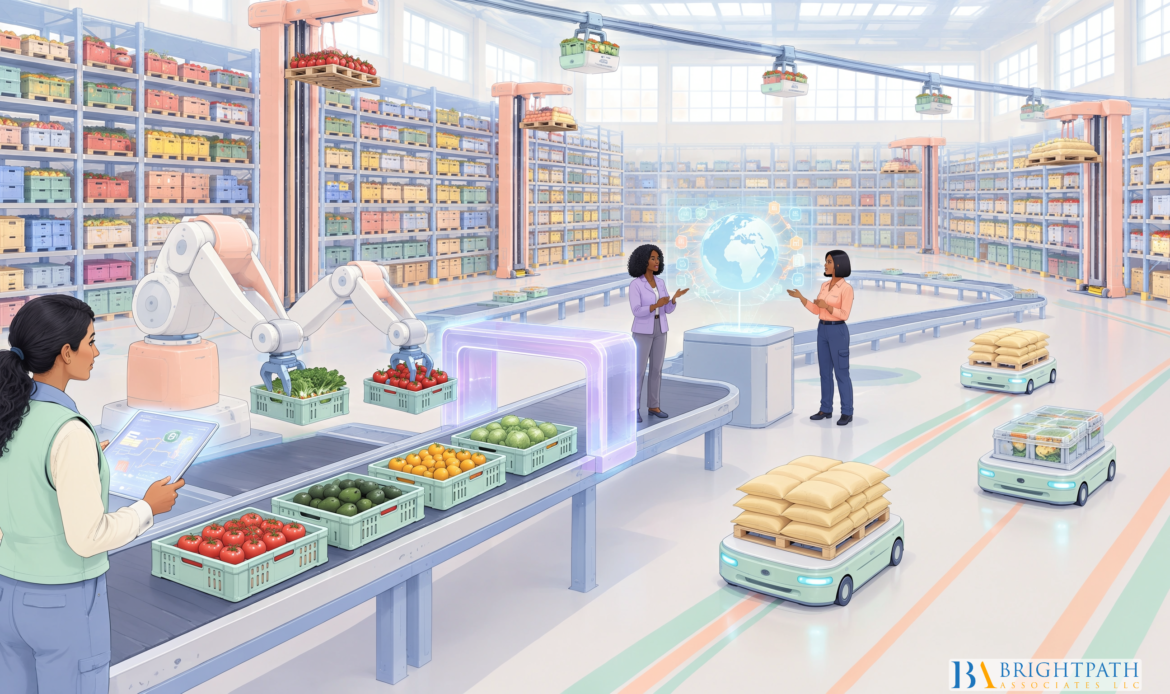
Food procurement is no longer a back office process that ends when a purchase order is issued. In 2026, ingredient availability, supplier qualification, cold chain conditions, #PackagingFormats, traceability requirements, and demand volatility increasingly shape what an automated food plant can produce. The Future of Food Procurement: Lessons From 2026’s Supply Chain Shifts for Industrial Automation Industry is therefore not only about better buying decisions. It is about whether procurement, warehouse, plant, quality, and controls teams can operate from the same version of the truth.
For executives, the tension is clear. Automation investments are often approved to lower labor dependence or raise throughput. Yet a highly automated line can still lose capacity if an approved supplier changes a case format, an ingredient is placed on quality hold, or a substitution does not match a robot cell’s programmed assumptions. The practical question is not whether to automate. It is where procurement uncertainty should influence automation design, data architecture, and leadership hiring.
Table Of Contents
• Why Procurement Is Now An Automation Design Input
• Build A Procurement To Plant Data Architecture
• Design Automation For Exceptions, Not Ideal Conditions
• Leadership And Talent Requirements For Connected Operations
• Key Takeaways
• Frequently Asked Questions
• Resources And Citations
Why Procurement Is Now An Automation Design Input
Supplier Variability Reaches The Plant Floor
Procurement decisions affect physical automation more directly than many capital plans assume. A new supplier may introduce different bag dimensions, pallet patterns, labels, moisture characteristics, ingredient particle sizes, or delivery windows. Any one of those changes can affect robotic palletizing, automated guided vehicle routing, machine vision thresholds, storage slotting, or line changeover work.
Consider a dry ingredient that arrives in sacks from a qualified alternate supplier during a shortage. If the sacks are taller, softer, or use a different label placement, a depalletizing robot may need new grip settings and a vision model may need retraining. If the enterprise resource planning system records only the supplier name, rather than packaging and material attributes, the warehouse team may not know that an automated cell needs a different operating rule before the truck reaches the dock.
That is why procurement volatility should be translated into design requirements before equipment is selected. In practical terms, leaders should ask whether an automation solution can accommodate approved variation without extensive mechanical rework or #PLCProgramming service calls. The answer will vary by process. A high speed, tightly controlled packaging line may need strict supplier specifications. A flexible warehouse cell may justify adjustable grippers, configurable vision recipes, and larger buffer capacity.
Food Engineering’s discussion of integrated project delivery supports the connection between engineering, procurement, construction, automation, and facility planning as a way to reduce project disconnects. The lesson is straightforward: do not treat procurement requirements as a document handed to engineering after the automation layout is complete.
Resilience Is Different From Labor Savings
A labor saving business case asks how many manual touches can be removed. A resilience business case asks whether the operation can continue producing when lead times move, a supplier fails qualification, demand shifts, or a shipment is delayed. Both are valid, but they require different investment choices.
| Investment Objective | Design Priority | Useful Measures | When It May Not Fit |
|---|---|---|---|
| Labor reduction | Cycle time, staffing, repetitive task elimination | Manual touches, throughput, downtime | When input variation creates frequent exceptions |
| Supply resilience | Flexibility, buffers, alternate material handling | Recovery time, supplier lead time variance, service level | When demand and sourcing are highly stable |
| Traceability and quality control | Lot capture, segregation, hold routing | Traceability completeness, hold response time | When systems cannot reliably capture lot events |
No broad public evidence establishes a standard payback period for resilience oriented automation in food manufacturing. Executives should be skeptical of generic return claims. Still, resilience can be the stronger justification where a missed production window creates customer penalties, spoilage, or a food safety exposure that exceeds the value of direct labor savings.
Sustainability Must Be Operational, Not Cosmetic
Sustainability targets influence procurement through energy use, transport choices, waste, packaging, and inventory policies. But an automation project should not assume that fewer labor steps automatically mean a lower environmental impact. A refrigerated automated storage system, for example, may improve inventory control while increasing electricity demand. The relevant question is whether it reduces total waste, unnecessary movement, and temperature excursions enough to justify its #EnergyProfile.
For plant leaders evaluating that tradeoff, these energy efficiency tips for food manufacturing plants provide a related operational lens. Procurement, facilities, and automation leaders should set joint measures for waste, energy per unit, inventory age, and cold chain exceptions rather than allowing each function to optimize a separate target. (elevate efficiency in food manufacturing)
Build A Procurement To Plant Data Architecture
Connect The Systems That Describe Reality
AI driven solutions can assist with demand forecasting, replenishment optimization, and purchasing workflows. They are less useful when the underlying systems disagree about inventory, material status, or actual consumption. Food processors are applying AI to forecasting, replenishment, workflow automation, logistics, and enterprise data integration, as described in Food Manufacturing’s review of AI uses in food processing.
The architecture does not need to begin with a massive platform replacement. It does need clear ownership of core data objects. Enterprise resource planning software should hold supplier, purchase order, commercial inventory, and financial information. The manufacturing execution system should record what was actually consumed, produced, held, or scrapped. The warehouse management system should record receiving, location, movement, picking, and shipping. Quality systems must determine whether a lot is released, restricted, or on hold.
A useful minimum data model includes:
• Supplier identity, qualification status, approved ingredients, and packaging specifications
• Material code, lot number, expiration or best by date, and allergen or quality attributes
• Purchase order quantity, confirmed arrival date, and actual receiving event
• Warehouse location, temperature state where relevant, and movement history
• Production order, actual material consumption, yield, scrap, and substitution event
• Quality release, hold, test result, and disposition decision
• Robot recipe, vision parameters, pallet pattern, and equipment changeover requirements
The point is not to centralize every data field. It is to make sure a change in one system produces the right response in another. If quality places a lot on hold, the warehouse system should block it from automated picking. If procurement approves a substitute, the MES and control systems should identify whether that material requires a different recipe or operator verification.
Data Quality Is A Management Issue
Technology alone does not fix poor master data. Supermarket Perimeter reported that an Aptean 2026 survey found 81% of food and beverage decision makers identified data quality and access as the largest challenge to AI implementation. Its broader reporting also notes that food AI depends on usable data, suitable systems, and human oversight, with adoption ranging from pilots to #EmbeddedWorkflows. Those findings make the reported food AI adoption and data quality challenge especially relevant to leaders considering automated procurement.
The executive issue is governance. Someone must decide who owns supplier master data, who approves changes to material attributes, and who resolves conflicts between physical inventory and system inventory. Without that discipline, an AI tool may produce recommendations that look precise but rest on incomplete or stale records.
Production Grade Automation Needs Controls
A pilot can show whether a model produces useful recommendations. Production deployment is different. It requires interface testing, user permissions, exception queues, audit trails, fallback procedures, and an operating owner who is accountable after launch.
A practical rollout uses controlled permissions:
- Start with AI generated demand signals and buyer review.
- Allow automatic purchase order preparation for stable, approved materials within budget and quantity limits.
- Require buyer approval for price movement, quantity outside planning tolerance, or unapproved supplier changes.
- Require quality or food safety approval for substitutions, allergen changes, specification changes, and materials connected to a hold or recall.
- Require finance approval for commitments above a defined threshold or outside contract terms.
This approach is slower than unrestricted automation, but it is better suited to perishable and regulated food environments. The goal is not to remove judgment. It is to concentrate judgment where the business consequence is highest.
Design Automation For Exceptions, Not Ideal Conditions
Perishability Creates A Different Replenishment Problem
Forecasting demand for perishable ingredients is not simply a question of predicting volume. The system must account for shelf life, minimum order quantities, inbound lead time, yield loss, temperature sensitivity, quality holds, and the time needed to consume a lot before expiration.
For example, a forecast may correctly project 10,000 units of finished #ProductDemand. It can still recommend the wrong ingredient order if it ignores a delayed delivery, a short shelf life, or a constrained production schedule. In that case, the buyer needs an exception workflow, not a more confident forecast.
Effective exception management distinguishes between events that can be resolved by rules and events that need human review:
| Exception | Possible Automated Action | Required Human Decision |
|---|---|---|
| Late approved shipment | Recalculate projected inventory and alert planning | Decide whether to expedite, reschedule, or use alternate supply |
| Quality hold on a lot | Block picking and route inventory to hold location | Determine disposition and production impact |
| Approved packaging variation | Select validated robot or vision recipe | Confirm equipment readiness if validation is incomplete |
| Unapproved substitution | Prevent automatic release | Evaluate supplier qualification, food safety, and formulation impact |
Traceability Changes The Automation Business Case
Lot traceability is often discussed as a compliance feature. In an automated operation, it is also a design constraint. Scanners, labels, computer vision, warehouse routing, and MES transactions must preserve the relationship between incoming lots, intermediate batches, finished products, and shipment records.
If a pallet is moved by automated equipment without a reliable lot event, the organization may lose the ability to isolate affected product quickly during a quality event. That risk changes the economics of scanning hardware, sensor placement, and exception handling. Cheaper automation that cannot capture lot identity at the right handoff can create expensive manual reconciliation later.
The proposed Maison Solutions collaboration illustrates how procurement, inventory, logistics, workflow automation, robotics, computer vision, and sensor based collection are increasingly considered together. The SEC filed announcement describing the proposed collaboration specifically includes those connected capabilities. It does not establish outcomes, but it does reflect the direction of system design: digital procurement and physical material movement are converging.
Contracts Need To Match Automation Capability
Supplier contracts and automation specifications should be reviewed together. Procurement may negotiate flexibility in supplier choice, packaging, or delivery terms. Operations may require strict control of dimensions, labeling, pallet patterns, and ingredient characteristics for manufacturing automation to run reliably. Neither position is automatically correct.
Leaders should define a controlled variation process. It should specify which attributes a supplier may change without notice, which changes require advance notification, and which changes trigger validation by quality, engineering, or controls teams. A revised carton size may be commercially minor but operationally material if it causes unstable pallet stacking or missed machine vision reads.
This is where industrial machine vision, SCADA systems, robotics integration, and control systems need representation in sourcing decisions. Procurement cannot be expected to understand every automation constraint. It does need a formal path to obtain that input before approving a change that affects the plant.
Leadership And Talent Requirements For Connected Operations
The Executive Role Is Becoming More Cross Functional
The future operating model requires leaders who can connect supply chain choices to plant constraints. A procurement leader may need enough technical literacy to understand lot traceability and automated material handling. An operations leader may need to understand supplier qualification and the commercial effect of alternate sourcing. A technology leader may need to govern AI tools without handing critical decisions to opaque workflows.
That does not mean every executive must be a controls engineer. It does mean executive requirements are expanding beyond functional depth. The highest value leaders can set decision rights across procurement, quality, manufacturing, finance, and IT while maintaining accountability for service, cost, and food safety.
#FoodManufacturers also need specialized leaders below the executive level, including automation engineering managers, manufacturing systems leaders, warehouse automation specialists, data governance leaders, and quality professionals who understand digital traceability. These roles may be difficult to fill because candidates often need both domain knowledge and the ability to work across legacy systems.
Vacancy Risk Is Operational Risk
A prolonged vacancy in a senior automation or supply chain role can delay equipment acceptance, defer data governance decisions, and leave vendor work without an internal owner. A poor hire can create a different problem: a leader who treats procurement, automation, and quality as separate projects may increase rework and friction.
The right response is not simply to widen the applicant pool. Start with a sharper role definition. Specify the decisions the leader will own, the systems they must connect, the authority required to resolve conflict, and the first operational outcomes expected. For a director of manufacturing automation, that might include integrating MES and WMS data, reducing manual exception handling, and establishing change control for supplier driven packaging variation.
For companies evaluating the workforce side of these shifts, talent acquisition in food processing offers a relevant starting point. Executive search can be appropriate when the role requires rare combinations of food operations, controls, data, and leadership capability, or when discretion and assessment depth matter. It is not a substitute for a clear mandate, realistic authority, and a credible operating plan.
Recruit For Decision Quality, Not Keywords
A resume with PLC programming service, robotics integration, SCADA systems, or manufacturing automation experience does not automatically prove executive readiness. Interview processes should test how a candidate handles tradeoffs.
Useful assessment questions include:
• How would the candidate decide whether a supplier substitution requires automation revalidation?
• How would they set approval gates for AI generated purchasing recommendations?
• How would they respond when the WMS, MES, and ERP show conflicting inventory positions?
• How would they balance a production outage against a quality hold and a customer delivery commitment?
• How would they define automation success beyond labor savings?
These questions reveal whether a leader can manage exception rich systems. They also make industrial automation executive search more disciplined. The objective is not to hire the person with the longest list of tools. It is to identify a leader who can improve decision quality across the #ConnectedOperation.
Key Takeaways
• Food procurement now affects automation reliability through supplier variation, packaging changes, material substitutions, and cold chain conditions.
• Procurement, quality, warehouse, production, and controls systems need shared data on lots, material attributes, inventory status, and equipment recipes.
• AI should begin with supported recommendations and controlled workflows. Purchase execution should remain subject to approval gates for high consequence exceptions.
• Lot traceability must be designed into scanners, vision systems, warehouse movements, and production transactions rather than added after equipment commissioning.
• Resilience oriented automation may be justified by continuity, recovery speed, and food safety control, even where labor savings alone produce a weaker case.
• Leadership hiring should test cross functional decision making, not only technical credentials or procurement experience.
Frequently Asked Questions
What Does The Future Of Food Procurement Look Like For U.S. Manufacturers?
It looks more connected to physical operations. Procurement systems will increasingly exchange data with warehouse, quality, production, and automation systems so that purchase decisions reflect actual inventory, approved lots, capacity, and material constraints. Human judgment remains necessary for substitutions, unusual price changes, and food safety related decisions.
Should A Company Automate Purchasing, Warehouse Handling, Or Production First?
Start where the constraint is clearest. Automate purchasing workflows first when buyers spend significant time on repeatable approved orders and data is reliable. Start with warehouse handling when receiving, storage, and picking errors disrupt production. Start with production automation when the primary constraint is cycle time, safety, or labor availability. Avoid sequencing projects by trend alone.
What Data Is Needed Before Automating Procurement?
At minimum, maintain accurate supplier qualification data, material specifications, lot and expiration details, purchase order status, inventory location, quality holds, production consumption, and approved substitution rules. If these records are fragmented or routinely inaccurate, automate data governance and workflow discipline before allowing purchase orders to #ExecuteAutomatically.
Can AI Reliably Forecast Perishable Ingredients?
AI can support forecasting, but it cannot remove uncertainty from perishability. It should incorporate shelf life, lead times, minimum orders, production schedules, yields, quality holds, and temperature related risk. Forecast outputs should feed an exception queue when assumptions break, rather than automatically triggering decisions in every case.
What Procurement Decisions Should Remain With A Human Buyer?
Human approval is appropriate for unapproved suppliers, substitutions that change specifications or allergens, large financial commitments, contract exceptions, severe demand deviations, and any event involving a quality hold or potential recall. Stable replenishment of approved materials within defined limits is a better candidate for workflow automation.
How Does Lot Traceability Affect Automation Investments?
It affects equipment selection and workflow design. Automated receiving, storage, picking, batching, and shipping must preserve lot identity at every meaningful handoff. A solution that moves product efficiently but loses lot history may create major recall, quality, and reconciliation risks.
When Does Automation Improve Resilience Rather Than Merely Reduce Labor?
It improves resilience when it helps the operation absorb disruption, such as supplier changes, delayed shipments, quality holds, or demand swings, without losing control of inventory and production. Measure recovery time, exception resolution, traceability completeness, and service performance alongside labor related measures.
Resources And Citations
- Food Engineering — Food Manufacturing’s Growth Calls for Integrated Project Delivery
https://www.foodengineeringmag.com/articles/103913-food-manufacturings-growth-calls-for-integrated-project-delivery - Supermarket Perimeter — AI: A food industry update
https://www.supermarketperimeter.com/articles/14525-ais-speed-in-supply-chain-frees-up-time - CIO Dive — Sysco targets $500M in AI-driven cost savings
https://www.ciodive.com/news/sysco-targets-500m-ai-driven-cost-savings/829977/ - Food Manufacturing — How Food Processors Can Utilize AI — Now and in the Future
https://www.foodmanufacturing.com/ingredients/news/22973198/how-food-processors-can-utilize-ai-now-and-in-the-future - SEC — Maison Solutions strategic collaboration announcement
https://www.sec.gov/Archives/edgar/data/1892292/000121390026066627/ea029408001ex99-1.htm - BrightPath Associates — Automation Industry Trends: https://brightpathassociates.com/automation-industry-trends-staying-ahead-in-a-rapidly-evolving-landscape/
Find your next leadership role in Industrial Automation Industry today!
Stay informed with the latest insights on Industrial Automation Industry!