
Introduction
Intelligence, surveillance, and reconnaissance (ISR) missions generate enormous quantities of data. Modern satellites, airborne sensors, electro-optical systems, synthetic aperture radar, #HyperspectralInstruments, and other sensing technologies can capture information at a scale that traditional ground-based processing architectures increasingly struggle to manage. Instead of transmitting every raw data point to Earth, defense organizations are exploring a different approach: processing more information directly in orbit.
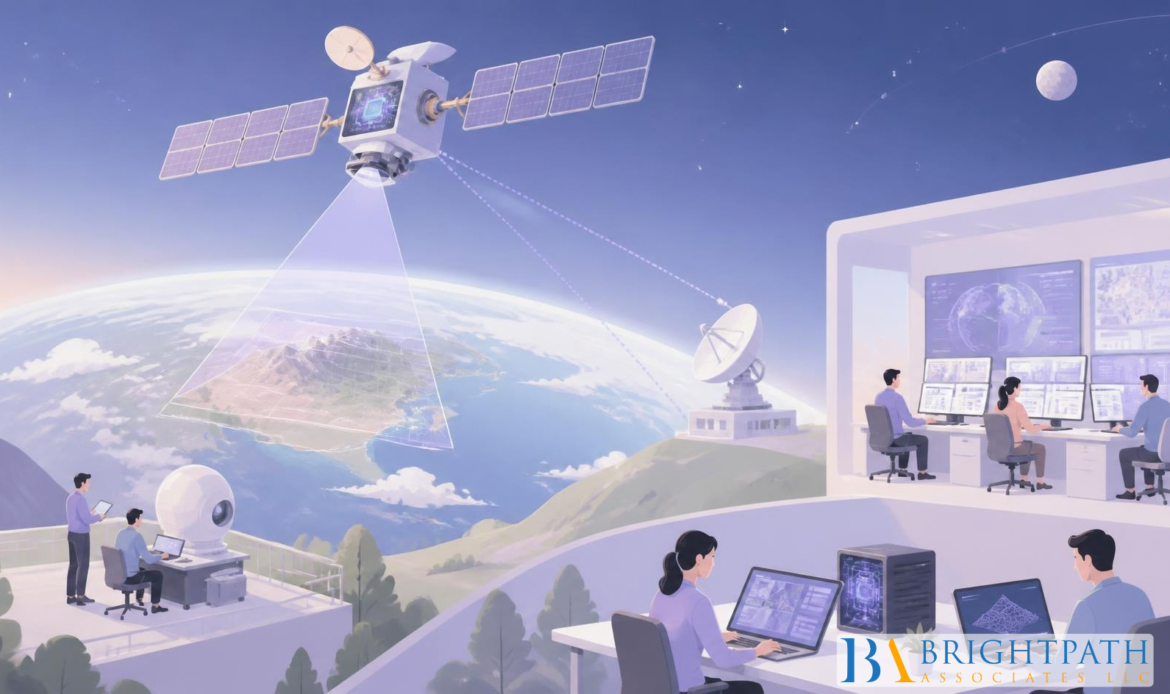
This concept, known as edge computing in space, moves computational capabilities closer to where data is generated. Rather than sending large volumes of unprocessed sensor data through limited communication links, satellites can analyze, filter, compress, classify, and prioritize information before transmitting selected outputs to ground stations.
The approach is becoming increasingly relevant to Defense Space Systems as organizations seek greater responsiveness, resilience, and data efficiency. Improvements in Space Electronics, onboard artificial intelligence, networking, and radiation-tolerant computing are creating new possibilities for processing information beyond Earth.
Edge computing traditionally refers to processing data near its point of generation rather than sending everything to a centralized data center. In an orbital environment, the principle is similar, but the technical constraints are considerably different.
Satellites operate with limited power, thermal capacity, bandwidth, storage, and computational resources. Hardware must also withstand radiation, vibration, extreme temperature variations, and the challenges associated with launch and long-duration operation. These constraints make space-based computing fundamentally different from conventional terrestrial cloud infrastructure.
An orbital edge-computing architecture places processors, accelerators, memory, and specialized software aboard satellites. These systems can process sensor information locally and determine which data requires transmission to Earth.
For ISR missions, this can mean transmitting a concise intelligence product rather than an entire raw sensor collection. The resulting reduction in data volume can improve communication efficiency while potentially reducing the time between observation and operational awareness.
Why Data Efficiency Matters for ISR
ISR systems are becoming increasingly data-intensive. Higher-resolution sensors generate more information, while multi-sensor architectures create additional streams that may need to be correlated. At the same time, satellite communication networks have finite capacity.
Transmitting all raw information can consume valuable bandwidth and introduce delays. In certain mission architectures, data may also need to travel through multiple communication nodes before reaching analysts or decision-makers.
Edge processing changes the workflow. A satellite can examine incoming data and determine whether it contains information relevant to the mission. Algorithms can identify patterns, detect changes, remove redundant information, or prioritize specific observations.
The result is a shift from a “collect everything and process later” model toward a more selective and mission-oriented approach. This does not eliminate the need for ground processing. Instead, it creates a layered architecture in which initial processing occurs in orbit while more complex analysis remains available on the ground.
The development of Defense Space Systems is increasingly influenced by distributed architectures, commercial technologies, software-defined capabilities, and network-centric operations. Instead of relying exclusively on a small number of highly specialized satellites, organizations are exploring architectures involving multiple platforms and interconnected systems.
In such environments, onboard computing becomes particularly important. Satellites may need to process information independently while also exchanging information with other spacecraft.
A distributed constellation can potentially allow different satellites to contribute complementary observations. One spacecraft may identify an area of interest, while another platform collects additional information. Edge computing can support this coordination by enabling satellites to make preliminary decisions without waiting for continuous instructions from Earth.
This creates opportunities for more responsive space architectures while also increasing the importance of interoperability, software development, and secure communications.
Space Electronics as the Computational Foundation
Advanced Space Electronics are central to the development of orbital edge computing. Processing systems must deliver sufficient performance without creating excessive power consumption or thermal loads.
Traditional space-qualified processors have historically prioritized reliability and radiation tolerance over raw computational performance. The growing demand for onboard AI and advanced analytics is encouraging the development of more capable processors, graphics processing units, field-programmable gate arrays, and specialized accelerators.
These components can support tasks such as image preprocessing, object detection, anomaly identification, compression, and sensor fusion. The challenge is achieving these capabilities within the reliability requirements of spacecraft.
Hardware selection therefore involves balancing computational performance, radiation resilience, power consumption, thermal management, size, weight, and lifecycle requirements.
#ArtificialIntelligence is one of the technologies driving interest in onboard processing. Machine-learning models can potentially identify patterns in sensor data without requiring every raw image or signal to be transmitted to Earth.
For example, an onboard system could analyze imagery and identify changes between observations. Instead of sending every image in full resolution, the satellite could prioritize areas where significant changes have been detected.
However, deploying AI in space presents unique challenges. Models must operate reliably on constrained hardware and may need to function despite limited opportunities for software updates. Developers must also account for changes in sensor behavior, environmental conditions, and mission requirements.
Validation is therefore particularly important. An algorithm that performs well in laboratory conditions must be tested against representative operational data and hardware limitations before becoming part of a critical space architecture.
Space Cybersecurity and Trusted Computing
As more processing moves into orbit, Space Cybersecurity becomes increasingly important. A satellite that can independently process and interpret information also becomes a valuable computational and data-management asset that must be protected.
Cybersecurity considerations extend across hardware, software, communications, supply chains, operating systems, firmware, and data pipelines. Secure boot mechanisms, authentication, encryption, access controls, anomaly detection, and secure software-update processes can contribute to a more resilient architecture.
The cybersecurity challenge is particularly significant because satellites can remain operational for many years. Systems designed without adequate mechanisms for updates and security maintenance may become increasingly difficult to protect as threats evolve.
Edge computing can also introduce new attack surfaces. If algorithms or processing systems are compromised, the integrity of the information produced onboard could potentially be affected. Consequently, trusted computing and secure system design need to be considered from the earliest stages of satellite development.
The growth of Space Robotics is another factor influencing the development of autonomous orbital systems. Robotic spacecraft and servicing platforms may eventually need to make decisions with limited communication from ground operators.
Edge computing can provide the computational foundation for these autonomous capabilities. A robotic system could process sensor information locally, assess its surroundings, identify objects, and determine appropriate actions within predefined mission parameters.
This approach can be particularly useful when communication delays or intermittent connectivity make continuous human control impractical. It also reduces the amount of raw sensor data that needs to be transmitted.
As autonomous capabilities expand, engineers will need to establish clear boundaries between automated decision-making and human oversight. Reliability, verification, explainability, and fail-safe mechanisms will remain important considerations.
Defense Simulation and Testing Before Deployment
#DefenseSimulation can play an important role in validating orbital edge-computing architectures. Space-based AI and autonomous systems cannot simply be deployed without extensive testing because physical intervention after launch is extremely limited.
Simulation environments allow engineers to reproduce spacecraft behavior, sensor conditions, communication constraints, computational loads, and potential failure scenarios. Developers can test algorithms against large datasets and examine how systems respond under different operational conditions.
Digital simulation can also support hardware-in-the-loop testing, where actual processors or electronics are incorporated into simulated mission environments. This provides an opportunity to identify performance limitations before launch.
As onboard processing becomes more sophisticated, simulation will become increasingly important for validating not only individual components but entire mission architectures.
The expansion of orbital computing is creating new requirements for Defense manufacturing. Spacecraft manufacturers increasingly need to integrate high-performance computing hardware with conventional satellite subsystems.
This creates opportunities for companies specializing in processors, sensors, radiation-hardened components, thermal systems, power electronics, networking equipment, and embedded software.
Supply-chain resilience is also becoming increasingly significant. Space systems depend on specialized components that may have long procurement cycles or limited sources. Manufacturers must balance performance requirements with availability, qualification standards, and lifecycle support.
The integration of commercial technologies introduces additional considerations. Commercial processors can offer rapid innovation, but adapting them to demanding space environments may require additional qualification, redundancy, or protective measures.
Aerospace Industry Trends and Commercial Innovation
Broader Aerospace industry trends are influencing the development of orbital edge computing. The expansion of commercial satellite constellations, reusable launch systems, standardized spacecraft platforms, and software-defined satellites is changing how space missions are designed.
Commercial companies are increasingly developing technologies that can potentially be adapted for government and defense applications. This creates a more interconnected ecosystem in which government organizations, established aerospace companies, startups, research institutions, and component manufacturers contribute to technological development.
Space Venture Capital is also contributing to this environment by providing funding for companies developing satellite processors, AI software, autonomous systems, sensors, communications infrastructure, and other space technologies.
However, commercial investment does not remove the need for rigorous qualification. Technologies intended for operational defense missions must satisfy mission-specific reliability, security, regulatory, and performance requirements.s
The expansion of autonomous computing in orbit is occurring within a broader environment shaped by Defense Space Policy and international space governance. Governments are developing approaches to address responsible behavior, spectrum usage, satellite operations, debris mitigation, cybersecurity, and commercial participation in space.
Space Regulatory requirements can influence how satellites are licensed, operated, communicated with, and disposed of at the end of their missions. As constellations become more distributed and autonomous, regulatory frameworks may need to address increasingly complex interactions among spacecraft.
Policy discussions also involve questions surrounding data security, commercial-government partnerships, international cooperation, and responsible use of emerging space technologies.
The regulatory environment therefore needs to be considered alongside engineering requirements rather than treated as a separate stage of development.
Investment and Leadership Requirements
The transition toward data-efficient ISR architectures requires more than advanced hardware. Organizations need leaders capable of integrating aerospace engineering, software, cybersecurity, artificial intelligence, manufacturing, procurement, and mission strategy.
This is creating demand for multidisciplinary leadership across the space sector. #ExecutiveSearchRecruitment can help organizations identify executives with experience spanning traditional aerospace operations and emerging digital technologies.
Leadership teams must understand how investments in onboard computing affect the broader architecture. A faster processor alone does not necessarily improve mission performance if sensors, communications, software, cybersecurity, or ground infrastructure remain limiting factors.
Successful transformation therefore requires an integrated approach to technology, organizational capabilities, supply-chain strategy, and long-term mission planning.
Edge computing is likely to become an increasingly important component of future space architectures. As processors become more capable and energy-efficient, satellites may perform increasingly sophisticated analysis before transmitting information to Earth.
Future constellations could combine onboard AI, inter-satellite networking, autonomous tasking, advanced sensors, and secure communications into interconnected systems capable of responding dynamically to mission requirements.
The objective is not simply to put more computing power into orbit. It is to create a more efficient information architecture in which the right data can be identified, processed, prioritized, and delivered at the appropriate time.
Conclusion
The move toward edge computing in orbit represents an important evolution in space-based ISR. By processing information closer to the sensor, defense organizations can explore new approaches to bandwidth management, data prioritization, autonomy, and mission responsiveness.
The technology intersects with Defense Space Systems, Space Cybersecurity, Space Robotics, Space Electronics, Defense Simulation, and Defense manufacturing while also reflecting wider Aerospace industry trends and investment activity. At the same time, Defense Space Policy and Space Regulatory frameworks will continue to influence how these capabilities are developed and deployed.
As orbital systems become increasingly software-defined and interconnected, computational capability will become an integral part of spacecraft architecture rather than a supporting function. Organizations that combine reliable hardware, validated algorithms, secure infrastructure, resilient manufacturing, and experienced leadership will be better positioned to manage the technical complexity of this emerging environment.
Find your next leadership role in Defense and Space Industry today!
Stay informed with the latest insights on Defense and Space Industry!