
Introduction
Manufacturing is entering an era in which physical equipment and #DigitalIntelligence increasingly operate as part of the same production environment. Large manufacturers have been investing in connected factories, simulation platforms, artificial intelligence, and advanced automation for years. However, the same technologies are becoming increasingly practical for small and mid-sized enterprises that need to improve productivity without making disruptive investments in completely new facilities.
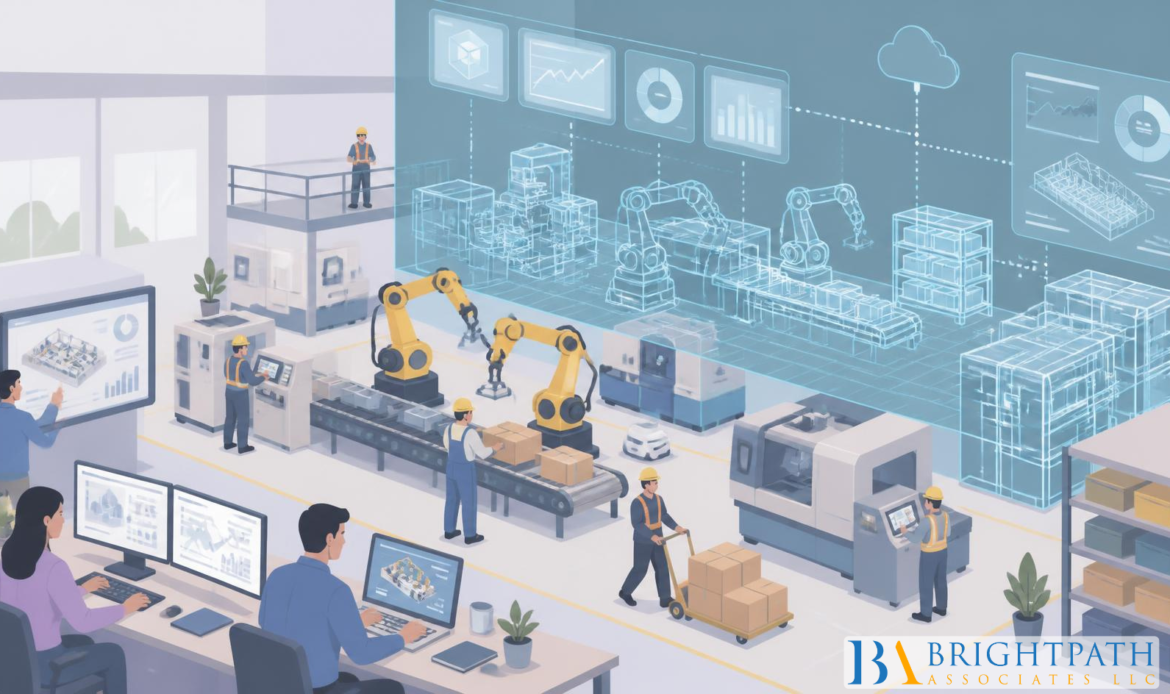
One technology attracting growing attention is the digital twin. A digital twin creates a dynamic digital representation of a physical machine, production process, production line, or factory environment. Unlike a static 3D model, a manufacturing digital twin can incorporate operational data, allowing companies to monitor performance, simulate changes, identify bottlenecks, and evaluate potential improvements before making physical changes.
For SMEs, the opportunity is particularly significant. Instead of replacing an entire factory, manufacturers can begin with one machine, one production cell, or one recurring operational challenge. This focused approach can help companies understand where digital twins can create measurable value while limiting implementation complexity.
A digital twin connects the physical and digital sides of manufacturing. Data from machines, sensors, production systems, maintenance records, and other operational sources can be used to create a digital representation of what is happening on the factory floor.
The purpose is not simply to visualize equipment. The real value comes from using the digital environment to answer practical manufacturing questions. A company may want to know how a new production sequence will affect throughput, whether adding another machine will eliminate a bottleneck, or what could happen if a critical machine becomes unavailable.
Modern digital twin technology increasingly combines real-time data, simulation, analytics, and automation. Research published in 2026 describes industrial digital twins as systems that integrate sensing, modeling, simulation, data fusion, and intelligent decision-making to support manufacturing and asset management.
For an SME, this creates an opportunity to move from reactive decision-making toward more predictive and scenario-based operations.
Start With a Specific Factory Problem
The first practical step toward implementing a digital twin is not purchasing software. It is identifying the business problem the technology needs to solve.
An SME may experience frequent downtime on a critical machine, inconsistent production throughput, excessive changeover time, inefficient material movement, or difficulty determining whether additional equipment is necessary. These problems can become the starting point for a digital twin project.
For example, a manufacturer involved in Precision machining could create a digital representation of a high-value machining cell. The model could incorporate cycle times, machine utilization, production schedules, tooling information, and equipment availability. Management could then simulate different production scenarios before changing the physical process.
This approach keeps the technology connected to business objectives. Rather than creating a digital twin simply because it is a modern technology, manufacturers can evaluate whether it solves a specific operational challenge.
Before creating a digital twin, manufacturers need a clear understanding of their existing factory environment. This includes production equipment, machine controllers, sensors, software platforms, maintenance systems, production schedules, quality records, and material flows.
Many SMEs already have substantial amounts of operational data. The problem is often that this information exists in disconnected systems. Machine data may remain within individual controllers, maintenance records may be stored separately, and production information may exist within ERP or manufacturing execution systems.
The digital twin project should therefore begin by identifying what data already exists and determining how different systems can communicate.
This assessment is especially important for US Machinery manufacturers operating facilities that combine modern connected equipment with older Industrial machinery. Legacy machines should not automatically be considered unsuitable for digital transformation. Additional sensors, gateways, or connectivity technologies can sometimes provide the information required to incorporate older assets into a broader digital environment.
Build a Digital Twin Around High-Value Assets
Not every machine requires the same level of digital modeling. SMEs should prioritize equipment that has a meaningful impact on production, quality, cost, or customer delivery.
A high-value #CNCMachine, automated production cell, robotic assembly station, or critical packaging line may provide a stronger starting point than an asset with limited operational importance.
The level of detail should also match the objective. A manufacturer interested in production scheduling may need information about cycle times, capacity, and machine availability. A company focused on maintenance may need information about vibration, temperature, operating hours, load conditions, and historical failures.
The digital twin should therefore be designed around the decisions management wants to make.
Digital twins become particularly powerful when they are connected with Industrial automation solutions. Automation systems generate valuable information about machine status, production cycles, alarms, process parameters, and equipment performance.
When this information is connected to a digital model, manufacturers can simulate how automation changes could affect the broader production environment.
For example, a manufacturer considering a robotic system could model robot movements, conveyor speeds, workstation locations, production sequences, and operator interactions before installing the equipment. The digital environment can reveal potential bottlenecks or layout problems before physical implementation.
This makes digital twins valuable not only after automation has been installed but also during the planning and engineering stages.
Using Digital Twins to Improve Machinery Maintenance
Machinery maintenance is another practical application for SMEs. Unexpected equipment failures can create significant production disruption, particularly when a company depends on a small number of critical machines.
A digital twin can combine machine operating information with maintenance history to provide a clearer picture of asset health. Instead of relying exclusively on fixed schedules, maintenance teams can use operational data to understand how equipment is actually being used.
This can support more informed maintenance planning and help organizations identify assets that require closer attention.
Recent research specifically examining digital twins for SME maintenance identifies limited resources, skilled-person shortages, and inadequate IT infrastructure as important challenges for smaller manufacturers. The research proposes modular approaches that allow digital twin capabilities to be aligned with an SME’s specific requirements rather than requiring an unnecessarily complex system.
For smaller companies, this reinforces an important principle: digital twin implementation should be scalable and practical.
One of the most valuable capabilities of a digital twin is scenario simulation. Manufacturers can create alternative production scenarios and compare their potential impact before making changes to the physical factory.
Consider a company that is preparing to introduce a new product. Management may need to determine whether current equipment can handle the additional production volume. A digital twin can help model different schedules, machine allocations, production sequences, and capacity assumptions.
Similarly, a manufacturer considering a factory layout change can simulate equipment positioning and material movement before physically relocating machines.
Research into digital twins for manufacturing has demonstrated their potential for evaluating changes involving robot paths, conveyor speeds, process sequences, equipment layouts, throughput, cycle times, and resource utilization.
This reduces reliance on trial and error and gives management a structured environment for evaluating operational alternatives.
Digital Twins and Manufacturing Efficiency
The ultimate objective should be measurable Manufacturing efficiency. A digital twin should help manufacturers improve the way resources, machines, people, materials, and time are utilized.
Manufacturers can use #DigitalModels to examine machine utilization, production throughput, bottlenecks, changeover times, energy consumption, and scheduling performance.
For SMEs, even relatively small improvements can have an important financial effect because production capacity is often constrained by limited equipment and workforce availability. If a digital twin identifies a way to increase throughput using existing assets, the company may be able to delay or reduce the need for additional capital expenditure.
The technology can therefore support continuous improvement rather than simply serving as a visualization platform.
The decision to purchase Used machinery can also benefit from digital modeling. Used equipment can provide manufacturers with a way to expand capacity while controlling capital expenditure, but its value depends on how well it fits into the existing production environment.
Before purchasing equipment, an SME could model the expected machine capacity, cycle time, footprint, production sequence, and interaction with existing equipment.
This provides a broader perspective than evaluating the machine based solely on purchase price or technical specifications. A machine that appears inexpensive may not provide meaningful value if it creates a bottleneck elsewhere in the production process.
Digital simulation can help management evaluate the equipment as part of the complete factory system.
Supporting Smarter Machinery Financing Decisions
Capital investment decisions require careful consideration, particularly for smaller manufacturers. Machinery financing can influence cash flow, expansion plans, production capacity, and long-term competitiveness.
Digital twins can provide an operational layer to these financial decisions. Before financing a new machine, management can simulate how the equipment could affect production capacity, utilization, throughput, and scheduling.
This does not replace financial modeling. Instead, it provides additional operational information that can make investment discussions more informed.
For example, if a digital simulation shows that a new machine would remain underutilized because another process remains a bottleneck, management may need to reconsider the sequence of investments.
Technology adoption also changes the skills required on the factory floor. Manufacturing jobs are increasingly connected with automation, data interpretation, machine monitoring, digital systems, and advanced equipment.
Operators may need to understand digital dashboards and automated systems. Maintenance professionals may increasingly work with sensor information and predictive analytics. Production managers may use simulations to evaluate scheduling decisions.
This does not mean traditional manufacturing expertise is becoming less important. Instead, technical knowledge and digital capabilities are becoming increasingly interconnected.
Manufacturers that invest in digital twins should therefore consider employee training alongside technology implementation. The value of a digital system depends heavily on whether the people using it understand its purpose and can incorporate its insights into daily decisions.
Leadership and Executive Talent Become More Important
#DigitalTransformation is ultimately an organizational challenge as much as a technical one. A digital twin may provide sophisticated information, but leadership must determine how that information influences production planning, maintenance, investment, workforce development, and continuous improvement.
As the Industrial machinery industry becomes more technology-intensive, companies may need leaders who can bridge manufacturing operations and digital transformation.
#ExecutiveSearchRecruitment can support this transition when companies require specialized leadership with experience across engineering, automation, manufacturing operations, analytics, and organizational change.
The objective is not simply to recruit technology specialists. Manufacturing organizations need leaders who understand how technology can contribute to measurable business outcomes.
A successful SME does not need to digitize its entire factory simultaneously. A phased approach can make implementation easier to manage.
The first stage should involve assessing current processes, identifying the most important operational problem, and determining whether sufficient data exists to build a useful model. The next stage can focus on one machine, production cell, or process.
Once the model has been validated, manufacturers can introduce scenario simulation and connect additional data sources. The digital twin can then expand into areas such as maintenance, scheduling, quality management, energy optimization, and production planning.
This gradual approach also allows employees to develop familiarity with the technology while management evaluates measurable results.
Conclusion
Digital twins are becoming a practical tool for SMEs that want to simulate, understand, and optimize their factory operations without relying exclusively on physical experimentation. By connecting Industrial machinery with operational data, simulation, automation, and analytics, manufacturers can create a more informed approach to production management.
For US Machinery manufacturers, the technology can support decisions involving Precision machining, Industrial automation solutions, Machinery maintenance, Used machinery, and Machinery financing. It can also influence how companies approach Manufacturing efficiency, workforce development, and future Manufacturing jobs.
The most successful implementations will not necessarily be the most complicated. They will be the ones that begin with a clear business problem, use reliable data, involve employees, and connect digital capabilities with measurable operational objectives.
For SMEs, the digital twin should therefore be viewed not as a futuristic replacement for the factory floor, but as a practical decision-making environment. When implemented strategically, it can help manufacturers test possibilities, identify constraints, optimize existing assets, and build a more responsive production operation.
Find your next leadership role in Machinery Industry today!
Stay informed with the latest insights on Machinery Industry!