
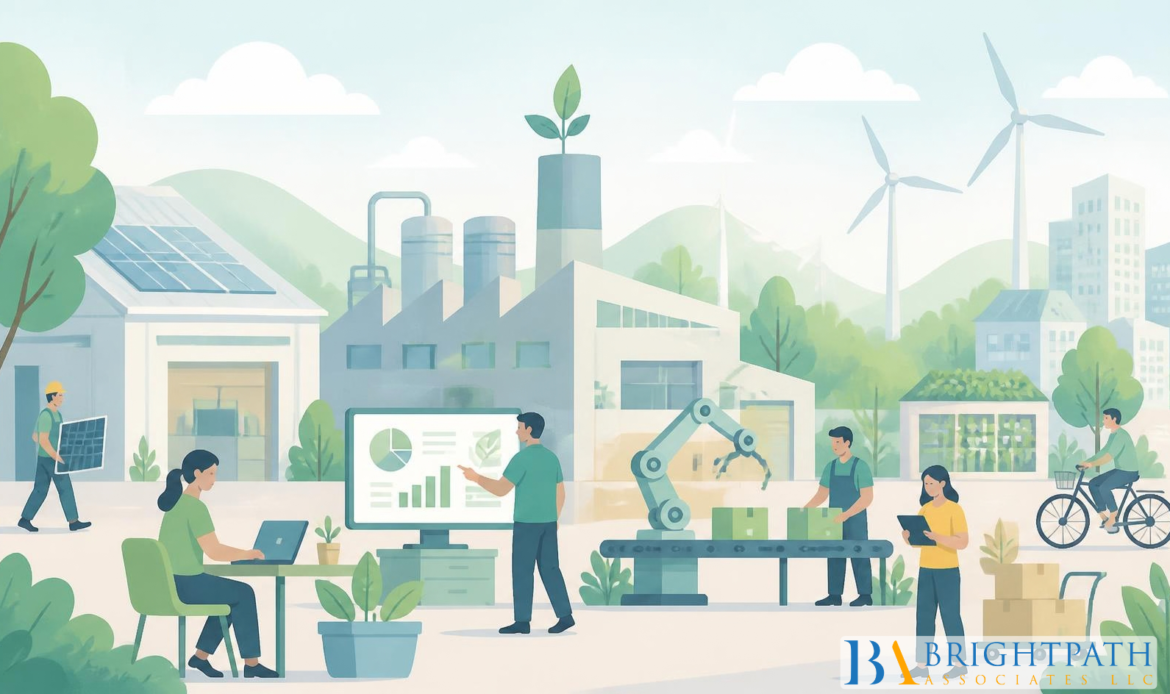
[Bethany, Connecticut – 07 October 2026] – BrightPath Associates has highlighted innovative strategies that can help small and mid-sized enterprises (SMEs) separate business growth from rising carbon emissions. The latest analysis examines how companies can combine operational efficiency, clean technology, resource management, and environmental innovation to reduce their environmental impact while maintaining competitiveness in a changing global market.
For C-suite leaders in the Environmental Services Industry, the challenge is becoming increasingly strategic. Businesses are facing pressure from customers, investors, regulators, employees, and supply-chain partners to demonstrate measurable progress toward Environmental sustainability. Rather than viewing decarbonization solely as a cost, SMEs can use it as an opportunity to improve efficiency, strengthen resilience, manage risk, and develop new sources of value.
Why Decoupling Growth From Carbon Matters
Economic growth has traditionally been closely associated with increased energy use and resource consumption. However, advances in technology and changes in business models are creating opportunities for companies to grow while reducing emissions intensity. BrightPath Associates’ analysis, “Decoupling Growth From Carbon: Innovative Strategies for SMEs,” explores how smaller businesses can adopt practical approaches without requiring the financial resources of large corporations.
The article emphasizes that decoupling does not mean stopping growth. Instead, it involves finding more efficient ways to produce goods and services while reducing carbon emissions and resource consumption. Energy-efficient equipment, renewable energy, digital monitoring, waste reduction, process optimization, and improved supply-chain management can all contribute to this transition.
For executives, this approach can also strengthen long-term business resilience. Companies that reduce energy dependence, improve resource efficiency, and prepare for evolving environmental requirements may be better positioned to manage future operating costs and regulatory expectations. The detailed analysis of Decoupling Growth From Carbon Through Innovative Strategies for SMEs provides additional insight into these opportunities.
Environmental Innovation Creates New Business Opportunities
Environmental innovation is increasingly influencing how businesses approach products, services, production systems, and customer relationships. SMEs can use innovation to identify areas where environmental improvements also create operational or commercial benefits.
The adoption of Clean technology is one important pathway. Businesses can explore energy-efficient systems, renewable power, smart monitoring technologies, low-emission equipment, and digital tools that improve resource utilization. Green technology can also support companies in reducing waste, lowering energy consumption, and developing more sustainable products and processes.
These opportunities extend across the broader Environmental industry. Solutions involving Air pollution control, Water treatment, waste management, environmental monitoring, and resource recovery are becoming increasingly important as organizations seek to meet sustainability objectives. Companies operating in these areas can help other businesses achieve measurable environmental improvements while creating new markets for innovative solutions.
Compliance and Sustainability Become Executive Priorities
Environmental performance is also closely connected to regulatory and reputational risk. Environmental compliance requires organizations to understand applicable standards, monitor operations, maintain accurate records, and respond to changing requirements. For SMEs with limited internal resources, establishing practical systems for monitoring environmental performance can be particularly important.
The expanding Environmental Services Industry is helping organizations address these challenges through specialized expertise, technology, consulting, monitoring, and operational services. For C-suite executives, partnerships with experienced environmental service providers can provide access to knowledge and capabilities that may be difficult to build internally.
At the same time, sustainability initiatives need clear business objectives. Executives can evaluate environmental programs based on factors such as energy savings, resource efficiency, operational improvements, compliance risk, customer expectations, and long-term resilience. This helps position sustainability as a business strategy rather than an isolated corporate initiative.
About BrightPath Associates
BrightPath Associates is an executive recruitment and talent solutions firm serving organizations across the United States and multiple industries. The company helps businesses identify experienced executives and specialized professionals who can support growth, innovation, operational performance, and long-term organizational success. BrightPath Associates is committed to connecting businesses with the talent needed to navigate changing markets and achieve strategic goals.
Media Contact:
Name: Corporate Communications Team
Company: BrightPath Associates
Email: media@brightpathassociates.com
Website: https://brightpathassociates.com