
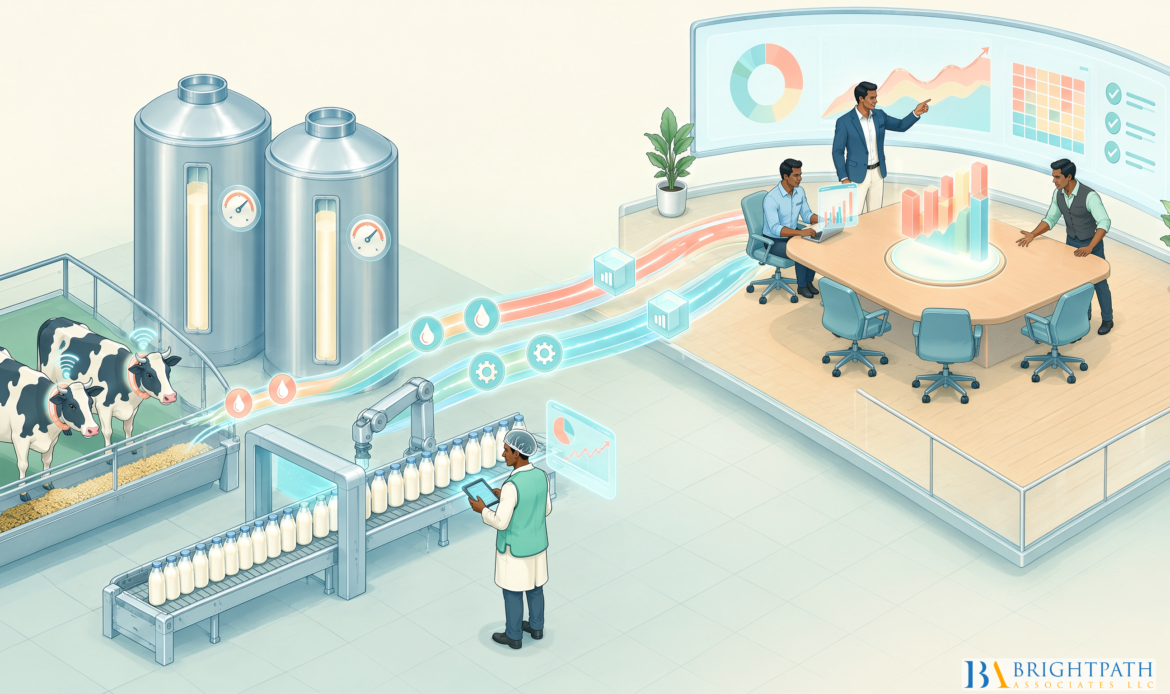
Data-Driven Dairy: Transforming Raw Metrics into C-Suite Decision Intelligence for Dairy industry is not mainly about collecting more sensor readings. It is about deciding which signals deserve attention, connecting them to #FinancialOutcomes, and assigning leaders the authority to act. A dairy may have milk-yield records, wearables, laboratory results, feed data, labor schedules, and plant reports. Yet executives still face a harder question: Which changes will protect margin, capacity, animal welfare, and customer service this week?
The difference between data collection and decision intelligence is material. A health alert may be useful to a herd manager. For a COO or CEO, its value depends on whether it changes treatment timing, milk quality exposure, labor allocation, replacement decisions, or production forecasts. For a CFO, it must eventually connect to cost, cash flow, capital spending, or risk.
Table Of Contents
• From Raw Signals To Executive Decisions
• Building A Dairy KPI Hierarchy That Executives Can Use
• Managing Investment, Governance, And Leadership Capacity
• Key Takeaways
• Frequently Asked Questions
• Resources And Citations
From Raw Signals To Executive Decisions
Define Decision Intelligence Before Buying Another Tool
#DecisionIntelligence is the disciplined use of data analytics, business rules, forecasts, and human judgment to make a specific decision. In dairy operations, it links cow-level and plant-level signals to enterprise choices.
The usual mistake is beginning with technology. A better starting point is a decision map: identify the recurring decision, the owner, the time window, the required evidence, and the financial or operational result. If an alert cannot change a decision, it may belong in a historical report rather than an executive dashboard.
Consider a rise in conductivity readings from a milking system. That signal alone does not tell the C-Suite what to do. A usable decision chain looks more like this:
| Decision Layer | Question | Example Evidence | Business Outcome |
|---|---|---|---|
| Signal | What changed? | Conductivity readings rise in a pen | Possible health exception |
| Validation | Is the signal reliable? | Sensor calibration, treatment history, milk test results | Lower false-alert risk |
| Operational action | What must happen now? | Inspect specified animals and revise milking workflow | Faster intervention |
| Financial translation | What is at stake? | Potential discarded milk, treatment cost, output loss | Margin protection |
| Executive decision | Does this require a broader response? | Repeated events by site, shift, equipment, or supplier | Capital, staffing, or process decision |
This is why dashboards built around volume often disappoint. A page with 80 charts can make an operation appear informed while delaying action. Exception management is more useful: show leaders the deviations that are material, explain the likely driver, and specify who owns the next decision.
Use Analytics In The Right Order
Descriptive analytics explains what happened. Predictive analytics estimates what may happen next. Prescriptive analytics recommends an action within constraints such as labor, treatment protocols, capacity, and cost. Dairy Brain, a dairy decision-support framework, describes the use of an agricultural data hub and API to connect multiple sources for these descriptive, predictive, and prescriptive applications. The Dairy Brain framework for integrated dairy analytics is useful because it treats the architecture and the decision as connected problems.
Executives should resist skipping straight to prescriptive systems. A recommendation is only as dependable as its data, definitions, and operating rules. If milk components are recorded differently across sites, or if feed-cost data arrive after the decision window has passed, a highly polished prediction can still lead to the wrong action.
For example, a model may predict lower production next month. That forecast is useful only if managers can separate a weather effect, ration issue, reproduction pattern, equipment constraint, or data-entry error. The executive response differs in each case. One may require feed procurement; another may require maintenance; another may require no action at all.
Put Confidence Gates In Front Of Automated Actions
AI and #PredictiveModeling can help prioritize health, welfare, production, and maintenance exceptions. They should not automatically replace judgment in decisions with significant animal, financial, or customer consequences.
A confidence gate is a rule that determines whether an alert is informational, requires human review, or can initiate a preapproved workflow. The threshold should reflect the cost of being wrong. A low-risk reminder to inspect a sensor can have a lower threshold than a recommendation to alter treatment or commit capital.
A practical gate includes three checks:
- Data completeness: Are the required readings present and recent?
- Model validity: Has the prediction been checked against current conditions, not just past data?
- Action cost: What is the consequence of a false positive or a missed event?
No universal threshold exists for dairy AI alerts. A large operation with trained analysts may review more exceptions centrally. A smaller dairy with limited connectivity may need simpler rules and a narrower alert set. The correct design is not the one with the most automation. It is the one operators can trust and use consistently.
Building A Dairy KPI Hierarchy That Executives Can Use
Start With Enterprise Outcomes, Not Device Outputs
A sensor may report rumination minutes. A robotic milking system may report visits and throughput. A plant system may report yield, downtime, and quality results. These measures matter, but executives need a hierarchy that rolls operational signals into a limited set of business outcomes.
An executive KPI hierarchy can connect four levels:
| Level | Typical Metrics | Primary Decision Owner | Executive Question |
|---|---|---|---|
| Animal and equipment | Activity, rumination, milk flow, temperature, alerts | Herd manager, veterinarian, maintenance lead | What needs immediate attention? |
| Process | Pregnancy rate, somatic cell count, feed conversion, parlor throughput, downtime | Operations leader | Where is performance drifting? |
| Financial | Cost per hundredweight, labor cost, discarded milk, maintenance spend, working capital | CFO, COO | What is changing margin or cash? |
| Strategic | Capacity, customer service, capital return, supply resilience, risk exposure | CEO, board, C-Suite | What should the business fund, change, or stop? |
The hierarchy does not mean every metric must be perfect before leaders act. It means every major KPI needs a clear definition, accountable owner, refresh frequency, and lineage. Data lineage records where a metric originated and how it was transformed. Without it, a CFO cannot tell whether an apparent cost improvement reflects real performance, an accounting timing difference, or a revised data rule.
For an operational perspective, enhancing efficiency in dairy farm operations offers related context on connecting process improvements to farm performance.
Choose CEO, COO, And CFO Measures Differently
A CEO dashboard should focus on material exceptions, strategic capacity, market exposure, capital priorities, and enterprise risk. It should not replicate the herd manager’s daily screen.
A COO needs leading indicators that reveal whether production and quality targets are at risk before month-end. Examples may include equipment downtime patterns, missed milking events, labor coverage, quality deviations, and supply-chain constraints.
A CFO needs measures that translate operations into economic terms. Useful questions include:
• Is cost per hundredweight improving because of durable operational change or because of a temporary input-price movement?
• What is the cost of discarded milk, rework, downtime, overtime, or delayed shipments?
• Which technology investments have measurable maintenance, training, financing, and replacement costs?
• How sensitive is projected cash flow to production volume, quality outcomes, and customer demand?
This role-based design prevents dashboard fatigue. If everyone receives the same report, leaders either ignore it or spend time reconciling numbers that were never intended for their decisions.
Connect Farm, Plant, And Supply Chain Metrics
#DairyIndustry digital transformation often stalls at the boundary between systems. Herd records, milk testing, processing, logistics, finance, and customer demand may each sit in separate platforms. The problem is not merely technical connectivity. It is semantic interoperability: whether “yield,” “loss,” “inventory,” or “quality event” means the same thing across the business.
A 2025 review of dairy data integration identifies inconsistent formats, proprietary concerns, infrastructure barriers, and limited interoperability as major constraints. It also points to common exchange standards, APIs, and clearer distinctions among raw, processed, and analyzed data as pathways forward. Research on dairy data-integration barriers and exchange pathways supports treating integration as an executive governance issue, not an IT afterthought.
For example, a production forecast may show sufficient raw milk volume while a transportation disruption threatens customer fulfillment. If supply-chain data are isolated, the company can optimize the farm and still disappoint a buyer. Leaders examining building strength in the dairy sector should consider whether their information model connects product availability, transportation risk, and customer commitments early enough to act.
Managing Investment, Governance, And Leadership Capacity
Evaluate Technology As A Business Case
Precision-dairy adoption has grown in the United States, but adoption alone does not prove that a particular system will pay back for every operation. USDA Economic Research Service research found that robotic milking was associated with average net returns that were $3.15 per hundredweight higher than for nonadopters after accounting for farm and operator characteristics. Farms using more than one specified precision technology showed an average $3.18 per hundredweight difference. USDA ERS estimates of precision-dairy net-return differences provide a useful benchmark, not a guaranteed return for an individual buyer.
A sound investment case should calculate annual benefit against the full cost of ownership:
- Estimate benefits from labor changes, production gains, lower losses, quality protection, maintenance avoidance, or improved capacity.
- Include installation, software, integrations, training, financing, maintenance, cybersecurity, and eventual replacement costs.
- Test assumptions under weaker milk prices, higher labor costs, connectivity failure, and slower adoption by managers.
- Define the decision point: proceed, pilot, renegotiate, or stop.
The break-even question is simple: How much recurring economic improvement must this system produce to cover its annualized cost? The inputs are not always simple. A system that saves labor but adds vendor-management time and analyst workload may have a very different return than its sales presentation suggests.
USDA ERS also documents the growth of U.S. precision-dairy adoption and the technologies shaping cow-level management and profitability. USDA ERS research on precision dairy farming and profitability reinforces the need to evaluate returns in the context of each farm’s scale, management model, and operating constraints.
For executives assessing margin priorities, actionable solutions for dairy farm profitability addresses related operational and financial considerations.
Treat Data Rights And Vendor Exit As Board-Level Risks
A vendor’s claim that it has an API is not enough. Procurement should establish what data can be extracted, how frequently, in what format, at what cost, and whether historical records remain accessible after a contract ends.
The contract should answer these questions:
• Who owns raw device data, processed records, derived scores, and aggregated benchmarks?
• Can the dairy export data in a documented format without a proprietary application?
• Does the vendor disclose API limits, service levels, data-retention terms, and cybersecurity responsibilities?
• What happens to data access, integrations, and historical records if the vendor is acquired or the agreement ends?
• Can the company audit the metric definitions used in executive reports?
These terms affect strategic control. A dairy that cannot retrieve its history may be unable to change vendors without losing trend analysis and operational context. That is an investment risk, not a minor technology inconvenience.
Build The Leadership Model Around Decisions, Not Software
Data-driven dairy changes executive requirements. The organization may need leaders who can connect food technology, milk production technologies, dairy automation technologies, finance, quality systems, sustainable dairy farming practices, and supply-chain strategy. It may also need specialists in data engineering, cybersecurity, food safety, plant operations, or #DigitalProductManagement.
The leadership challenge is not solved by hiring a single “data person.” A CIO without operational credibility may struggle to gain adoption. An operations leader without analytical support may be overwhelmed by vendor outputs. A CFO may correctly demand ROI but lack the operational data needed to validate assumptions.
A stronger model assigns clear roles:
| Responsibility | Leadership Need | Core Accountability |
|---|---|---|
| Decision ownership | COO, farm leader, plant leader | Act on validated exceptions and improve workflows |
| Economic accountability | CFO or finance leader | Confirm costs, benefits, and capital-return assumptions |
| Data governance | CIO, technology leader, or assigned owner | Maintain definitions, access controls, lineage, and quality standards |
| Talent and adoption | CEO, HR leader, functional executives | Build training, incentives, and succession plans |
A U.S. survey of dairy producers found substantial precision-technology adoption among respondents, while also reporting that analyzing the resulting information requires significant time. The U.S. survey of precision-dairy adoption and analysis burden highlights a practical talent issue: data capture can expand faster than management capacity.
For executive hiring, the relevant question is not whether a candidate has used a dashboard. It is whether that leader has the judgment to define decisions, challenge weak inputs, align operating teams, and turn information into accountable action. Specialized dairy industry executive search may be justified when a vacancy combines operational leadership with data, automation, quality, or supply-chain requirements that conventional recruiting channels do not reach reliably.
Key Takeaways
• Data is not decision intelligence until it changes an accountable action. Start with decisions and economic outcomes, then identify the required data.
• Executive dashboards should emphasize exceptions. A CEO, COO, and CFO need different views of the same operating reality.
• Predictive models need confidence gates. Validate inputs, monitor performance, and keep human review for high-consequence decisions.
• Technology ROI must include the full cost of ownership. Integration, training, maintenance, financing, and replacement can materially change payback.
• Interoperability and data ownership are strategic risks. APIs, export rights, metric definitions, and exit terms belong in procurement and board discussions.
• Leadership capacity is a constraint. Digital dairy programs require operating, financial, technical, and people leaders who can work from shared definitions.
Frequently Asked Questions
What Does Data-Driven Dairy Mean In Practical Business Terms?
It means using connected operational, financial, quality, and supply-chain information to make better decisions about margin, production, labor, animal welfare, capacity, and risk. The practical test is whether the data changes a decision in time to affect the outcome.
Which Dairy KPIs Should Appear On A CEO Dashboard?
A CEO dashboard should focus on enterprise outcomes: margin trends, production and capacity risk, major quality exceptions, customer service exposure, capital performance, labor constraints, and supply-chain disruptions. Detailed animal and equipment metrics should appear only when they create a material executive exception.
What Metrics Matter Most To A Dairy CFO?
Cost per hundredweight, labor cost, discarded milk, downtime cost, maintenance expense, working-capital exposure, capital payback, and forecast sensitivity are common priorities. The exact mix depends on whether the business operates farms, plants, branded dairy products, e-commerce channels, or a combination of these models.
How Should A Dairy Calculate ROI For Sensors Or Robotic Milking?
Estimate recurring benefits, subtract all recurring and one-time costs, then compare the annual net benefit with the investment. Include integration, training, financing, maintenance, data infrastructure, and replacement assumptions. Test the model under less favorable production, labor, and milk-price conditions before approving the purchase.
Why Do Dairy Data Systems Fail To Integrate?
Common causes include proprietary formats, weak APIs, inconsistent definitions, delayed data feeds, limited connectivity, and unclear ownership rights. Integration can also fail when teams connect systems technically but never agree on what each #BusinessMetric means.
Who Owns Dairy Data Generated By Sensors And Vendors?
There is no single universal answer. Ownership, access, use, retention, and export rights should be defined in contracts. Executives should distinguish raw data, vendor-processed data, derived analytics, and aggregated benchmark data rather than assuming they are governed the same way.
When Should A Manager Trust An Automated Recommendation?
Trust should depend on data completeness, model performance under current conditions, and the cost of error. Low-risk operational prompts may be automated. High-impact health, treatment, capital, or customer-service decisions should retain human review unless the organization has validated the system and established clear escalation rules.
Resources And Citations
• USDA Economic Research Service — Precision Dairy Farming, Robotic Milking, and Profitability in the United States: https://ers.usda.gov/publications/113704
• USDA Economic Research Service — Robotic milking and other precision dairy technologies improve dairy farmer profitability: https://www.ers.usda.gov/data-products/charts-of-note/114210
• PubMed Central — Data Integration and Analytics in the Dairy Industry: https://pmc.ncbi.nlm.nih.gov/articles/PMC11816260/
• Journal of Dairy Science — Symposium review: Dairy Brain—Informing decisions on dairy farms using data analytics: https://www.journalofdairyscience.org/article/S0022-0302(20)30145-4/fulltext
• PubMed — A survey of US Dairy farmer perception and adoption of precision dairy technologies: https://pubmed.ncbi.nlm.nih.gov/42219012/
• BrightPath Associates — Enhancing Efficiency in Dairy Farm Operations: https://brightpathassociates.com/enhancing-efficiency-in-dairy-farm-operations/
Find your next leadership role in Dairy Industry today!