
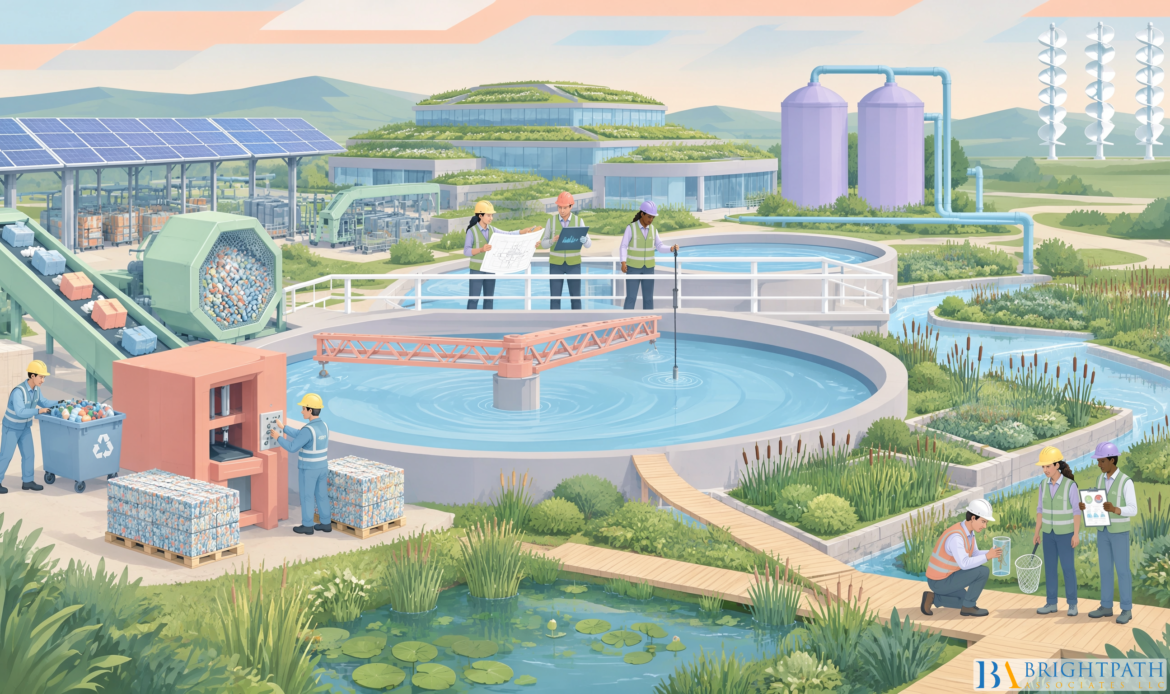
Beyond Triple Bottom Line: Creating Shared Value in Environmental Services for Environmental Services is not simply a new label for sustainability. It is a tougher operating question: can a #WaterTreatment, remediation, air pollution control, waste, or restoration service create measurable business value while improving ecological conditions and producing fairer outcomes for the people affected?
For environmental-services companies, the answer depends less on public commitments than on contract design, operating discipline, and leadership. A project can reduce emissions or restore habitat yet still fail the shared-value test if benefits are temporary, costs are shifted to a community, or the provider cannot sustain a viable business model. We see this as a leadership issue as much as an environmental one.
Table Of Contents
• Why Triple Bottom Line Is Not Enough
• Designing Environmental Services That Create Shared Value
• Leadership And Talent Requirements
• Key Takeaways
• Frequently Asked Questions
• Resources And Citations
Why Triple Bottom Line Is Not Enough
From Balanced Reporting To Operating Choices
The Triple Bottom Line asks organizations to consider economic, social, and environmental performance together. That remains useful, but it can become a reporting exercise: three columns of indicators, three separate objectives, and no clear explanation of how one operating decision improves all three.
Creating Shared Value, or CSV, asks a sharper question. Does solving an environmental or social problem improve the company’s competitive position through its core business? Maastricht University’s ICIS material describes CSV as an approach that creates economic value while addressing social and environmental problems through the same activity. The ICIS discussion of Creating Shared Value is useful because it places the environmental issue inside the business model rather than outside it as a charitable add-on.
For an environmental-services provider, that distinction matters. A contractor that helps an industrial customer meet a permit condition may deliver an important service. But shared value is stronger when the same service also reduces operating risk, lowers resource losses, improves public health protections, develops local technical capability, or restores an ecological function that supports the surrounding area.
Shared Value Is Not The Same As Shared Values
#EnvironmentalServices involve two related ideas that should not be blended together. CSV concerns the connection between business competitiveness and social or environmental improvement. Shared environmental values concern how groups understand and prioritize ecosystems, places, risks, and benefits.
A watershed restoration plan illustrates the difference. A provider may have a CSV case if restoration services create recurring revenue while reducing a utility’s treatment risk and improving water quality. Yet the community may value the watershed for recreation, cultural meaning, flood protection, or habitat. Those values cannot always be reduced to a single dollar amount or a customer’s willingness to pay.
That is why a technically sound financial model can still fail socially. If project sponsors count only savings to a utility but ignore access, displacement, or local land-use concerns, they may confuse a profitable service with shared value. Stakeholder deliberation is not ceremony. It is a way to identify the benefits and harms that standard project finance may miss.
The Environmental Services Test
We recommend using a simple pass-or-revise test before calling an initiative shared value. The service should meet all four conditions below.
| Test | Decision Question | Warning Sign |
|---|---|---|
| Core-business fit | Is the environmental outcome produced through the company’s primary service, technology, or operating capability? | The initiative sits only in corporate giving or communications. |
| Economic durability | Is there a credible revenue, savings, risk-reduction, or asset-value mechanism for the provider and buyer? | The model depends indefinitely on unpriced goodwill. |
| Ecological additionality | Is the improvement beyond the baseline, legal minimum, or activity that would have occurred anyway? | Benefits are claimed without a baseline or counterfactual. |
| Fair benefits incidence | Can decision-makers explain who receives benefits, who pays, and who bears remaining risk? | Community costs are treated as external to the business case. |
The fourth test is often the neglected one. A waste-processing facility may improve regional diversion rates but increase truck traffic and air quality burdens in one neighborhood. The project may still be worthwhile, but it should not be described as broadly shared value unless those burdens are addressed through siting, operations, monitoring, compensation, or an alternative design.
Designing Environmental Services That Create Shared Value
Start With The Service Value Chain
A shared-value contract begins by mapping the full delivery chain rather than stopping at the buyer and provider. For water treatment, that chain can include equipment suppliers, plant operators, #IndustrialCustomers, municipal regulators, ratepayers, nearby residents, upstream land managers, and downstream ecosystems.
For each group, document four things: what it contributes, what it gains, what it risks, and how results will be verified. This benefits-incidence map makes distribution visible before capital is committed.
Consider a hypothetical industrial water-reuse service. The client may gain more reliable supply and lower discharge exposure. The provider may earn recurring service revenue. The community may gain lower pressure on a local source, but only if reclaimed-water handling does not create new exposure risks. The ecosystem may gain from reduced withdrawals, provided the baseline withdrawal level is established. The design cannot be judged from one metric alone.
This is also where clean technology and green technology become commercially relevant. They are not valuable merely because they are newer. They are valuable when their monitoring, treatment, separation, control, or recovery capabilities change the economics and assurance of the service itself. For a related leadership perspective, see BrightPath Associates’ green technology accelerates environmental innovation.
Build Additionality And Attribution Into The Contract
Environmental claims become weak when a company measures only the final condition. If emissions declined, did the installed air pollution control system cause the decline? Did production slow? Did a new regulation require the change? Did another party fund or operate the intervention?
Additionality asks whether the project produced improvement beyond a credible baseline. Attribution asks how much of the observed improvement the provider’s action caused. Neither requires perfection, but both require a method agreed early.
A practical workflow has five steps:
- Set the baseline. Define the pre-project condition, measurement period, relevant compliance requirements, and expected business-as-usual path.
- Define the intervention boundary. Specify which equipment, practices, sites, suppliers, and operating hours the contract covers.
- Assign indicators and ownership. Identify who collects each data point, who validates it, and who can access it.
- Account for confounders. Record changes in weather, production volume, commodity inputs, regulations, or third-party actions that could alter results.
- Report uncertainty. Present a defensible range or qualification when the result cannot be cleanly attributed.
Fair warning: a service provider should not claim credit for regulatory compliance alone. Compliance can be an essential foundation, particularly in remediation and water treatment, but it is not automatically evidence of additional shared value. The stronger claim is that a service exceeded the baseline in a way that was measured and contractually supported.
Use The Right Valuation Method For The Decision
Not every environmental outcome should be monetized. Dollar estimates can help compare capital options, price a performance-based contract, or show avoided operating costs. They can also create false precision when ecological uncertainty is high or community priorities are contested.
| Decision Situation | Best-Fit Method | When To Avoid Relying On It Alone |
|---|---|---|
| Clear operating savings or avoided treatment costs | Financial analysis with verified operating data | When savings depend on uncertain ecological conditions or untested assumptions |
| Contract needs a payment trigger | Physical performance metric, such as contaminant reduction or water recovered | When the metric can be improved while shifting harm elsewhere |
| Competing community and ecosystem outcomes | Participatory multi-criteria analysis | When the process excludes groups bearing the greatest risk |
| Public preferences need structured discussion before pricing | Deliberative monetary valuation | When a monetary figure is likely to be misread as the full value of the ecosystem |
Environmental leaders should distinguish monetization from valuation. A wetland’s flood-control benefit may be modeled financially. Its biodiversity, public access, or cultural importance may require qualitative evidence, deliberation, and nonmonetary criteria. A sound investment decision can use both.
Leadership And Talent Requirements
The Executive Role Has Become More Integrated
#EnvironmentalServicesLeadership has long required technical credibility, customer trust, safety discipline, and environmental compliance. The shared-value model adds another layer: executives must connect science, operations, finance, public expectations, and commercial design without overstating what the organization can prove.
That changes the leadership brief. A chief executive, general manager, operations leader, or commercial executive may need to evaluate whether a proposed circular-economy offering has a real customer payment mechanism, whether digital monitoring data are decision-grade, and whether a project’s community effects are visible in governance rather than buried in an ESG report.
An International Journal of Economics and Finance article frames CSV around social or environmental issues that intersect with a company’s line of business. Its discussion of business-line intersection in CSV supports an important hiring implication: the strongest candidates are not merely sustainability communicators or technical specialists. They can translate material environmental issues into operational and commercial decisions.
Where Specialized Searches Can Break Down
Conventional hiring can struggle when a role demands a narrow combination of domain knowledge and executive judgment. A company seeking a water-treatment president may need experience with process technology, customer contracting, regulated operations, capital planning, field safety, and talent development. Requiring every credential from a single candidate can shrink an already limited pool and extend a critical vacancy.
We suggest separating requirements into three categories before launching a search:
• Nonnegotiable operating capabilities, such as accountable P and L leadership, regulated-service oversight, or safety governance.
• Transferable adjacent experience, such as moving from industrial services to remediation, or from utility technology to water reuse.
• Capabilities that can be built around the executive, including specialized technical expertise available through a strong operating team, advisor, or board member.
This distinction prevents organizations from using a job description as a wish list. It also creates a clearer basis for assessing candidates from adjacent sectors such as industrial technology, infrastructure services, clean technology, manufacturing, or environmental consulting.
Vacancy Risk Is More Than Lost Time
A prolonged executive vacancy can affect more than recruitment cost. In environmental services, unclear leadership may delay capital allocation, weaken customer confidence during renewals, defer process improvements, or leave compliance escalation decisions without a clear owner. The risk is especially acute when a company is introducing a new service model that depends on data quality, community confidence, or performance guarantees.
The evidence does not establish a universal cost for an unfilled environmental-services executive role. Companies should be cautious of generic vacancy-cost formulas. Instead, quantify the decisions that cannot wait: bid approvals, plant upgrades, permit strategy, contract renewals, safety investments, or integration work after an acquisition.
#EnvironmentalCompliance deserves the same leadership rigor as growth strategy. BrightPath Associates’ resource on compliance excellence in environmental regulations provides useful context for organizations considering how regulatory capability fits into senior-role design.
When Executive Search Adds Value
Executive search is most defensible when the role is strategically consequential, technically specialized, confidential, or difficult to assess through a broad applicant process. It is not automatically the answer to every opening. If the company has a credible internal successor and a clearly defined development path, an internal process may be faster and more durable.
For external searches, executives should insist on evidence-based assessment. Ask candidates to explain how they would establish baselines, govern environmental claims, handle a community trade-off, and decide whether a proposed service has a credible shared-value mechanism. Those questions reveal more than a generic commitment to ESG.
A useful hiring process also tests whether the company itself is ready. If the board, owners, or leadership team cannot agree on whether the priority is growth, compliance recovery, operational transformation, or new-service commercialization, even an excellent hire will inherit conflicting mandates. A roadmap for environmental sustainability leadership can help frame the leadership outcomes before the position is defined.
Key Takeaways
Treat Shared Value As A Contract And Governance Discipline
Shared value is credible when business benefit, ecological improvement, and stakeholder outcomes are designed into the service model. It is not proven by a sustainability statement or a single environmental metric.
Measure What The Project Actually Caused
Use baselines, intervention boundaries, data ownership, and uncertainty statements to separate additional outcomes from compliance, market shifts, or actions by others.
Hire For Integration, Not A Perfect Resume
Environmental-services executives increasingly need to connect technical systems, commercial economics, environmental risk, workforce capability, and community legitimacy. Define which capabilities are essential, transferable, or buildable before the search begins.
Frequently Asked Questions
What Does Beyond Triple Bottom Line Mean In Environmental Services?
It means moving from reporting environmental, social, and economic results separately to designing services that create linked value. A water, waste, remediation, or restoration offering should improve a business outcome while producing measurable environmental improvement and addressing how benefits and risks are distributed.
How Is Creating Shared Value Different From Triple Bottom Line?
#TripleBottomLine is a framework for considering three performance dimensions. CSV is a business strategy that links competitive advantage to solving an environmental or social problem through the company’s core operations. The distinction is practical: CSV requires a clear value-creation mechanism, not only balanced reporting.
Can Environmental Services Create Profit And Ecological Benefits At The Same Time?
Yes, but the outcome is conditional. A performance-based water-reuse service, for example, may create provider revenue, customer resilience, and reduced withdrawal pressure. It is not automatically shared value if monitoring is weak, benefits would have occurred anyway, or risks are shifted to nearby communities.
How Can A Company Prove Environmental Benefits Are Additional?
Define a credible baseline before implementation, identify the regulatory minimum, and document what would probably happen without the intervention. Then measure the project’s outcomes while recording other factors that may have influenced results. Where causation remains uncertain, state that uncertainty rather than claiming full credit.
When Should Ecosystem Services Be Monetized?
Monetize outcomes when a financial estimate supports a specific decision, such as avoided treatment cost, asset protection, or performance pricing. Use participatory and qualitative methods alongside monetary analysis when impacts involve contested priorities, cultural meaning, biodiversity, or uneven community burdens.
What Makes An Environmental-Service Contract Shared Value Rather Than CSR?
The service should be central to the business, economically sustainable, environmentally additional, and transparent about who benefits and who bears costs. CSR may be valuable, but a voluntary donation or isolated community project is not CSV unless it is connected to the company’s operating model and measurable shared outcomes.
What Should Executives Test When Hiring Shared-Value Leaders?
Test practical judgment. Candidates should be able to explain how they would set a baseline, structure performance measures, address a trade-off between margin and ecological integrity, and build cross-functional accountability. Broad ESG language is not enough for a role accountable for field operations and #CustomerCommitments.
Resources And Citations
Verified External Sources
• knepublishing.com: https://knepublishing.com/index.php/KnE-Social/article/download/16519/26346
• maastrichtuniversity.nl: https://www.maastrichtuniversity.nl/sites/default/files/2023-03/icis-e-book-10.pdf
• econjournals.com: https://www.econjournals.com/index.php/ijefi/article/download/14448/7738/36233
• BrightPath Associates, Roadmap for Environmental Sustainability Leadership: https://brightpathassociates.com/roadmap-for-environmental-sustainability-leadership/
Find your next leadership role in Environmental Services Industry today!
Stay informed with the latest insights on Environmental Services Industry!