
Introduction
#AgricultureIndustry has always depended on observation, experience, and adaptation. Farmers evaluate weather conditions, soil quality, crop health, water availability, market conditions, and seasonal patterns to determine what to plant and how to manage their operations. Today, these traditional decision-making processes are increasingly being supplemented by sophisticated digital systems.
Advances in Agricultural technology have introduced satellite imagery, connected sensors, drones, artificial intelligence, machine learning, automated machinery, and predictive analytics into modern farming. These tools can process enormous amounts of information and identify patterns that may be difficult to recognize manually. However, their growing influence also creates a significant question: what happens when farmers and agricultural organizations become overly dependent on algorithms whose decisions are difficult to understand?
Black-box models can produce highly sophisticated recommendations without clearly explaining how they reached a particular conclusion. In agriculture, where environmental conditions can change rapidly and biological systems are inherently complex, this lack of transparency can create operational, financial, and sustainability risks.
The challenge is not whether algorithms should be used in agriculture. Instead, the industry must determine how digital intelligence can complement agricultural expertise without replacing the human judgment required to manage unpredictable biological systems.
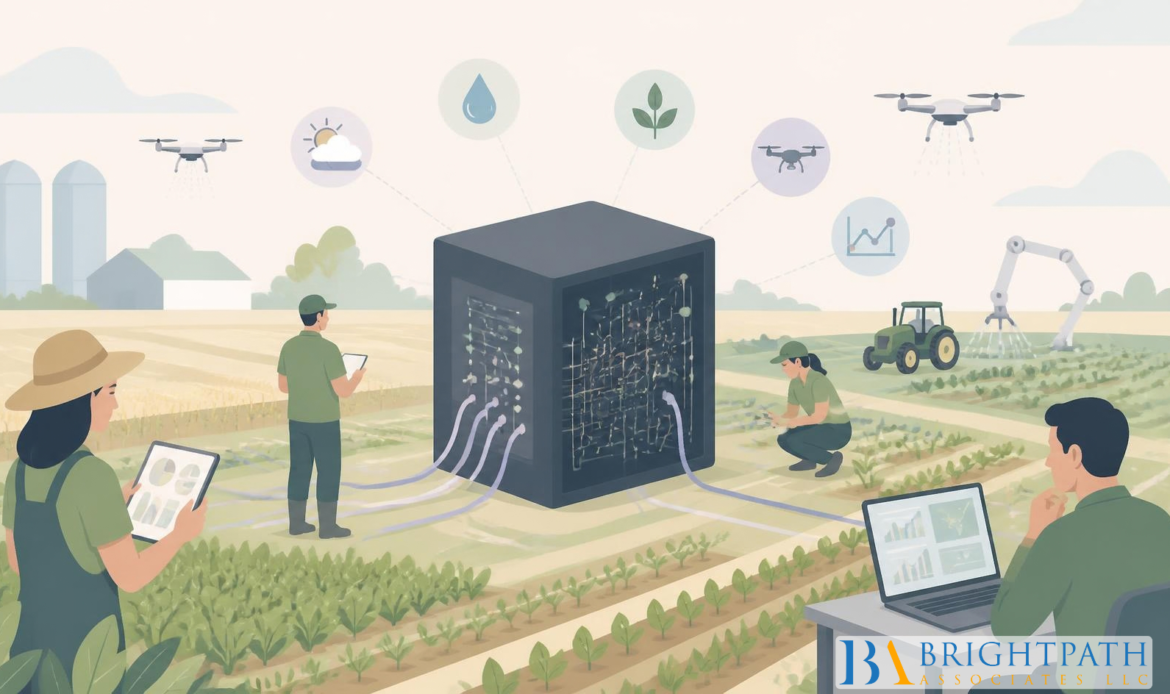
A black-box model is a computational system whose internal decision-making process is difficult for users to interpret. Many modern machine-learning models analyze large datasets and generate predictions based on complex relationships among variables.
In an agricultural setting, an algorithm might analyze satellite images, soil measurements, weather forecasts, historical yields, irrigation records, and crop characteristics before recommending when to irrigate or apply a treatment. The recommendation may be statistically supported by historical data, but the farmer may not know precisely which factors influenced the output.
This creates a distinction between prediction and explanation. A model can sometimes produce an accurate prediction while still being difficult to interpret.
For agricultural decision-makers, this distinction matters because conditions in the field are rarely identical to conditions represented in historical datasets.
The Growing Role of Agricultural Technology
Agricultural technology is transforming how farms collect, process, and use information. Connected sensors can monitor soil moisture and temperature, drones can inspect crops, and satellite systems can provide large-scale information about vegetation and field conditions.
These technologies can contribute to Precision agriculture by helping farmers manage resources according to localized conditions. Instead of applying the same amount of water or nutrients across an entire field, digital systems can identify areas that require different treatment.
The benefits can be substantial when the underlying data is accurate and the recommendations are appropriate. However, the increasing sophistication of digital platforms can make it difficult for users to recognize when an algorithm is operating outside the conditions for which it was designed.
Technology therefore needs to be treated as a decision-support system rather than an infallible source of truth.
Agricultural systems are highly variable. Soil conditions can differ within the same field, weather patterns can change unexpectedly, pests can emerge rapidly, and crop responses can vary according to genetics and environmental conditions.
An algorithm trained on historical information may perform well under familiar circumstances but become less reliable when conditions change significantly.
For example, an unusually hot season could create growing conditions that are poorly represented in historical datasets. A model may still generate a recommendation because it has been designed to produce an output, even though the underlying circumstances are outside its strongest area of performance.
This is one of the central risks associated with black-box systems. Users may interpret a confident algorithmic recommendation as evidence of certainty when it may actually reflect statistical assumptions and historical patterns.
Implications for Food Production
The consequences of algorithmic errors can extend beyond individual farms. Agriculture is directly connected to Food production, supply chains, commodity markets, and #FoodSecurity.
If automated recommendations consistently lead to poor planting decisions, inappropriate irrigation, incorrect resource allocation, or ineffective crop management, the consequences could include reduced yields and increased costs.
At the farm level, an incorrect recommendation may result in wasted inputs or lost production. Across larger agricultural networks, widespread dependence on a flawed model could potentially amplify similar errors across multiple operations.
This does not mean algorithmic systems are inherently dangerous. Rather, it highlights the importance of validation, monitoring, and human oversight when digital systems influence decisions with significant biological and economic consequences.
Precision agriculture is often associated with the ability to make increasingly localized and data-driven decisions. However, precision should not be confused with certainty.
A sensor may accurately measure soil moisture at a particular location, but the interpretation of that measurement depends on crop type, soil structure, weather conditions, irrigation infrastructure, and other factors.
Similarly, an algorithm may identify a pattern in crop imagery without understanding an unusual local condition that an experienced farmer would recognize.
Combining algorithmic outputs with field observations can therefore create a stronger decision-making process. Digital tools can identify areas requiring attention, while farmers and agronomists provide contextual interpretation.
Sustainable farming requires decisions that balance productivity with environmental resource management. Water use, soil health, biodiversity, energy consumption, fertilizer application, and chemical inputs all influence long-term agricultural performance.
Algorithms can contribute to Sustainable farming by helping optimize resource allocation. Precision irrigation systems, for example, may use sensor data to determine when crops require water.
However, an optimization model is only as sustainable as the objectives it has been designed to pursue. If a system is primarily optimized for short-term yield, it may not adequately account for long-term soil health or ecological impacts.
This creates an important governance issue. Agricultural organizations must understand what a model is actually optimizing before allowing it to influence sustainability-related decisions.
Organic Farming and Algorithmic Limitations
#OrganicFarming presents another interesting context for algorithmic agriculture. Organic operations may have different production methods, input restrictions, soil-management strategies, and pest-control approaches than conventional farms.
An algorithm trained predominantly on conventional agricultural data may not accurately represent organic production systems.
This highlights the importance of dataset diversity. Models should be trained and validated using information that reflects the conditions in which they will actually be used.
Farmers should also be cautious when adopting tools that claim broad applicability without clearly communicating the data sources, operating assumptions, and limitations behind their recommendations.
Agricultural innovation has historically emerged through a combination of technology and practical knowledge. Modern digital systems should continue this tradition rather than creating a complete separation between farmers and decision-making.
Human expertise remains valuable because agricultural professionals understand local conditions that may not be represented in centralized datasets. A farmer may recognize subtle changes in soil behavior, crop development, pest activity, or weather patterns based on years of experience.
The strongest technology strategies can combine this expertise with digital information. Algorithms can process large datasets rapidly, while people can interpret unusual circumstances and challenge recommendations that appear inconsistent with field conditions.
This human-machine partnership can make agricultural systems more resilient.
Digital Farming is increasingly dependent on interconnected platforms that combine sensors, machinery, analytics, and farm management systems. As these systems become more autonomous, explainability becomes more important.
An explainable system should provide users with meaningful information about why a recommendation was generated. This does not necessarily require exposing complex mathematical calculations. Instead, the system might identify the key factors that influenced a recommendation and indicate the level of confidence associated with the prediction.
For farmers, this can make technology easier to evaluate. If a system recommends irrigation because soil moisture has declined, temperatures are elevated, and rainfall probability is low, the recommendation is easier to understand than an unexplained command.
Transparency can also encourage users to question recommendations when field conditions contradict the model.
Farm Management Software and Decision Integration
Farm management software increasingly serves as a central platform for organizing information about fields, crops, equipment, inputs, labor, finances, and production.
When AI-driven recommendations are integrated into these platforms, farmers may receive increasingly automated suggestions about planting, irrigation, fertilization, harvesting, and other activities.
The advantage is convenience. The risk is that recommendations can become embedded within routine workflows and may receive less scrutiny over time.
Software providers and agricultural organizations should therefore design systems that preserve meaningful human review. Users should be able to understand the source of recommendations, review historical performance, and override automated decisions when appropriate.
Agricultural Sustainability and Long-Term Model Performance
#AgriculturalSustainability requires looking beyond immediate operational outcomes. A model that improves productivity this season may not necessarily produce the best long-term result.
For example, repeated optimization for maximum output could potentially overlook gradual changes in soil quality, water availability, or biodiversity.
Agricultural sustainability therefore requires models to incorporate broader objectives. Organizations should periodically evaluate whether their algorithms continue to support the environmental and economic outcomes they were originally intended to achieve.
Models should also be recalibrated as agricultural conditions change. Climate patterns, crop varieties, pest populations, technologies, and farming practices evolve over time, meaning historical datasets can gradually become less representative.
The solution to black-box risk is not necessarily to eliminate automation. Instead, organizations can establish structured oversight.
High-impact recommendations can require human approval, while lower-risk decisions may be automated more extensively. Organizations can also monitor model performance and establish thresholds that trigger additional review when predictions fall outside expected ranges.
Scenario testing can provide another layer of protection. Before deploying an algorithm widely, agricultural organizations can evaluate how it performs under different weather conditions, crop varieties, soil types, and operational environments.
This creates a more disciplined approach to digital adoption.
Sustainable Agriculture Investment and Technology Governance
Sustainable agriculture investment increasingly includes digital infrastructure alongside physical assets. Investors and agricultural organizations may evaluate technologies based on expected productivity gains, resource efficiency, labor requirements, and environmental outcomes.
However, technology investment should also consider governance. A sophisticated algorithm without appropriate validation, cybersecurity, data management, or accountability mechanisms can create hidden operational risks.
Investment decisions should therefore examine not only what a system can do but also how it performs when conditions change and how users can identify errors.
This approach can make digital transformation more resilient over the long term.
The increasing integration of technology into farming is changing the skills required within agricultural organizations. Leaders must understand both agricultural operations and the implications of digital technologies.
This includes knowledge of data governance, artificial intelligence, cybersecurity, sustainability, technology procurement, and workforce development.
#ExecutiveSearchRecruitment can help agricultural businesses identify leadership talent capable of managing this convergence. The most effective leaders in technology-driven agriculture may need to communicate across scientific, operational, technical, and commercial teams.
Leadership is particularly important when organizations must decide how much authority to give automated systems. Technology strategy ultimately requires organizational judgment about risk, accountability, and operational priorities.
The Future of Algorithmic Agriculture
The future of algorithmic agriculture is likely to involve increasingly sophisticated models that combine satellite data, sensors, weather information, machinery data, biological measurements, and historical records.
These systems can create valuable opportunities for Food production, Precision agriculture, Sustainable farming, and resource optimization. At the same time, greater sophistication makes transparency and governance increasingly important.
Future #AgriculturalPlatforms may place greater emphasis on explainable AI, confidence indicators, model monitoring, scenario testing, and human-in-the-loop decision-making.
The goal should not be to choose between agricultural expertise and technology. It should be to develop systems in which each strengthens the other.
Conclusion: Balancing Automation With Agricultural Judgment
Algorithmic agriculture offers significant opportunities, but its benefits depend on responsible implementation. Black-box models can process information at a scale that humans cannot easily match, yet they may struggle when conditions fall outside the data and assumptions on which they were developed.
Agricultural technology can support Precision agriculture, Sustainable farming, Organic farming, Digital Farming, and broader Agricultural innovation, but technology should complement rather than obscure human expertise.
For organizations investing in the future of agriculture, the priority should be building transparent, validated, adaptable, and appropriately supervised digital systems. Farm management software, machine learning, and predictive analytics can become valuable tools when users understand their strengths and limitations.
Ultimately, resilient agriculture will depend on more than increasingly powerful algorithms. It will require farmers, scientists, technology providers, investors, and executives to create a balanced operating model in which data-driven intelligence informs decisions while human experience remains an essential part of the process.
Find your next leadership role in Farming Industry today!