
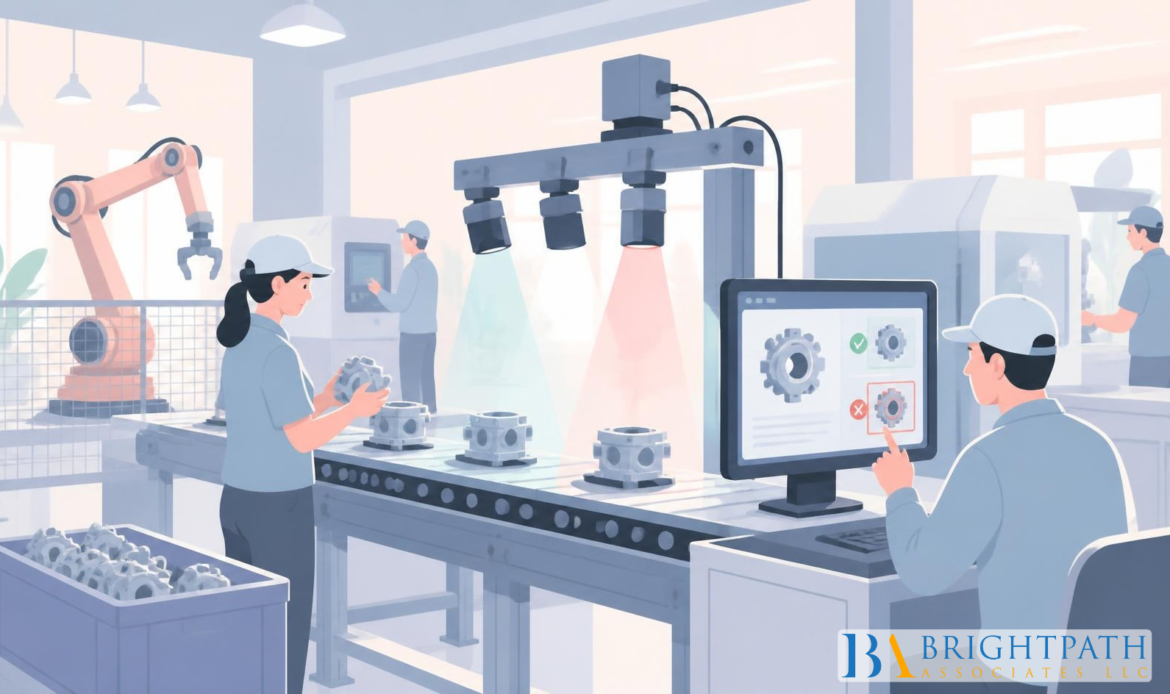
[Bethany, Connecticut – 02 October 2026] – BrightPath Associates has highlighted how artificial intelligence and real-time vision systems are transforming quality control across the machinery manufacturing sector. The latest industry analysis explains how AI-powered inspection can help US Machinery manufacturers detect defects earlier, reduce scrap and rework, improve Manufacturing efficiency, and connect quality data with production and Machinery maintenance strategies.
For C-suite executives managing increasingly complex manufacturing operations, quality control is becoming a strategic business priority rather than simply a production function. Rising material costs, labor shortages, tighter customer specifications, and demanding delivery schedules are increasing the financial impact of defective components.
The analysis, titled “AI-Driven Quality Control: Reducing Scrap Rates with Real-Time Vision Systems,” examines how cameras, sensors, machine-learning models, and automated control systems can identify production problems while manufacturing is still underway.
Real-Time Inspection Addresses Costly Production Defects
Scrap can represent much more than the cost of discarded raw materials. A defective component may already have consumed machine capacity, labor, energy, tooling, inspection resources, and production time before the problem is discovered. When defects are identified only after hundreds or thousands of components have been produced, manufacturers can face substantial rework, disposal, and customer-return costs.
The BrightPath analysis notes that “real-time vision systems change the timing of detection.” By monitoring products continuously, AI-powered inspection can identify dimensional variations, surface defects, assembly errors, contamination, and other quality issues closer to where they occur. This gives production teams an opportunity to intervene before an entire batch is affected.
For manufacturers exploring this approach, the detailed analysis of AI-Driven Quality Control and Real-Time Vision Systems for Scrap Reduction explains how intelligent inspection can support more consistent production while providing valuable operational data.
AI Vision Connects Quality Control With Industrial Machinery
Modern vision systems combine cameras, lighting, image-processing hardware, software, and analytical models to evaluate products against established quality standards. Machine-learning models can also be trained using examples of acceptable and defective products, allowing systems to identify patterns that may be difficult to detect consistently through manual inspection.
The opportunity becomes particularly important in Precision machining, where small dimensional or surface variations can affect component performance. Tool wear, vibration, thermal changes, machine calibration, and material variation can all influence machining outcomes. AI-enabled inspection can identify scratches, burrs, geometry problems, and other irregularities while connecting inspection results with machine data.
This approach can also strengthen Machinery maintenance. Increasing defect rates may sometimes indicate tooling degradation, calibration drift, mechanical wear, or changes in machine performance. By combining vision data with vibration, temperature, spindle, and other operational information, manufacturers can investigate whether equipment conditions are contributing to quality problems.
Modernizing the Machinery Industry With Practical Automation
The Industrial machinery industry includes machine tools, heavy equipment, pumps, compressors, motors, material-handling systems, and specialized production equipment. AI vision technology can support quality checks across these environments, from component dimensions and surface conditions to assembly position and final product inspection.
For executives evaluating modernization investments, the analysis emphasizes that manufacturers do not necessarily need to replace every existing asset. Used machinery can sometimes be upgraded with cameras, sensors, computing hardware, and modern control interfaces. The feasibility depends on equipment age, control architecture, available space, production requirements, and system compatibility.
Investment decisions should also consider the complete business case. Machinery financing may become relevant when AI inspection forms part of a wider automation program. Potential benefits include lower scrap, reduced rework, fewer customer returns, lower inspection labor requirements, improved throughput, and better machine utilization.
The broader Machinery Industry is therefore entering a period in which technology investments increasingly need to connect directly with measurable operational outcomes.
About BrightPath Associates
BrightPath Associates is an executive recruitment and talent solutions firm serving organizations across multiple industries in the United States. The company helps businesses identify leadership and specialized professionals who can support growth, operational performance, workforce development, and long-term business objectives. With a focus on connecting organizations with the right talent, BrightPath Associates works to make hiring more effective and strategic.
Media Contact:
Name: Corporate Communications Team
Company: BrightPath Associates
Email: media@brightpathassociates.com
Website: https://brightpathassociates.com