
Introduction
Manufacturers are under continuous pressure to improve product quality while controlling production costs. Rising raw-material prices, tighter customer specifications, labor shortages, shorter #DeliverySchedules, and increasingly complex production processes have made quality control a strategic priority. Among the most costly consequences of inconsistent quality is scrap. Every defective component represents wasted material, machine capacity, energy, labor, and production time.
Artificial intelligence and real-time vision systems are changing how manufacturers approach this challenge. Instead of relying exclusively on manual inspections or sampling-based quality checks, manufacturers can deploy cameras, sensors, machine-learning algorithms, and automated control systems to identify defects while production is still underway.
For companies operating in the Industrial machinery industry, these technologies create opportunities to improve Manufacturing efficiency while reducing waste. Real-time inspection can identify dimensional variations, surface defects, assembly errors, contamination, and other quality issues before large batches of defective products are produced.
The combination of Industrial automation solutions and AI-driven vision therefore represents more than a quality-control upgrade. It can become an important component of a broader strategy for improving productivity, asset utilization, and manufacturing economics.
Scrap costs extend far beyond the price of discarded raw materials. When a defective component reaches the end of a production cycle, manufacturers have already invested labor, machine time, energy, tooling, inspection resources, and logistics into producing it.
The financial impact becomes even greater when defects are discovered late. A production line may manufacture hundreds or thousands of components before a quality problem is identified. If the issue originated from incorrect machine settings, tool wear, material variation, or process instability, a large quantity of products may already require rework or disposal.
Traditional quality-control systems can struggle to prevent this situation when inspections are performed periodically rather than continuously.
Real-time vision systems change the timing of detection. By monitoring production as products are manufactured, AI-based inspection can identify deviations earlier and potentially prevent an entire batch from being affected.
How AI-Powered Vision Systems Work
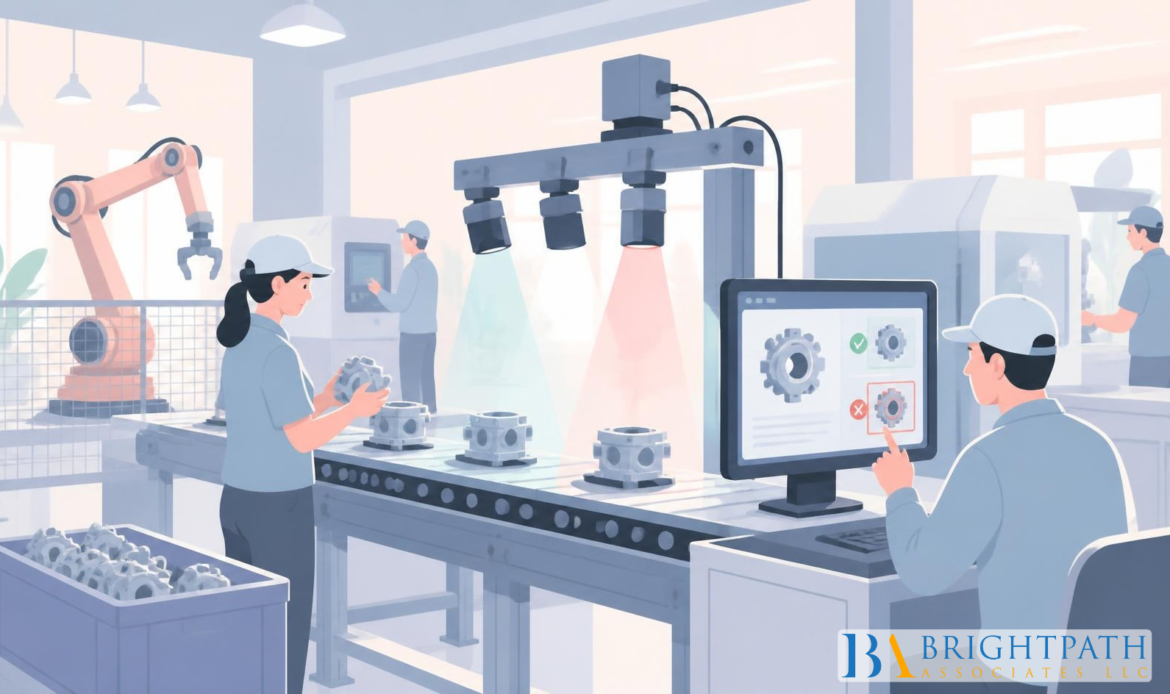
An industrial vision system generally combines cameras, lighting, image-processing hardware, software, and analytical models. Cameras capture images of products or processes, while software evaluates those images against predefined quality criteria.
Artificial intelligence adds another layer of capability. Machine-learning models can be trained using examples of acceptable and defective products. Once trained, the system can identify patterns associated with defects that may be difficult to detect consistently through manual inspection.
Modern systems can evaluate characteristics such as shape, dimensions, surface condition, alignment, color, texture, component presence, and assembly position.
The system can then communicate results to manufacturing equipment or operators. In a highly automated environment, defective products can potentially be removed from the production line automatically, while process-control systems can receive information that helps identify the source of the problem.
The greatest financial advantage of real-time vision inspection is the ability to identify defects closer to the point where they occur.
Consider a precision machining operation in which a cutting tool gradually becomes worn. If the tool produces components outside acceptable specifications, manual inspection may identify the problem only after multiple parts have been manufactured.
An AI-enabled vision system can monitor dimensional or surface characteristics continuously. If the system detects a developing pattern, it can alert operators or trigger an appropriate process response.
This can reduce the number of defective products produced before intervention.
The same principle applies to assembly operations. If a component is missing, incorrectly positioned, or damaged, automated vision can detect the problem immediately instead of allowing the finished product to proceed to later production stages.
Precision Machining and Intelligent Inspection
#PrecisionMachining presents particularly strong opportunities for AI-driven quality control because even small deviations can affect component performance.
Manufacturers producing aerospace, automotive, medical, energy, or industrial components often work with tight dimensional tolerances. Tool wear, vibration, thermal changes, material inconsistencies, and machine calibration can influence machining outcomes.
Vision systems can inspect machined surfaces and identify irregularities such as scratches, burrs, incorrect geometry, or surface inconsistencies. When combined with other sensors and machine data, these systems can provide a more comprehensive picture of process performance.
For precision machining operations, the objective is not merely to identify defective parts. The larger opportunity is to connect inspection results with process conditions so manufacturers can understand why defects occur.
Industrial automation solutions provide the infrastructure required to integrate real-time inspection into production environments. Vision systems can communicate with programmable controllers, robots, manufacturing execution systems, databases, and other industrial equipment.
This integration creates a closed-loop quality environment.
For example, a vision system can identify a defective component, communicate the result to a control system, and direct a robotic mechanism to remove the part from the production line. At the same time, the inspection result can be recorded in a production database.
Over time, this information can help manufacturers identify recurring patterns. Management may discover that defects increase during particular shifts, at certain machine speeds, with specific raw materials, or after a certain amount of machine operation.
This makes quality control more data-driven and potentially more predictive.
Connecting Vision Systems With Industrial Machinery
Industrial machinery generates large amounts of operational information. Temperature, vibration, speed, pressure, cycle time, energy consumption, and other parameters can provide useful context for quality analysis.
When machine data is combined with vision inspection data, manufacturers can investigate relationships between equipment conditions and product quality.
For example, a recurring surface defect may correspond with increasing vibration levels or changes in spindle performance. Instead of treating the defect as an isolated quality problem, engineers can investigate whether machinery performance is contributing to it.
This integration can also strengthen Machinery maintenance strategies. Quality data can provide another signal that a machine or component may require inspection or servicing.
Traditional maintenance strategies often rely on fixed schedules or reactive repairs. AI-enabled manufacturing environments can move toward more condition-based approaches.
When vision systems identify increasing defect frequencies, maintenance teams can investigate whether equipment deterioration is responsible. Combined with vibration sensors, temperature monitoring, and machine performance data, these signals can help identify potential equipment issues before they result in major downtime.
This relationship between quality control and Machinery maintenance is particularly important because machine deterioration can affect both production continuity and product quality.
A manufacturer may initially view an increasing defect rate as a quality problem, but the underlying cause could be tooling degradation, calibration drift, mechanical wear, or another equipment issue.
Integrated data helps organizations investigate the entire process rather than treating each problem separately.
Applications Across the Industrial Machinery Industry
The #IndustrialMachineryIndustry encompasses a wide range of manufacturing environments, including machine tools, heavy equipment, industrial components, pumps, compressors, motors, material-handling systems, and specialized production equipment.
AI vision can support quality control throughout these environments.
For component manufacturers, systems can inspect dimensions, surfaces, holes, threads, and assembly characteristics. For equipment manufacturers, vision can verify whether components are correctly installed. In packaging-related machinery, automated inspection can verify labels, seals, alignment, and product placement.
The technology can also support final inspection before products leave the factory.
The appropriate application depends on production volume, defect characteristics, product complexity, inspection speed, and the cost associated with quality failures.
US Machinery manufacturers operate in an environment where productivity, quality, workforce availability, and cost competitiveness are closely connected. Automation can help manufacturers increase output without relying entirely on additional labor for repetitive inspection activities.
AI-based inspection can also support consistent quality across multiple production shifts and facilities.
However, technology adoption should be connected to measurable business outcomes. Manufacturers need to evaluate whether an AI vision system can reduce scrap, lower inspection costs, increase throughput, improve traceability, or prevent customer complaints.
The most effective implementations are likely to begin with clearly defined quality problems rather than adopting AI simply because it is technologically attractive.
Integrating Used Machinery With Modern Vision Technology
Manufacturers do not necessarily need to replace every existing machine to introduce intelligent inspection. In some cases, Used machinery can be upgraded with sensors, cameras, computing hardware, and modern control interfaces.
This can provide an alternative to replacing an otherwise productive machine.
The feasibility depends on the machine’s age, control architecture, available space, production requirements, and ability to communicate with modern systems. Older equipment may require additional integration work, but retrofitting can sometimes provide a cost-effective path toward greater automation.
For CFOs and plant managers, the decision should be based on total lifecycle economics rather than equipment age alone.
The financial investment required for AI vision systems can vary considerably depending on the application. A simple inspection station may require relatively limited infrastructure, while a fully integrated system involving multiple cameras, robotics, high-speed computing, and production-system integration can require substantial capital.
Machinery financing strategies can therefore become relevant when manufacturers are implementing broader automation programs.
The investment case should consider more than the cost of the vision equipment. Potential financial benefits may include lower scrap, reduced rework, fewer customer returns, lower inspection labor requirements, increased throughput, and improved machine utilization.
A clear baseline is essential. Manufacturers should measure existing defect rates and calculate the cost associated with those defects before estimating the potential financial return of an automated inspection project.
Improving Manufacturing Efficiency
Manufacturing efficiency depends on the interaction between people, machines, materials, processes, and information. AI vision systems can contribute by providing faster and more consistent inspection.
However, inspection alone does not automatically create efficiency. Manufacturers must act on the information generated by the system.
If a vision system detects recurring defects but operators lack the authority, training, or equipment access to correct the underlying issue, the organization may simply collect more data without achieving meaningful improvement.
Effective implementation therefore requires integration between technology and operational processes.
Employees should understand what the system measures, how alerts are generated, and what actions should follow when defects are detected.
Workforce Implications and Manufacturing Jobs
The adoption of AI-driven inspection does not necessarily eliminate the need for human workers. Instead, it can change the nature of Manufacturing jobs.
Employees who previously performed repetitive visual inspection may increasingly focus on exception handling, process improvement, equipment operation, data interpretation, and quality analysis.
Manufacturers may therefore need workers with stronger digital and technical capabilities. Training programs can help existing employees transition into these roles.
This creates an opportunity to combine automation with workforce development. Instead of treating technology and employment as separate issues, manufacturers can use automation to eliminate repetitive activities while developing employees for higher-value responsibilities.
AI systems are only as effective as the data and processes supporting them. Vision models require representative examples of both acceptable and defective products. If the training data does not adequately represent production variability, the system may produce false positives or miss important defects.
Manufacturers must therefore establish processes for model validation, monitoring, and continuous improvement.
Changes in #RawMaterials, lighting, product design, machine settings, or production conditions can affect inspection performance. Regular system validation is necessary to ensure that the technology continues to perform as expected.
This is particularly important when AI systems become part of critical quality-control processes.
Building a Scalable Quality Strategy
Manufacturers should consider AI vision as part of a broader digital manufacturing strategy rather than an isolated technology project.
A successful implementation can begin with one production line or one high-cost defect category. Once the organization establishes measurable results, the approach can potentially be expanded to additional processes.
Integration with production databases, maintenance systems, enterprise software, and analytics platforms can create a more comprehensive manufacturing intelligence environment.
Over time, manufacturers may be able to connect quality information with production planning, maintenance, inventory management, and customer-service processes.
Technology transformation requires leadership capable of connecting engineering objectives with business outcomes. Manufacturing leaders must understand how AI, Industrial automation solutions, equipment reliability, quality management, and workforce development interact.
#ExecutiveSearchRecruitment can help manufacturers identify senior professionals with experience in industrial technology, operations, digital transformation, engineering, and manufacturing strategy.
As factories become increasingly connected, leadership roles may require broader combinations of technical and commercial knowledge.
The ability to evaluate technology investments, manage implementation, develop technical talent, and measure operational results can become increasingly important for manufacturing executives.
Conclusion
AI-driven quality control is changing how manufacturers approach scrap reduction and production consistency. Real-time vision systems can identify defects earlier, provide continuous inspection, generate valuable production data, and support more responsive manufacturing processes.
For companies operating across the Industrial machinery industry, the technology can complement Precision machining, Machinery maintenance, and Industrial automation solutions while contributing to broader Manufacturing efficiency.
The strongest results come when vision systems are integrated into a wider operational strategy. Manufacturers need reliable data, appropriate infrastructure, trained employees, effective process controls, and clear financial objectives.
US Machinery manufacturers and other industrial producers can also explore modernization pathways that combine new automation technologies with existing or Used machinery, depending on the economics and technical feasibility of each facility.
As AI capabilities continue to develop, real-time vision systems are likely to become an increasingly important component of modern quality management. Their greatest value lies not simply in detecting defective products, but in helping manufacturers understand production behavior, intervene earlier, reduce waste, and build more consistent and efficient manufacturing operations.
Find your next leadership role in Machinery Industry today!
Stay informed with the latest insights on Machinery Industry!