
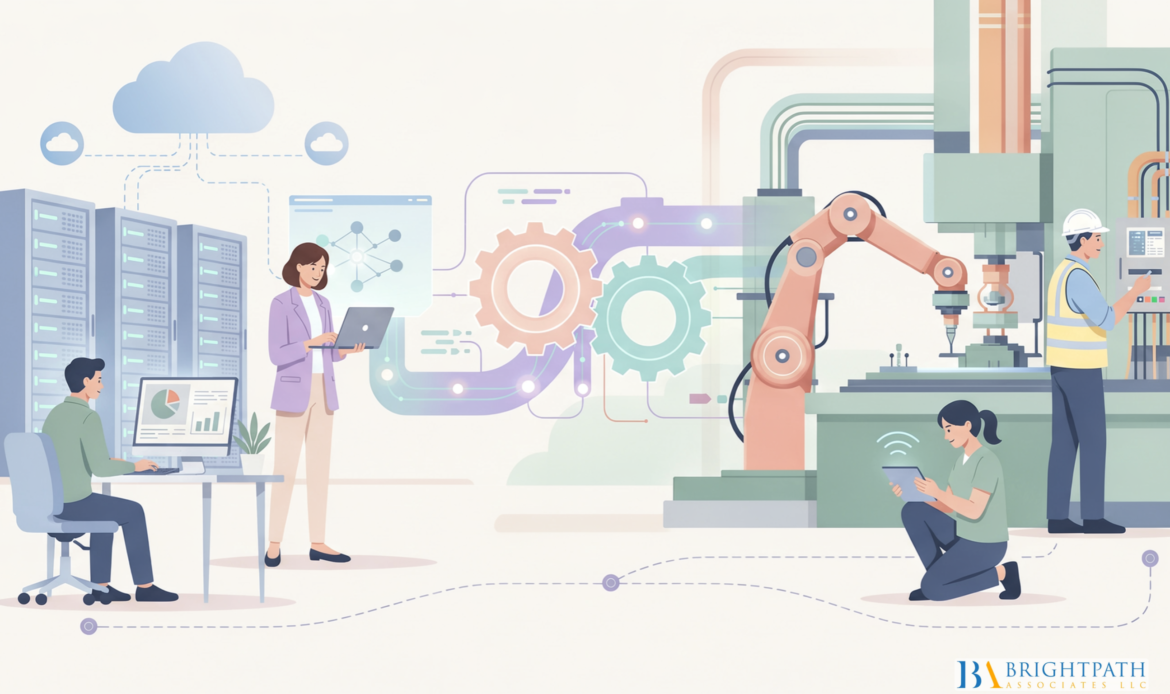
Navigating Great Integration: Syncing IT and Operational Technology Systems for Machinery Industry is not mainly a software project. It is a business and operating model decision. When a #MachineController, CNC, robot, or SCADA system connects to MES, ERP, analytics, or #CloudServices, the company gains visibility but also creates new safety, availability, and cybersecurity responsibilities.
For US machinery manufacturers, the practical question is not whether every asset should be connected. It is which data should move, who should own it, and what must continue working when enterprise systems are unavailable.
Table Of Contents
- Why Machinery Integration Requires Different Decisions
- Build A Safe IT And OT Architecture
- Make Integration An Operating And Leadership Discipline
- Key Takeaways
- Frequently Asked Questions
- Resources And Citations
Why Machinery Integration Requires Different Decisions
IT manages information, identity, enterprise applications, and business data. Operational Technology, or OT, monitors and controls physical processes. In an industrial machinery setting, OT includes PLCs, CNC controls, robot cells, industrial networks, sensors, SCADA, historians, and operator interfaces.
The distinction matters because an enterprise application can often tolerate a planned outage. A production line, press, machine tool, or packaging cell may not. Lost connectivity can affect output, quality, safety, maintenance response, or recovery time.
NIST NCCoE guidance on manufacturing ICS integrity explains that industrial control systems monitor and control machinery and production lines, while IT and OT connectivity introduces integrity and cybersecurity requirements. That is the central tension: better information can improve decisions, but a poorly designed connection can expose systems that were never built as ordinary corporate endpoints.
Start With Business Value, Not A Connectivity Inventory
A common mistake is treating integration as a race to collect every available tag from every machine. More data does not automatically create more value. Unstructured data can increase storage costs, alert fatigue, troubleshooting time, and confusion about which number is authoritative.
We recommend ranking opportunities by operational value and risk before selecting gateways, brokers, or cloud platforms. A high value use case often has a clear owner, a measurable operating problem, and a known decision that better data will improve.
| Decision Criterion | Connect Earlier When | Delay Or Keep Local When |
|---|---|---|
| Safety impact | Data is read only and does not alter a safety function | A connection could affect machine state, interlocks, or safety logic |
| Business value | The asset constrains throughput, quality, or maintenance planning | The data has no identified user or operating decision |
| Availability need | Buffered data is acceptable during an outage | The use case depends on continuous remote control |
| Asset condition | The machine supports secure protocols or a managed gateway | The controller is obsolete, unsupported, or vendor restricted |
| Data quality | States, units, timestamps, and part counts can be verified | Signals are ambiguous, duplicated, or manually overridden |
Consider a precision machining cell where spindle load, cycle time, alarm state, and completed part count can support maintenance and production planning. Read only collection through an edge gateway may be a practical first project. By contrast, sending job changes directly from ERP into a #CNCController is a far more consequential design decision. It requires validation of part programs, operator authority, revision control, and a recovery process if a downstream system sends incorrect instructions.
Read Only Monitoring Is Not Remote Control
This is the most important distinction in machinery integration.
Read only integration sends machine events, condition data, and production status outward for monitoring, analysis, or reporting. It can support dashboards, historians, maintenance alerts, and MES visibility without allowing enterprise systems to command equipment.
Write back integration sends instructions toward machinery. Examples include setpoint changes, recipe selection, work order downloads, remote resets, or control commands. Write back can be appropriate, but it must be treated as a controlled operational change, not a routine data connection.
| Integration Type | Typical Example | Primary Risk | Appropriate Starting Point |
|---|---|---|---|
| Read only | Sending cycle counts to a historian | Incomplete or misleading data | Most legacy machinery projects |
| Supervised write back | Operator approves a MES work order at the machine | Wrong revision or unauthorized instruction | Stable processes with documented controls |
| Direct write back | Enterprise system changes a machine setpoint automatically | Unsafe or incorrect physical behavior | Only after rigorous engineering, safety, and change review |
NIST’s manufacturing ICS protection documentation identifies destructive malware, insider threats, and unauthorized software as integrity concerns in connected environments. That is why permission to observe a machine should never be assumed to equal permission to control it.
For broader context on workforce and technology pressures in industrial operations, see BrightPath Associates’ discussion of Industrial Automation Trends and Challenges. The operational challenge is rarely only technical. It also involves whether engineering, maintenance, IT, production, and security teams agree on risk ownership.
Build A Safe IT And OT Architecture
A resilient architecture limits what a failure or compromise can reach. It also preserves local machine operation when a gateway, network connection, MES platform, ERP system, or cloud service is unavailable.
Use Layers To Contain Failure
#LegacyManufacturingArchitectures can make IT and OT integration difficult and inflexible, as described in NIST research on smart manufacturing architecture. A practical response is not necessarily a full replacement program. It is a layered design that adds controlled connection points.
- Machine layer: PLCs, CNCs, robots, drives, sensors, and safety systems perform local control.
- Edge and gateway layer: A managed gateway collects, filters, normalizes, and buffers data near the machine.
- Industrial DMZ: A controlled boundary separates plant systems from enterprise IT and limits direct paths to controllers.
- Plant services layer: Historians, SCADA, local MES functions, and manufacturing applications manage operational data.
- Enterprise and cloud layer: ERP, business intelligence, data platforms, and approved cloud analytics use curated data.
An edge gateway is not just a protocol converter. It can enforce read only access, buffer telemetry during outages, translate legacy protocols, and forward data later through store and forward behavior. If cloud connectivity fails for two hours, the gateway should preserve approved data locally and the machine should continue under its local controls or enter a defined degraded mode.
Loss of enterprise connectivity should not automatically stop production machinery. That principle must be tested, not merely assumed.
Normalize Meaning, Not Just Messages
OPC UA and MQTT are useful tools, but neither automatically solves the harder problem: data meaning. OPC UA can expose structured industrial data, while MQTT can distribute lightweight publish and subscribe messages. TeamViewer’s overview of IT and OT convergence notes that OPC UA and MQTT can help connect legacy OT environments with modern IT without immediate replacement projects.
Still, a message that says Run=1 has limited value unless the receiving system knows the machine, line, shift, job, product, timestamp, unit of measure, and state model. A spindle speed value without units, a part count without a reset rule, or a downtime code without operator context can produce misleading reports.
Define a common data model before scaling:
• A stable asset identifier for each machine, cell, line, and controller
• Standard machine states such as running, idle, blocked, starved, faulted, setup, and planned downtime
• Time synchronization rules and the authoritative source for timestamps
• Unit conventions for pressure, temperature, speed, energy, dimensions, and #QualityMeasures
• A process for linking machine events to work orders, material lots, operators, and revision levels
This is where Industrial Internet of Things programs often stall. The connection works, but the organization cannot trust the resulting metrics. Contextualization is the bridge between raw telemetry and usable manufacturing intelligence.
Design For Legacy Equipment And Outages
Machinery can remain productive for decades, while enterprise software, operating systems, and cybersecurity tools change much more quickly. This mismatch affects budgeting, patching, vendor support, spare parts, authentication methods, and integration choices.
A used #MachineryAcquisition may offer capacity at an attractive price, yet its controller may use an older protocol, lack modern authentication, or have limited vendor documentation. That does not automatically make integration impossible. It means the business case must include the cost of safe isolation, gateway support, data validation, and long term maintenance.
A reasonable production cutover sequence is:
- Capture a baseline of machine availability, alarms, counts, and manual reporting methods.
- Test data collection in a lab, simulator, or noncritical environment where possible.
- Deploy read only collection during a planned operating window.
- Compare collected values against operator screens and production records.
- Test network loss, gateway restart, and upstream platform outages.
- Keep manual operation and a documented rollback path available until acceptance criteria are met.
The objective is not zero risk. No production change offers that. The objective is controlled risk with a clear recovery path.
Make Integration An Operating And Leadership Discipline
Technology choices matter, but machinery integration also changes the leadership requirements of industrial businesses. The company needs people who can interpret operational consequences, not simply install software or configure networks.
Assign Decision Rights Before Problems Occur
Integration fails when ownership is vague. A firewall rule might be an IT responsibility. A PLC change may belong to controls engineering. A historian tag could be owned by OT or manufacturing engineering. Emergency vendor access may involve maintenance, cybersecurity, and plant leadership.
Create a written decision model before connecting critical assets.
| Decision Area | Accountable Function | Required Participants |
|---|---|---|
| PLC and CNC logic changes | Controls engineering or authorized machine owner | Safety, production, maintenance |
| Firewall and remote access rules | IT or cybersecurity leadership | OT engineering, plant operations |
| Machine data definitions | Manufacturing engineering or operations | Quality, maintenance, IT data teams |
| MES and ERP integration changes | Applications or digital operations leader | Production planning, OT, finance as needed |
| Emergency access approval | Named plant authority | IT security, maintenance, equipment vendor when relevant |
A connected machine is a cyber physical system, not merely a networked device. Its digital behavior can have physical consequences.
This affects #ExecutiveHiring. A plant leader may need stronger digital fluency. A CIO may need a working grasp of industrial control constraints. A manufacturing engineering leader may need experience with data governance, industrial cybersecurity, and cross functional change control. These are blended requirements, and they can make executive searches more specialized than a conventional job description suggests.
For executives evaluating operational modernization, Digital Transformation in Automation offers related context on how automation decisions affect business processes beyond the shop floor.
Define Acceptance Criteria That Operations Trusts
A project is not successful because data appears on a dashboard. It is successful when the information is accurate enough, timely enough, secure enough, and useful enough to support a real operating decision.
Acceptance criteria should include measurable thresholds selected for the individual process, not copied from a generic template. There is no universal acceptable latency or completeness percentage for all industrial machinery. A daily energy report, for example, can tolerate delayed transmission. A real time fault alert for a constrained production line may not.
Use criteria such as:
• Data completeness during normal operation and after reconnection
• Timestamp accuracy against the approved plant time source
• Match rate between collected part counts and verified production records
• False alarm rate for maintenance or quality notifications
• Gateway recovery behavior after power loss or network interruption
• Confirmation that manual operation continues during enterprise, MES, ERP, or cloud outages
• Evidence that only authorized users and systems can access approved functions
The leadership test is simple: can the organization explain who relies on each data stream, what they will do differently, and what happens if that data is wrong?
Use Talent Strategy To Reduce Integration Risk
Not every small or mid sized machinery business needs a large internal digital manufacturing team. But every business needs enough accountable expertise to evaluate vendors, set safety boundaries, and avoid dependence on undocumented contractor knowledge.
Executive search can be useful when the role requires an uncommon mix of plant leadership, controls engineering, cybersecurity governance, MES or ERP knowledge, and change management. It is less useful when the organization has not defined the operating problem or decision rights. Recruiting cannot compensate for an unclear mandate.
A stronger approach is to define the mission first:
• Which production, quality, maintenance, or scheduling decision must improve?
• Which machinery assets create the most operational value or risk?
• What authority will the leader have over IT, OT, vendors, budget, and process change?
• Which skills must be permanent leadership capabilities, and which can be delivered through systems integrators or contract specialists?
• What evidence will demonstrate that the integration program is safe and operationally useful?
For a wider view of machinery business conditions that may shape these decisions, review Challenges and Opportunities in the Machinery Industry.
Key Takeaways
• Begin with a business decision, not a list of available machine tags. The first integration should solve a defined production, maintenance, quality, or scheduling problem.
• Treat read only data collection and write back control as different risk categories. Remote commands require stronger engineering, safety, authorization, and rollback controls.
• Use edge gateways and an industrial DMZ to limit direct enterprise access to machinery controls.
• Preserve local operation. A machine should continue safely, or enter a defined degraded mode, when upstream systems fail.
• Standardize context as well as protocols. Machine identity, units, timestamps, work orders, and state definitions determine whether data can be trusted.
• Make ownership explicit. IT, OT, engineering, maintenance, cybersecurity, and operations need documented decision rights before a production incident occurs.
• Hire for the operating model you need. The most valuable leaders can translate between physical process constraints, digital systems, workforce needs, and business priorities.
Frequently Asked Questions
What Is IT And OT Integration In A Machinery Plant?
IT and OT integration connects enterprise systems such as ERP, MES, analytics, and identity platforms with systems that monitor or control machinery. The purpose is to move approved, contextualized data between business and production environments without compromising safe equipment operation.
Which Machines Should Be Connected First?
Start with assets that constrain throughput, create recurring quality losses, require costly maintenance, or lack reliable production visibility. Avoid choosing a machine simply because it is easy to connect. Business value and operational risk should drive the order.
Should Machine Data Go Directly To The Cloud?
Usually, a controlled edge gateway and plant boundary are safer than direct controller to #CloudConnections. The gateway can filter, buffer, normalize, and secure data while keeping the controller isolated from unnecessary enterprise exposure.
What Is The Safest Way To Connect Legacy Machinery?
Use a read only gateway where feasible, document the legacy protocol and controller limitations, segment the connection, validate data against known records, and retain manual machine operation. A legacy asset may need isolation rather than aggressive modernization if support or safety risks are too high.
How Do OPC UA And MQTT Differ?
OPC UA is commonly used for structured industrial interoperability and can represent machine data with rich context. MQTT is a lightweight messaging method that works well for moving telemetry through brokers. Many architectures use one, the other, or both depending on the machine, gateway, and application requirements.
What Happens If MES, ERP, Or Cloud Services Go Offline?
The machinery should continue under local control when safe to do so, while gateways or plant services buffer approved data for later transmission. Test this behavior before production rollout. Recovery should not depend on operators improvising under pressure.
Who Should Approve PLC Changes And Remote Access?
PLC logic changes should remain under authorized controls engineering and machine ownership processes, with safety and production participation. Remote access should require IT or cybersecurity approval plus plant authorization. The exact model varies, but shared responsibility without clear authority is unreliable.
Resources And Citations
• National Institute of Standards and Technology/NCCoE — Executive Summary, Protecting Information and System Integrity in Industrial Control System Environments: https://www.nccoe.nist.gov/publication/1800-10/VolA/index.html
• National Institute of Standards and Technology — The Paradigm Shift in Smart Manufacturing System Architecture: https://tsapps.nist.gov/publication/get_pdf.cfm?pub_id=920863
• OMRON — What is “IT-OT integration,” the Key to DX in Manufacturing: https://www.ia.omron.com/solution/i-belt/manufacturing-it-ot/
• TeamViewer — How IT and OT convergence boosts manufacturing efficiency: https://www.teamviewer.com/en/insights/how-it-and-ot-convergence-boosts-manufacturing-efficiency/
• nccoe.nist.gov: https://www.nccoe.nist.gov/sites/default/files/2022-03/mf-ics-nist-sp1800-10a-final.pdf
• BrightPath Associates resource: Standardizing Shop Floor for Machinery Industry Growth
Find your next leadership role in Machinery Industry today!
Stay informed with the latest insights on Machinery Industry!